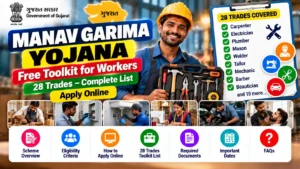

What if the government handed you the tools to start your own business — for free? For thousands of Scheduled Caste families in Gujarat, that is exactly what the Manav Garima Yojana does. If you have a skill — tailoring, plumbing, mobile repairing, hair cutting — but no money to buy equipment, this scheme could be your way out.
✅ This guide is based on official government sources and notifications. Last verified: October 12, 2026. Scheme details, eligibility criteria, and benefit amounts are revised by the government from time to time — always cross-check the latest information on the official portal before applying.
In this guide, you will find everything about the Manav Garima Yojana 2026: the complete list of 28 trade toolkits, who can apply, what documents you need, how to apply online through the e-Samaj Kalyan portal, and how to track your application. I have also compared it with similar schemes so you can pick the right one for your situation.
Manav Garima Yojana (मानव गरिमा योजना) is a Gujarat state government scheme that gives free toolkits and financial assistance to people from Scheduled Caste (SC) communities who want to start their own small business. The name literally means “human dignity scheme” — and that is the whole point. Instead of depending on daily-wage work, you get the equipment to become self-employed.
The scheme is run by the Gujarat Scheduled Caste Development Corporation, headquartered in Gandhinagar, under the state’s Social Justice and Empowerment Department. Rather than giving a bank loan you have to repay, the government directly provides the tools of your trade — a sewing machine for tailoring, a toolkit for plumbing, a repair kit for mobile servicing — along with a small financial grant.
Here is the basic idea in one line: pick one of 28 approved trades, prove you are eligible, and the government equips you to start earning from it.
Online via e-Samaj Kalyan portal or offline
| Point | Details |
|---|---|
| Scheme name | Manav Garima Yojana |
| State | Gujarat only |
| Run by | Gujarat Scheduled Caste Development Corporation, Gandhinagar |
| Who can apply | Scheduled Caste residents of Gujarat (BPL / low-income) |
| Benefit | Free toolkit for 1 of 28 trades + financial assistance of ₹4,000 |
| Income limit | ₹47,000/year (rural) / ₹60,000/year (urban) — check latest circular |
| Age | 18 to 60 years (as per current guidelines) |
| How to apply | Online via e-Samaj Kalyan portal or offline at district offices |
Benefits: What Do You Actually Get?
Two things come your way when your application is approved:
1. A complete toolkit for your chosen trade. This is the heart of the scheme. Instead of cash that could get spent elsewhere, you receive the actual working tools — distributed through the corporation’s supply chain — so you can start your trade from day one. A tailoring beneficiary, for example, receives sewing-related equipment; a plumbing beneficiary receives a plumber’s toolkit.
2. Financial assistance of ₹4,000. This grant is transferred directly to your bank account through DBT (Direct Benefit Transfer) after verification. It is meant to cover small setup costs — renting a corner for your shop, buying raw material for the first batch of work, or transport.
Some updated guidelines mention toolkits valued up to ₹5,000 alongside the grant. The exact value depends on the trade and the current year’s approved rates, so treat ₹4,000 + toolkit as the baseline and check the portal for the current figures.
The 28 Trade Toolkits: Complete List
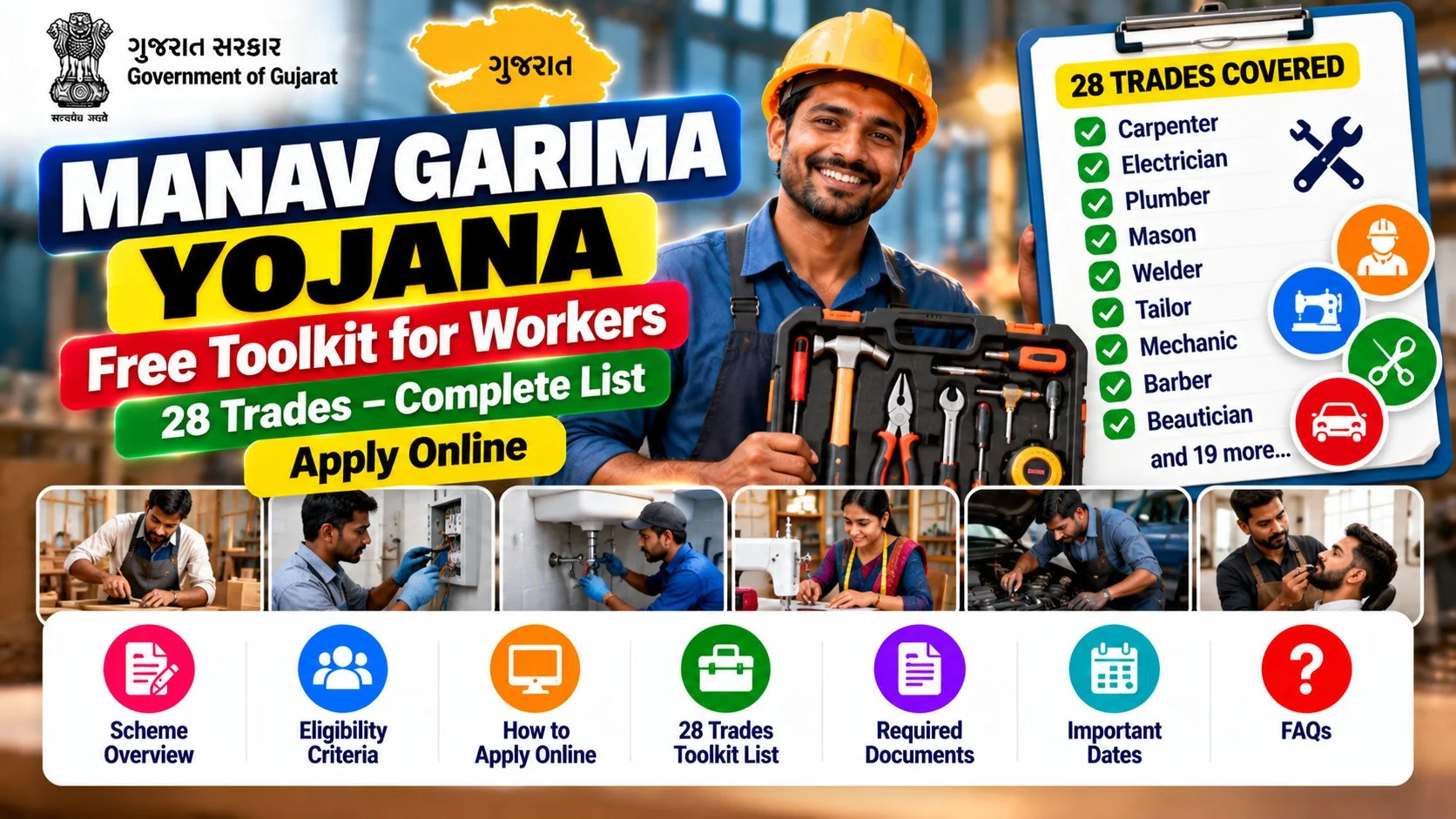
This is the section most websites skip over — but it is the most important part of the scheme. You must pick one trade when you apply, so choose the one you already know or can learn quickly. Here are all 28 approved trades:
Stitching and Garment Trades
- Tailoring — sewing machine and stitching tools for garment work, the most popular choice, especially for women
- Embroidery — frames, threads and needles for embroidery and embellishment work
Repair and Technical Trades
- Mobile Repairing — soldering kit, screwdriver sets and testing tools for phone repair shops
- Repairing Electric Appliances — tools for fan, mixer, iron and small appliance repair
- Vehicle Servicing and Repairing — mechanical toolkit for two-wheeler and auto repair
- Puncture Repair Kit — compressor and patching tools for tyre puncture shops
- Plumber — wrenches, cutters and fitting tools for plumbing work
- Agricultural Blacksmith / Welding Work — welding set and smithy tools for farm equipment repair
- Carpentry — saws, planes, drills and measuring tools for woodwork
- Masonry — trowels, levels and mixing tools for construction labour turning contractor
- Centring / Shuttering Work — plates and supports used in building construction
Personal Care Trades
- Hair Cutting (Barber) — clippers, scissors, chairs and salon basics
- Beauty Parlour — parlour equipment for women’s grooming services, a strong option for self-employment from home
- Laundry — press, washing setup and packaging material for laundry/press shops
Food and Daily-Need Trades
- Flour Mill (Atta Chakki) — grinding setup for neighbourhood flour milling
- Spice Mill — grinding and packing tools for masala making
- Papad Making — rolling and drying setup for papad production
- Pickle Making — vessels and packing material for achaar business
- Milk and Curd Seller — cans, measuring tools and storage for dairy vending
- Fish Seller — ice boxes, weighing scale and display setup
- Hot and Cold Drinks / Snack Sales — cart equipment for tea, coffee and snack vending
- Hawker Cart (Feri) — pushcart for vegetable or general vending
Craft and Household Production
- Pottery — wheel and shaping tools for clay work
- Cobbler (Shoe Repair) — lasts, hammers, adhesives and stitching tools
- Broom Making (Supada) — binding tools and raw material setup
- Diya Making — moulds and kiln access for earthen lamp production (often via Sakhi Mandal groups)
- Paper Cup and Dish Making — pressing machine support through Sakhi Mandal groups
- Pressure Cooker for Cooking — provided to eligible Ujjwala gas connection beneficiaries for food-related micro work
How to choose: Pick a trade you already have some skill in, or one with steady local demand. Tailoring, mobile repairing, beauty parlour and plumbing rarely run out of customers. Food trades work well near markets and bus stands. If you are unsure, the district social welfare office can guide you — they see which trades succeed in your area.
Eligibility Criteria: Who Can Apply?
Before you gather documents, check every point below. Applications get rejected most often for one simple reason — the applicant did not meet the caste or income condition.
- Gujarat resident: You must be a permanent resident of Gujarat. Applicants from other states cannot apply, even if they live in Gujarat temporarily.
- Scheduled Caste category: You must belong to a Scheduled Caste community and hold a valid SC caste certificate issued in Gujarat.
- Below Poverty Line / low income: The classic income ceiling is ₹47,000 per year for rural families and ₹60,000 per year for urban families. Some newer circulars mention higher limits, so verify the current figure on the e-Samaj Kalyan portal before applying. There is no income limit for the most backward castes within the SC category, as per scheme rules.
- Age: Between 18 and 60 years at the time of application.
- One benefit per family: If you or any family member has already received the benefit under this scheme earlier, you cannot apply again.
- Willingness for self-employment: You should intend to start a cottage industry or small business in the chosen trade — the toolkit is for working, not for resale.
Documents Required
Keep scanned copies ready before you start the online form. Blurry uploads are a common reason for delays.
- Aadhaar Card
- SC Caste Certificate (issued by competent authority in Gujarat)
- Income Certificate (showing family income within the limit)
- Proof of residence — electricity bill, rent agreement, election card or property card
- Ration Card
- Bank passbook first page / bank account details (for DBT)
- Recent passport-size photograph
- Voter ID Card
- BPL Certificate (if applicable)
- Self-declaration and agreement form (format available on the portal)
- Proof of vocational training in the trade (if you have it — strengthens the application)
The application runs through the e-Samaj Kalyan portal (the Social Justice Department’s online platform). Here is the step-by-step process:
- Open the e-Samaj Kalyan portal of the Gujarat Social Justice and Empowerment Department.
- Register as a new user with your mobile number and Aadhaar-linked details, or log in if you already have an account.
- From the scheme list, select Manav Garima Yojana.
- Choose your trade from the 28 approved options — remember, you can select only one.
- Fill the application form carefully: personal details, caste, income, bank account and address must match your documents exactly.
- Upload scanned copies of all required documents in the specified format and size.
- Submit the form and note down your application number — you will need it to track status.
- After submission, the district social welfare office verifies your documents and eligibility.
- Once approved, the ₹4,000 grant is transferred to your bank account via DBT, and the toolkit is issued for your trade.
Tip: Name spellings on your Aadhaar, caste certificate and bank account must match. Mismatches are the number one cause of verification delays.
How to Apply Offline
Not comfortable with the online process? You can apply offline too:
- Visit your district’s Social Welfare Office or the office of the Gujarat Scheduled Caste Development Corporation.
- Ask for the Manav Garima Yojana application form — it is free.
- Fill it in block letters and attach self-attested photocopies of all documents listed above.
- Submit it at the same office and collect the acknowledgement receipt with your application number.
- The office forwards it for the same verification and DBT process as online applications.
How to Check Application Status
After applying, you do not have to keep visiting the office. Log in to the e-Samaj Kalyan portal with your user ID and password, open your application dashboard, and enter your application number to see the current stage — submitted, under verification, approved, or toolkit issued. If the status stays stuck on verification for more than a few weeks, visit the district office with your acknowledgement number and ask politely for an update.
How Toolkit Distribution Works
Once your application is approved, the toolkit for your trade is arranged through the corporation’s supply network. You will be informed when and where to collect it — usually the district office or a designated distribution camp. Inspect the tools at the time of collection and get a receipt. The tools are meant for your own business use; selling them defeats the purpose of the scheme and can lead to recovery action.
Confused between schemes? This quick comparison helps you pick correctly:
| Point | Manav Garima Yojana | PM Vishwakarma |
|---|---|---|
| For whom | SC residents of Gujarat | Traditional artisans across India |
| Benefit type | Free toolkit + ₹4,000 grant | Toolkit incentive + subsidised loans + training |
| Loan involved? | No — grant, not a loan | Yes — loans at 5% interest |
| Trades covered | 28 fixed trades | 18 traditional crafts |
| Apply where | e-Samaj Kalyan portal (Gujarat) | pmvishwakarma.gov.in |
If you are an SC resident of Gujarat with no capital at all, Manav Garima Yojana is the simpler starting point — no loan, no repayment. If you already run a craft and want to scale with training and credit, look at PM Vishwakarma separately. You can also explore the Sukanya Samriddhi Yojana guide if you are planning long-term savings for a daughter alongside your business income.
5 Common Mistakes That Get Applications Rejected
- Wrong caste certificate: Only a Gujarat-issued SC certificate works. A certificate from another state will be rejected.
- Income above the limit: Double-check the current rural/urban ceiling before applying — it changes with new circulars.
- Mismatched names: Your name must read identically on Aadhaar, caste certificate, income certificate and bank account.
- Blurry document scans: Upload clear scans within the portal’s size limits. Rejected uploads stall the whole file.
- Applying twice: If anyone in your family already took this benefit, a second application is automatically disqualified.
Frequently Asked Questions
Any permanent resident of Gujarat belonging to the Scheduled Caste category, aged 18 to 60, with family income within the prescribed rural/urban limit, who has not availed the scheme before.
The scheme covers 28 types of trades and businesses — from tailoring, plumbing and mobile repairing to papad making, pottery and beauty parlour services. You select one trade at the time of application.
The widely cited limits are ₹47,000 per year for rural families and ₹60,000 per year for urban families. Some newer guidelines mention higher ceilings, so always verify the current limit on the e-Samaj Kalyan portal before applying.
Approved beneficiaries receive financial assistance of ₹4,000 through DBT plus a complete toolkit for their chosen trade (toolkits valued around ₹5,000 as per updated guidelines).
No. If you or any member of your family has already received the benefit under this scheme, you cannot apply again.
Through the e-Samaj Kalyan portal of Gujarat’s Social Justice and Empowerment Department. Register, select Manav Garima Yojana, choose your trade, upload documents and submit. Save your application number to track status.
Making Your Toolkit Business Profitable: Practical Tips
Getting the toolkit is only half the story. Here is how beneficiaries turn free tools into steady income:
Start from home to save rent. Beauty parlour, tailoring, mobile repairing and pickle/papad making all work beautifully from a home setup. Your ₹4,000 grant stretches much further when there is no shop rent eating into it. Once orders grow, then
Manav Garima Yojana: official links to bookmark. Submit your Manav Garima Yojana application only through the e-Samaj Kalyan portal — the scheme has no authorised agents, so never pay anyone who promises faster approval. For the latest Manav Garima Yojana circulars, district office addresses and department notifications, visit the official website of the Government of Gujarat before you apply for Manav Garima Yojana.
A quick recap: Manav Garima Yojana gives eligible SC families in Gujarat a free toolkit for one of 28 trades plus a ₹4,000 grant paid through DBT. If Manav Garima Yojana fits your situation, apply early in the year when district quotas open — Manav Garima Yojana applications filed late often roll into the next cycle. Bookmark the official links above so you can track your Manav Garima Yojana application status online without visiting the district office again, and share this Manav Garima Yojana guide with anyone who might qualify.
think about a separate space.
Price slightly below the market at first. Your first 20 customers matter more than your first ₹20,000. Fair pricing plus good work spreads your name faster than any advertisement in a village or small town. Word of mouth is still the strongest marketing in these trades.
Keep a simple register. Note every job, every rupee earned and every rupee spent on raw material. Many first-time business owners mix household and business money — that is how small ventures quietly die. A ₹50 notebook habit can save your business.
Use the Sakhi Mandal network. If you are a woman beneficiary, the Sakhi Mandal (self-help group) system in Gujarat connects you with group orders — diya making before Diwali, papad/pickle bulk orders, paper cup supply to local events. Group selling beats selling alone.
Reinvest the first profits into better raw material, not into upgrading tools you already got free. Better cloth for tailoring, better cream for the parlour, better spices for pickles — quality inputs bring repeat customers.
Is there any training provided with the toolkit?
The scheme itself focuses on toolkits and the grant. However, Gujarat’s district industries centres and ITIs run short skill courses through the year. If you are new to your chosen trade, completing a basic course before applying makes your application stronger and your business far more likely to succeed.
How long does approval take?
Timelines vary by district and application volume. After document verification, approved beneficiaries typically receive the DBT grant and toolkit within a few weeks to a couple of months. Track your status on the portal, and follow up at the district social welfare office if it stalls.
Final Words
The Manav Garima Yojana is one of those rare schemes that respects what you already know. If you can stitch, repair, cook or build, the government hands you the tools instead of a lecture. The 28-trade list means almost every practical skill has a place here.
My honest advice: do not wait for the “perfect” time. Gather your documents this week, check the current income limit on the portal, and file the application. A free toolkit today can become a running business by next month. And if this guide helped you, share it with someone in your village or mohalla who has the skill but not the tools — that is exactly who this scheme was made for.