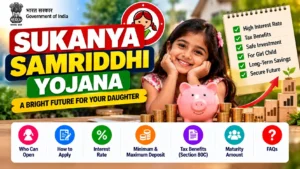

If you have a daughter below 10 years of age, the Sukanya Samriddhi Yojana 2026 could be the single best investment you make for her future. With an 8.2% interest rate — the highest among all small savings schemes — plus triple tax benefits, SSY turns even modest yearly deposits into a substantial corpus by the time your daughter turns 21.
✅ This guide is based on official government sources and notifications. Last verified: October 12, 2026. Scheme details, eligibility criteria, and benefit amounts are revised by the government from time to time — always cross-check the latest information on the official portal before applying.
In this complete guide, you’ll find the latest Sukanya Samriddhi Yojana 2026 interest rate, eligibility rules, deposit limits, tax benefits, premature withdrawal conditions, required documents, step-by-step account opening process, and an advanced calculator — with PPF comparison, tax savings estimator, and year-by-year breakdown.
What is Sukanya Samriddhi Yojana?
Sukanya Samriddhi Yojana 2026 (SSY) is a government-backed savings scheme launched under the Beti Bachao Beti Padhao campaign. It is designed exclusively for the girl child, helping parents build a financial corpus for her education and marriage.
🧮 Try Our Advanced SSY Calculator
Monthly/Yearly mode • PPF comparison • Tax savings • Year-by-year table
The scheme is available at all post offices and authorised banks across India. What makes the Sukanya Samriddhi Yojana 2026 stand out is its unbeatable combination: the highest interest rate among small savings schemes (8.2%), complete tax exemption at all three stages (EEE), and sovereign guarantee on your money.
Sukanya Samriddhi Yojana Interest Rate 2026
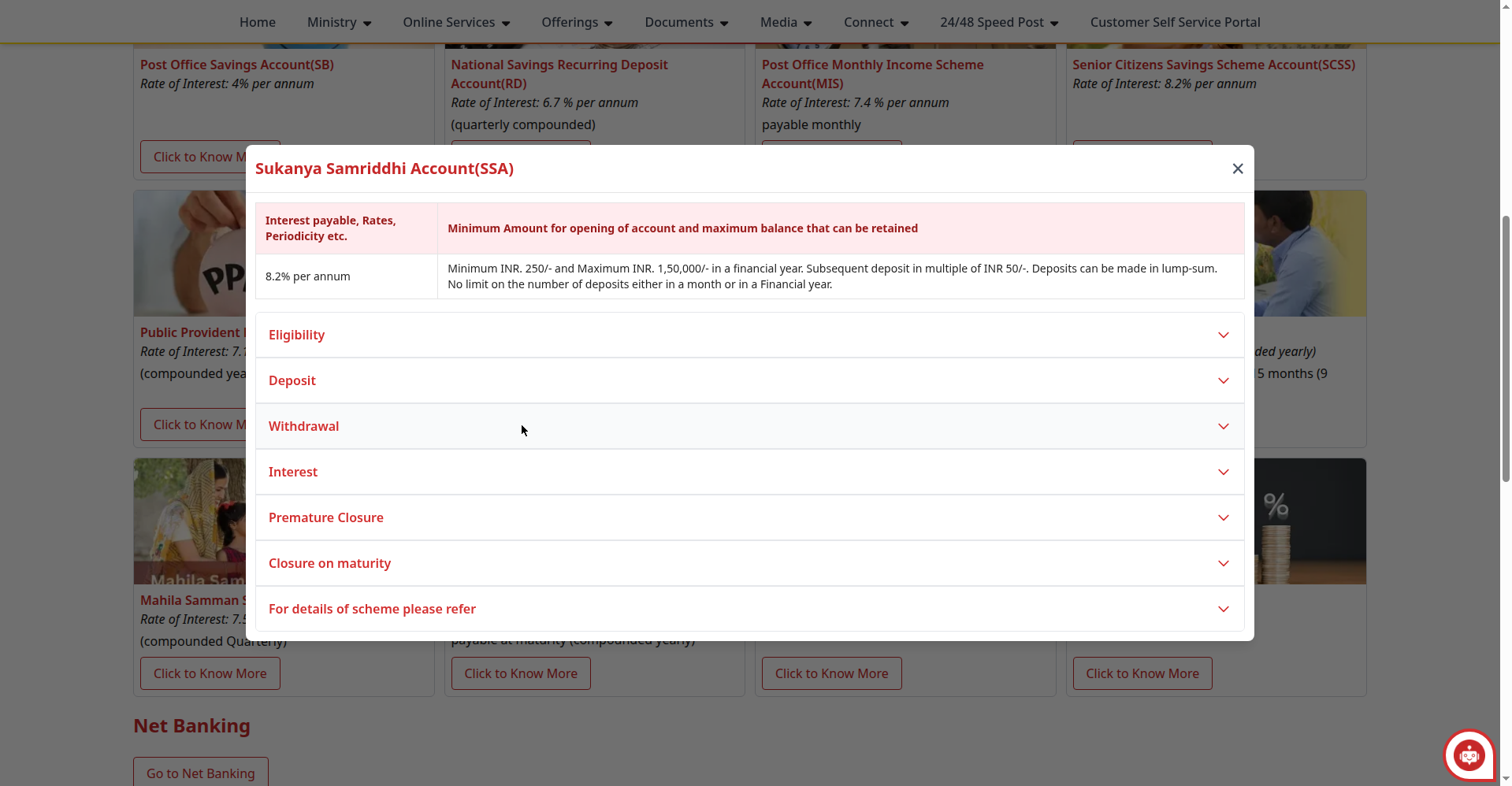
The current Sukanya Samriddhi Yojana 2026 interest rate is 8.2% per annum, compounded annually. This rate was confirmed for the October–December 2026 quarter by the Ministry of Finance notification dated September 30, 2026.
Here’s how SSY compares with other small savings schemes in 2026:
SSY has held the 8.2% rate since early 2024 — that’s nearly 10 consecutive quarters without change. Rates are revised quarterly by the Department of Economic Affairs, so always check the latest notification before making investment decisions.
Rate history: 8.2% (2024–2026) → 8.0% (2023) → 7.6% (2022). The trend shows SSY consistently offering premium rates.
SSY Eligibility: Who Can Open an Account?
Not everyone can open an SSY account. Here are the strict Sukanya Samriddhi Yojana 2026 eligibility rules:
- Girl child must be below 10 years of age at the time of account opening
- Account is opened and operated by the parent or legal guardian
- One account per girl child — no duplicates allowed
- Maximum two accounts per family (one per daughter)
- Exception: In case of twins or triplets in a single birth, a third account is permitted
- The girl child must be an Indian resident — NRI girls are NOT eligible
- If the girl becomes an NRI or loses Indian citizenship later, premature closure is allowed
Deposit Rules: Minimum, Maximum & Tenure
Understanding the Sukanya Samriddhi Yojana 2026 deposit structure is crucial for maximising your SSY returns:
Sukanya Samriddhi Yojana 2026: How Much Can You Deposit?
- Minimum deposit: ₹250 per financial year (in multiples of ₹50)
- Maximum deposit: ₹1.5 lakh per financial year
- Important: Any amount deposited above ₹1.5 lakh in a year earns zero interest and can be withdrawn by the depositor
Sukanya Samriddhi Yojana 2026: Deposit Duration
- Deposits are required for 15 years only from the date of account opening
- The account continues to earn interest for the full 21 years even after you stop depositing
- Example: Open account in 2026 → deposit till 2041 → maturity in 2047
What If You Miss a Deposit?
If you fail to deposit the minimum ₹250 in any financial year, the account goes into default. To revive it:
- Pay a ₹50 penalty for each default year
- Plus the missed minimum deposit amount (₹250 × default years)
SSY Maturity: When Do You Get the Money?
The SSY account matures 21 years from the date of account opening. This is NOT linked to the girl’s age — it’s purely based on when you opened the account.
Key maturity rules:
- On maturity, the entire corpus is paid directly to the girl child
- She must be 18 years or older to receive the maturity amount
- No interest accrues after 21 years — withdraw promptly on maturity
- The maturity amount is completely tax-free
Maturity Examples (at 8.2%)
*These projections assume the 8.2% rate remains constant. Actual rates are revised quarterly.*
Tax Benefits: The Triple EEE Advantage
The Sukanya Samriddhi Yojana 2026 enjoys EEE (Exempt-Exempt-Exempt) tax status — the best possible tax treatment:
- Exempt on deposit: Investments up to ₹1.5 lakh per year qualify for Section 80C deduction (old tax regime only)
- Exempt on interest: All interest earned is completely tax-free (both old and new regime)
- Exempt on maturity: The entire maturity corpus is tax-free (both regimes)
Important notes:
- The 80C deduction requires opting for the old tax regime
- The ₹1.5 lakh 80C limit is shared across SSY, PPF, EPF, ELSS, and other 80C investments
- Even under the new regime (no 80C), your SSY interest and maturity remain tax-free — a huge advantage over taxable FDs
Premature Withdrawal Rules
SSY is a long-term commitment, but the government allows early access in specific situations:
For Higher Education (After Age 18)
- Allowed when the girl turns 18 OR passes Class 10, whichever is earlier
- Up to 50% of the balance (as at end of preceding financial year) can be withdrawn
- Can be taken as lump sum or in instalments (max 1 per year, up to 5 years)
- Requires proof: admission offer letter or fee slip from recognised institution
For Marriage (After Age 18)
- Account can be closed prematurely if the girl marries after turning 18
- Application window: 1 month before to 3 months after the wedding date
- Requires: age proof + affidavit or marriage certificate
Hardship Closure (After 5 Years)
Premature closure is permitted after 5 years only in these cases:
- Life-threatening disease of the account holder
- Death of the operating parent/guardian
- Undue hardship to the account holder (requires approval)
On Death of Account Holder
The account is closed immediately. The balance plus interest till the date of death is paid to the guardian. Interest for the period between death and closure is paid at the Post Office Savings Account rate.
Documents Required to Open SSY Account
Keep these ready before visiting the post office or bank:
- Girl child’s birth certificate (original + photocopy)
- Parent/guardian’s Aadhaar card
- Parent/guardian’s address proof (PAN, voter ID, passport, etc.)
- Passport-size photographs of the parent/guardian
- Duly filled SSY account opening form (available at post office/bank)
- First deposit (minimum ₹250 in cash or cheque)
How to Open Sukanya Samriddhi Account: Step-by-Step
SSY accounts can be opened offline at any post office or authorised bank (SBI, PNB, HDFC, ICICI, and most major banks).
Step 1: Visit your nearest post office or bank branch offering SSY
Step 2: Collect the SSY account opening form
Step 3: Fill in the girl child’s details (name, DOB) and guardian details
Step 4: Submit the form along with KYC documents listed above
Step 5: Make your first deposit (minimum ₹250)
Step 6: Receive your passbook — keep it safe, you’ll need it for all transactions
Tip: Some banks are rolling out online account opening via netbanking. Check with your bank (SBI YONO, for example) for the latest digital options.
SSY vs PPF: Which is Better in 2026?
Both Sukanya Samriddhi Yojana 2026 and PPF are excellent government schemes, but they serve different purposes:
Verdict: If you have an eligible daughter, SSY wins hands down — 1.1% higher interest compounded over 21 years creates a massive difference. Use our calculator above to see the exact numbers.
For a ₹1 lakh/year deposit:
- SSY maturity: ~₹46.2 lakh
- PPF maturity (15yr): ~₹27.1 lakh
- Difference: SSY gives ~₹19 lakh MORE!
SSY vs NPS Vatsalya: New Competitor in 2026
NPS Vatsalya (launched for all children under 18) is being compared with SSY in 2026. Key differences:
- SSY: Fixed 8.2% return, sovereign guarantee, EEE tax status, girl-child only
- NPS Vatsalya: Market-linked returns (potentially higher but not guaranteed), for all children, different tax treatment
SSY remains the safer, more predictable choice for risk-averse parents. NPS Vatsalya suits those comfortable with market volatility for potentially higher returns.
Common SSY Mistakes to Avoid
- Depositing more than ₹1.5 lakh/year — excess earns zero interest
- Missing the ₹250 minimum — account goes into default with ₹50/year penalty
- Not withdrawing on maturity — zero interest after 21 years
- Opening after age 10 — not allowed, strict cutoff
- Ignoring rate changes — rates revise quarterly; stay updated
SSY Account Transfer: Post Office to Bank (and Vice Versa)
Changed cities? No problem. Your daughter’s SSY account is fully transferable between post offices and authorised banks across India, completely free of charge. This is one of the most practical features of the scheme that many parents don’t know about.
How to transfer your SSY account:
- Visit your current post office or bank branch where the account is held
- Fill the account transfer request form (available at the branch)
- Submit your passbook along with KYC documents (Aadhaar, PAN of guardian)
- The branch will process the transfer electronically through CBS (Core Banking Solution)
- Collect your new passbook from the destination branch within 7-15 working days
The interest continues to accrue during the transfer period, so you don’t lose a single rupee. If you’ve moved from, say, Ahmedabad to Mumbai for work, just walk into the nearest post office with your documents. The account number stays the same in most CBS transfers.
SSY Nomination Facility: What Parents Must Know
Unlike PPF or bank fixed deposits, the Sukanya Samriddhi Yojana does not offer a nomination facility. This surprises many parents, but there’s a logical reason: the account belongs to the girl child, and the guardian is already the de facto operator until she turns 18.
Here’s what happens in different scenarios:
- If the guardian passes away: The surviving natural guardian or legal guardian takes over account operations. You’ll need to submit the death certificate and guardianship proof to the post office or bank.
- If the girl child passes away: The account is closed immediately, and the entire balance (deposits plus interest) is paid to the guardian. A death certificate is required.
- After the girl turns 18: She gains full operational control. She can manage deposits, request statements, and eventually close the account at maturity.
Since there’s no nominee, make sure at least one parent keeps the SSY passbook and account details in a safe, known location. Consider keeping a photocopy with your other important financial documents.
What Happens After SSY Maturity? Smart Next Steps
When the 21-year lock-in ends and ₹46 lakh (or whatever your corpus is) lands in your daughter’s account, the next decision matters as much as the 21 years of disciplined saving. Here are smart options:
1. Higher education funding: If your daughter is pursuing professional courses (medical, engineering, law, management), the corpus can directly fund tuition. Professional course fees in India range from ₹5-25 lakh, so SSY maturity often covers this comfortably.
2. Shift to PPF or NPS: If the money isn’t needed immediately, your daughter (now an adult) can open her own PPF account and continue the tax-free compounding habit. The SSY maturity amount is tax-free, so redeploying it doesn’t trigger any tax.
3. Marriage expenses: The scheme was partly designed for this. But financial planners suggest keeping marriage spending reasonable and investing the surplus.
4. Emergency fund + investments: Park 6 months of expenses in a high-interest savings account or liquid fund, then consider mutual funds for long-term growth if she has the risk appetite.
Important: The SSY account stops earning interest after maturity. Don’t leave the money sitting idle — either withdraw it or have a reinvestment plan ready before the maturity date.
SSY for NRIs: Can You Open an Account?
This is one of the most asked questions, and the answer has a twist. NRIs cannot open a new SSY account. The scheme is strictly for resident Indian citizens.
However, there’s an important exception: if you opened the SSY account while you were a resident Indian and later became an NRI, the account continues normally until maturity. You don’t need to close it. The deposits, interest accrual, and tax benefits continue as before.
But note these practical challenges for NRIs:
- You cannot make fresh deposits from an NRE/NRO account directly in all banks — check with your specific bank
- Interest credited to NRI-held SSY accounts may have different tax implications — consult a chartered accountant
- Premature closure rules remain the same regardless of residential status
If you’re planning to move abroad, open the SSY account before your status changes to NRI. Once opened as a resident, it’s protected.
SSY Interest Calculation: How the 8.2% Actually Works
Many parents assume 8.2% means simple multiplication. The reality is more generous — SSY uses monthly compounding based on the lowest balance between the 5th and the end of each month.
What this means for you: Deposit before the 5th of every month to maximise interest. If you deposit ₹12,500 on the 3rd of April versus the 20th of April, the April 3rd deposit earns interest for that full month, while the April 20th deposit doesn’t. Over 15 years, this timing difference can add up to thousands of rupees.
Pro tip: Set up a standing instruction or auto-debit for the 1st or 2nd of every month. This ensures you never miss the 5th deadline and your money compounds from day one. Most banks and India Post offer free auto-debit for SSY accounts.
The interest rate itself is revised quarterly by the Ministry of Finance based on government bond yields. While 8.2% is the current rate (2026), it has ranged from 7.6% to 9.2% since the scheme launched in 2015. Your existing balance always earns the prevailing rate — there’s no lock-in of the rate at account opening.
Frequently Asked Questions
What is the current Sukanya Samriddhi Yojana interest rate for 2026?
The SSY interest rate is 8.2% per annum (compounded annually) for the October–December 2026 quarter, as per the Ministry of Finance notification dated September 30, 2026. This rate has remained unchanged since early 2024.
What is the minimum and maximum deposit in SSY?
Minimum ₹250 per financial year, maximum ₹1.5 lakh per financial year. Deposits above ₹1.5 lakh earn no interest.
Can I open SSY account for my 11-year-old daughter?
No. The girl child must be below 10 years of age at the time of account opening. This is a strict rule with no exceptions.
Is SSY tax-free?
Yes, SSY has EEE (Exempt-Exempt-Exempt) status. Deposits qualify for 80C deduction (old regime), interest is tax-free, and maturity amount is tax-free.
When does SSY mature?
21 years from the date of account opening. Deposits are required for only the first 15 years.
Can I withdraw SSY money before maturity?
Partial withdrawal (up to 50%) is allowed for the girl’s higher education after she turns 18 or passes Class 10. Full premature closure is allowed for marriage after 18, or on hardship grounds after 5 years.
SSY vs PPF — which gives better returns?
SSY (8.2%) beats PPF (7.1%) significantly. On ₹1 lakh/year for 15 years, SSY yields ~₹46.2 lakh vs PPF’s ~₹27.1 lakh — a difference of ~₹19 lakh.
Can NRIs open a Sukanya Samriddhi Yojana account?
No, NRIs cannot open a new SSY account. However, if you opened it as a resident Indian and later became an NRI, the account continues normally until maturity with all benefits intact.
What happens if I deposit before the 5th vs after the 5th of the month?
SSY interest is calculated on the lowest balance between the 5th and month-end. Deposits made before the 5th earn interest for that month; deposits after the 5th don’t. Always deposit by the 4th to maximise returns.
Can I transfer my SSY account to another city?
Yes, SSY accounts are freely transferable between post offices and authorised banks across India at no cost. Submit a transfer request with your passbook and KYC documents; the process takes 7-15 working days.
Does SSY have a nomination facility?
No, SSY doesn’t offer nomination. If the guardian passes away, the surviving legal guardian takes over. If the girl child passes away, the balance is paid to the guardian after submitting the death certificate.
What should I do after SSY matures?
Withdraw the tax-free corpus and redeploy it based on your daughter’s needs — higher education, PPF continuation, or other investments. Don’t leave it idle as the account stops earning interest after maturity.
Conclusion
The Sukanya Samriddhi Yojana 2026 remains India’s best savings scheme for the girl child — 8.2% interest, triple tax benefits, and sovereign guarantee make it unbeatable for risk-averse parents. With deposits from just ₹250/year, every family can participate.
Next steps:
- Use the calculator above to plan your deposits
- Visit your nearest post office or bank with the documents listed
- Start before your daughter turns 10 — don’t miss the eligibility window
- Consider opening this Diwali as a gift for your daughter’s future
Sukanya Samriddhi Yojana 2026 at a Glance
Short on time? Here are the key facts in one place:
| Feature | Details |
|---|---|
| Interest Rate | 8.2% per annum, compounded annually (Oct–Dec 2026 quarter) |
| Eligibility | Girl child below 10 years; one account per girl child |
| Minimum Deposit | ₹250 per financial year |
| Maximum Deposit | ₹1.5 lakh per financial year |
| Deposit Period | 15 years from account opening |
| Maturity | 21 years; fully tax-free |
| Tax Status | EEE — 80C deduction (old regime), tax-free interest & maturity |
| Where to Open | Post offices and authorised banks |
| Premature Withdrawal | Up to 50% for education/marriage after age 18 |
SSY remains the highest-paying small savings scheme for the girl child. With sovereign guarantee and EEE tax status, few fixed-income options match it for long-term goals like education and marriage.
If your daughter is still below 10, opening an account today locks in 8.2% compounding for up to 21 years. Note that the interest rate is reviewed every quarter, so always check the latest notification. Official updates are published by India Post and the Department of Financial Services.
- Start before your daughter turns 10 — don’t miss the eligibility window
- Consider opening this Diwali as a gift for your daughter’s future
For more tax-saving guides, explore our Tax Saving category. For other government schemes, check Sarkari Yojana.
🧮 Sukanya Samriddhi Yojana Calculator
Calculate maturity value • Monthly/Yearly mode • PPF comparison • Tax savings