

Want to start a small business but don’t have the money? The PM Mudra Loan Yojana 2026 could be exactly what you need. Under this government scheme, you can get a business loan of up to ₹20 lakh without any collateral, guarantor, or property mortgage. In this complete guide, I’ll walk you through everything — the four loan categories, current interest rates, eligibility, documents, and the exact step-by-step process to apply online under the PM Mudra Loan Yojana 2026.
✅ This guide is based on official government sources including mudra.org.in, jansamarth.in, and Ministry of Finance notifications. Last verified: October 13, 2026. Interest rates and scheme details are revised by banks and the government from time to time — always cross-check the latest information on the official portal before applying.
When I first heard about Mudra loans a few years ago, I honestly thought it was too good to be true. A business loan with zero collateral? No property papers? It sounded like one of those WhatsApp forwards. But after digging into the official scheme documents and talking to actual borrowers, I realized this is one of the most genuine government schemes out there. Over 52 crore loans have been sanctioned under PMMY since 2015, according to Ministry of Finance data.
The best part? In the 2024 Budget, the government doubled the maximum loan limit from ₹10 lakh to ₹20 lakh under a brand-new category called Tarun Plus. If you’re planning to apply in 2026, this guide covers everything that’s changed.
What Is PM Mudra Loan Yojana?
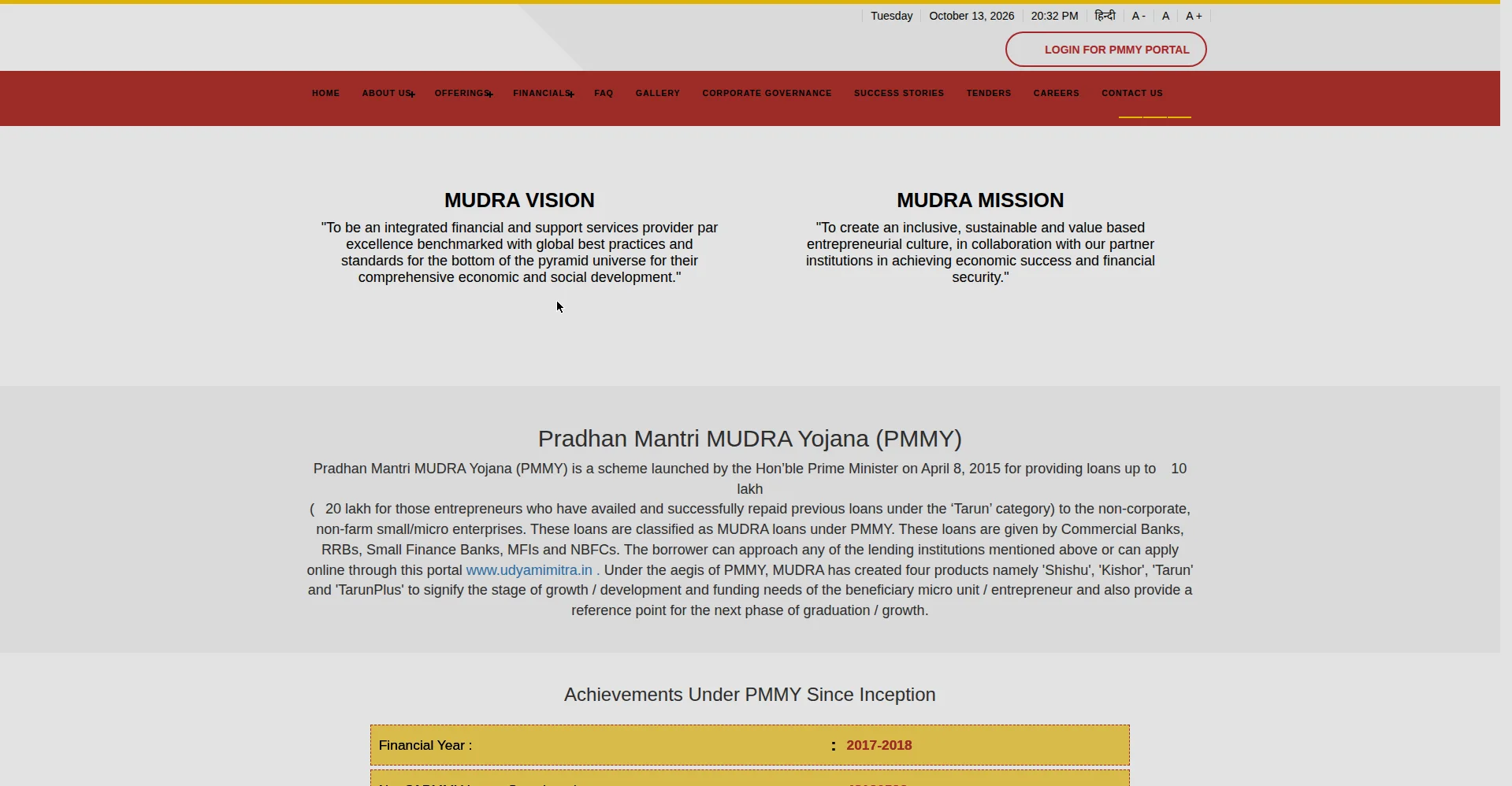
Pradhan Mantri MUDRA Yojana (PMMY) is a flagship scheme of the Government of India launched on April 8, 2015. It provides loans to non-corporate, non-farm small and micro enterprises — think small shops, tailoring units, food stalls, repair shops, salons, and home-based businesses.
The scheme is implemented through MUDRA Ltd, a wholly-owned subsidiary of SIDBI (Small Industries Development Bank of India), under the Ministry of Finance. MUDRA itself doesn’t lend money directly to you. Instead, it refinances and supports the banks, NBFCs, and microfinance institutions that give you the loan.
Here’s what makes Mudra different from a regular business loan:
- Zero collateral — no property, gold, or guarantor needed
- Government guarantee — loans are backed by the Credit Guarantee Fund for Micro Units (CGFMU)
- Flexible tenure — repayment periods from 3 to 7 years
- No processing fee on Shishu loans at most banks
- RuPay Mudra Card issued for working capital needs
The 4 Mudra Loan Categories Explained
Under the PM Mudra Loan Yojana 2026, loans are divided into four categories based on the loan amount and the stage of your business. Picking the right category is important — applying for the wrong one is a common reason for rejection.
| Category | Loan Amount | Best For | Typical Tenure |
|---|---|---|---|
| Shishu | Up to ₹50,000 | First-time entrepreneurs starting very small | 3–5 years |
| Kishore | ₹50,001 – ₹5,00,000 | Growing businesses needing expansion capital | 3–5 years |
| Tarun | ₹5,00,001 – ₹10,00,000 | Established businesses scaling up | 5–7 years |
| Tarun Plus | ₹10,00,001 – ₹20,00,000 | Only for borrowers who repaid a Tarun loan | 5–7 years |
Shishu: Loans Up to ₹50,000
Shishu (meaning “infant” in Hindi) is for absolute beginners. If you’re starting a tea stall, a small tailoring setup from home, or a vegetable cart, this is your category. The paperwork is minimal, processing is fastest (often 7–10 days), and most banks charge zero processing fee.
About 60% of all Mudra loans fall in the Shishu category, which tells you how popular it is among first-time borrowers.
Kishore: Loans From ₹50,001 to ₹5,00,000
Kishore (meaning “adolescent”) is for businesses that have started and now need money to grow. Maybe your kirana store needs more stock, your salon needs new equipment, or your food business needs a bigger setup. Banks will look at your existing business more carefully here — they may ask for 6 months of bank statements and a simple project report.
Tarun: Loans From ₹5,00,001 to ₹10,00,000
Tarun (meaning “young adult”) is for established businesses ready to scale significantly. At this level, banks expect a proper project report, GST registration (if applicable), and a clear repayment plan. Processing takes 15–30 days because of deeper verification.
Tarun Plus: Loans From ₹10,00,001 to ₹20,00,000 (NEW)
This is the newest category, announced in the Union Budget 2024-25. Tarun Plus doubles the earlier maximum from ₹10 lakh to ₹20 lakh. But there’s a catch — it’s only for borrowers who have already taken and successfully repaid a Tarun loan. First-time applicants cannot directly apply for Tarun Plus.
The logic is simple: the government wants to reward borrowers with a proven repayment track record by giving them bigger loans for serious expansion.
Mudra Loan Interest Rates in 2026
Here’s something most websites don’t tell you clearly: the government does NOT fix Mudra loan interest rates. Each bank or NBFC sets its own rate based on RBI guidelines, your credit profile, and the loan category. This means the rate you get can vary significantly between lenders.
Based on current bank disclosures, here are the indicative ranges for 2026:
| Lender Type | Indicative Rate (per year) | Max Tenure |
|---|---|---|
| Public Sector Banks (SBI, PNB, Bank of Baroda) | 8.50% – 12.15% | Up to 7 years |
| Private Banks (HDFC, ICICI, Axis) | 9.99% – 17.50% | Up to 5 years |
| Regional Rural Banks | Base rate + ~3.5% | Up to 7 years |
| NBFCs and Microfinance Institutions | 12.00% – 24.00% | Up to 5 years |
Important notes:
- These rates are indicative and change with RBI policy — always confirm with your chosen lender.
- Women entrepreneurs may get a concession of around 0.25% at some public sector banks.
- NBFCs process faster but charge significantly higher rates — use them only if banks reject you.
- Your CIBIL score, business vintage, and loan category all affect the final rate you’re offered.
Eligibility Criteria for PM Mudra Loan
Not everyone can get a Mudra loan. Here are the official eligibility conditions:
- Citizenship: Must be an Indian citizen
- Age: Minimum 18 years; maximum 65 years at most banks
- Business type: Non-farm income-generating activity — manufacturing, trading, or services. Allied agriculture like poultry, dairy, beekeeping, and fisheries is also eligible.
- Business structure: Individual, sole proprietor, partnership firm, or small private company/MSME
- Credit history: Must not be a defaulter with any bank or financial institution
- Purpose: The loan must be for business — not for personal expenses, and not for farm crop loans
- For Tarun Plus: Must have taken a Tarun loan earlier and repaid it with a clean record
There’s no minimum income requirement. A workable business idea matters more than your salary slip — which is exactly why this scheme exists.
Documents Required
Keep these ready before you apply. Missing documents are the number one reason for delays.
For All Categories
- Mudra loan application form (available at bank or online portal)
- Identity proof: Aadhaar card, PAN card, Voter ID, Passport, or Driving Licence
- Address proof: Aadhaar, utility bills, rent agreement
- Passport-size photographs
- Last 6 months’ bank statements
- Proof of business (if existing): trade licence, shop registration, GST certificate
Additional for Kishore, Tarun and Tarun Plus
- Project report or business plan (what you’ll buy, expected income, repayment plan)
- Latest Income Tax Returns (if filed)
- Business continuity proof: old bills, supplier invoices, Udyam registration
- SC/ST/OBC/Minority certificate, if applicable (for priority processing)
- For Tarun Plus: proof of Tarun loan repayment history
Pro tip: A project report is not strictly mandatory for Shishu loans, but having even a one-page plan dramatically improves your approval chances for Kishore and above.
How to Apply for Mudra Loan Online (Step by Step)
There are two official online portals. Both are free — never pay anyone to apply for you.
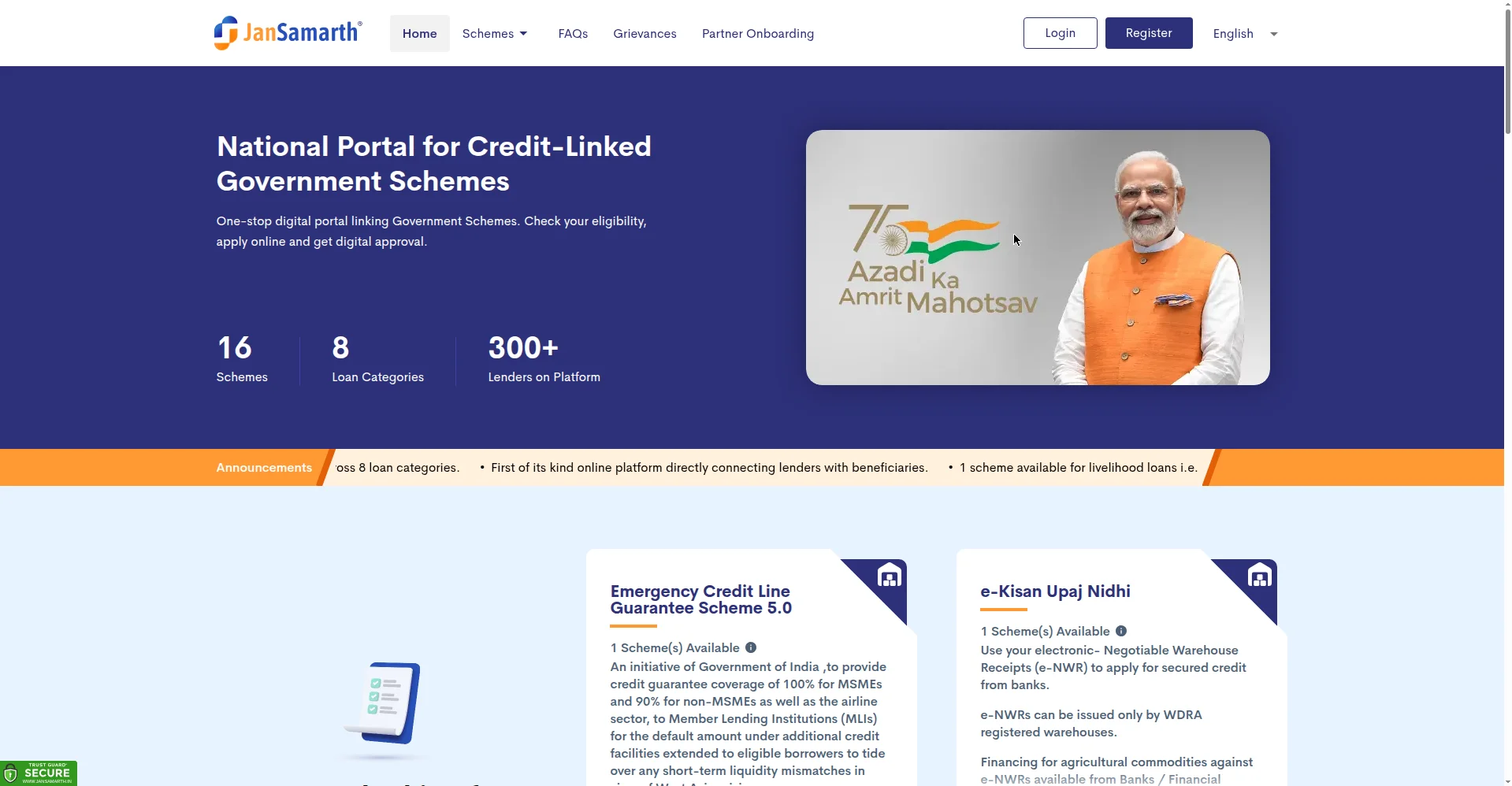
Option 1: JanSamarth Portal (jansamarth.in)
JanSamarth is the government’s single-window portal for credit-linked schemes.
- Go to jansamarth.in and click on “Business Activity Loan”
- Select “PM MUDRA Yojana” from the scheme list
- Register with your mobile number and verify with OTP
- Check your eligibility using the built-in checker
- Fill in personal details, business details, and loan requirements
- Upload documents (PAN, Aadhaar, bank statements, project report)
- Choose your preferred bank from the list
- Submit and note your application reference number
- The bank will contact you within a few working days for verification
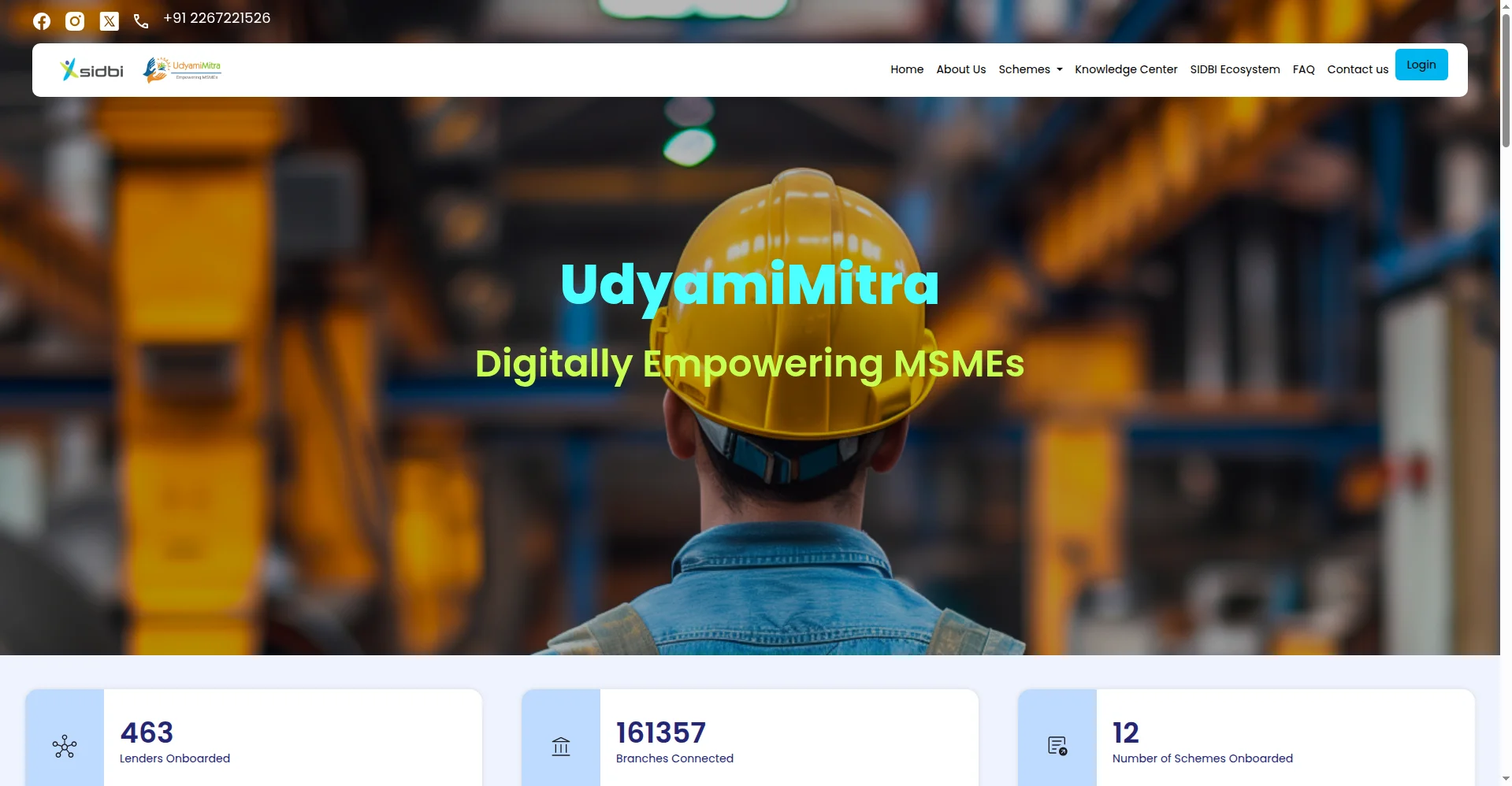
Option 2: Udyamimitra Portal (udyamimitra.in)
Udyamimitra is SIDBI’s portal specifically for Mudra and MSME loans.
- Visit udyamimitra.in and register as an applicant
- Select “MUDRA Loan” and choose your category (Shishu/Kishore/Tarun)
- Fill the loan application form with business details
- Upload the required documents
- Select up to three preferred banks
- Submit the application — banks can view it and respond with digital in-principle approval
- Complete physical verification at the bank branch when contacted
Online applications typically get an in-principle response within 7–15 days. The final disbursement happens after physical document verification at the branch.
How to Apply Offline at a Bank Branch
If you’re not comfortable with online portals, walk into any public sector bank, private bank, regional rural bank, or NBFC branch:
- Ask for the Mudra loan application form at the counter
- Fill it carefully — even a single wrong character can cause rejection
- Attach self-attested copies of all documents
- Include your project report (for Kishore and above)
- Submit and collect the acknowledgement receipt with your application number
- The bank’s field officer may visit your business premises for verification
- On approval, the loan amount is credited directly to your bank account
What Is the MUDRA Card?
When your Mudra loan is approved, most banks issue a RuPay-based Mudra Debit Card. This isn’t just a regular debit card — it’s designed for working capital management.
You can use the Mudra Card to withdraw working capital from ATMs or make purchases at POS machines, up to your sanctioned working capital limit. It gives you flexible access to funds without visiting the branch every time you need money for stock or raw material. Think of it as a pre-approved credit line attached to your loan.
CGFMU: Why Banks Give You Loans Without Collateral
This is the part most articles skip, but it’s the reason the whole scheme works. CGFMU stands for the Credit Guarantee Fund for Micro Units, managed by the National Credit Guarantee Trustee Company (NCGTC).
Here’s how it works: when a bank gives you a collateral-free Mudra loan, the CGFMU guarantees a large portion of that loan to the bank. If you default, the fund compensates the bank. This removes the bank’s fear of lending without security — which is exactly why banks are willing to give you money without asking for property papers.
You’re not paying for this guarantee directly. It’s funded by the government to make credit accessible. This is also why you should never let any bank demand collateral for a Mudra loan — the scheme explicitly prohibits it.
Calculate Your Mudra Loan EMI
Before applying, you should know exactly what your monthly burden will look like. Let me show you some real examples:
| Loan Amount | Category | Rate | Tenure | Monthly EMI | Total Interest |
|---|---|---|---|---|---|
| ₹50,000 | Shishu | 10% | 3 years | ₹1,613 | ₹8,062 |
| ₹3,00,000 | Kishore | 11% | 5 years | ₹6,523 | ₹91,360 |
| ₹7,50,000 | Tarun | 12% | 5 years | ₹16,684 | ₹2,51,060 |
| ₹15,00,000 | Tarun Plus | 12% | 7 years | ₹26,454 | ₹7,22,162 |
Notice how the interest adds up on bigger loans — on a ₹15 lakh Tarun Plus loan, you pay over ₹7 lakh just in interest. This is why comparing rates between banks matters so much.
Adjust amount, rate & tenure with sliders • See year-wise schedule • 100% free
I’ve built an advanced EMI calculator specifically for Mudra loans — it auto-detects your loan category, shows a principal-vs-interest breakdown chart, compares different interest rates side by side, and generates a complete year-wise repayment schedule. Try different combinations before you visit the bank so you can negotiate with confidence.
Common Rejection Reasons (And How to Avoid Them)
Mudra loans have a high approval rate compared to regular business loans, but rejections still happen. Here are the top reasons and how to avoid each:
- Wrong category selected: Don’t apply for Tarun when you need Shishu. Match the category to your actual funding need.
- Incomplete documents: Double-check every document before submitting. A missing bank statement can stall your file for weeks.
- No business plan: For Kishore and above, a one-page plan showing what you’ll buy and how you’ll repay makes a huge difference.
- Poor CIBIL score with no explanation: If you have past defaults, show the bank what changed. A small secured credit card used responsibly for 6 months can rebuild your score.
- Applying through middlemen: MUDRA explicitly warns against agents. Banks are instructed to reject applications routed through touts. Apply directly — it’s free.
- Farm or personal purpose: Mudra is strictly for non-farm business. Don’t apply if you need money for personal expenses or crop farming.
- Inconsistent details: Your name, address, and business details must match exactly across all documents. Even a spelling mismatch can trigger rejection.
Mudra vs PMEGP vs Stand-Up India: Which Loan Is Right for You?
These three schemes often confuse people. Here’s a clear comparison:
| Feature | PM Mudra Yojana | PMEGP | Stand-Up India |
|---|---|---|---|
| Max Loan | ₹20 lakh (Tarun Plus) | ₹50 lakh (manufacturing) / ₹20 lakh (services) | ₹1 crore |
| Subsidy | None (only credit guarantee) | 15–35% margin money subsidy | None (but RuPay card benefits) |
| Collateral | Not required | Not required up to ₹10 lakh | Not required (CGFSI cover) |
| Who It’s For | Micro/small businesses | New manufacturing & service units | Women & SC/ST entrepreneurs |
| Best When | You need quick, simple business credit | You want a subsidy on project cost | You’re a woman/SC/ST starting a greenfield venture |
My take: If you want simplicity and speed, go with Mudra. If your project cost is high and you can handle more paperwork, PMEGP’s 15–35% subsidy is hard to beat. If you’re a woman entrepreneur starting fresh, check Stand-Up India for loans up to ₹1 crore.
7 Tips to Increase Your Approval Chances
- Open a current account in your business name before applying — it signals seriousness.
- Get Udyam (MSME) registration — it’s free, takes 10 minutes online, and banks love seeing it.
- Maintain 6 months of clean bank statements — avoid bounced cheques and unexplained cash deposits.
- Write a one-page project report — what you’ll buy, expected monthly income, and how the EMI fits in.
- Apply at a bank where you already have an account — existing relationships speed up verification.
- Start with Shishu if you’re new — repay it on time, then graduate to Kishore and Tarun. Banks trust proven borrowers.
- Never pay an agent — report anyone asking for fees to the bank manager or on the Mudra portal.
Frequently Asked Questions
Is there any subsidy in Mudra loan?
No, there is no direct interest subsidy under PM Mudra Yojana. You pay the full interest charged by the bank. The government’s support comes through the CGFMU credit guarantee, which is what makes banks willing to lend without collateral. If you want a capital subsidy, look at PMEGP instead, which offers 15–35% margin money subsidy.
Can I get a Mudra loan without a business plan?
For Shishu loans (up to ₹50,000), a formal project report is usually not mandatory — banks mainly check your KYC and basic intent. For Kishore, Tarun, and Tarun Plus, a project report is highly recommended and often practically required. Even a simple one-page plan dramatically improves approval odds.
Can a first-time applicant get the ₹20 lakh Tarun Plus loan?
No. Tarun Plus is reserved exclusively for borrowers who have already taken a Tarun loan and repaid it with a clean record. If you’re applying for the first time, start with Shishu, Kishore, or Tarun based on your funding need.
What is the processing fee for a Mudra loan?
There is no processing fee for Shishu loans at most banks. For Kishore, Tarun, and Tarun Plus, banks may charge a nominal processing fee (typically 0.5%–1% of the loan amount). Always ask for the fee structure in writing before signing.
How long does Mudra loan approval take?
Shishu loans: 7–10 working days if documents are complete. Kishore and Tarun: 15–30 days due to deeper verification including project report analysis. Tarun Plus: 20–45 days because of additional checks on repayment history. NBFCs and MFIs are often faster but charge higher interest.
Can women get special benefits under Mudra?
While there’s no separate women’s quota in Mudra, banks are directed to prioritize women entrepreneurs, and some public sector banks offer an interest concession of around 0.25%. Women also get priority under the Stand-Up India scheme (₹10 lakh to ₹1 crore), which can be a better fit for larger ventures.
Final Thoughts
The PM Mudra Loan Yojana 2026 is one of the few government schemes that genuinely delivers what it promises — collateral-free business credit for ordinary people. The new Tarun Plus category taking the limit to ₹20 lakh makes it relevant even for serious small businesses, not just micro ventures.
The key to success is preparation: pick the right category, keep your documents ready, write a simple project report, and apply directly through official channels. And before you sign anything, run your numbers through the EMI calculator so there are no surprises. If you are also planning for your family’s financial security alongside your business, check out our Sukanya Samriddhi Yojana 2026 guide for tax-free savings and Atal Pension Yojana for retirement planning.
Ready to Plan Your Mudra Loan?
Calculate your exact monthly EMI with our free advanced calculator — category auto-detection, rate comparison & year-wise schedule included.
Found this guide helpful? Share it with someone planning to start a business — it might be the push they need. And if you’ve taken a Mudra loan yourself, I’d love to hear about your experience in the comments.