How much do you actually need to pay every month to get a guaranteed ₹5,000 pension after retirement? If you are 18, it is just ₹210 a month — less than the cost of a pizza. But wait till 40, and the same pension costs ₹1,454 a month. That difference is exactly why the Atal Pension Yojana chart matters, and this guide gives you the complete age-wise contribution table for 2026.
✅ This guide is based on official government sources and notifications. Last verified: October 12, 2026. Scheme details, eligibility criteria, and benefit amounts are revised by the government from time to time — always cross-check the latest information on the official portal before applying.
The Atal Pension Yojana (APY) is the Government of India’s flagship pension scheme for workers in the unorganised sector. Launched on May 9, 2015, by Prime Minister Narendra Modi, it guarantees a fixed monthly pension of ₹1,000 to ₹5,000 after you turn 60. The scheme is administered by the PFRDA (Pension Fund Regulatory and Development Authority), the same body that regulates the National Pension System (NPS).
Unlike market-linked retirement plans, APY is simple: you pick a pension amount, pay a fixed monthly contribution based on your entry age, and the government guarantees the pension. There is no stock market risk, no confusing NAV calculations, and no fund manager to track. For crores of Indians without EPF or formal retirement benefits, this is often the only structured pension available.
Atal Pension Yojana Contribution Chart 2026
This is the heart of the scheme. Your monthly contribution depends on only two things: your age when you join and the pension amount you choose. The table below shows the official monthly contribution for every entry age from 18 to 40, across all five pension slabs.
| Entry Age | Years of Contribution | ₹1,000 Pension | ₹2,000 Pension | ₹3,000 Pension | ₹4,000 Pension | ₹5,000 Pension |
|---|---|---|---|---|---|---|
| 18 | 42 | ₹42 | ₹84 | ₹126 | ₹168 | ₹210 |
| 19 | 41 | ₹46 | ₹92 | ₹138 | ₹183 | ₹228 |
| 20 | 40 | ₹50 | ₹100 | ₹150 | ₹198 | ₹248 |
| 21 | 39 | ₹54 | ₹108 | ₹162 | ₹215 | ₹269 |
| 22 | 38 | ₹59 | ₹117 | ₹177 | ₹234 | ₹292 |
| 23 | 37 | ₹64 | ₹127 | ₹192 | ₹254 | ₹318 |
| 24 | 36 | ₹70 | ₹139 | ₹208 | ₹277 | ₹346 |
| 25 | 35 | ₹76 | ₹151 | ₹226 | ₹301 | ₹376 |
| 26 | 34 | ₹82 | ₹164 | ₹246 | ₹327 | ₹409 |
| 27 | 33 | ₹90 | ₹178 | ₹268 | ₹356 | ₹446 |
| 28 | 32 | ₹97 | ₹194 | ₹292 | ₹388 | ₹485 |
| 29 | 31 | ₹106 | ₹212 | ₹318 | ₹423 | ₹529 |
| 30 | 30 | ₹116 | ₹231 | ₹347 | ₹462 | ₹577 |
| 31 | 29 | ₹126 | ₹252 | ₹379 | ₹504 | ₹630 |
| 32 | 28 | ₹138 | ₹276 | ₹414 | ₹551 | ₹689 |
| 33 | 27 | ₹151 | ₹302 | ₹453 | ₹602 | ₹752 |
| 34 | 26 | ₹165 | ₹330 | ₹495 | ₹659 | ₹824 |
| 35 | 25 | ₹181 | ₹362 | ₹543 | ₹722 | ₹902 |
| 36 | 24 | ₹198 | ₹396 | ₹594 | ₹792 | ₹990 |
| 37 | 23 | ₹218 | ₹436 | ₹654 | ₹870 | ₹1,087 |
| 38 | 22 | ₹240 | ₹480 | ₹720 | ₹957 | ₹1,196 |
| 39 | 21 | ₹264 | ₹528 | ₹792 | ₹1,054 | ₹1,318 |
| 40 | 20 | ₹291 | ₹582 | ₹873 | ₹1,164 | ₹1,454 |
Source: PFRDA official APY contribution chart. Contributions are auto-debited monthly from your linked savings account. Quarterly and half-yearly payment modes are also available at proportionate amounts.
How to Read the APY Chart: 3 Practical Examples
The chart looks simple, but let me show you what it actually means with real numbers.
Example 1 — Ramesh, age 18, wants ₹5,000 pension: He pays ₹210 every month for 42 years (until 60). Total paid over his lifetime: about ₹1.06 lakh. From age 60, he gets ₹5,000 every month for life — that is ₹60,000 a year. In just two years of pension, he recovers his entire lifetime contribution. Everything after that is pure gain, guaranteed by the government.
Example 2 — Sunita, age 30, wants ₹3,000 pension: She pays ₹347 a month for 30 years. Total contribution: roughly ₹1.25 lakh. From 60, she receives ₹3,000 monthly (₹36,000/year) for life. Her break-even comes in under 4 years of pension.
Example 3 — A married couple, both 25, each take ₹5,000 pension: Each pays ₹376/month, so the household pays ₹752/month. After 60, the household receives ₹10,000/month combined. If one spouse passes away, the surviving spouse continues to get their own ₹5,000 plus the deceased spouse’s ₹5,000 — the APY rules specifically protect the spouse this way.
The pattern is unmistakable: every year you delay joining, your monthly contribution jumps. Between 18 and 25, the ₹5,000 pension contribution rises from ₹210 to ₹376. Between 30 and 40, it leaps from ₹577 to ₹1,454. Starting early is the single biggest lever you have.
APY Eligibility Criteria 2026
Not everyone can join APY. Here are the exact eligibility conditions as they stand in 2026:
- Age: You must be between 18 and 40 years old at the time of joining. Once enrolled, you contribute until age 60.
- Citizenship: Only Indian citizens can open an APY account. NRIs are not eligible.
- Bank account: You must have a savings bank account or post office savings account. This account is linked for auto-debit.
- Aadhaar and mobile: Your Aadhaar must be linked to the savings account, and an active mobile number is required for OTP verification and alerts.
- Income tax payer rule (important): Since October 1, 2022, any citizen who is or has been an income tax payer cannot open a new APY account. This rule was introduced to keep the scheme focused on the unorganised sector and lower-income groups. If you enrolled before October 2022 as a taxpayer, your existing account continues normally.
One common confusion: having an EPF or EPS account does not disqualify you from APY. The restriction is specifically about being an income tax payer, not about other pension or provident fund memberships.
How to Apply for Atal Pension Yojana Online
You can open an APY account without visiting a branch if your bank offers net banking or mobile banking enrollment. Here is the exact process:
- Log in to your bank’s net banking or mobile app. Look for the “Social Security Schemes” or “Government Schemes” section. Most major banks (SBI, HDFC, ICICI, Bank of Baroda, PNB) list APY there.
- Select Atal Pension Yojana and fill in the registration form: your Aadhaar number, savings account number, nominee details, and your chosen pension amount (₹1,000–₹5,000).
- Verify with OTP. An OTP comes to your Aadhaar-registered mobile number. Enter it to authenticate.
- Set up auto-debit. Authorise the bank to auto-debit your monthly contribution from the linked savings account.
- Get your PRAN. Within 24 hours, your Permanent Retirement Account Number (PRAN) is generated. Save it — this is your APY identity for life.
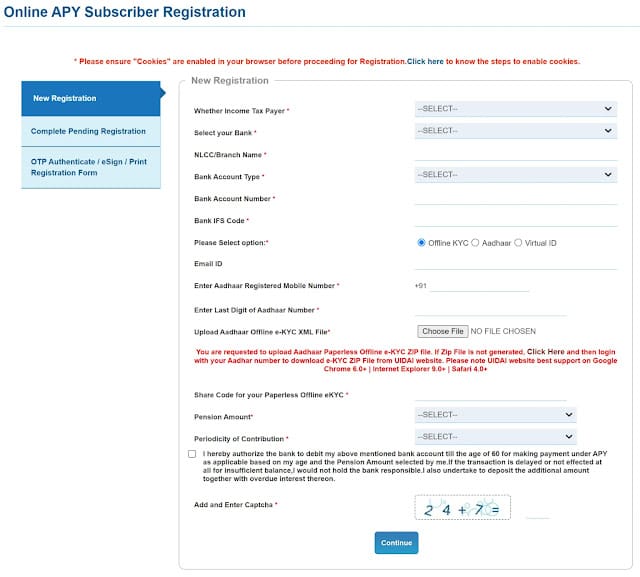
The screenshot above shows the actual online APY subscriber registration page on the NSDL portal (npscra.nsdl.co.in), where you enter your bank details, Aadhaar, and pension amount. The process is entirely paperless if your KYC is complete.
How to Apply for APY Offline at Bank or Post Office
Prefer paper? Visit any bank branch or post office where you hold a savings account:
- Ask for the APY subscriber registration form — it is a single-page form available free at the counter.
- Fill in your savings account number, Aadhaar number, nominee name and relationship, date of birth, and chosen pension amount.
- Attach a photocopy of your Aadhaar card.
- Submit the form. The branch verifies your details and activates auto-debit.
- Your account is typically active within 2–3 working days, and you receive your PRAN by SMS.
Post offices across India also offer APY enrollment through India Post Payments Bank (IPPB) and regular post office savings accounts. If your village has a post office but no bank branch, that is your easiest route.
Documents Required for Atal Pension Yojana
The paperwork is minimal — deliberately so, since the scheme targets workers who may not have extensive documentation:
- Aadhaar card (photocopy for offline, number for online) — mandatory
- Savings bank account number — the account APY will be linked to
- Active mobile number — registered with Aadhaar for OTP
- Nominee details — name, date of birth, and relationship
PAN is not required at the time of APY registration. You only need it later if you want to claim the additional ₹50,000 tax deduction under Section 80CCD(1B) — and even then, only taxpayers claim it, who are now excluded from new APY enrollment anyway.
Tax Benefits of Atal Pension Yojana
Beyond pensions, the government runs wider social-security support — see the PM Samajik Sahayata scheme for details on eligibility and benefits.
APY contributions qualify for the same tax treatment as NPS contributions:
- Section 80CCD(1): Contributions up to ₹1.5 lakh per year are deductible, within the overall Section 80C ceiling. For most APY subscribers the annual contribution is far below this (even the maximum, ₹1,454 × 12 = ₹17,448/year, fits easily).
- Section 80CCD(1B): An additional deduction of up to ₹50,000 per year, over and above the 80C limit. This is the same extra benefit NPS subscribers get.
A practical note: since October 2022, new APY subscribers cannot be income taxpayers — so the tax benefit mainly matters for subscribers who enrolled earlier, or for those whose income falls below the taxable threshold in a given year but who still file returns. The pension itself, when received after 60, is taxable as income in the year of receipt.
APY vs NPS: Which Should You Choose?
This is the most common comparison people make. Both are PFRDA-regulated, but they serve different needs:
Want something even simpler than NPS with a very low entry point? The NPS Sanchay scheme lets you start building a pension with just ₹250 — worth a look if APY’s fixed structure feels rigid. And if you pick regular NPS instead, remember it has two parts: the locked-in Tier 1 and the flexible Tier 2 account for voluntary savings.
| Feature | Atal Pension Yojana | National Pension System |
|---|---|---|
| Returns | Fixed, government-guaranteed pension of ₹1,000–₹5,000/month | Market-linked; depends on corpus and annuity rates at exit |
| Entry age | 18–40 years only | 18–70 years |
| Who can join | Indian citizens who are not income taxpayers | Indian citizens, NRIs, and OCIs; no tax-status bar |
| Minimum contribution | As low as ₹42/month (age 18, ₹1,000 pension) | ₹500 minimum per contribution; ₹1,000/year minimum |
| Exit before 60 | Only on death or terminal illness; voluntary exit forfeits government co-contribution | Partial withdrawals and premature exit allowed with conditions |
| Tax benefit | 80CCD(1) + 80CCD(1B) extra ₹50,000 | 80CCD(1) + 80CCD(1B) extra ₹50,000 |
| Best for | Unorganised-sector workers wanting a guaranteed pension floor with zero market risk | Salaried and self-employed comfortable with market risk for a potentially larger corpus |
The honest answer: they are not competitors. If you are eligible for APY, it makes sense as a guaranteed base layer — ₹210/month at 18 is negligible — while NPS (or EPF, PPF, mutual funds) builds the growth layer on top. One gives certainty, the other gives growth.
Pension Payment, Spouse and Nominee Rules
What actually happens to the money over a lifetime? The rules are clearly defined:
- At age 60: You start receiving your chosen fixed pension (₹1,000–₹5,000) every month for life. It does not increase with inflation — the amount is locked at enrollment.
- If the subscriber dies after 60: The spouse continues to receive the same pension amount for life. This is automatic — no fresh application needed, just an intimation to the bank with the death certificate.
- After both subscriber and spouse pass away: The entire accumulated pension corpus is returned to the nominee. The corpus amounts are fixed: ₹1.7 lakh (for ₹1,000 pension), ₹3.4 lakh (₹2,000), ₹5.1 lakh (₹3,000), ₹6.8 lakh (₹4,000), and ₹8.5 lakh (₹5,000).
- If the subscriber dies before 60: The spouse can either continue the account (paying contributions till the subscriber would have turned 60) or exit and take the accumulated corpus.
Because the pension is guaranteed, the “return of corpus” feature makes APY unusually generous: your family either gets lifetime pension or the full corpus back. The money is never lost to the system.
Premature Exit Rules and Penalties for Missed Contributions
APY is designed as a till-60 commitment, and early exit is deliberately difficult:
- Voluntary exit before 60 is permitted only in exceptional circumstances (such as terminal illness). If you exit voluntarily, you get back your contributions plus interest earned — but the government’s co-contribution (for eligible early joiners) and its interest are forfeited.
- Missed contributions attract penalties charged by the bank: ₹1/month for contributions up to ₹100, ₹2/month for ₹101–₹500, ₹5/month for ₹501–₹1,000, and ₹10/month for above ₹1,000. These are small, but repeated defaults matter.
- Account downgrade on persistent default: If you default for 6 months, the account is frozen. After 12 months of default, it is deactivated. After 24 months, the account is closed entirely and the balance paid to you. Keep your auto-debit funded.
- Restarting auto-debit: If your account is frozen (not closed), you can restart contributions by paying the arrears with penalties through your bank.
The practical takeaway: treat the APY debit like a non-negotiable bill. Set a calendar reminder to check your account balance a day before the debit date, especially if your income is irregular.
5 Common APY Mistakes to Avoid
1. Joining late without realising the cost. Every year of delay raises your monthly contribution permanently. A 25-year-old pays ₹376/month for ₹5,000 pension; a 35-year-old pays ₹902. If you are eligible and under 30, joining this month versus next year already saves you money.
2. Choosing too low a pension slab. ₹1,000/month in 2045 will buy far less than ₹1,000 today. If you can afford ₹210/month now (age 18, ₹5,000 slab), pick the highest slab you can sustain. You can also increase your pension amount once a year in April — use that option as your income grows.
3. Not keeping the savings account funded. Auto-debit failures lead to penalties, freezing, and eventual closure. Maintain a small buffer in the linked account.
4. Forgetting to update nominee details. Marriages, births, and family changes happen over a 42-year horizon. Review your nominee every few years at your bank.
5. Assuming the pension adjusts for inflation. It does not. The ₹5,000 you lock in at 25 is still ₹5,000 at 70. Plan supplementary retirement savings (PPF, NPS, mutual funds) alongside APY rather than relying on it alone.
Frequently Asked Questions
What is the minimum and maximum monthly contribution in APY?
The minimum is ₹42/month (age 18, ₹1,000 pension) and the maximum is ₹1,454/month (age 40, ₹5,000 pension). Your exact amount comes from the official contribution chart based on your entry age and chosen pension slab.
Can I change my pension amount after joining APY?
Yes. You can increase or decrease your pension slab once a year, in the month of April. Your monthly contribution is then recalculated based on your current age and the new pension amount. Visit your bank branch to request the change.
Is Atal Pension Yojana tax-free?
Contributions qualify for deduction under Section 80CCD(1) (within the ₹1.5 lakh 80C limit) plus an additional ₹50,000 under 80CCD(1B). The monthly pension received after age 60 is taxable as income in the year of receipt.
What happens to APY if I become an income taxpayer after joining?
The October 2022 rule bars new enrollment by income taxpayers. If you joined before becoming a taxpayer, your existing account continues normally — you do not need to close it. The restriction applies only at the time of opening a new account.
Can both husband and wife open separate APY accounts?
Yes. Each eligible individual can hold one APY account. A couple can hold two accounts and receive a combined pension of up to ₹10,000/month after 60 — ₹5,000 each. This is one of the most popular ways families use the scheme.
How do I check my APY balance and get my e-PRAN statement?
Visit npscra.nsdl.co.in and use the “View APY e-PRAN / Transaction Statement” option. Enter your PRAN and date of birth to download your statement. You can also check contributions through your bank’s net banking or by requesting a physical statement at your branch.
Conclusion
The Atal Pension Yojana chart tells a simple story: time is the cheapest contribution. At 18, a lifetime pension of ₹5,000/month costs less per day than a cup of tea. At 40, it costs nearly seven times more for the identical benefit. The scheme itself is straightforward — guaranteed pension, government backing, minimal paperwork — which is exactly why it works for the crores of Indians outside the formal social security net.
If you are between 18 and 40, an Indian citizen, and not an income taxpayer, there is rarely a reason to wait. Pick the highest pension slab your budget allows, set up the auto-debit, and let the chart work in your favour. And if this guide helped you understand the scheme, share the contribution table with someone who is still deciding — that one forwarded chart might save them thousands over their working life.
Related reading: Compare APY with the Sukanya Samriddhi Yojana if you are planning for a daughter’s future, or use our SSY calculator to see how small monthly contributions compound over time. We published a thorough PMAY Online Form guide earlier — worth a look. The complete PM Awas Yojana Urban 2.0 process is documented in our other article.