
When my father turned 60, his biggest worry was not health — it was income. “Pension kitni milegi?” he kept asking. Like many families, we looked at the Pradhan Mantri Vaya Vandana Yojana (PMVVY), the government’s guaranteed-pension scheme for senior citizens. But here is what shocked us: the scheme stopped accepting new applications in 2023. If you are researching PMVVY today, you need the honest, updated picture — not outdated articles promising enrollment. This guide gives you exactly that.
✅ This guide is based on official LIC notifications and government announcements about PMVVY. Last verified: October 17, 2026. Scheme status and rates are set by the government — always cross-check the latest information on licindia.in before acting.
The pradhan mantri vaya vandana yojana is a pension scheme for senior citizens, operated by LIC. In this guide we explain pradhan mantri vaya vandana yojana interest rates, eligibility, and how to apply — with honest, up-to-date details.
What Is Pradhan Mantri Vaya Vandana Yojana?
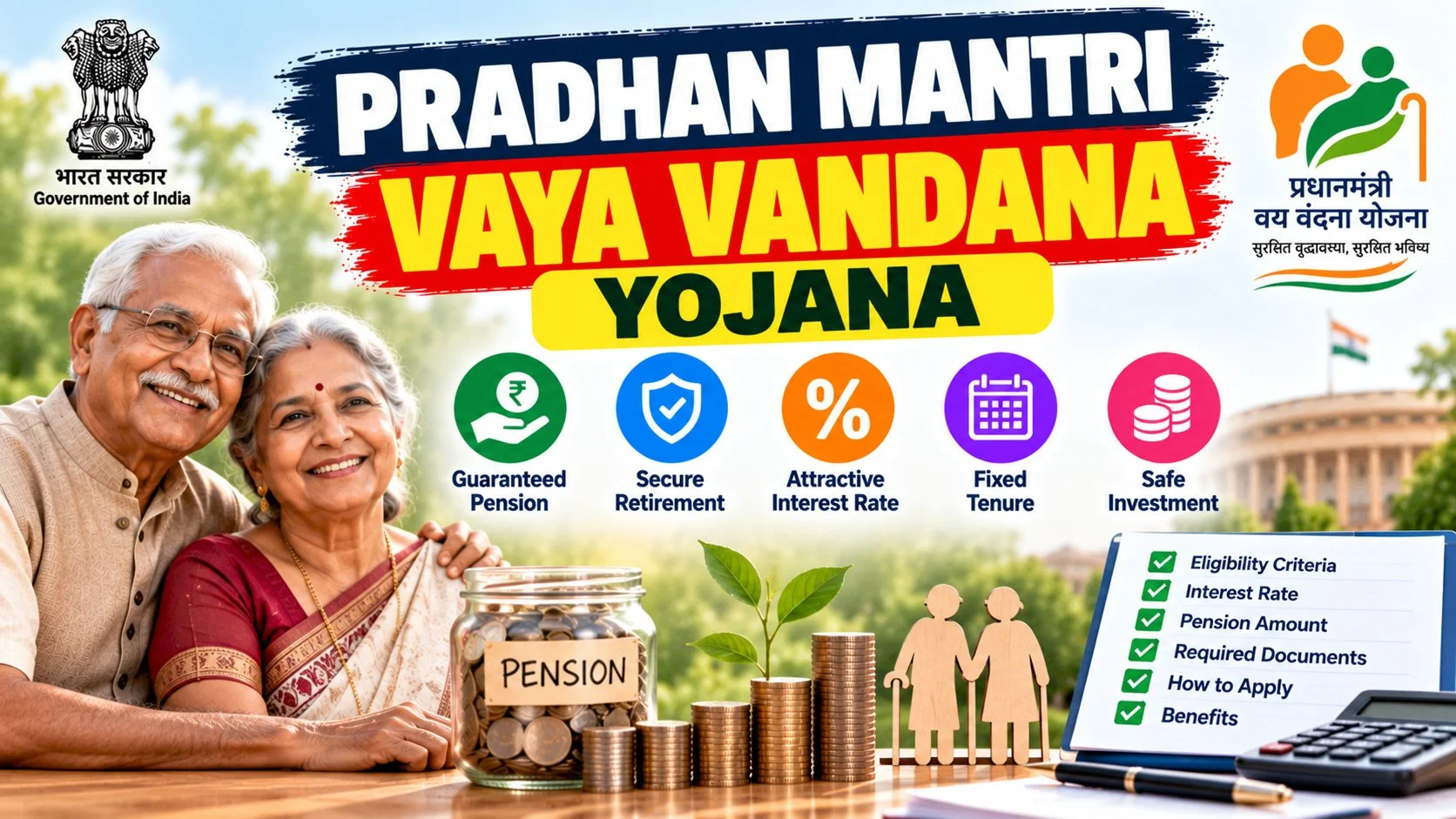
The Pradhan Mantri Vaya Vandana Yojana (PMVVY) is a pension scheme for senior citizens launched by the Government of India and operated exclusively by the Life Insurance Corporation of India (LIC) as Plan 856. It was designed to give Indians aged 60 and above a guaranteed pension for 10 years, protecting them from falling interest rates.
The scheme’s promise was simple and powerful: invest a lump sum once, receive a fixed pension every month (or quarter, half-year, or year) for ten years, and get your full investment back at the end. The government subsidized the difference between the guaranteed rate and LIC’s actual earnings, making it a true zero-risk proposition for retirees.
PMVVY Key Features at a Glance
| Feature | Details |
|---|---|
| Scheme name | Pradhan Mantri Vaya Vandana Yojana (PMVVY) |
| Operated by | LIC of India (Plan 856) |
| Launched | May 4, 2017 |
| Eligibility | Senior citizens aged 60+ (no maximum age) |
| Policy term | 10 years |
| Minimum pension | ₹1,000 per month |
| Maximum pension | ₹9,250 per month |
| Maximum investment | ₹15 lakh per senior citizen |
| Current status | CLOSED for new subscriptions since March 31, 2023 |
PMVVY Interest Rates: The Guaranteed Returns
The scheme’s headline attraction was its assured interest rate, locked at purchase for the full 10-year term. The rate varied slightly by payout frequency:
| Pension Mode | Effective Interest Rate (per annum) |
|---|---|
| Monthly | 7.40% |
| Quarterly | 7.45% |
| Half-yearly | 7.52% |
| Yearly | 7.60% |
To be transparent: different sources quote the yearly rate as 7.60% or 7.66%. The monthly 7.40% figure is consistently reported across sources. What matters is that whatever rate you locked at purchase stayed fixed for 10 years — the government bore the subsidy cost if market rates fell.
For context, when PMVVY launched, bank FD rates for seniors hovered around 7–7.5%. The scheme’s edge was not just the rate but the 10-year guarantee — no bank promised that.
PMVVY Pension Amounts: Investment vs Monthly Income
How much did you need to invest for a given pension? Here are the official purchase-price slabs:
Minimum Investment Slabs
| Pension Mode | Minimum Purchase Price | Pension You Get |
|---|---|---|
| Monthly | ₹1,62,162 | ₹1,000 per month |
| Quarterly | ₹1,61,074 | ₹3,000 per quarter |
| Half-yearly | ₹1,59,574 | ₹6,000 per half-year |
| Yearly | ₹1,56,658 | ₹12,000 per year |
Maximum Investment Slabs
| Pension Mode | Maximum Purchase Price | Pension You Get |
|---|---|---|
| Monthly | ₹15,00,000 | ₹9,250 per month |
| Quarterly | ₹14,89,933 | ₹27,750 per quarter |
| Half-yearly | ₹14,76,064 | ₹55,500 per half-year |
| Yearly | ₹14,49,086 | ₹1,11,000 per year |
The ₹15 lakh ceiling applied per senior citizen. So a retired couple could together invest ₹30 lakh and draw ₹18,500 per month — a meaningful retirement income. Over the 10-year term, ₹15 lakh at ₹9,250/month totals ₹11,10,000 in pension payments, plus the ₹15 lakh returned at maturity.
Is PMVVY Still Open in 2026? The Honest Answer
No. The Pradhan Mantri Vaya Vandana Yojana closed for new subscriptions on March 31, 2023, and has not been reopened since. LIC does not accept fresh PMVVY applications. Any website or agent offering you a new PMVVY policy today is giving incorrect information — treat it as a red flag.
But here is what has not changed:
- Existing policies are fully active. If you or your parents invested before the deadline, the pension continues at your locked-in rate for the full 10-year term.
- Servicing continues normally. Bank mandate updates, beneficiary changes, maturity claims, and death claims are all processed at LIC branches and through the LIC customer portal.
- The purchase price is still returned at maturity along with the final pension installment.
So if your search is “can I still apply for PMVVY” — the answer is no. But if your search is “what happens to my existing PMVVY policy” — the answer is: nothing changes, it runs its course.
PMVVY Loan Facility: 75% After 3 Years
One of PMVVY’s most practical features was the loan facility. After completing 3 policy years, policyholders could borrow up to 75% of the purchase price. This addressed the biggest fear of locking ₹15 lakh for a decade — “what if I need money urgently?”
- Loan interest was set by LIC periodically and recovered from pension payouts — no separate EMI stress.
- Interest accrued according to the pension payment frequency chosen.
For existing policyholders, this facility remains available per the original terms. It is one of the reasons PMVVY was considered more flexible than it looked.
PMVVY Maturity, Death Benefits, and Premature Exit
On Survival to Maturity
If the pensioner survives the 10-year term, they receive the full purchase price back along with the final pension installment. Using the maximum example: ₹11,10,000 in total pensions + ₹15,00,000 returned = ₹26,10,000 over 10 years on a ₹15 lakh investment.
On Death During the Term
If the pensioner dies during the 10-year policy term, the purchase price is paid to the nominee. The family does not lose the capital.
Premature Exit
Early exit was allowed only in cases of critical or terminal illness of the pensioner or spouse. In such cases, 98% of the purchase price was refundable. This was deliberately restrictive — the scheme was designed as a 10-year commitment.
PMVVY Taxation: What You Must Know
Here is the part many articles gloss over. PMVVY pension was fully taxable as income — there was no special tax exemption on the pension payouts. The purchase itself did not qualify for 80C deduction either (unlike PPF or ELSS).
So the real, post-tax return was lower than the headline 7.40%. For a senior citizen in the 20% slab, the effective return worked out closer to 5.9%. Still decent for a zero-risk product, but you should always compare post-tax numbers. If tax-free income matters to you, the Senior Citizen Savings Scheme article covers the closest active alternative — though note SCSS interest is also taxable.
PMVVY vs Senior Citizen Savings Scheme (SCSS): Best Alternative in 2026
Since PMVVY is closed, the government points seniors to the Senior Citizen Savings Scheme (SCSS) as the primary alternative. Here is how they compare:
| Feature | PMVVY (Closed) | SCSS (Active) |
|---|---|---|
| Status | Closed since Mar 2023 | Open for new deposits |
| Max investment | ₹15 lakh | ₹30 lakh |
| Term | 10 years | 5 years (extendable by 3) |
| Interest | 7.40% assured (locked) | Revised quarterly |
| Payout | Monthly/quarterly/half-yearly/yearly | Quarterly |
| Loan facility | 75% after 3 years | Not available |
| Tax on interest | Taxable | Taxable (TDS above threshold) |
| 80C benefit | No | Yes, on deposit up to ₹1.5L |
SCSS wins on availability and 80C benefit; PMVVY (for existing holders) wins on the 10-year rate lock. If you are a senior citizen investing fresh money in 2026, SCSS is the practical choice — read our detailed SCSS guide before visiting the bank.
What Existing PMVVY Holders Should Do in 2026
If you hold a PMVVY policy, here is your action checklist:
PMVVY and the Bigger Retirement Picture
PMVVY was one piece of India’s senior-citizen safety net, alongside SCSS, the Atal Pension Yojana (for unorganized workers, still open), and Pradhan Mantri Jeevan Jyoti Bima Yojana (life cover). Its closure leaves a gap: no current scheme offers a 10-year assured rate for seniors. SCSS revises rates quarterly, and market products carry risk.
Whether the government launches a PMVVY successor is unknown. Until then, seniors must build their own “guaranteed” income by laddering SCSS deposits, high-quality bonds, and conservative hybrid funds. The era of a single 10-year government guarantee may be over — diversification is the new guarantee.
How to Check Your PMVVY Policy Status in 2026
Existing policyholders often ask how to track their policy. Here is what you can do:
Keep your policy bond document safe — it is the primary proof of your purchase price and terms. If lost, apply for a duplicate through your servicing branch with an indemnity bond.
PMVVY Death Claim Process: What Nominees Should Know
This is the section nobody wants to read but everyone should know. If a PMVVY pensioner passes away during the term:
- The nominee (as recorded in the policy) should inform the servicing LIC branch with the death certificate.
- Submit the claim form along with the original policy bond, nominee ID proof, and bank details.
- LIC verifies and releases the purchase price to the nominee. Pension payments stop as of the date of death; any excess paid is adjusted.
- If no nominee was recorded, legal heirs must produce succession documentation — slower and more painful. This is why nomination matters.
Do not delay claims. While there is no strict deadline advertised, prompt filing avoids complications. Keep a folder — physical or digital — with the policy bond, premium receipts, and nominee details, and tell your family where it is.
PMVVY for Competitive Exams: Key Facts Students Search
A large share of PMVVY searches comes from UPSC, SSC, banking, and state PSC aspirants. If that is you, here are the exam-ready facts:
- Full name: Pradhan Mantri Vaya Vandana Yojana
- Launched: May 4, 2017 (some sources say July 2017 for operational rollout)
- Ministry: Department of Financial Services, Ministry of Finance
- Operator: LIC of India exclusively (Plan 856)
- Target: Senior citizens aged 60+
- Term: 10 years; assured return 7.40% p.a. (monthly mode)
- Max investment: ₹15 lakh per senior citizen
- Status: Closed for fresh subscriptions from March 31, 2023
- GST: Exempted from Goods and Services Tax
Common exam traps: the scheme is not open currently (many outdated MCQs say it is); the operator is LIC only (not banks generally); and the 7.40% was assured, not market-linked.
PMVVY Interest Rate History: How the 7.40% Came to Be
The 7.40% rate was not the original offer. Understanding the timeline explains why the scheme closed:
- 2017 launch: PMVVY opened with an assured 8% per annum for the first cohort — remarkably generous even then.
- 2018–2020: As RBI cut repo rates and bank FDs slid toward 6–7%, the 8% guarantee became expensive for the government to subsidize.
- 2020 extension: The scheme was extended to March 2023 with a revised assured rate of 7.40% (monthly mode), reset annually by the government.
- March 31, 2023: The extension window closed. With interest rates rising again and the subsidy bill growing, the government let the scheme sunset for new investors.
This history carries a lesson for every investor: assured-return schemes are creatures of their interest-rate environment. When rates fall, governments cannot afford the subsidy; when rates rise, investors do not need it. The window for such schemes opens and closes — which is why acting during the window matters more than perfect timing.
Senior Citizen Options Compared: Where to Put Money in 2026
With PMVVY gone, here is the honest landscape for a 60+ investor with ₹15 lakh today:
| Option | Approx. Return | Term | Risk | Tax |
|---|---|---|---|---|
| SCSS | ~8.2% | 5+3 years | Zero (govt-backed) | Interest taxable; 80C on deposit |
| Bank FD (senior) | 7–7.75% | Flexible | Near-zero (DICGC ₹5L) | Interest taxable |
| RBI Floating Rate Bonds | 8.05% (reset 6-monthly) | 7 years | Zero (sovereign) | Interest taxable, no premature exit |
| POMIS (Post Office) | ~7.4% | 5 years | Zero (govt-backed) | Interest taxable, no 80C |
| Conservative hybrid MF | Market-linked | Open-ended | Moderate | 12.5% LTCG above ₹1.25L |
No single option replicates PMVVY’s 10-year lock. The practical 2026 strategy is laddering: split ₹15 lakh across SCSS (₹30 lakh limit gives headroom), a 5-year FD, and RBI bonds. You lose the single-rate simplicity but gain flexibility — and SCSS’s quarterly payouts mimic PMVVY’s pension rhythm. For the full SCSS walkthrough, see our Senior Citizen Savings Scheme guide.
Frequently Asked Questions
Is Pradhan Mantri Vaya Vandana Yojana still open in 2026?
No. PMVVY closed for new subscriptions on March 31, 2023, with no reopening announced afterwards. Existing policies continue normally for their 10-year term.
What was the PMVVY interest rate?
The assured rate was 7.40% per annum (monthly mode), 7.45% quarterly, 7.52% half-yearly, and 7.60% yearly — locked for 10 years at purchase.
What is the maximum pension under PMVVY?
₹9,250 per month on the maximum ₹15 lakh investment (monthly payout mode).
Can I get a loan against my PMVVY policy?
Yes — existing policyholders can borrow up to 75% of the purchase price after 3 policy years, with interest recovered from pension payouts.
What happens to my PMVVY policy on maturity?
You receive the full purchase price back along with the final pension installment after the 10-year term.
What is the best alternative to PMVVY in 2026?
The Senior Citizen Savings Scheme (SCSS) — open for fresh deposits, up to ₹30 lakh, with quarterly interest payouts and 80C benefits. For market-linked growth with low costs, the National Pension System also deserves a look, though it works very differently from PMVVY’s assured pension model.
Can both husband and wife invest in PMVVY?
Yes. The ₹15 lakh investment cap applies per person, not per family. So if both spouses are senior citizens, each of them could hold a PMVVY policy of up to ₹15 lakh — ₹30 lakh combined.
Is there a free look-in period in PMVVY?
Yes. For policies bought online, you get a 30-day free look-in period. If you change your mind within that window, the purchase price is returned after deducting stamp duty and registration charges.
Can I invest in PMVVY multiple times?
Multiple policies are permitted as long as the combined purchase price across all your PMVVY policies does not exceed ₹15 lakh.
How do I receive my PMVVY pension?
Pension is credited directly to your bank account through NEFT or the Aadhaar Enabled Payment System. You choose the payout frequency at the time of purchase — monthly, quarterly, half-yearly or yearly.
What is “purchase price” in PMVVY?
It is simply the lump sum you invest to buy the pension. For example, a purchase price of around ₹7.5 lakh bought you the maximum ₹5,000 monthly pension under the scheme.
Is there an upper age limit for PMVVY?
No. There was no maximum entry age — any Indian senior citizen aged 60 or above could join during the enrolment window.
Is PMVVY interest taxable?
Yes. Pension payouts are added to your total income and taxed as per your slab. The scheme itself is exempt from GST, but there is no 80C deduction on the investment.
Do I need to claim my purchase price at maturity?
No. LIC returns the purchase price automatically along with the final pension instalment at the end of the 10-year term. You do not need to file a separate claim.
Final Word
The Pradhan Mantri Vaya Vandana Yojana was a genuinely good deal for those who got in — a 10-year government-backed 7.40% pension with capital return is rare in any market. Its closure in 2023 was a loss for incoming retirees, but existing holders should take comfort: your policy is safe, your rate is locked, and your money comes back.
For everyone else, the lesson is timeless — when a good assured-return scheme is open, act; when it closes, adapt with the next best option. In 2026, that means SCSS, smart laddering, and starting early enough that you never depend on a single scheme. And if there is one thing PMVVY’s story teaches younger readers, it is this: retirement planning cannot wait for the perfect scheme. The investors who benefited most from PMVVY were not the ones who timed it perfectly — they were the ones who had ₹15 lakh ready when the window was open. Build your corpus in your 40s and 50s through NPS, PPF, and diversified investing, so that when the next PMVVY-like opportunity appears, you can seize it without hesitation. If you are planning for parents right now, our SCSS guide is the natural next read — and if you are planning for yourself, start with the NPS guide today.