
Here’s a number that stopped me mid-scroll: over 60 crore Indians now have access to ₹5 lakh of free annual health cover under Ayushman Bharat. That’s roughly one in three people in this country carrying a card that can pay for surgery, ICU stays and cancer treatment — and many of them still don’t know they qualify.
If you’ve been meaning to check whether your family qualifies for the Ayushman Bharat card, this guide covers everything in one place: who is eligible in 2026, how to apply for the Ayushman Bharat card online step by step, how to download it, how to find empanelled hospitals, and how to actually use the card at a hospital. I have also included the latest 2026 updates — including the 70+ senior citizen expansion and the big West Bengal announcement — so you are reading the most current version of this information anywhere.
Ayushman Bharat in 2026: 8 Years, 60 Crore Beneficiaries
The Pradhan Mantri Jan Arogya Yojana (PM-JAY), popularly known as Ayushman Bharat, completed eight years on September 23, 2026. What started in 2018 as the world’s largest government-funded health insurance scheme has kept growing, and the latest official numbers are genuinely impressive:
- 60+ crore beneficiaries now have access to ₹5 lakh annual health cover, according to the Union Health Ministry’s eighth-anniversary announcement.
- 48.51 crore Ayushman cards have been created as of September 21, 2026 — about one-third of India’s population.
- 13.25 crore hospital admissions worth ₹2.03 lakh crore have been funded through the scheme so far.
- 38,000 to 39,000 public and private hospitals are empanelled across the country.
- All 36 states and union territories are now covered. West Bengal signed the MoU with the National Health Authority on June 8, 2026 and started the cashless rollout on July 1, 2026, becoming the 36th state/UT to join. Delhi joined in April 2025 and Odisha adopted co-branded cards in January 2025.
- 1.36 crore Ayushman Vaya Vandana cards have been issued to senior citizens aged 70 and above.
- ₹9,500 crore was allocated for PM-JAY in the Union Budget 2026-27, up from ₹9,000 crore the previous year.
- 93.95 crore ABHA digital health IDs have been created, linking patient records across hospitals.
- 29 lakh inter-state portability admissions worth over ₹8,383 crore have been authorised — patients can get cashless treatment in any state, not just their home state.
Prime Minister Narendra Modi marked the anniversary by calling it the largest healthcare scheme in the world and noting it has enabled record savings on medical expenses for poor and middle-class families. Union Health Minister J.P. Nadda added that over 13 crore people have already availed treatment under the scheme. The bottom line: this is not a scheme that exists only on paper. It is actively paying for real treatments, every single day, in thousands of hospitals.
What the Ayushman Bharat Card Covers: ₹5 Lakh Cashless Treatment
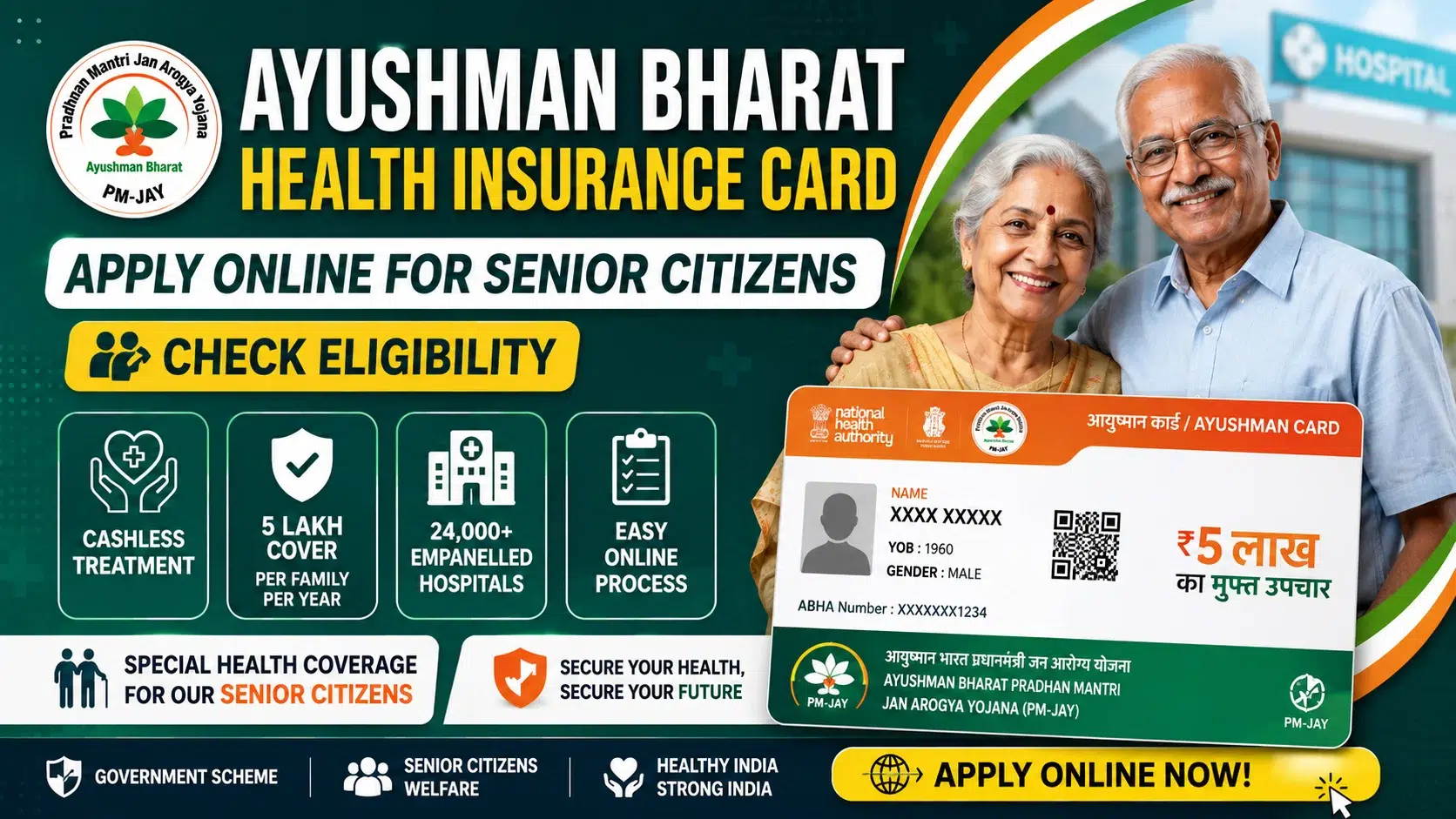
The Ayushman Bharat card gives your family cashless health cover of ₹5 lakh per family per year for secondary and tertiary care hospitalisation at any empanelled hospital — government or private. “Cashless” means exactly what it sounds like: the hospital bills the scheme directly, and you don’t pay at the counter.
Here is what the cover typically includes:
| Covered Benefit | What It Means |
|---|---|
| Hospitalisation & surgery | Cashless treatment for surgeries and medical procedures at empanelled hospitals |
| ICU & critical care | ICU charges, ventilator support and intensive care are covered |
| Medicines & diagnostics | Drugs, lab tests, imaging and diagnostics during hospitalisation |
| Pre-existing diseases | Covered from day one — unlike most private policies that impose waiting periods |
| Post-hospitalisation care | Follow-up care, medicines and check-ups up to 15 days after discharge |
| Maternity & newborn care | Delivery and related care are among the most-used benefits under the scheme |
| Dialysis & chronic care | Dialysis is consistently one of the top treatments claimed under PM-JAY |
| Day-care procedures | Treatments that don’t need overnight stay are also covered |
One feature that deserves special mention is portability. Because the scheme is implemented across all 36 states and UTs, your card works at any empanelled hospital anywhere in India. If you are a migrant worker in Maharashtra and your home state is Bihar, you can still get cashless treatment in Maharashtra. The government reports more than 29 lakh such inter-state admissions so far — this is genuinely useful for families that move for work.
What the Ayushman Bharat Card Does NOT Cover
Honest guides tell you the limits too, so here they are. PM-JAY is designed for hospitalisation — secondary and tertiary care. That means:
- Outpatient (OPD) consultations are generally not covered — a regular doctor visit without admission is outside the scheme’s scope.
- Pharmacy purchases outside hospitalisation are not covered on their own.
- Cosmetic and purely elective procedures that are not medically necessary are excluded.
- Treatment at non-empanelled hospitals will not be reimbursed — the hospital must be part of the PM-JAY network.
For everyday primary care, the government runs Ayushman Arogya Mandirs (earlier called Health and Wellness Centres) — over 1,85,940 are operational and they have recorded more than 500 crore visits. Think of it this way: primary care at Arogya Mandirs, hospitalisation through PM-JAY. Together they cover most of a family’s health needs.
Who Is Eligible for the Ayushman Bharat Card in 2026
This is the question most people get wrong about the Ayushman Bharat card. Many assume the scheme is only for BPL families, but eligibility has widened considerably. Here are the categories that qualify in 2026:
1. Families in the SECC 2011 database
The original base of the scheme is 12 crore families (revised from 10.74 crore in January 2023 to account for population growth), identified under the Socio-Economic Caste Census 2011 — roughly the bottom 40% of India’s population. In rural areas this covers households meeting deprivation criteria (no shelter, destitute, manual scavenger families, primitive tribal groups, released bonded labour). In urban areas it covers 11 occupational categories including street vendors, construction workers, domestic workers, ragpickers, drivers, sanitation workers, artisans, tailors, washermen, security guards and shop helpers.
2. All senior citizens aged 70 and above
This is the biggest expansion. Since 2024, every Indian citizen aged 70 or above is eligible for an additional ₹5 lakh health cover per year — regardless of income, economic status or whether they already have insurance. This works as a family floater top-up on top of any existing PM-JAY cover. Over 1.36 crore Vaya Vandana cards have been issued so far. If you are eligible but haven’t enrolled, this section of the article is for you.
3. ASHA and Anganwadi workers’ families
Around 37 lakh families of Accredited Social Health Activists, Anganwadi workers and Anganwadi helpers were brought under the scheme in March 2024. As of September 2026, about 44.81 lakh Ayushman cards have been issued to them.
4. Migrant workers registered on e-Shram
Workers registered on the e-Shram portal are automatically considered eligible, which makes the card especially relevant for the migrant workforce that moves between states.
If you are not sure which category you fall into, don’t guess — the online eligibility check takes two minutes and I explain it below.
Documents Required for Ayushman Bharat Card Registration
Keep these ready before you start the online application:
- Aadhaar card — mandatory, since verification happens through Aadhaar-based e-KYC. Your mobile number should be linked to your Aadhaar for OTP.
- Ration card or Family ID — used to pull up your family record in the beneficiary database.
- Active mobile number — for OTP logins at multiple steps.
- Live photograph — the portal captures this through your phone or computer camera during e-KYC; you don’t need to upload a photo separately.
If your mobile number is not linked to Aadhaar, visit the nearest Aadhaar enrolment centre first — the online process becomes much harder without it. I have a separate guide on checking your Aadhaar card status if you need it.
How to Check Your Ayushman Bharat Eligibility Online
Before applying, verify that your family is in the beneficiary database:
- Go to the official beneficiary portal: beneficiary.nha.gov.in. This is the only official NHA enrolment portal — avoid third-party websites promising “fast registration”.
- Click on Beneficiary Login and enter your mobile number with the captcha, then verify with the OTP.
- Select your state, scheme (PMJAY) and district.
- Search using your Aadhaar number, ration card/family ID or name.
- If your family appears in the results, you are eligible — proceed to e-KYC below.
You can also call the national helpline 14555 (toll-free) or check through the official Ayushman mobile app.
How to Apply for the Ayushman Bharat Card Online (Step-by-Step)
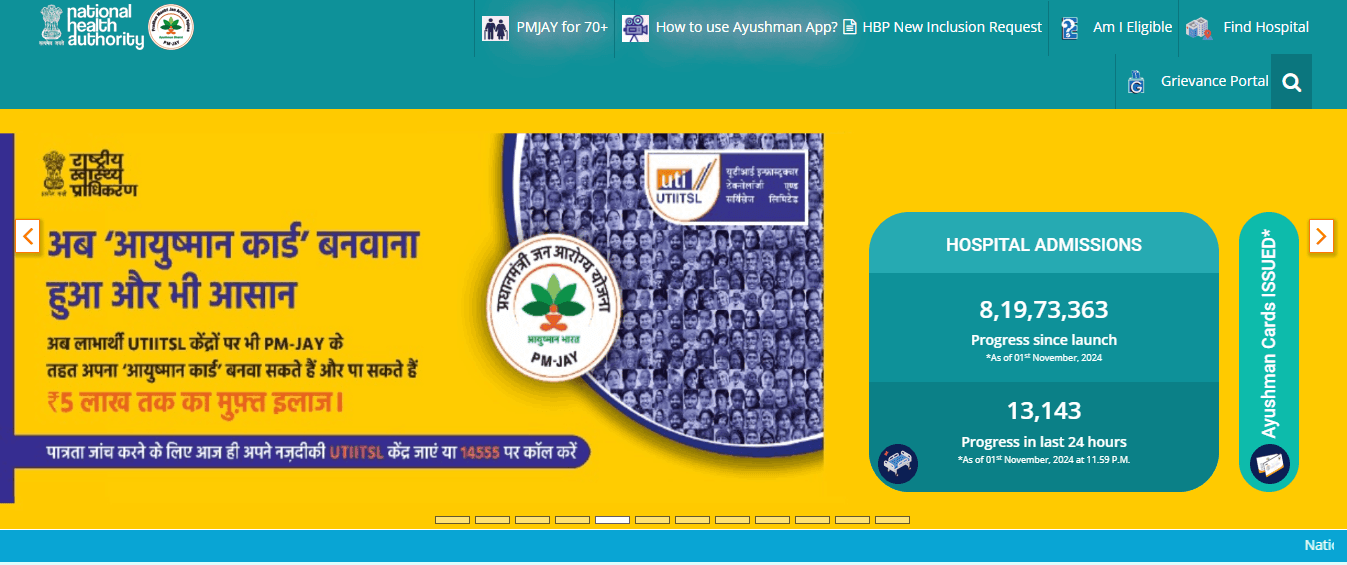
Once eligibility is confirmed, the card itself is generated through e-KYC. Here is the full process:
- Log in to the beneficiary portal. Visit beneficiary.nha.gov.in, choose Beneficiary Login, and authenticate with your mobile number and OTP.
- Search your family record. Select your state, PMJAY scheme and district, then search by Aadhaar number, PMJAY ID, family ID or name. Your family members will appear on screen.
- Start e-KYC. Click the Action / e-KYC button next to the family member’s name. Choose Aadhaar OTP as the authentication mode.
- Verify with Aadhaar OTP. An OTP goes to the mobile number registered with UIDAI. Enter it — the portal matches your details with the Aadhaar database.
- Capture a live photo. The portal will ask you to turn on your camera and take a clear, well-lit photo. Confirm basic details like PIN code, date of birth and relationship to the head of the family.
- Submit. After submission you will typically see an “e-KYC Completed” message. Approval usually takes anywhere from 15-20 minutes to 24 hours.
- Download the card. Once the status shows Approved, click the download icon to save your Ayushman Bharat card as a PDF. You can print it at a CSC centre or keep the digital copy — both work at hospitals.
If your name is not in the database but you believe you qualify (for example, a 70+ senior citizen), use the new-enrolment flow on the same portal or register through the SETU portal at setu.pmjay.gov.in, or simply visit the nearest Common Service Centre (CSC) or an empanelled hospital’s Ayushman Mitra counter — the staff there complete the entire process for you, including biometric e-KYC.
Ayushman Vaya Vandana Card: Special Process for 70+ Citizens
Senior citizens get a dedicated Ayushman Bharat card under the 70+ expansion. The online flow is almost identical, with one difference: after OTP login, if the record is not found, click “New Enrollment for AB 70+” and enter the name, Aadhaar number, date of birth and gender exactly as printed on the Aadhaar card — even a single character mismatch can cause rejection. The 70+ card works as a family floater: if two members of the same family are above 70, they share the ₹5 lakh top-up.
Children or relatives can complete this process on behalf of elderly parents — just make sure the senior’s Aadhaar-linked mobile is accessible for the OTP steps. If OTP-based verification fails, a CSC visit with biometric authentication is the reliable fallback.
How to Download Your Ayushman Bharat Card
Already approved but lost your Ayushman Bharat card PDF? Log in again to beneficiary.nha.gov.in, go to your family member’s record and use the Download Ayushman Card option. The official Ayushman mobile app (available on Android and iOS) also lets you download and store the card. At the hospital, the digital PDF on your phone works fine — the Ayushman Mitra scans the QR code on the card to verify it.
How to Find Empanelled Hospitals Near You
A card is only useful if you know where to use it. To find PM-JAY hospitals:
- Visit pmjay.gov.in or the beneficiary portal and look for the hospital search option.
- Filter by state, district and hospital type (public or private) and, if needed, by speciality — for example, hospitals offering cardiology or oncology.
- Note the hospital’s address and contact details before visiting.
With 38,000+ empanelled hospitals nationwide, most districts have several options. For planned treatments, it is worth calling ahead to confirm the hospital is still empanelled and that the specific treatment package is covered.
How to Use the Ayushman Card at a Hospital
Using your Ayushman Bharat card at a hospital is deliberately simple:
- Present your physical or digital Ayushman card at the hospital’s Ayushman Mitra help desk.
- The Mitra scans the QR code and verifies your identity and eligibility.
- Treatment proceeds cashless — the hospital raises the claim directly with the scheme.
- Post-discharge follow-up care for up to 15 days is included.
Remember the portability rule: this works at any empanelled hospital in any state. If you are working away from your home state, you are still covered.
Ayushman App and ABHA Health ID
Two digital tools make the scheme easier to use. The Ayushman App (Android and iOS) lets you check eligibility, complete e-KYC and download your card from your phone. Separately, the ABHA (Ayushman Bharat Health Account) number — a 14-digit digital health ID created at abha.abdm.gov.in — stores your prescriptions, lab reports and diagnoses digitally. Over 93.95 crore ABHA IDs have been created so far. Creating one is optional for PM-JAY but it makes repeat hospital visits smoother.
Ayushman Bharat Card: Key Facts 2026
| Fact | Detail (2026) |
|---|---|
| Scheme name | Ayushman Bharat Pradhan Mantri Jan Arogya Yojana (AB PM-JAY) |
| Launched | September 23, 2018 by Prime Minister Narendra Modi |
| Implementing body | National Health Authority (NHA), Government of India |
| Cover | ₹5 lakh per family per year, cashless |
| 70+ top-up | Additional ₹5 lakh per year (family floater) for all citizens aged 70+ |
| Beneficiaries | 60+ crore (12 crore families + 6 crore senior citizens 70+) |
| Cards issued | 48.51 crore (as of September 21, 2026) |
| Coverage | All 36 states and UTs (West Bengal joined June 2026) |
| Empanelled hospitals | 38,000+ public and private |
| Treatments funded | 13.25 crore admissions worth ₹2.03 lakh crore |
| Budget 2026-27 | ₹9,500 crore |
| Official portal | beneficiary.nha.gov.in |
| Helpline | 14555 (toll-free) |
Frequently Asked Questions
Is the Ayushman Bharat card really free?
Yes. The Ayushman Bharat card is completely free — no premium, no registration fee and no payment at the hospital for covered treatments. The government pays the hospital directly. Be cautious of anyone asking for money to “register” you — report them to the 14555 helpline.
Can I use the Ayushman card in a private hospital?
Yes, as long as the private hospital is empanelled under PM-JAY. Thousands of private hospitals are part of the network. Always verify on the hospital search before visiting.
My parents are above 70. Do they need to be BPL to qualify?
No. The 70+ expansion covers all senior citizens regardless of income or economic status. This is one of the most significant changes to the scheme.
How long does it take to get the card after applying?
Online e-KYC approvals for the Ayushman Bharat card typically take 15-20 minutes to 24 hours when records match. CSC-assisted applications may take a few days depending on verification.
Can I use the card in another state?
Yes. Portability is a core feature of the Ayushman Bharat card — over 29 lakh inter-state admissions have already been authorised. Your Ayushman Bharat card works at any empanelled hospital across India.
Farmers should also check the PM-KISAN Samman Nidhi Yojana for annual income support under another central government scheme.
What if my name is not in the beneficiary list?
First, double-check using different search methods (Aadhaar, ration card, name). If you genuinely qualify but are missing — for instance as a 70+ citizen or e-Shram worker — use the new-enrolment flow on beneficiary.nha.gov.in or visit a CSC centre for assisted registration.
Final Thoughts
With 60 crore beneficiaries, 48.51 crore Ayushman Bharat cards issued and ₹2.03 lakh crore worth of treatments already funded, Ayushman Bharat is no longer a scheme you “might” need someday — for many families it is the difference between getting treatment and going into debt. The 70+ expansion and the entry of West Bengal in 2026 mean the eligible base is larger than ever, and the online process has genuinely become doable from a smartphone.
If this guide helped, check your eligibility today on beneficiary.nha.gov.in rather than postponing it — health emergencies don’t wait for paperwork. And if you found this useful, you may also want to read my guide on checking your Aadhaar card status, since Aadhaar e-KYC is the backbone of the whole application process.