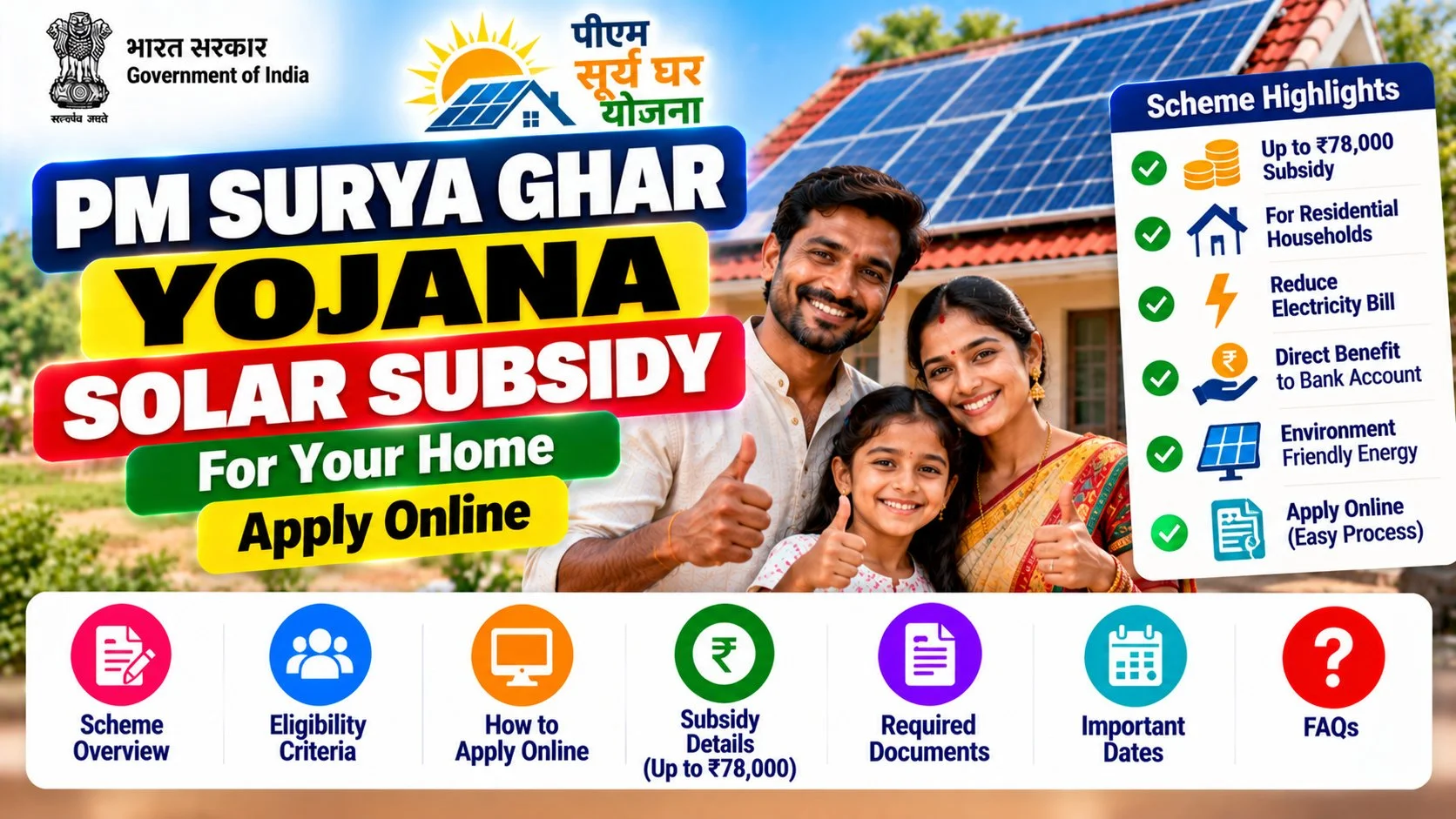

Your electricity bill keeps going up every year, right? What if your rooftop could pay it for you — and the government gave you up to ₹78,000 to make it happen? That is exactly what the PM Surya Ghar Muft Bijli Yojana does — the PM Surya Ghar Yojana is built for exactly this. It is India’s biggest rooftop solar scheme, and if you own a house with a decent rooftop, you could be generating your own power within a couple of months.
✅ This guide is based on official government sources and notifications. Last verified: October 13, 2026. Scheme details, eligibility criteria, and benefit amounts are revised by the government from time to time — always cross-check the latest information on the official portal before applying.
In this guide, you will find everything about PM Surya Ghar Yojana 2026: the exact subsidy for 1 kW, 2 kW and 3 kW systems, who can apply, what documents you need, the step-by-step online application process on pmsuryaghar.gov.in, how to check your subsidy status, how to pick a registered vendor, and a real cost-vs-savings calculation so you know exactly when your investment pays for itself.
PM Surya Ghar Yojana 2026: Key Highlights
| Point | Details |
|---|---|
| Scheme name | PM Surya Ghar: Muft Bijli Yojana |
| Launched | February 15, 2024 |
| Budget | ₹75,021 crore |
| Target | 1 crore households by March 2027 |
| Subsidy | ₹30,000 (1 kW) / ₹60,000 (2 kW) / ₹78,000 (3 kW+) |
| Free electricity | Up to 300 units per month |
| Official portal | pmsuryaghar.gov.in |
| Implemented by | Ministry of New and Renewable Energy (MNRE) |
What Is PM Surya Ghar Muft Bijli Yojana?
PM Surya Ghar Muft Bijli Yojana is the central government’s flagship rooftop solar scheme for homes. The Ministry of New and Renewable Energy (MNRE) describes it as the world’s largest domestic rooftop solar programme. The idea is simple: instead of paying for every unit of electricity you consume, you install solar panels on your roof, generate your own power, and the government pays a large part of the installation cost as a direct subsidy.
The scheme was approved in February 2024 with an outlay of ₹75,021 crore. The goal is to cover 1 crore (10 million) households by March 31, 2027. As of September 2026, the scheme had crossed 17.5 GW of installed rooftop capacity with about 5.95 million households covered — which means roughly 4 million more homes need to join in the remaining months.
Here is the core deal of the PM Surya Ghar Yojana in one line: you install a rooftop solar system through a registered vendor, the government transfers up to ₹78,000 straight to your bank account, and your monthly electricity bill drops to near zero.
Subsidy Breakdown: How Much Money Do You Get?
The central financial assistance (CFA) is fixed by system size. This is the part most people ask about first, so here are the exact numbers:
| System Size | Subsidy Amount | How It Is Calculated |
|---|---|---|
| 1 kW | ₹30,000 | ₹30,000 per kW |
| 2 kW | ₹60,000 | ₹30,000 per kW × 2 |
| 3 kW | ₹78,000 | ₹60,000 for first 2 kW + ₹18,000 for the 3rd kW |
| Above 3 kW (up to 10 kW) | ₹78,000 (capped) | Maximum subsidy per household — does not increase beyond 3 kW |
Two things to note. First, the subsidy is capped at ₹78,000 even if you install a 5 kW or 10 kW system. Second, the subsidy goes directly to your bank account through DBT after installation and net-meter commissioning — not to the vendor. It usually arrives within 15 to 30 days of the final approval.
The 300 Units Free Electricity Promise, Explained
The PM Surya Ghar Yojana’s name says “Muft Bijli” — free electricity. What this actually means: a 1–2 kW rooftop system typically generates around 120–150 units per month per kW in most Indian states, depending on sunlight. A 2 kW system can therefore generate roughly 240–300 units a month — enough to cover the entire electricity consumption of an average household.
With net metering, the extra power you generate during the day goes back to the grid, and you get credits for it. At night or on cloudy days, you draw from the grid. Your bill is calculated on the net difference. For most families consuming under 300 units a month, the net bill after installing a 2 kW system drops to almost zero — just the fixed charges.
Who Can Apply: Eligibility Criteria
The eligibility rules for the PM Surya Ghar Yojana are straightforward:
- You must be an Indian citizen.
- You must own a house with a suitable rooftop for installing solar panels. The roof should ideally be shadow-free and structurally sound.
- You must have a valid electricity connection in your name.
- You must not have availed any other solar rooftop subsidy for the same property earlier.
Tenants generally cannot apply because the scheme requires rooftop ownership. However, housing societies and RWAs can explore group net-metering arrangements — check with your DISCOM for the local rules.
Documents Required
Keep these ready before you start the online application:
| Document | Purpose |
|---|---|
| Aadhaar card | Identity proof + mandatory Aadhaar authentication for subsidy processing |
| Latest electricity bill | Proof of electricity connection + consumer number |
| Property ownership proof | Registry, property tax receipt, or similar |
| Bank account details + cancelled cheque | For direct subsidy transfer (DBT) |
| Passport-size photograph | Application record |
| Rooftop photograph | Feasibility assessment by DISCOM |
How to Apply Online: Step-by-Step Process
The entire PM Surya Ghar Yojana application runs through the National Portal at pmsuryaghar.gov.in. Here is the exact sequence:
Step 1 — Register on the portal. Go to pmsuryaghar.gov.in and click “Apply for Rooftop Solar”. Select your state, your electricity distribution company (DISCOM), and enter your consumer number, mobile number and email. You will get an OTP to verify.
Step 2 — Submit the application. Log in with your consumer number and mobile number. Fill in the rooftop details and upload the required documents. Submit the application for feasibility approval.
Step 3 — DISCOM feasibility approval. Your DISCOM checks whether your rooftop and connection can support a solar system of the requested size. Do NOT start installation before this approval — installing early is one of the most common reasons subsidy claims get rejected.
Step 4 — Choose a registered vendor and install. Pick a vendor registered under the scheme in your DISCOM area. The vendor installs the system using ALMM-listed, BIS-certified solar modules. Since June 1, 2026, the modules must use domestically manufactured solar cells (ALMM List II) to qualify for the subsidy.
Step 5 — Net meter installation. After installation, the DISCOM installs a net meter and carries out the inspection and commissioning.
Step 6 — Submit bank details and claim subsidy. Upload your bank account details and cancelled cheque on the portal along with the commissioning certificate. The subsidy is credited to your account, typically within 15 to 30 days.
The image below shows the official National Portal homepage — this is where every application starts:
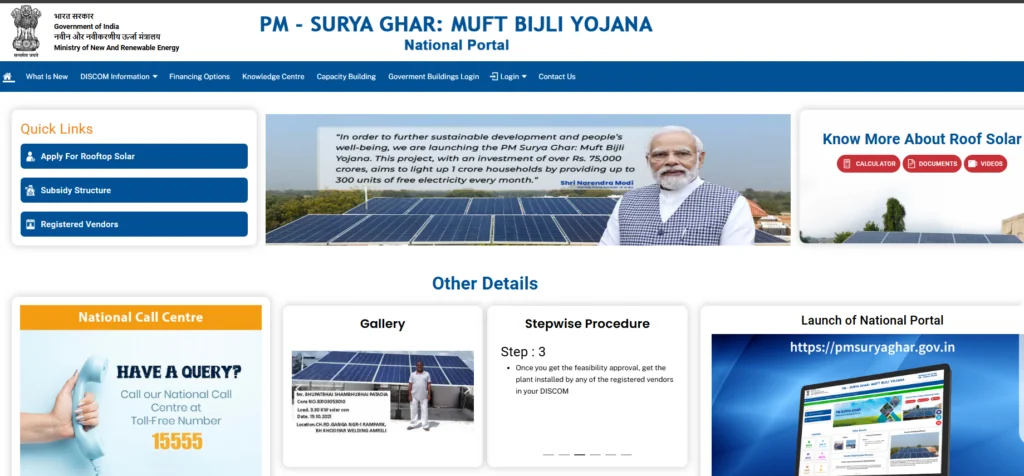
The official PM Surya Ghar National Portal (pmsuryaghar.gov.in) — all applications, vendor selection and subsidy claims run through this site. (Screenshot: official portal)
How to Check Application and Subsidy Status
Log in to pmsuryaghar.gov.in with your registered consumer number and mobile number, then open the “My Applications” section. You can track each stage: feasibility approval, installation, net-meter commissioning, and subsidy disbursement. If your subsidy is delayed beyond 30 days after commissioning, check that your bank details and cancelled cheque were uploaded correctly — wrong bank details are the most common cause of delayed payments.
Choosing the Right Vendor: What to Watch For
Only installations done by vendors registered under the PM Surya Ghar Yojana qualify for the subsidy. A few practical tips:
- Always pick a vendor from the registered vendor list on the portal for your DISCOM — never an unregistered contractor who “promises” the subsidy.
- Confirm the panels are ALMM-listed and BIS-certified. Ask the vendor for the ALMM listing of the exact module model.
- Since July 2026, registered vendors must follow standard MNRE branding guidelines on installations — this is actually useful for you, because it lets you visually confirm you are dealing with a genuine registered installer.
- Get a written quotation breaking down panel cost, inverter, structure, wiring, net-meter charges and installation labour separately.
- The portal now requires you to review and approve the vendor-consumer agreement in your login before installation begins — read it before approving.
Real Cost vs Savings: When Does It Pay for Itself?
Let us do the maths for a typical 3 kW system, which suits most families consuming 250–350 units a month:
| Item | Amount |
|---|---|
| 3 kW system cost (approx.) | ₹2,30,000 – ₹2,40,000 |
| Central subsidy (3 kW) | − ₹78,000 |
| Your net cost | ₹1,52,000 – ₹1,62,000 |
| Monthly electricity saving (300 units @ ~₹7/unit) | ~₹2,100 |
| Payback period | Roughly 6–7 years |
Solar panels last 25+ years with minimal maintenance. After the payback period, the electricity is essentially free for the remaining life of the system. If your state offers an additional top-up subsidy on top of the central one, the payback gets even shorter — check your state DISCOM’s page on the portal.
The image below shows what a typical residential rooftop installation looks like in an Indian neighbourhood:
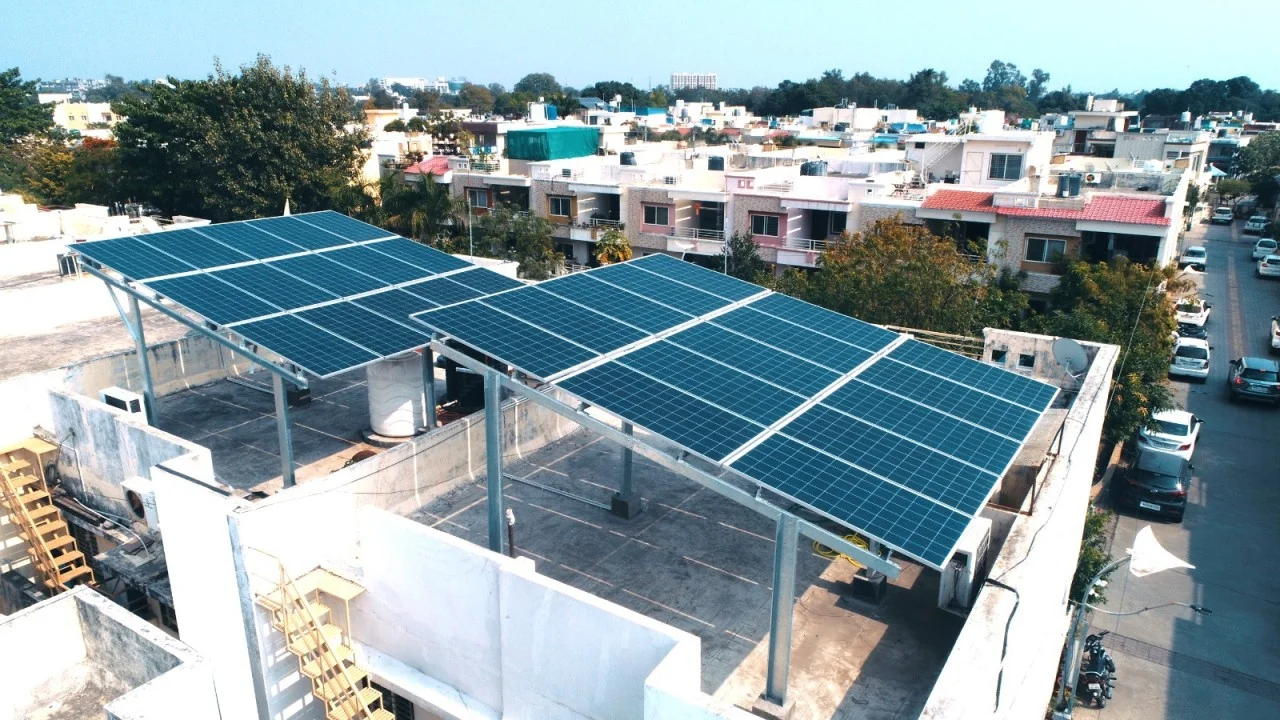
A typical residential rooftop solar installation — panels mounted on elevated structures above Indian homes. (Photo: real installation)
PM Surya Ghar vs Other Solar Schemes
People often confuse the PM Surya Ghar Yojana with other solar schemes. Here is the quick distinction:
| Scheme | For Whom | What It Covers |
|---|---|---|
| PM Surya Ghar | Residential households | Rooftop solar, up to ₹78,000 CFA |
| PM-KUSUM | Farmers | Solar pumps, solarisation of agri feeders |
| State top-up schemes | Varies by state | Extra subsidy over central CFA (e.g., some states add ₹10,000–₹25,000) |
If you are a farmer looking for solar pumps, PM-KUSUM is the relevant scheme — not PM Surya Ghar. And if your state announces an additional rooftop subsidy, you can usually claim it on top of the central ₹78,000.
Common Mistakes That Delay or Kill Your Subsidy
- Installing before DISCOM approval. This is the number one rejection reason. Wait for feasibility approval first.
- Using an unregistered vendor. Only registered vendors count. Verify on the portal.
- Non-ALMM modules. Panels must be ALMM-listed with domestically manufactured cells (since June 2026) to qualify.
- Wrong bank details. Double-check account number, IFSC and the cancelled cheque upload.
- Assuming subsidy above 3 kW. The CFA is capped at ₹78,000 — a 5 kW system gets the same ₹78,000.
- Skipping net-meter commissioning paperwork. The subsidy claim needs the commissioning certificate.
Latest 2026 Updates You Should Know
A few recent developments worth knowing before you apply:
- Strong progress, tight timeline: By September 2026 the scheme had crossed 17.5 GW and 5.95 million households. With the March 2027 deadline approaching, the pace of installations needs to pick up — applying sooner is better than later.
- Gujarat leads the country: In August 2026, Gujarat added 628.7 MW of rooftop capacity — the highest of any state — followed by Uttar Pradesh and Andhra Pradesh.
- Next phase under discussion: MNRE has begun consultations on what follows the current scheme, including possible battery storage support. Nothing is confirmed yet — the current subsidy structure is what you apply under today.
- Vendor accountability tightening: MNRE deactivated 66 registered vendors in August 2026 over pending consumer applications, and the portal now requires consumers to approve the vendor agreement before installation.
How Much Rooftop Space Do You Need for PM Surya Ghar Yojana?
One of the first questions people ask about the PM Surya Ghar Yojana is whether their roof is big enough. As a rule of thumb, a 1 kW solar system needs roughly 100 square feet of shadow-free rooftop area. So a 2 kW system needs about 200 sq ft and a 3 kW system needs around 300 sq ft.
The roof should be free from shadows cast by water tanks, neighbouring buildings or trees for most of the day — even partial shading can noticeably cut generation. A south-facing tilt gives the best output in India, though east-west orientations also work with slightly lower efficiency. If your roof is small or heavily shaded, a 1 kW system (₹30,000 subsidy) is still worth it — it can cover a large part of a modest household’s bill.
During the DISCOM feasibility check, the technical team assesses exactly this: roof area, shadow analysis, structural strength and your sanctioned load. If the roof is found unsuitable, the application is rejected at this stage — which is why honest rooftop photos in the application matter.
State Top-Up Subsidies: Extra Money Over the Central ₹78,000
The ₹78,000 under PM Surya Ghar Yojana is the central government’s share. Several states add their own top-up subsidy on top of it, which makes the deal even sweeter. For example, some states offer an additional ₹10,000–₹25,000 per household for residential rooftop systems.
To check whether your state offers a top-up, log in to pmsuryaghar.gov.in and look at your state DISCOM’s section on the portal — state-specific incentives are listed there. The state subsidy is processed separately from the central CFA, so you may need to submit a separate claim on the state portal. Always confirm the current top-up amount with your DISCOM before signing the vendor agreement, since state schemes change frequently.
Combined central + state support can bring the net cost of a 3 kW system well below ₹1.5 lakh in some states, cutting the payback period to under 5 years.
Frequently Asked Questions
1. How much subsidy do I get for a 2 kW solar system under PM Surya Ghar Yojana?
You get ₹60,000 as central financial assistance for a 2 kW residential rooftop system (₹30,000 per kW). The subsidy is credited directly to your bank account after installation and net-meter commissioning.
2. Is the ₹78,000 subsidy available for a 5 kW system?
Yes, a 5 kW system is eligible, but the central subsidy is capped at ₹78,000 per household. Installing more than 3 kW does not increase the central assistance, though it generates more power.
3. How do I apply for PM Surya Ghar Yojana online?
Visit pmsuryaghar.gov.in, register with your state, DISCOM, consumer number and mobile number, submit the application, wait for DISCOM feasibility approval, get installation done by a registered vendor, complete net metering, and then claim the subsidy with your bank details on the portal.
4. Who is eligible for PM Surya Ghar Muft Bijli Yojana?
Indian citizens who own a house with a suitable rooftop, have a valid electricity connection, and have not taken a rooftop solar subsidy for the same property before. Tenants are generally not eligible.
5. How long does it take to get the subsidy after installation?
The subsidy is usually credited within 15 to 30 days after net-meter commissioning and successful upload of bank details and the commissioning certificate on the portal.
6. Can I get a loan for the solar system cost?
Yes. Banks offer loans for rooftop solar under the scheme at concessional interest rates (around 7%). You can apply through the financing options section on the portal.
7. What happens to extra electricity my panels generate?
With net metering, surplus power goes to the grid and you earn credits. These credits adjust against the electricity you draw at night or on cloudy days, bringing your net bill close to zero.
8. Is PM Surya Ghar Yojana ending in 2027?
The current scheme runs until March 31, 2027, with a target of 1 crore households. MNRE has started early consultations on a possible next phase (including battery storage), but nothing is confirmed — apply under the current rules.
Final Words
The PM Surya Ghar Yojana is one of those rare schemes where the maths genuinely works in your favour: the government pays up to ₹78,000 of the cost, your bill drops to near zero, and the panels keep working for 25 years. The process is fully online, the subsidy comes straight to your bank account, and with the March 2027 deadline getting closer, there is no good reason to wait.
Start at pmsuryaghar.gov.in, check your DISCOM’s feasibility rules, pick a registered vendor, and let your rooftop start earning for you. If this guide helped, share it with someone whose terrace is still empty — they will thank you when their first near-zero bill arrives.
Related reads on punitpatel.in: PM Awas Yojana Urban 2.0 — apply online guide and Shramik Basera Yojana — ₹5/day housing for workers.