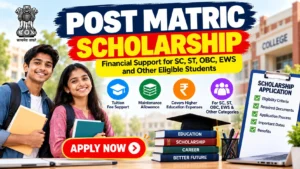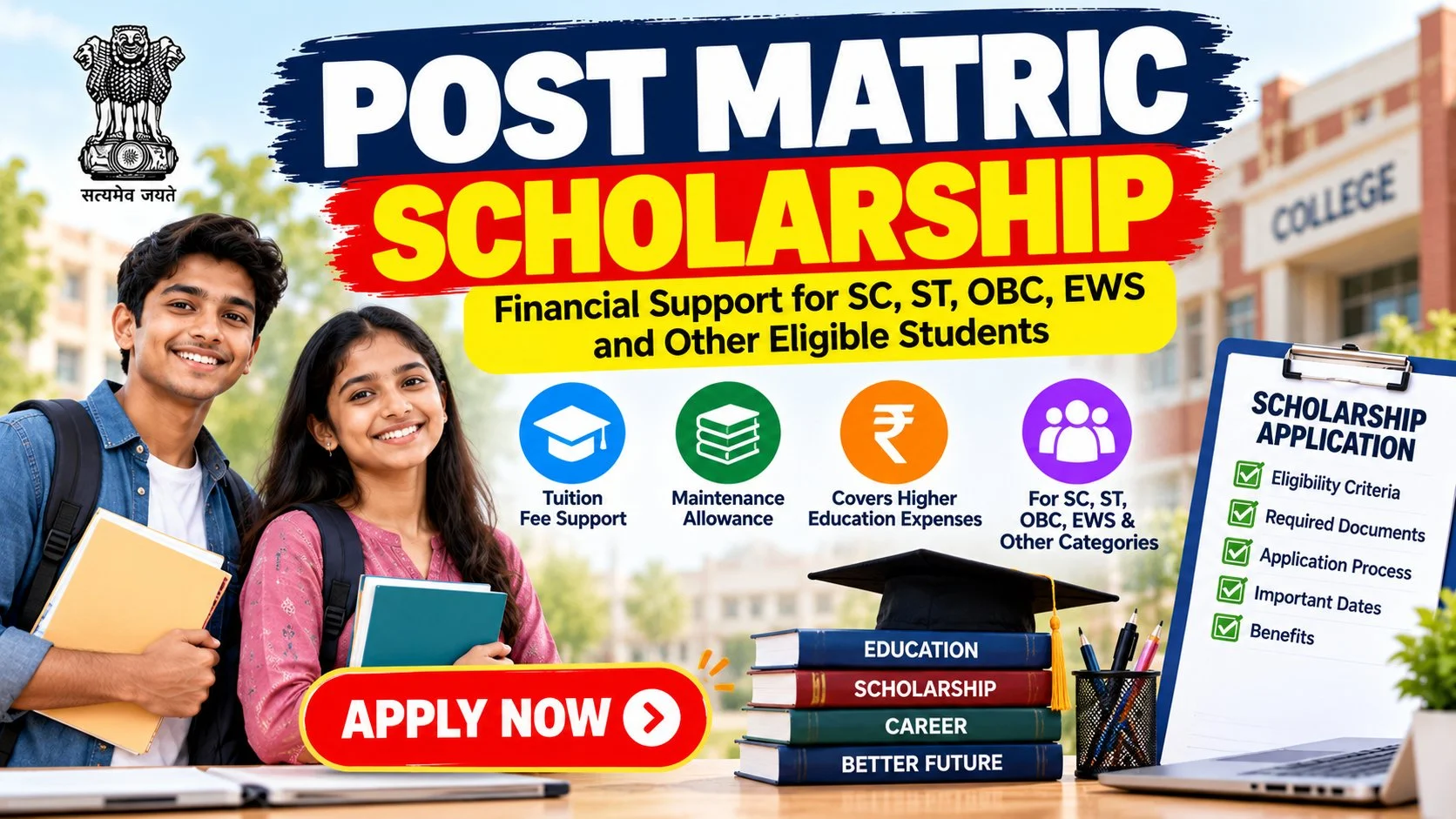

Just finished Class 10 and worried about paying for Class 11, 12, or college? You’re not alone — this is the exact point where thousands of bright students drop out every year because their families can’t afford the fees. The Post Matric Scholarship exists specifically to stop that from happening.
✅ This guide is based on official government sources and notifications. Last verified: October 17, 2026. Scheme details, eligibility criteria, and benefit amounts are revised by the government from time to time — always cross-check the latest information on the official portal before applying.
Whether you’re entering Class 11, starting a diploma, or heading to college, this guide covers everything: who qualifies, how much you’ll get, the documents you need, and the exact online application process. I’ve cross-checked the official NSP guidelines so you get accurate, actionable information — not vague promises.
What Is the Post Matric Scholarship?
“Post Matric” simply means after matriculation — that is, after Class 10. So this scholarship supports students from Class 11 all the way through postgraduate studies, including ITI, diploma, undergraduate, and postgraduate courses.
Like its pre-matric sibling, this isn’t one single scheme. It’s a group of centrally sponsored schemes for different categories:
- Post Matric Scholarship for SC students
- Post Matric Scholarship for ST students
- Post Matric Scholarship for OBC students
- Post Matric Scholarship for Minority students
The big difference from pre-matric? The amounts are significantly higher because they cover tuition fees — not just maintenance. For many students, this scholarship literally pays their entire college fee. If you’re still in school, also read our complete NSP application guide which covers the portal basics.
Eligibility: Do You Qualify?
The eligibility bar is clear-cut. Check each point honestly:
| Criteria | SC / ST | OBC | Minority |
|---|---|---|---|
| Education level | Class 11 to PG | Class 11 to PG | Class 11 to PhD |
| Family income limit | ₹2.5 lakh/year [VERIFY] | ₹2.5 lakh/year [VERIFY] | ₹2 lakh/year [VERIFY] |
| Minimum marks | Pass (no minimum %) | Pass (no minimum %) | 50% in previous exam [VERIFY] |
| Institution | Recognized institution | Recognized institution | Recognized institution |
| Course type | All recognized courses | All recognized courses | Listed courses (check NSP) |
Three things people get wrong about post-matric eligibility:
- Distance/correspondence courses: Most post-matric schemes cover regular courses. Distance education has limited coverage — check your specific scheme’s guidelines.
- Second degree at same level: If you already completed a BA with scholarship support, you generally can’t get it again for another BA. But you can get it for MA (higher level).
- Employed students: If you’re working full-time and studying, some schemes exclude you. Part-time work alongside studies is usually fine.
Scholarship Amount: What You Actually Get
Here’s where post-matric gets serious. Unlike pre-matric’s modest maintenance amounts, post-matric covers compulsory non-refundable fees (tuition, exam fees, library fees) plus a monthly maintenance allowance.
Courses are grouped for allowance purposes [VERIFY: groupings change]:
| Course Group | Examples | Monthly Allowance [VERIFY] |
|---|---|---|
| Group 1 | Professional degrees (Engineering, Medicine, Management) | ₹550–₹1,200/month |
| Group 2 | Other professional courses, PG courses | ₹5,300–₹6,000/year |
| Group 3 | Bachelor’s degree courses (BA, BSc, BCom) | ₹3,000–₹3,600/year |
| Group 4 | Class 11–12, ITI, diploma | ₹2,300–₹2,500/year |
Plus: Full tuition fee reimbursement (as charged by the institution, within caps), exam fees, and additional allowances for students with disabilities. Hostellers get higher maintenance rates than day scholars across all groups.
For minority students, the post-matric scholarship is administered by the Ministry of Minority Affairs with similar structures. The key difference: the 50% marks requirement and ₹2 lakh income cap tend to be stricter.
Students in Gujarat should also explore the MYSY scholarship, which offers substantial support for higher education and can complement your planning.
Documents You Need
The document list is longer than pre-matric because colleges are involved. Start collecting these early:
The fee receipt is the document most students forget. Without proof of fees paid, the tuition reimbursement component can’t be processed. Get it from your college office before starting the application.
How to Apply Online: Complete Process
Step 1: Visit scholarships.gov.in. If you’re a first-time applicant, click “New Registration” and accept the guidelines.
Step 2: Fill in personal details, Aadhaar number, and bank information. The system generates an Application ID.
Step 3: Log in and select your scheme — “Post Matric Scholarship” under the correct ministry (Social Justice for SC/OBC, Tribal Affairs for ST, Minority Affairs for minorities).
Step 4: Enter academic details: institution name (select from the registered list), course, year, and fee details exactly as per your fee receipt.
Step 5: Upload documents. Each file has size limits — keep scans clear but compressed.
Step 6: Submit and save the acknowledgement. Your institution verifies the application through their NSP login.
Step 7: Track through “Application Status” — stages go from institute verification to district, state, and finally payment.
State-specific portals (e-Kalyan for Bihar, MahaDBT for Maharashtra, Digital Gujarat for Gujarat) follow similar steps with local variations. Gujarat applicants can use our Gujarat scholarship status guide for tracking.
Important Dates
- Applications open: July–August [VERIFY: check NSP current year]
- Last date (fresh + renewal): October–31 [VERIFY: varies by state/scheme]
- Institute verification deadline: Mid-November [VERIFY]
- Disbursement: January–March via DBT
Renewal applicants: don’t assume the dates are the same as last year. Check the portal every July.
Renewal: Keep Getting It Every Year
Post-matric scholarships must be renewed annually. The renewal is simpler than the fresh application but has one critical requirement: you must have passed the previous year and been promoted. Failed students generally can’t renew until they clear the year.
For renewal you need: previous year’s marksheet, fresh income certificate, and continued enrollment proof. Your institution re-verifies. That’s it — no need to re-upload caste or domicile certificates unless they expired.
Top Rejection Reasons (Avoid These)
- Income certificate older than one financial year
- Course/institution not in the approved list on NSP — verify your college is registered before applying
- Fee details mismatch between application and fee receipt
- Applying for a lower-level course after completing a higher one (e.g., doing another bachelor’s after one BA)
- Bank account issues — not Aadhaar-linked, dormant, or name mismatch
- Missing gap affidavit when there’s a break in studies
Pre Matric vs Post Matric: Quick Comparison
| Aspect | Pre Matric | Post Matric |
|---|---|---|
| Level | Class 1–10 | Class 11 to PG/PhD |
| Tuition covered? | No (maintenance only) | Yes (full reimbursement) |
| Amount range | ₹1,000–₹7,000/year [VERIFY] | ₹2,500–₹20,000+/year [VERIFY] |
| Key document | School bonafide | Fee receipt + bonafide |
What If Your Application Gets Rejected?
Rejection isn’t the end. Here’s your action plan:
Step 1: Read the rejection reason carefully. Log in to NSP and check the exact remark — “income certificate invalid,” “course not approved,” “document unclear,” etc. Each has a specific fix.
Step 2: Check if correction is allowed. Many rejections at the institute/district level allow resubmission within a correction window. Act fast — these windows are short (often 7–15 days).
Step 3: Escalate properly. If you believe the rejection is wrong, approach in this order: (1) your institution’s nodal officer, (2) the District Scholarship Officer, (3) the State Nodal Officer (contact details are on NSP under “Know Your Nodal Officer”). Put everything in writing — emails create a paper trail.
Step 4: Prepare for next year. If the academic year’s window has closed, fix the underlying issue now (get a fresh income certificate, resolve the bank account problem) so next year’s application is bulletproof.
One hard truth: rejections for income above the limit or unrecognized institution can’t be appealed — these are eligibility fundamentals, not technicalities. Focus energy on what you can actually fix.
DBT Payment: Tracking Your Money
After final approval, money moves through the Public Financial Management System (PFMS). Understanding this helps you track delays:
- Payment initiated: Your district/state has released the funds. Money should credit within 7–15 working days.
- Payment failed: Usually a bank account issue. Check if your account is active and Aadhaar-seeded, then contact your bank.
- Payment pending: Funds are approved but not yet released — this is a government processing queue, not a problem with your application. Wait, but follow up if it exceeds 60 days.
You can check DBT payment status at pfms.nic.in under “Know Your Payments” using your bank account number. This is more detailed than the NSP status page for payment-stage queries.
Special Notes for Girl Students
Several states offer additional incentives for girl students under post-matric schemes — higher maintenance allowances, extra book grants, or priority processing. [VERIFY: check your state’s specific provisions]
Beyond that, girl students should also look at:
- Pragati Scholarship (AICTE) — for girls in technical education, ₹50,000/year [VERIFY]
- State-specific girl child schemes that stack with post-matric at different education stages
- The MYSY scholarship in Gujarat, which has strong provisions for girl students in higher education
How to Get an Income Certificate (Step by Step)
The income certificate is the single most important document — and the one most applications get wrong. Here’s how to get a valid one:
Where to apply: Your Tehsildar/SDM office, or online through your state’s e-district portal (most states now offer this). In Gujarat, it’s through Digital Gujarat; in UP, through e-Sathi; in Bihar, through the RTPS portal.
What you need: Aadhaar of the earning family member(s), ration card or address proof, salary slips (if salaried) or self-declaration of income (if self-employed/farmer), and passport photos.
How income is calculated: Total annual income of both parents combined (and the student’s own income if employed). Agricultural income is included. The certificate must explicitly state the yearly figure — vague certificates get rejected.
Validity: Most scholarship schemes require a certificate issued within the current financial year. A 2-year-old certificate will be rejected even if your income hasn’t changed. Get a fresh one every academic year — mark it on your calendar for June.
Common trap: Some families understate income to qualify. Don’t. Income certificates are cross-verified with tax and land records in many states now, and getting caught means a multi-year ban from all government schemes — not just this scholarship.
Which Scheme Should YOU Apply For? (Decision Guide)
Confused between the options? Use this quick decision framework:
| Your Situation | Apply For |
|---|---|
| SC student, Class 11–12, family income under ₹2.5L | Post Matric for SC (Ministry of Social Justice) |
| ST student, any recognized course, income under ₹2.5L | Post Matric for ST (Ministry of Tribal Affairs) |
| OBC student, college, income under ₹2.5L | Post Matric for OBC |
| Minority community, 50%+ marks, income under ₹2L | Post Matric for Minorities (Ministry of Minority Affairs) |
| Child of registered construction worker | Also check Labour Welfare Scholarship |
| Gujarat domicile, any category | Check Digital Gujarat schemes + status tracking guide |
When in doubt, the NSP portal’s “Check Eligibility” feature (if available for your state) can point you to the right scheme. Otherwise, your institution’s scholarship nodal officer is the best human to ask — they process hundreds of these applications yearly.
Your Academic Year Action Calendar
Scholarship success is 80% timing. Here’s your month-by-month playbook:
- June: Get a fresh income certificate. Confirm your institution is registered on NSP. Gather all documents.
- July–August: NSP/state portal opens. Register and fill the application in the first two weeks — don’t wait for the deadline rush when portals slow down.
- September: Follow up with your institution to complete their verification. This is where most delays happen.
- October: Deadline month. If you haven’t applied yet, do it NOW. Track status weekly.
- November–December: District/state verification happens. Respond immediately to any “defect” notices.
- January–March: Disbursement window. Track PFMS payment status. Follow up on failures.
- April–May: Save your documents and acknowledgement for next year’s renewal. Note what went well and what didn’t.
Put these in your phone calendar with alerts. The students who get scholarships consistently aren’t smarter — they’re just organized. And remember: the NSP portal is your single source of truth for dates — don’t rely on WhatsApp forwards or coaching-center notices, which are frequently outdated or just wrong.
Can You Get Two Scholarships Together?
This is one of the most-asked questions, so let’s settle it clearly. The general rule across central schemes: one student cannot receive two central government scholarships for the same course and academic year. If you’re getting the Post Matric Scholarship for SC students, you can’t simultaneously take the Post Matric for OBC — even if you technically qualify for both.
However, there are legitimate combinations:
- Central + state top-up: Some states add their own top-up amount over the central scholarship. This isn’t a “second scholarship” — it’s a designed supplement.
- Different education levels: A scholarship for your current degree doesn’t block a different scholarship when you move to the next level (e.g., post-matric now, then a merit scholarship for PG later).
- Non-government scholarships: Private trust and CSR scholarships generally don’t conflict with government ones — but always declare them honestly in your application if asked.
When in doubt, choose the scholarship with the higher benefit and formally decline the other. Getting caught with undisclosed dual benefits can lead to recovery of funds and blacklisting.
Frequently Asked Questions
Q1. Can I get post-matric scholarship for private college?
Yes, if the college is recognized/affiliated. The scholarship doesn’t distinguish between government and private institutions — only recognition and course approval matter. However, fee reimbursement may be capped for very high-fee private colleges [VERIFY: check scheme caps].
Q2. I’m doing ITI. Am I eligible?
Yes. ITI courses fall under the post-matric umbrella (Group 4 in most schemes). Make sure your ITI is government-recognized.
Q3. What if my college is not listed on NSP?
Ask your college administration to register on NSP — institutions must onboard themselves. You cannot apply for an unlisted institution. This is a common issue with smaller private colleges.
Q4. Can I apply for both pre-matric (sibling) and post-matric (self)?
Yes — scholarships are per-student, not per-family (except the minority scheme’s two-children cap). Your sibling’s pre-matric application doesn’t affect your post-matric one.
Q5. How long does disbursement take after final verification?
Typically 1–3 months via DBT. If it exceeds 3 months, check PFMS status and contact your district scholarship officer with your Application ID.
Q6. Is there any age limit?
Most post-matric schemes don’t specify a strict upper age limit, but the course must be pursued within a reasonable timeframe after previous qualification. Gap years need explanation via affidavit.
Q7. What is the last date for post matric scholarship 2026-27?
On NSP, the post-matric window typically closes on October 31 [VERIFY: current NSP schedule], while pre-matric closes earlier. State portals set their own dates — Bihar’s PMS window for 2026-27 ran from July 15 to September 30 [VERIFY: pmsonline.bihar.gov.in]. Never rely on last year’s dates; check the live notification on the portal you are applying through.
Q8. Bihar me post matric scholarship ka status kaise check karein?
BC/EBC students: log in at pmsonline.bih.nic.in. SC/ST students: use scstpmsonline.bih.nic.in. Your application moves through nine stages — Finalized, Institute Verify, District Verify, and finally Payment. Keep your User ID and password safe; a forgotten password can be recovered with your Aadhaar number and registered mobile number.
Q9. My status says ‘approved’ but the money hasn’t arrived. Why?
Approval and payment are separate stages. The most common reason is a bank account that isn’t Aadhaar-seeded for DBT — which is different from merely having Aadhaar linked to the account. Track the actual transfer on PFMS (pfms.nic.in → Know Your Payments) and check the UIDAI bank mapper to see which account your Aadhaar is seeded with.
Q10. What does ‘defective’ status mean in post matric scholarship?
An objection has been raised — wrong IFSC, blurry caste certificate, name mismatch, and so on. You usually get about 15 days to correct it [VERIFY: portal guidelines]. Correct the defect AND re-finalize the application. If you fix it but don’t re-finalize, the application lapses when the window closes.
Q11. I missed applying in the 1st year of college. Can I apply in 2nd year?
Yes. You can submit a fresh application in the second year as long as you meet the eligibility criteria for that year. Renewal is only for students who received the scholarship in the previous year — everyone else applies as ‘fresh’.
Q12. What is the income limit for post matric scholarship?
The standard ceiling is ₹2.5 lakh per year for SC/ST/OBC students under central schemes; minority post-matric schemes cap it at ₹2 lakh [VERIFY: current NSP guidelines]. State schemes may set their own limits, so check your state’s departmental notification too.
Q13. I forgot my NSP login password. How do I recover it?
Use the ‘Forgot Password’ option on the portal login page. You’ll need your registered mobile number or Aadhaar number, and the reset OTP goes to your registered mobile. Save your Application ID and password somewhere safe the moment you register — this is the single most common support query every year.
Q14. Are ITI and diploma students eligible for post matric scholarship?
Yes, if the ITI/diploma course is from a recognized institution. Post-matric covers Class 11–12, ITI, diploma, UG, PG and professional courses. The allowance slabs differ by course group — check the scheme guidelines for your specific course level.
Final Words
The jump from Class 10 to higher education is where financial pressure hits hardest — and it’s exactly where the Post Matric Scholarship helps most. Between tuition reimbursement and maintenance allowances, eligible students can realistically cover most of their education costs.
Don’t wait for someone to tell you about deadlines. Bookmark the NSP portal, prepare your documents now, and apply the moment the window opens. And if you have younger siblings in school, point them to our NSP guide for pre-matric options. Every year of education you fund through scholarships is a year your family doesn’t go into debt.