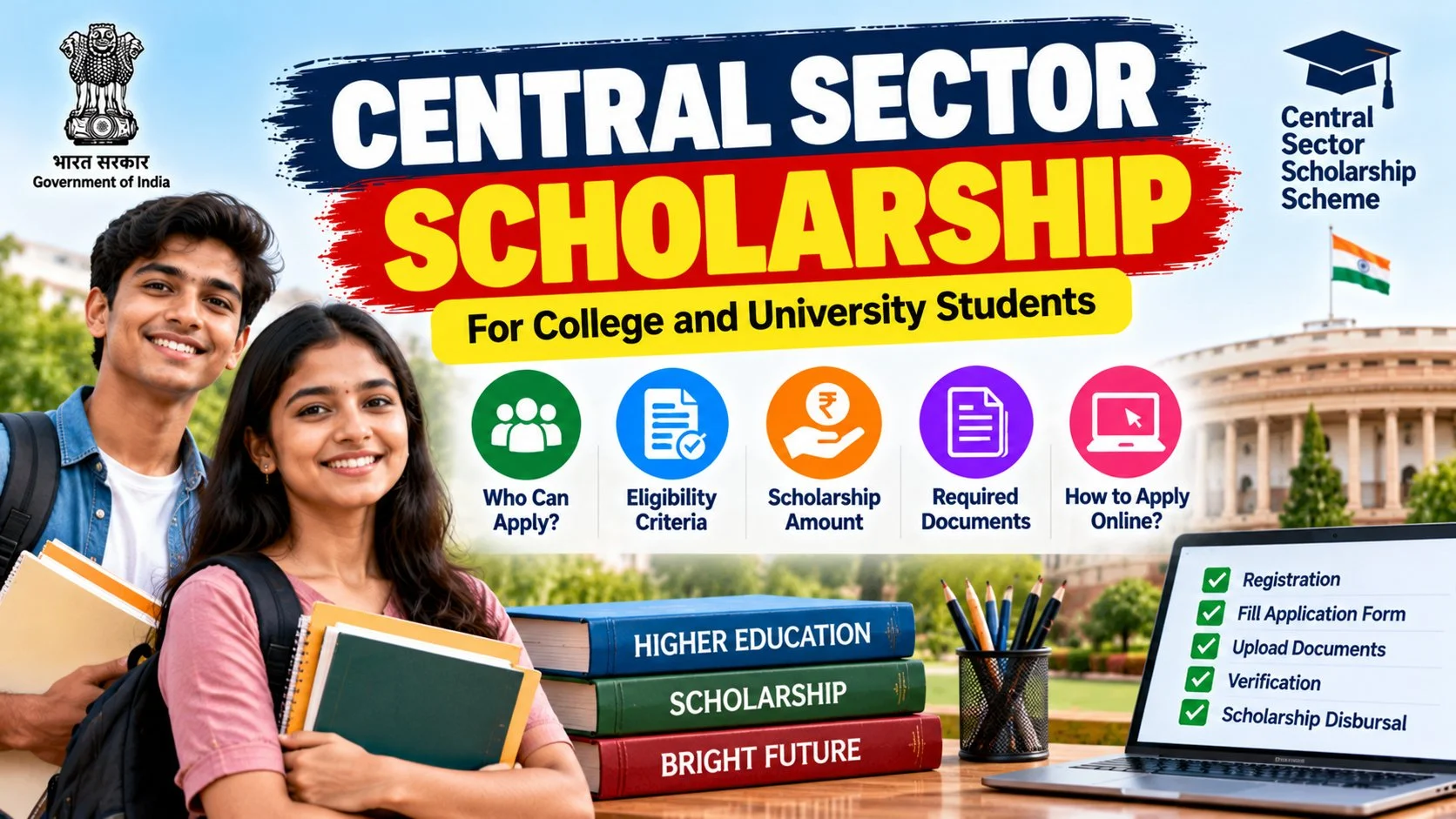

Scored above 80% in Class 12? Then the government might literally pay for your college degree. The Central Sector Scholarship — officially the Central Sector Scheme of Scholarship for College and University Students (CSSS) — rewards top-performing Class 12 students across India with up to ₹20,000 per year through their entire graduation and post-graduation.
✅ This guide is based on official government sources and notifications. Last verified: November 3, 2026. Scheme details, eligibility criteria, and benefit amounts are revised by the government from time to time — always cross-check the latest information on the official portal before applying.
⚠️ 2026–27 window closed: The NSP application window for 2026–27 closed on 31 October 2026. This guide remains useful for verification/tracking of submitted applications and for preparing for the next cycle — fresh applications cannot be submitted until the next window opens.
Here’s the catch most students don’t know: this scholarship is purely merit-based with an income ceiling — no caste certificate needed, no minority requirement, and no complex paperwork beyond standard documents. If you scored well and your family income is within limits, you qualify regardless of category. This comprehensive guide covers the exact eligibility criteria, the top-82,000 selection process, scholarship amounts year by year, and the complete NSP application walkthrough.
What Is the Central Sector Scholarship (CSSS)?
The Central Sector Scheme of Scholarship for College and University Students is run by the Department of Higher Education, Ministry of Education. Every year, it selects 82,000 fresh scholarships — 41,000 for boys and 41,000 for girls — from students who passed Class 12 and are entering regular undergraduate courses.
The “central sector” in the name means it’s fully funded by the central government (no state contribution needed), and it’s implemented through the National Scholarship Portal. Unlike caste-based schemes, CSSS is open to all categories — General, OBC, SC, ST — with the selection based on Class 12 merit within each state board’s quota.
If you’re exploring other central options, our complete NSP guide maps the full portal landscape.
Eligibility: The Three Gates
CSSS has exactly three eligibility requirements. All three must be met:
| Gate | Requirement |
|---|---|
| 1. Merit | Above 80th percentile in Class 12 from a recognized board (top 20% of successful candidates) |
| 2. Course | Regular full-time undergraduate degree (not correspondence/distance) |
| 3. Income | Family income not exceeding ₹4.5 lakh per year |
Let me unpack each gate because the details matter:
The 80th percentile rule: This doesn’t mean 80% marks. It means you must be in the top 20% of students who passed your board’s Class 12 exam. For CBSE, the cutoff percentile is published each year — it typically translates to roughly 85–90%+ in practice. State boards have their own cutoffs based on their result distributions.
Regular courses only: Distance education, correspondence, and part-time courses are excluded. You must be enrolled full-time in a recognized college or university. Diploma courses right after Class 10 don’t qualify — CSSS starts at the UG level after Class 12. This surprises many polytechnic students, so check carefully: if you did a 3-year diploma after Class 10 and are now entering B.Tech lateral entry, your eligibility depends on whether the lateral-entry admission counts as “after Class 12” under current guidelines. When in doubt, contact the NSP helpdesk before applying rather than after a rejection.
The income ceiling: ₹4.5 lakh per year of family income. This is more generous than most caste-based scholarships, which is deliberate — CSSS targets the “meritorious middle class” that often falls through the cracks of other schemes.
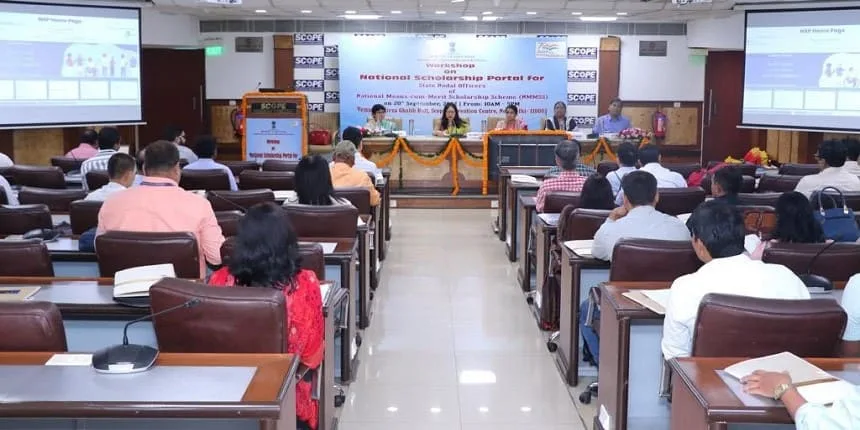
How the 82,000 Seats Are Distributed
The scholarships aren’t first-come-first-served. They’re allocated by a formula:
- State/UT quota: Seats are divided among states based on population (18–25 age group). Larger states get more seats.
- Board-wise split: Within each state, seats are divided between CBSE, ICSE, and State boards based on student population.
- Gender parity: 50% reserved for girls, 50% for boys — a deliberate design to support female higher education.
- Stream-wise: Further divided among Science, Commerce, and Humanities streams.
- Category reservation: SC gets 15%, ST gets 7.5%, OBC gets 27% reservation within the total, per central norms.
What this means for you: you’re competing within your state + board + stream + gender + category bucket — not against all of India. A student from a smaller state board may face less competition than a CBSE Delhi student, even with similar marks.
Scholarship Amount: Year-by-Year
CSSS pays more as you progress — rewarding students who stay in education longer:
| Year of Study | Annual Amount |
|---|---|
| 1st–3rd year (UG) | ₹12,000 per year (₹1,000/month for 10 months) |
| 4th–5th year (PG) | ₹20,000 per year |
For a student doing a 3-year UG + 2-year PG, the total support is ₹76,000 (₹36,000 + ₹40,000). For professional courses like B.Tech (4 years UG), the 4th year gets the higher ₹20,000 rate.
Payment is via DBT in installments, directly to your Aadhaar-linked bank account. Gujarat students pursuing higher education should also check the MYSY scholarship for additional state support.
Documents Required
How to Apply on NSP
Step 1: Visit scholarships.gov.in. New users complete “New Registration.”
Step 2: After login, find “Central Sector Scheme of Scholarships for College and University Students” under Department of Higher Education schemes. (Tip: use the portal’s search — the full name is long.)
Step 3: Enter your Class 12 details: board, year of passing, roll number, and marks. The system may auto-verify against board databases.
Step 4: Enter current college/course details and upload documents.
Step 5: Submit and get your institution to verify through their NSP login.
Step 6: Track status — institute → district/state → final → payment.
Renewal Rules: Strict and Non-Negotiable
CSSS renewal is annual and has firm academic conditions:
- Minimum 50% marks in the previous year’s/semester’s examination
- 75% attendance (institutions certify this)
- Good conduct certified by the institution
- Continued enrollment in a regular full-time course
Unlike fresh applications (82,000 cap), renewals are not capped — everyone who meets the criteria gets renewed. But miss the 50% marks bar even once, and the scholarship stops. There’s no probation year.
CSSS vs Other Merit Scholarships
| Scholarship | Basis | Amount |
|---|---|---|
| CSSS | Class 12 merit (80th percentile) + income ≤ ₹4.5L | ₹12,000–₹20,000/year |
| NSP Merit-cum-Means | 50% marks + minority + income ≤ ₹2.5L | Up to ₹30,000/year |
| State merit scholarships | Varies by state | Varies |
You cannot hold CSSS simultaneously with another central scholarship for the same course. Choose the higher-value one. CSSS can sometimes be combined with state top-ups — check your state’s rules.
Common Mistakes
- Confusing percentile with percentage: 80th percentile ≠ 80% marks. Check your board’s published cutoff.
- Applying with distance education: Only regular full-time courses qualify. Distance learners are ineligible, full stop.
- Missing the income certificate freshness: Must be current financial year.
- Not checking the board quota: Your competition is within your board+state bucket. A “safe” score in one board may not make the cut in another.
- Late institution verification: Follow up with your college — their NSP login verification is mandatory.
Important Dates
- Applications open: July–August
- Last date: October–31
- Verification: November–December
- Disbursement: January–March via DBT
What If You Missed the 80th Percentile?
Don’t despair — CSSS is just one of many options. If you didn’t make the merit cut:
- Post-matric scholarships (no merit bar for SC/ST/OBC, 50% for minorities) — see our NSP guide
- State merit scholarships — many states have lower cutoffs than CSSS
- College-specific scholarships — most universities have their own merit awards; ask your college office
- Private trust scholarships — Tata Endowment, JN Tata, and hundreds of smaller trusts
- Children of registered workers: Labour Welfare Scholarship
Understanding the 80th Percentile: A Practical Guide
This is the most misunderstood part of CSSS, so let’s break it down completely.
What percentile means: If you’re in the 80th percentile, you scored better than 80% of students who appeared. Put differently, you’re in the top 20%. This is not the same as scoring 80% marks.
How cutoffs are set: Each board (CBSE, ICSE, each State board) analyzes its Class 12 results and publishes the cutoff marks corresponding to the top 20%. For example, if CBSE Science stream’s top 20% starts at 88%, then 88% is the cutoff — a student with 87.9% doesn’t qualify, even though it’s “close.”
Why it varies: Different boards have different difficulty levels and marking patterns. A state board with generous marking might have its 80th percentile at 92%, while a tougher board might set it at 84%. This is fair — you’re compared against your own board’s students, not the nation’s.
Where to find your board’s cutoff: The Department of Higher Education publishes board-wise cutoffs each year, usually linked from the NSP portal’s CSSS section. Check for the current academic year’s notification — last year’s cutoff is indicative but not binding.
Stream matters: Science, Commerce, and Humanities have separate cutoffs within each board. Science cutoffs are typically highest (more high-scorers), Humanities often lowest. Your stream’s cutoff is what counts.
State Quota Examples: Know Your Competition
To give you a feel for the competition landscape, here’s how the quota system works conceptually:
| State/UT Type | Approximate Annual Quota | Competition Level |
|---|---|---|
| Large states (UP, Maharashtra, Bihar, WB) | 5,000–8,000+ seats | High volume, moderate per-seat competition |
| Medium states (Gujarat, Rajasthan, MP, Karnataka) | 2,500–5,000 seats | Balanced |
| Small states/UTs (Goa, Himachal, Northeast states) | 200–1,000 seats | Fewer seats but also fewer applicants |
The takeaway: don’t assume a small state means no chance. The quota scales with population, so your relative odds are roughly similar everywhere — but the absolute cutoff marks differ significantly.
From UG to PG: Continuing Your Scholarship
One of CSSS’s best features: it follows you into post-graduation. Here’s how the transition works:
- Automatic progression: If you received CSSS for your UG degree and enroll in a regular PG program, you continue at the higher ₹20,000/year rate — no fresh merit competition.
- Same conditions apply: 50%+ marks, 75% attendance, good conduct, continued income eligibility.
- Course gap: If you take a gap year between UG and PG, check whether the scholarship can be held over. Generally, continuous enrollment is expected.
- Professional PG courses: M.Tech, MBA, and similar professional postgraduate programs are covered at the PG rate.
This 5-year support arc (3 UG + 2 PG) is what makes CSSS uniquely valuable among merit scholarships — most others stop at graduation.
Tracking Your Application Status
After submission, monitor these stages on scholarships.gov.in:
- Submitted: Application received.
- Institute verified: Your college confirmed enrollment.
- District/State verified: Eligibility validated against board merit lists.
- Final verified: Approved — you’re in the 82,000.
- Payment initiated/done: DBT to your Aadhaar-linked account.
Merit list publication: Unlike other schemes, CSSS involves an actual merit-based selection. The cutoffs and selected lists are published — check whether your name appears. If you’re above the cutoff but not selected, contact your State Nodal Officer immediately with your marksheets.
For payment-stage tracking, PFMS (“Know Your Payments”) gives more detail than NSP.
What If Your Board’s Cutoff Isn’t Published Yet?
Timing mismatch is common: NSP applications open in July–August, but some boards publish their 80th percentile cutoffs later. Here’s how to handle it:
- Apply anyway if you’re clearly above last year’s cutoff. If last year’s cutoff for your board+stream was 86% and you scored 93%, apply confidently — cutoffs rarely jump 7 points year-over-year.
- If you’re borderline, still apply. There’s no application fee, and being in the system means you’re considered when the cutoff is finalized. Not applying guarantees zero chance.
- Keep checking the NSP notice board. Cutoff notifications appear as circulars — check weekly during the application window.
- Ask your school. Schools receive board circulars directly and often know the cutoff before it’s widely published online.
Income Certificate Deep Dive for CSSS
The ₹4.5 lakh ceiling is generous, but the certificate requirements are strict:
Issuing authority: Tehsildar, SDM, or equivalent. Some states accept certificates from Block Development Officers for rural applicants — verify locally.
What’s included: Combined annual income of parents. If the student is employed (part-time), that income counts too. Agricultural income, rental income, and business income all count — there are no exemptions for income type, only the total figure matters.
Salaried parents: The certificate is typically based on Form 16 / salary slips. Make sure the figure matches your parent’s actual taxable income — discrepancies between the certificate and tax records can trigger verification failures.
Validity: Must be from the current financial year. An income certificate is not a lifetime document — get a fresh one every academic year for renewals too.
Frequently Asked Questions
Q1. I scored 82% in Class 12 CBSE. Am I in the 80th percentile?
Percentile depends on the year’s result distribution, not a fixed percentage. CBSE publishes the cutoff marks for the top 20% each year — check the current year’s notification on NSP. Historically it’s been around 85–90%+ for the science stream.
Q2. Can I apply in 2nd year if I missed 1st year?
CSSS fresh applications are for students entering the first year of UG. If you missed it, you generally can’t join mid-course as a fresh applicant.
Q3. Does CSSS cover professional courses like B.Tech and MBBS?
Yes — any regular full-time UG degree qualifies, including professional courses. The 4th year of a 4-year professional degree gets the higher ₹20,000 rate.
Q4. My college is private. Am I eligible?
Yes, if it’s recognized/affiliated. Government vs private doesn’t matter for CSSS — only recognition and regular full-time enrollment.
Q5. Is there an interview or additional test?
No. Selection is purely on Class 12 merit (within quotas) + income eligibility. No interviews, no essays, no additional exams.
Q6. What if my family income increases above ₹4.5 lakh mid-course?
Renewal requires continued income eligibility. If family income exceeds the ceiling, renewal is typically denied from that year onward.
Q7. Is the CSSS income limit ₹4.5 lakh or ₹8 lakh? I’m seeing both.
You’re seeing both because the limit changed. Older notifications and many third-party articles still quote ₹8 lakh, but the current PM-USP (the restructured CSSS) guidelines set the family income ceiling at ₹4.5 lakh per annum. Always go by the current year’s official notification — not old blog posts.
Q8. How much money does CSSS actually pay?
₹12,000 per year for the first three years of graduation, and ₹20,000 per year for post-graduation. For professional and integrated courses (like B.Tech), you get ₹12,000/year for the first three years and ₹20,000 in the 4th and 5th years. It is paid as a lump sum via DBT, not monthly.
Q9. Is CSSS only for CBSE students?
No. Students from all recognized boards — CBSE, ICSE, and every state board — are eligible. The 80th percentile cutoff is computed separately for each board and each stream (Science/Commerce/Humanities), so you compete within your own board’s pool, not against CBSE toppers.
Q10. Can distance education or correspondence students apply for CSSS?
No. The scheme covers only regular, full-time degree courses. Correspondence, distance-mode and diploma courses are explicitly excluded. Your college must also be recognized, with a valid AISHE code.
Q11. What do I need to renew CSSS each year?
Two non-negotiable conditions: at least 50% marks in the annual examination and at least 75% attendance. Miss either and the renewal stops. You can also lose it over indiscipline or ragging complaints. Renewal applications go through NSP every year — it isn’t automatic.
Q12. How many CSSS scholarships are awarded? Is there really a quota for girls?
82,000 fresh scholarships every year — 41,000 for boys and 41,000 for girls. Within that, seats are distributed across boards by population, split between streams in a 3:3:1 ratio (Science : Commerce : Humanities), with 15% SC, 7.5% ST, 27% OBC and 5% horizontal reservation for benchmark disabilities.
Q13. What is PM-USP? Has CSSS been renamed?
CSSS is now administered as part of the Pradhan Mantri Uchchatar Shiksha Protsahan (PM-USP) Yojana by the Department of Higher Education. The core scheme — 80th percentile, income ceiling, NSP application — continues; the name on the portal may show PM-USP CSSS. Don’t get confused if you see the new name.
Final Words
The Central Sector Scholarship is the government’s straightforward deal with bright students: score well in Class 12, and we’ll fund your college. No caste certificate needed, no complex criteria — just merit plus a reasonable income ceiling that covers most middle-class families.
With 82,000 seats every year and a gender-balanced, state-distributed quota system, your odds are better than you think — especially if you’re from a state board with a smaller applicant pool. Check your board’s 80th percentile cutoff, gather your documents, and apply the moment NSP opens. The students who win CSSS aren’t just the toppers — they’re the toppers who actually applied. And share this with every Class 12 high-scorer you know — too many eligible students never hear about CSSS until the window has closed, and that is the real tragedy this guide is trying to prevent.