
Every year, thousands of freelancers, business owners, and even salaried employees with side income get shocked by a tax notice — not because they evaded tax, but because they didn’t know about advance tax. If your total tax liability for the year crosses ₹10,000, the Income Tax Department expects you to pay it in installments during the year, not in one shot at filing time. Miss it, and you’ll pay interest under sections 234B and 234C on top of your tax.
✅ This guide is based on the Income Tax Act, 1961 and official CBDT notifications. Last verified: October 17, 2026. Tax rules, rates, and deadlines are revised by the government from time to time — always cross-check the latest information on incometax.gov.in before acting.
What Is Advance Tax and Why Does It Exist?
Advance tax is simply income tax paid in advance, spread across the financial year, instead of paying everything at once when you file your return. Think of it as the government’s “pay as you earn” system. Just like your employer deducts TDS from your salary every month, the government wants people who earn without TDS — freelancers, shop owners, landlords, investors — to pay their tax in four installments through the year.
The logic is straightforward: the government needs steady revenue through the year to run the country, not one big pile in July. And honestly, paying in smaller chunks is easier on your cash flow too. A ₹80,000 tax bill hurts a lot less as four payments of roughly ₹12,000–₹32,000 than as one massive payment.
Here’s the golden rule you must remember: if your total tax payable for the financial year is ₹10,000 or more (after subtracting TDS/TCS), you must make advance payments. This single threshold decides whether these tax provisions apply to you at all.
Who Should Pay Advance Tax?
Not everyone needs to bother with advance payments. Let’s break down exactly who falls under this rule and who gets a pass.
You MUST make advance payments if:
- Salaried employees with extra income: Your employer deducts TDS on salary, but if you also earn from rent, capital gains, interest, or freelancing — and your total tax after TDS is ₹10,000 or more — you owe advance tax on that extra income.
- Freelancers and professionals: Doctors, consultants, designers, developers, YouTubers — anyone whose clients may or may not deduct TDS. If your net tax crosses ₹10,000, this tax applies.
- Business owners: Whether you’re a sole proprietor, partnership, or company — if your estimated tax liability is ₹10,000+, you’re in.
- Landlords: Rental income rarely has TDS deducted (tenants deduct TDS only if rent exceeds ₹50,000/month under section 194-IB, and many don’t). So landlords almost always need to make advance payments.
- Investors: Capital gains from stocks, mutual funds, or property sales can push you over the threshold unexpectedly.
You do NOT need to make advance payments if:
- Resident senior citizens (60+ years): If you’re a resident senior citizen with no income from business or profession, you’re completely exempt from advance payments — even if your tax liability is above ₹10,000. This is a genuine relief the law provides.
- Your total tax liability is below ₹10,000: The threshold is absolute. ₹9,999 in tax? No advance payment needed.
- All your tax is covered by TDS: If you’re purely salaried and your employer deducts the full TDS correctly, you don’t need to make advance payments.
If you’re still unsure whether this tax applies to your situation, our detailed guide on ITR filing last date and penalties explains what happens when tax compliance goes wrong.
Advance Tax Due Dates: The Installment Schedule
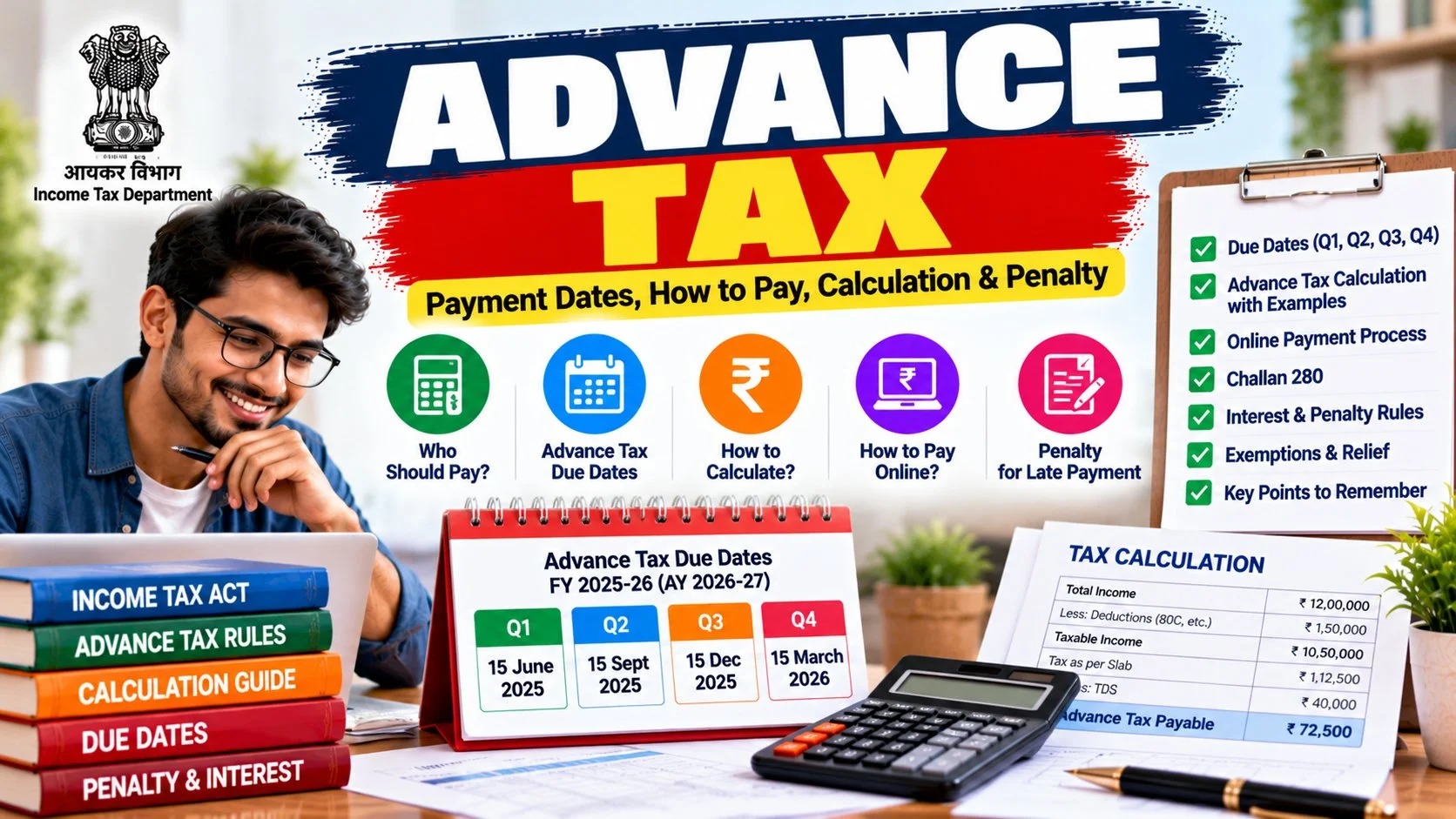
These payments aren’t made randomly — the law prescribes exact percentages by specific dates. Here’s the complete schedule that applies to most taxpayers:
| Due Date | Minimum Cumulative Payment | Who It Applies To |
|---|---|---|
| 15 June | 15% of total advance tax | All taxpayers (except 44AD) |
| 15 September | 45% of total advance tax | All taxpayers (except 44AD) |
| 15 December | 75% of total advance tax | All taxpayers (except 44AD) |
| 15 March | 100% of total advance tax | Everyone (including 44AD) |
Special case — presumptive taxation (Section 44AD/44ADA): If you’ve opted for presumptive taxation as a small business or professional, you get a breather. You can pay your entire advance tax in a single installment by 15 March. No quarterly headache.
What if a due date falls on a Sunday or public holiday? You can pay on the next working day without penalty. The Income Tax Department officially allows this.
How to Calculate Advance Tax: Step-by-Step With Examples
Calculating your advance dues sounds intimidating, but it’s really just five steps. Let’s walk through it with a real example.
The 5-step calculation method
- Add up ALL your income for the financial year — salary, business, rent, capital gains, interest, everything.
- Subtract deductions — 80C, 80D, standard deduction, etc.
- Calculate total tax on this net income using the applicable slab rates.
- Subtract TDS/TCS already deducted or collected.
- The result is your advance dues. If it’s ₹10,000+, split it per the installment schedule above.
Example 1: Freelance designer
Priya earns ₹12,00,000 from freelance design work in FY 2025-26. Her clients deduct 10% TDS (₹1,20,000). She claims ₹1,50,000 under 80C. Let’s calculate under the old regime for illustration:
| Step | Calculation | Amount |
|---|---|---|
| Gross income | Freelance receipts | ₹12,00,000 |
| Less: 80C deduction | PPF + ELSS | − ₹1,50,000 |
| Taxable income | 12,00,000 − 1,50,000 | ₹10,50,000 |
| Tax on ₹10,50,000 (old regime, approx) | Slab calculation + 4% cess | ~₹1,24,800 |
| Less: TDS deducted | 10% of receipts | − ₹1,20,000 |
| Advance tax payable | 1,24,800 − 1,20,000 | ~₹4,800 |
Since ₹4,800 is below ₹10,000, Priya does not need to make advance payments. She can pay the balance when filing her return.
Example 2: Landlord with rental income
Rajesh earns ₹6,00,000 salary (TDS fully deducted: ₹20,000) plus ₹4,80,000 annual rent (no TDS deducted by tenant). Total income: ₹10,80,000. After standard deduction of ₹50,000: ₹10,30,000 taxable. Tax ≈ ₹1,20,000. Less TDS of ₹20,000 = ₹1,00,000 payable as advance dues.
His installment schedule:
| Due Date | % of ₹1,00,000 | Amount to Pay | Cumulative |
|---|---|---|---|
| 15 June | 15% | ₹15,000 | ₹15,000 |
| 15 September | 45% − already paid | ₹30,000 | ₹45,000 |
| 15 December | 75% − already paid | ₹30,000 | ₹75,000 |
| 15 March | 100% − already paid | ₹25,000 | ₹1,00,000 |
Understanding which tax regime suits you affects this calculation significantly — our new vs old tax regime comparison can help you decide.
Section 234B vs 234C: Interest on Late or Short Advance Tax
This is where most people get confused, so let’s make it crystal clear. Sections 234B and 234C levy interest (not penalty — there’s a difference) when you don’t pay enough of it on time.
Section 234B — Interest for not paying enough advance dues overall
When it applies: If the advance payments you made during the year is less than 90% of your total tax liability, section 234B kicks in.
Rate: 1% simple interest per month (or part of a month) on the shortfall.
Period: From 1 April of the assessment year until the date you actually pay the tax.
Example: Your total tax is ₹1,00,000. You paid only ₹70,000 in advance (less than 90%). Shortfall = ₹30,000. If you pay the balance when filing in July (3 months after 1 April), interest = 1% × 3 × ₹30,000 = ₹900.
Section 234C — Interest for missing quarterly installments
When it applies: Even if you eventually pay 100% by March, 234C charges interest if you missed the quarterly percentages (15%/45%/75%).
Rate: 1% per quarter on the shortfall for that quarter.
| Quarter | Required Cumulative % | Interest if Short |
|---|---|---|
| 15 June | 15% | 1% for 3 months on shortfall |
| 15 September | 45% | 1% for 3 months on shortfall |
| 15 December | 75% | 1% for 3 months on shortfall |
| 15 March | 100% | 1% for 1 month on shortfall |
234B vs 234C: Key differences at a glance
| Aspect | Section 234B | Section 234C |
|---|---|---|
| Trigger | Paid less than 90% of total tax | Missed quarterly % targets |
| Rate | 1% per month | 1% per quarter |
| Can both apply? | Yes! If you underpay overall AND miss quarters, both 234B and 234C interest apply together. | |
Important relief: No 234C interest applies if the shortfall is due to capital gains or unexpected income (like lottery winnings) — provided you pay the tax on such income in the remaining installments of that year.
Advance Tax Interest Calculator
Want to quickly estimate the interest you’d owe under 234B and 234C? Use this simple calculator — enter your total tax liability and what you actually paid each quarter:
Advance Tax Interest Estimator
Estimate only — actual interest is computed by the Income Tax Department per sections 234B/234C.
How to Pay Advance Tax Online: Challan 280 Walkthrough
Making advance payments online takes about 10 minutes. Here’s the exact process:
The #1 mistake: Selecting the wrong payment type. If you accidentally choose “Self Assessment Tax (300)” instead of “Advance Tax (100)”, the payment won’t count correctly toward your quarterly liability. Double-check this dropdown every single time.
After payment, you can verify it reflects in your Form 26AS/AIS within a few days — always confirm before the next installment date.
Advance Tax for Different Types of Taxpayers
These advance payment rules apply differently depending on how you earn. Let’s look at the practical reality for each major taxpayer type.
Salaried employees with side income
This is the most common trap. Your employer deducts TDS on your salary perfectly — but TDS doesn’t know about your ₹3 lakh annual rent, your mutual fund redemptions, or your weekend consulting gigs. At year-end, you discover an extra ₹40,000 tax liability and wonder why there’s interest on it.
The fix: Every September, do a rough income projection. Add salary + expected rent + expected capital gains + freelance income. Subtract 80C and other deductions. Compute tax, subtract TDS already deducted. If the gap exceeds ₹10,000, start advance payments from the December installment onward. You can’t go back and fix June/September, but paying December and March correctly limits 234C damage to the earlier quarters only.
Freelancers and gig workers
Freelancers face the trickiest situation because income is irregular. Some months bring ₹2 lakh, others bring zero. The law still expects quarterly estimates — but it also allows revision.
Practical approach: In June, estimate conservatively based on confirmed projects. In September and December, revise upward if new work came in. The department doesn’t penalize honest revision — it penalizes deliberate underpayment. Keep a simple spreadsheet: month-wise receipts, TDS deducted by clients (check Form 26AS quarterly), and running tax estimate.
One more thing freelancers miss: expenses reduce your advance dues. That laptop, coworking membership, internet bill, and software subscriptions are legitimate business expenses. Lower net income means lower advance dues. Maintain proper books — it’s worth real money.
Business owners (non-presumptive)
If your turnover exceeds the 44AD limits (₹2 crore for businesses, ₹50 lakh for professionals) or you’ve opted out of presumptive taxation, you follow the standard quarterly schedule. The challenge is estimating profit before the year ends.
Practical approach: Base your June estimate on last year’s profit adjusted for known changes. Most businesses see 234C interest as a cost of doing business — but you can minimize it by front-loading payments when cash flow allows. Paying 45% by September even if you’re unsure is almost always smarter than waiting.
Senior citizens
Here’s where the exemption creates confusion. A 65-year-old with only pension + interest income: fully exempt from advance tax. But a 65-year-old who also runs a small shop or does consultancy: not exempt — the business income disqualifies the exemption entirely, not partially.
Senior citizens also get higher basic exemption (₹3 lakh) and the Section 80TTB deduction (₹50,000 on interest income), which often brings their liability below ₹10,000 anyway. But don’t assume — calculate.
NRIs
NRIs earning in India (rent, capital gains, NRO interest) must make advance payments like residents — but without the senior-citizen exemption. TDS on NRI income is often deducted at higher rates (e.g., 30% on NRO interest), which usually covers the liability. Still, large capital gains can create a gap.
Common Advance Tax Mistakes to Avoid
- Forgetting the ₹10,000 threshold test: Many salaried people with rental income assume TDS covers everything. Calculate your total liability first.
- Wrong assessment year: FY 2025-26 corresponds to AY 2026-27. Mixing these up is extremely common.
- Ignoring 234C: Paying 100% in March doesn’t save you from quarterly interest. Respect the 15/45/75 schedule.
- Not revising estimates: If your income changes mid-year (big bonus, property sale), revise remaining installments. You’re allowed — and expected — to adjust.
- Senior citizens assuming full exemption: The exemption applies only if you have no business income. A 65-year-old running a shop must still make advance payments.
- Missing the 44AD single-installment benefit: Presumptive taxpayers who pay quarterly are overcomplicating — one payment by 15 March is enough.
Maximizing your deductions also reduces your advance dues — check our complete 80C deduction list to lower your taxable income legally.
Frequently Asked Questions
What are the advance tax due dates?
15 June (15%), 15 September (45%), 15 December (75%), and 15 March (100%). Taxpayers under presumptive taxation (44AD/44ADA) can pay 100% in a single installment by 15 March.
Who should pay advance tax in India?
Anyone whose total tax liability for the financial year is ₹10,000 or more after TDS/TCS — including salaried individuals with extra income, freelancers, business owners, landlords, and investors. Resident senior citizens (60+) with no business income are exempt.
What is the difference between 234B and 234C interest?
Section 234B charges 1% per month if your total advance tax paid is less than 90% of your liability. Section 234C charges 1% per quarter if you miss the quarterly installment percentages (15/45/75). Both can apply simultaneously.
Is advance tax applicable on salary income?
Generally no, because employers deduct TDS. But if you have salary plus other income (rent, capital gains, freelance) pushing your net tax above ₹10,000 after TDS, advance tax applies on the extra portion.
What happens if I don’t pay advance tax?
You’ll owe interest under sections 234B and 234C when you file your return — this is automatic and calculated by the department. There’s no separate penalty, but the interest adds up.
Can senior citizens skip advance tax?
Resident senior citizens (60 years or older) with no income from business or profession are fully exempt from advance payments. If you have business income, the exemption doesn’t apply.
How do I pay advance tax online?
Visit incometax.gov.in → e-Pay Tax → enter PAN → select the correct Assessment Year → choose payment type “(100) Advance Tax” → pay via net banking/UPI/card → save the challan receipt.
What is Challan 280?
Challan 280 is the form/challan used to pay income tax online — including advance tax, self-assessment tax, and regular assessment tax. On the e-pay portal, selecting “(100) Advance Tax” generates the equivalent of Challan 280.
Can I revise my advance tax installments?
Yes. Advance tax is based on estimated income. If your income changes during the year, adjust your remaining installments accordingly. The law expects your best estimate, not perfection in June.
Is advance tax refunded if I overpay?
Yes. Any excess advance tax paid is refunded when you file your ITR, along with interest under section 244A if applicable. Our guide on ITR filing covers the refund process.
Final Word
Advance tax isn’t a punishment — it’s just timing. The government wants its share through the year, and paying in installments is genuinely easier than one lump sum. The key numbers to tattoo on your brain: ₹10,000 threshold, 15-45-75-100 schedule, 1% interest under 234B/234C. Set calendar reminders for the four due dates, pay via Challan 280 on the e-pay portal, and you’ll never face an interest shock again. And if your income is unpredictable, remember — revise your estimates each quarter. The department rewards honest estimation, not June clairvoyance.