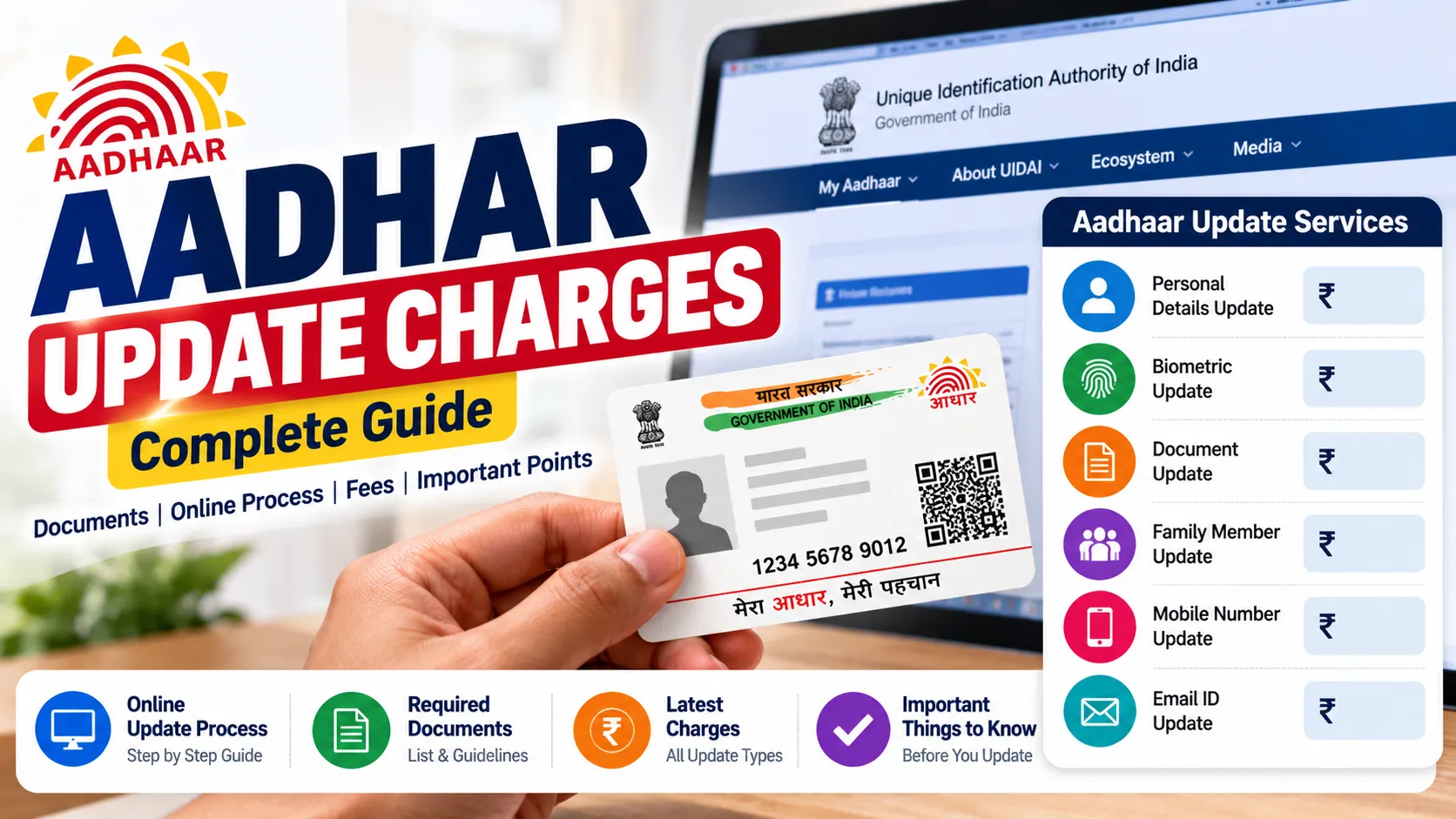

Need to change your Aadhaar address, mobile number, photo, or date of birth and want to know exactly how much UIDAI will charge? The fee is not the same for every service: a demographic update, a biometric update, and a supporting-document update are different transactions. When I checked the latest official information for this guide, I also found temporary fee waivers and differences between newer service pages and older FAQs that are easy to miss.
The good news is that you do not need to pay an agent to understand the charges or book an appointment. By identifying the service you need and checking the current fee schedule, you can avoid unnecessary expenses and choose the correct update method.

This guide explains the applicable Aadhaar update charges in India, which services are free, where you can apply online, which changes require an enrolment centre, and how to track your request after submitting it.
Aadhaar Update Charges in 2026: Quick Answer
As of October 2026, the principal charges published by the Unique Identification Authority of India (UIDAI) are as follows. Temporary exemptions and service-specific conditions apply.
| Aadhaar service | Applicable charge |
|---|---|
| New Aadhaar enrolment | Free |
| Separate demographic update, such as name, date of birth, or gender | ₹75 |
| Standard biometric update | ₹125 |
| Mandatory biometric update for children aged 5–17 | Free under the current concession, subject to the applicable category |
| Document update at an Aadhaar centre | ₹75 |
| Document update through the myAadhaar portal | Free until 14 June 2027 |
| Email update through the Aadhaar mobile app | Free until 31 December 2026 |
| Online address update | ₹75 on the current myAadhaar service page |
| Aadhaar PVC card order | ₹75 |
| Aadhaar download | Free |
| Colour Aadhaar printout on an A4 sheet through the listed centre service | ₹40 |
Important: Always confirm the final fee on the current UIDAI service page or payment screen before proceeding. Some older official FAQs still display earlier prices for online address updates. The current service information should take priority over old screenshots and articles.
What Determines Your Aadhaar Update Fee?
The amount you pay depends on three factors: the type of information being changed, the method used to submit the request, and whether you qualify for a temporary or age-based exemption.
UIDAI broadly classifies Aadhaar information into two categories.
Demographic information includes your name, address, date of birth, gender, mobile number, and email address.
Biometric information includes your photograph, fingerprints, and iris scans.
There is also a third service that often confuses: document update. This involves submitting proof-of-identity or proof-of-address documents in support of the information already recorded in Aadhaar. It does not automatically mean that the information printed on your Aadhaar will change.
When I compared the different services, this distinction was the first thing I wanted to make clear. Someone correcting a spelling error in their name needs a different service from someone simply uploading updated identity and address documents.
The charges are therefore best understood service by service rather than as one flat Aadhaar card update fee.
1. Aadhaar Biometric Update Charges
The biometric update fee covers changes to your photograph, fingerprints, and iris information.
UIDAI’s published fee schedule lists the standard biometric update charge as ₹125. However, mandatory biometric updates for children have special exemptions, so the standard amount does not apply to every resident.
When is a biometric update free?
Aadhaar enrolment initially captures limited biometric information for very young children. As children grow, UIDAI requires their biometric information to be updated at specified ages.
According to the current UIDAI homepage, mandatory biometric updates for children aged 5–17 are free until 30 September 2027. UIDAI’s detailed fee page also specifies age-based exemptions for mandatory updates and a temporary waiver for children aged 7–15.
Because the detailed fee page lists specific conditions, parents should confirm that their child’s request qualifies as the applicable mandatory biometric update before paying.
For adults, the standard biometric update charge is ₹125 unless a particular exemption applies.
What does a biometric update include?
A biometric update can involve one or more of these details:
- Photograph
- Fingerprints
- Iris scans
If your fingerprints are not being authenticated reliably, you have experienced a significant change affecting biometric capture, or UIDAI has asked you to refresh your biometric information, an authorised Aadhaar enrolment centre is the appropriate place to enquire about the service.
Biometric capture requires the relevant equipment and an in-person process. You cannot independently upload a new photograph or fingerprint image through the ordinary document-update facility.
Can demographic details be updated at the same time?
UIDAI’s published fee schedule says demographic updates performed alongside an eligible biometric update are free as a demographic component. However, it also states that a mandatory biometric update is a stand-alone transaction and cannot be clubbed with another transaction.
Do not assume that every combination of biometric and demographic changes qualifies for a single free transaction. Explain what you need to change to the centre operator and confirm the applicable total before the request is processed.
2. Aadhaar Demographic Update Charges
A demographic update changes personal information recorded in the Aadhaar system.
The current UIDAI fee schedule lists ₹75 for a separate demographic update at an enrolment centre. This covers one or more demographic fields in the applicable update request rather than charging ₹75 automatically for every field.
For example, suppose your address and mobile number both need correction. If the centre accepts them as part of the same demographic update request, you should not assume that two separate ₹75 charges are automatically required. Confirm the request structure and fee with the operator.
Name correction in Aadhaar
Name changes can be needed after marriage, a legal name change, or correction of a spelling mistake.
Visit an authorised Aadhaar enrolment centre with the appropriate supporting document when the requested correction cannot be completed through a supported online service.
Check the document requirements before travelling. UIDAI may reject a request if the evidence does not support the requested name or does not meet its document rules.
Date of birth update
Date of birth corrections need particular care because UIDAI restricts how frequently this field can normally be changed.
The usual rule is that the date of birth can be updated once. If it is already updated or the normal limit has been reached, additional requests may require UIDAI’s prescribed exception process and supporting evidence.
Do not pay an agent who promises to bypass UIDAI’s verification or update limits.
Gender update
Gender can normally be updated once in Aadhaar. If your request exceeds the permitted limit, ask UIDAI for the appropriate exception procedure rather than submitting repeated applications without checking eligibility.
Address update
Your address may need correction when you move to a new home, relocate for employment, or discover a mistake in the recorded details.
Address updates can be available through the myAadhaar portal or the Aadhaar mobile app, depending on the supported service and applicable authentication method.
For the address-update service, the current myAadhaar service page displays a ₹75 fee. Some older UIDAI FAQ pages still show ₹50, so verify the amount displayed by the live service before payment.
Mobile number and email address update
Your registered mobile number is important for receiving OTPs and accessing Aadhaar online services.
UIDAI’s new Aadhaar mobile app supports mobile-number updates. Depending on your situation, you may need to authenticate with OTPs for the old and new numbers and complete face authentication. The app’s instructions determine the applicable process and fee.
If you cannot access the old registered number or have never registered a mobile number, UIDAI directs residents to an Aadhaar Seva Kendra or authorised enrolment and update centre.
Email address updates are also supported through the Aadhaar mobile app. From 1 July through 31 December 2026, UIDAI has waived the ₹75 email-update charge when the service is completed through that app. The waiver is channel-specific; do not assume it automatically applies to an in-person request.
3. Aadhaar Document Update Charges
A document update is different from a demographic update.
It allows Aadhaar holders to submit Proof of Identity (PoI) and Proof of Address (PoA) documents in support of the demographic information already recorded in Aadhaar.
UIDAI currently provides these charges:
| Document-update method | Fee |
|---|---|
| Through the myAadhaar portal | Free until 14 June 2027 |
| At an Aadhaar enrolment or update centre | ₹75 |
The online concession is particularly useful if your details are already correct, but you need to submit supporting documents.
What is the difference between document update and address change?
Consider two situations.
In the first situation, your address is already correct, but you want to submit updated proof-of-address or identity documents. That is a document-update request.
In the second situation, you have moved to another house and want the new address to appear in Aadhaar. That is an address-update request.
These services should not be confused simply because both may involve address documents.
Uploading supporting documents does not automatically guarantee that UIDAI will change the address recorded in Aadhaar. Similarly, a document-update concession should not be treated as a blanket waiver for every demographic change.
How to complete the free online document update
- Visit the official myAadhaar portal.
- Sign in using the authentication method requested by the portal.
- Choose the document-update service.
- Review the information shown in your Aadhaar.
- Upload or submit the documents requested by the service.
- Follow the on-screen instructions and complete the submission.
- Save the acknowledgement or reference number, if provided, and check the request status later.
The free period currently runs until 14 June 2027. Check UIDAI’s website for any later extension or change before submitting your application.
4. Is Aadhaar Update Free Online?
Some Aadhaar services are free, while others carry a fee. The deciding factor is the service you are using—not simply whether you are applying online.
These distinctions matter:
- New enrolment: Free.
- Document update through myAadhaar: Free until 14 June 2027.
- Email update through the Aadhaar mobile app: Free until 31 December 2026.
- Online address update: The current myAadhaar service page displays ₹75.
- Biometric update: Usually ₹125, subject to applicable exemptions.
- Aadhaar download: Free.
- Aadhaar PVC card order: ₹75.
Why do some websites show ₹50 for an address update?
This is a useful example of why checking the date of a source matters.
Some older UIDAI FAQ pages continue to display ₹50 for online address updates. However, the current myAadhaar service page displays ₹75 for an address update, and UIDAI’s current centre fee schedule lists ₹75 for a separate demographic update.
When sources conflict, do not rely on an old article merely because it appears in search results. Start from the current official UIDAI website, select your exact service, and verify the charge shown before making payment.
This is also why a guide about Aadhaar fees should be checked regularly. A previously correct amount can become outdated after a fee revision or service-specific concession.
5. Aadhaar Update Charges: Online vs. Aadhaar Centre

Choosing the correct route can save you a trip, but not every Aadhaar change is available through every channel.
| Service | Online option | In-person option |
|---|---|---|
| Address | Supported on myAadhaar and in the Aadhaar app, where available | Available at an authorised centre |
| Supporting-document update | Available through myAadhaar | Available at an authorised centre |
| Mobile number | Supported through the Aadhaar app under its prescribed authentication process | Available at an authorised centre |
| Email address | Supported through the Aadhaar app; special waiver applies through 31 December 2026 | Available at an authorised centre |
| Photograph | Not an ordinary self-service upload | Visit an authorised centre |
| Fingerprints and iris | Requires biometric capture | Visit an authorised centre |
| Name, date of birth, or gender | Check the current service eligibility; centre assistance is generally required | Available subject to documentation and update rules |
UIDAI’s online services and mobile app do not necessarily offer identical features. The official update guidance explains the available modes, while the Aadhaar app provides the current mobile-service options.
When should you choose online updating?
Online services are useful if you can complete the required authentication, have access to the registered mobile number when required, and possess acceptable electronic documents.
They are particularly convenient for address updates and document submissions supported by myAadhaar.
When should you visit a centre?
An in-person visit is appropriate when the requested field requires biometric capture, your mobile-registration situation prevents online authentication, the service is not supported online, or UIDAI requires additional verification.
You can use UIDAI’s official website to locate a centre or book an appointment at an available Aadhaar Seva Kendra. Appointment booking itself is free.
6. How to Update Aadhaar Online: Step-by-Step Process
The exact screens may change as UIDAI updates its portal and mobile app, but the basic process remains straightforward.
Step 1: Open an official UIDAI service
Start at the myAadhaar portal or use the official Aadhaar app downloaded from the appropriate app store.
Avoid lookalike websites that request payment for services available directly through UIDAI.
Step 2: Sign in and authenticate
Follow the instructions on the selected service. Online portal services commonly require your Aadhaar number and OTP authentication through the registered mobile number.
The Aadhaar app may require additional authentication, including face authentication or OTP verification, depending on the service.
Step 3: Select the correct update type
Choose the service that actually matches your requirement.
For example, choose address update if you need to change your recorded address. Choose document update if you only need to submit supporting documents for the information already recorded.
Selecting the wrong service can cause confusion, unnecessary payment, or a rejected request.
Step 4: Upload valid supporting documents
Use documents from UIDAI’s accepted-document list. Make sure the uploaded copy is clear, complete, legible, and consistent with the information you are requesting.
A blurred scan or a document with a different spelling can delay verification.
Step 5: Review and submit
Before you submit the request, carefully check the updated field, spelling, supporting documents, and any fee shown by the portal.
Keep a record of the acknowledgement or reference number. A successful payment or submission confirms that a request has been lodged; it does not necessarily mean the updated information has already been approved.
7. How to Update Aadhaar at a Centre
If you need biometric capture or a demographic update requiring an operator, follow this process.
- Locate an authorised Aadhaar enrolment or update centre through UIDAI.
- Book an appointment if the centre offers the facility, or check its walk-in arrangements.
- Carry your Aadhaar details and the supporting documents required for your requested change.
- Explain which fields you want to update.
- Review the information entered by the operator before approving the request.
- Pay the applicable official fee and collect the acknowledgement receipt.
- Keep the Update Request Number (URN), where issued, for status tracking.
At UIDAI-run Aadhaar Seva Kendras, the official website lists services and appointment information. You can find centres and service details through the UIDAI Aadhaar Seva Kendra page.
Which documents should you take?
The answer depends on the field being changed.
For a name correction, take the prescribed proof supporting your name. For an address update, take acceptable proof of address. For date-of-birth correction, check the specific proof requirements because the field has restricted update limits.
Do not assume that every document accepted by a bank, employer, or other organisation is automatically accepted by UIDAI for every kind of Aadhaar update.
Always check UIDAI’s latest list of acceptable supporting documents before visiting.
8. How Many Times Can You Update Aadhaar?
Aadhaar updates have limits for certain fields. These limits are important because repeated submissions do not guarantee approval.
| Field | Normal update limit |
|---|---|
| Name | Twice in a lifetime |
| Gender | Once in a lifetime |
| Date of birth | Once in a lifetime |
| Address | No fixed numerical limit under the normal update policy |
| Mobile number | No fixed numerical limit under the normal update policy |
| Email address | No fixed numerical limit under the normal update policy |
Biometric updates may also be required at prescribed ages or when needed for authentication quality. Always check the current policy applicable to the requested service.
If you have already used the permitted update for your name, gender, or date of birth, do not assume that a normal paid application will solve the issue. UIDAI has an exception process for eligible cases requiring an update beyond the usual limit. You may need supporting documents and further verification.
The fee alone does not determine whether a change is allowed.
9. How Long Does an Aadhaar Update Take?
Aadhaar updates can take time because UIDAI verifies the request and supporting evidence.
UIDAI states that an update can take up to 90 days. This is a processing period, not a promise that every request will be completed within a particular number of days.
For that reason, avoid postponing a necessary correction until the day you need the updated information for a bank, examination, scholarship, or government service.
How to check Aadhaar update status
- Open the official Check Aadhaar Status service.
- Enter the reference information requested on the status page.
- Follow the displayed instructions.
- Keep checking for the final result if the request is still being processed.
If your request remains pending beyond 90 days, UIDAI advises residents to contact its toll-free helpline at 1947 or write to [email protected] for further assistance.
Do not repeatedly submit new requests simply because the first one is taking longer than expected. First, check the status and determine whether UIDAI requires any further action.
10. Practical Ways to Avoid Unnecessary Aadhaar Update Charges
You may not be able to avoid an applicable service fee, but you can avoid paying for the wrong service or paying someone unnecessarily.
Use free services when you qualify
If you only need to submit supporting documents and the online document-update concession is available, use the official portal rather than paying for the same service at a centre.
Similarly, if you need to update an email address, the Aadhaar app’s fee waiver is currently available through 31 December 2026. Do not confuse this with a permanent exemption.
Check all the information before submission
Spelling mistakes, incorrect dates, and unreadable document uploads can create avoidable problems.
Take a moment to compare the information on the screen with the original supporting documents. Correcting a mistake after submitting a request may require another application and further verification.
Suppose you need to correct your address and mobile number. Before making separate submissions, check whether the centre can accept the eligible fields within one demographic update request.
UIDAI’s fee structure charges for the demographic update request, not automatically for every field changed within it. But service eligibility and how requests are processed matter, so confirm the total before the operator submits the request.
Do not pay for an appointment or a blank form
Appointment booking is offered as a free UIDAI service. Do not pay an agent merely to reserve an appointment or obtain an ordinary enrolment/update form.
For genuine assistance, use UIDAI’s official portal and its published helpline.
Keep the acknowledgement receipt
The receipt provides important reference information for tracking your application. It also helps you verify the service you requested and the amount collected.
If you believe that a centre has charged you more than the published fee, preserve the receipt and contact UIDAI through an official grievance channel.
11. Worked Examples: How Much Might You Pay?
The following examples show how the charges apply to common situations. They are illustrative calculations based on the current published fee schedule, not reports of particular residents.
Example A: An adult changes their address
Suppose an adult moves to another city and wants the updated address reflected in Aadhaar.
If the person uses the current online address-update service, the myAadhaar service page displays a fee of ₹75. The applicant must submit acceptable supporting evidence and wait for UIDAI’s verification.
If the resident instead needs only to submit supporting documents without changing the recorded address, the free online document-update concession may be relevant. Those are different requests, even though both may involve address evidence.
Example B: A resident updates their name
Suppose a resident needs a spelling correction in their name and must apply at an Aadhaar centre.
The current separate demographic-update fee is ₹75. The resident should also carry supporting documentation that satisfies UIDAI’s name-update requirements.
If the normal name-update limit has already been reached, the applicant must check the applicable exception process. Paying ₹75 does not override the update limit.
Example C: Parents arrange a child’s mandatory biometric update
Suppose parents take their school-aged child to complete a mandatory biometric update.
UIDAI currently advertises free mandatory biometric updates for children aged 5–17 until 30 September 2027. Parents should confirm the child’s age category and service eligibility at the centre before payment.
This exemption is different from assuming that every optional biometric service is automatically free.
Example D: Someone needs a new physical Aadhaar card
Suppose a resident has valid Aadhaar details and simply wants a credit-card-sized PVC version.
The PVC card order costs ₹75, including applicable taxes and delivery charges. There is no need to submit a demographic update merely to order a new PVC card when the existing details are correct.
The key lesson from these examples is simple: determine what needs to change before choosing a service. In many cases, the biggest avoidable expense is not the official fee itself, but applying for the wrong service.
12. Common Mistakes to Avoid
Confusing a document update with a demographic update. Uploading proof documents does not necessarily change your recorded details.
Assuming every online service is free. Free document updating and the temporary email-update waiver are specific concessions, not universal exemptions.
Using an old fee chart. Some older pages show earlier amounts. Check the current fee on UIDAI’s official service page.
Ignoring update limits. Name, gender, and date-of-birth fields have restrictions that may require an exception process.
Submitting unclear documents. Blurred images, incomplete evidence, or inconsistent details can delay verification.
Sharing OTPs with agents. Do not disclose authentication codes, passwords, or sensitive personal information to an unknown caller or intermediary.
Discarding the acknowledgement. Keep the receipt and reference number until the request is resolved.
Frequently Asked Questions About Aadhaar Update Charges
1. What are the Aadhaar update charges in 2026?
UIDAI’s current fee schedule lists ₹75 for a separate demographic update, ₹125 for a standard biometric update, and ₹75 for document update at an Aadhaar centre. Applicable exemptions include certain mandatory biometric updates for children. Online document updating is currently free through 14 June 2027.
2. Is Aadhaar address update free online?
No, not under the current general address-update charge shown on UIDAI’s myAadhaar service page, which lists ₹75. Some older UIDAI FAQ pages show ₹50. Verify the amount shown by the current official service before paying.
3. Can I update my Aadhaar documents for free?
Yes. UIDAI currently offers free document updating through the myAadhaar portal until 14 June 2027. At an Aadhaar centre, the document-update charge is ₹75.
4. Is a biometric update free for children?
UIDAI currently advertises free mandatory biometric updates for children aged 5–17 until 30 September 2027. The detailed fee schedule lists specific age-based conditions, so parents should verify that the requested service qualifies for the exemption.
5. Can I change my mobile number online?
The official Aadhaar app supports mobile-number updates under its prescribed authentication process. Depending on your situation, OTP verification and face authentication may be required. If you cannot access the old registered mobile number or have never registered a number, UIDAI directs you to an authorised Aadhaar centre.
6. Is email updating free through the Aadhaar app?
Yes. UIDAI has waived the ₹75 email-update charge for the Aadhaar mobile app from 1 July through 31 December 2026. The waiver applies to that app-based service during the specified period, not automatically to every email-update method.
7. How much does an Aadhaar PVC card cost?
Ordering an Aadhaar PVC card costs ₹75, inclusive of taxes and delivery charges. This is a card-ordering fee, separate from the fee for changing the information recorded in Aadhaar.
8. How long does an Aadhaar update take?
UIDAI states that an update can take up to 90 days. Use the official status-check service to follow your request. If the request remains pending beyond 90 days, contact UIDAI on 1947 or email [email protected].
9. Can I change my Aadhaar name more than twice?
The normal limit for a name update is twice in a lifetime. Requests beyond the permitted limit may require UIDAI’s exception process and supporting evidence. Approval is not automatic, even if you are willing to pay the applicable fee.
10. Do I have to pay to book an Aadhaar appointment?
No. UIDAI’s appointment-booking service is free. Use the official website to book an appointment at a participating Aadhaar Seva Kendra and confirm the applicable update fee separately.
Conclusion
Aadhaar update charges depend on the type of service you need, and temporary concessions can make a meaningful difference to the final amount.
Before applying, check whether you need a demographic correction, a biometric update, or a document update. Use the official myAadhaar portal or Aadhaar app for supported online services, carry the prescribed documents for centre visits, and retain the acknowledgement receipt.
Most importantly, verify the fee on UIDAI’s current website instead of relying on outdated fee charts. A few minutes spent checking the correct service can save an unnecessary visit, prevent a mistaken application, and help you avoid paying more than required.