
After five years at the same company, there’s a line item in your full-and-final settlement that most people never question: gratuity. But do you actually know how it’s calculated — or whether the figure HR gave you is even right? The gratuity calculator formula is simple once someone explains it properly: (Basic Salary + DA) × 15 ÷ 26 × years of service. And here’s the part that surprises everyone — up to ₹20 lakh of gratuity is completely tax-free. This guide gives you a working gratuity calculator, the exact formula with real examples, the 4-year-240-day eligibility trick most employees miss, and the tax rules for 2026.
✅ This guide is based on the Payment of Gratuity Act, 1972, the Code on Social Security 2020, and Income Tax Act provisions. Last verified: October 17, 2026. Labour law provisions change from time to time — cross-check with your HR or a labour law advisor for your specific situation.
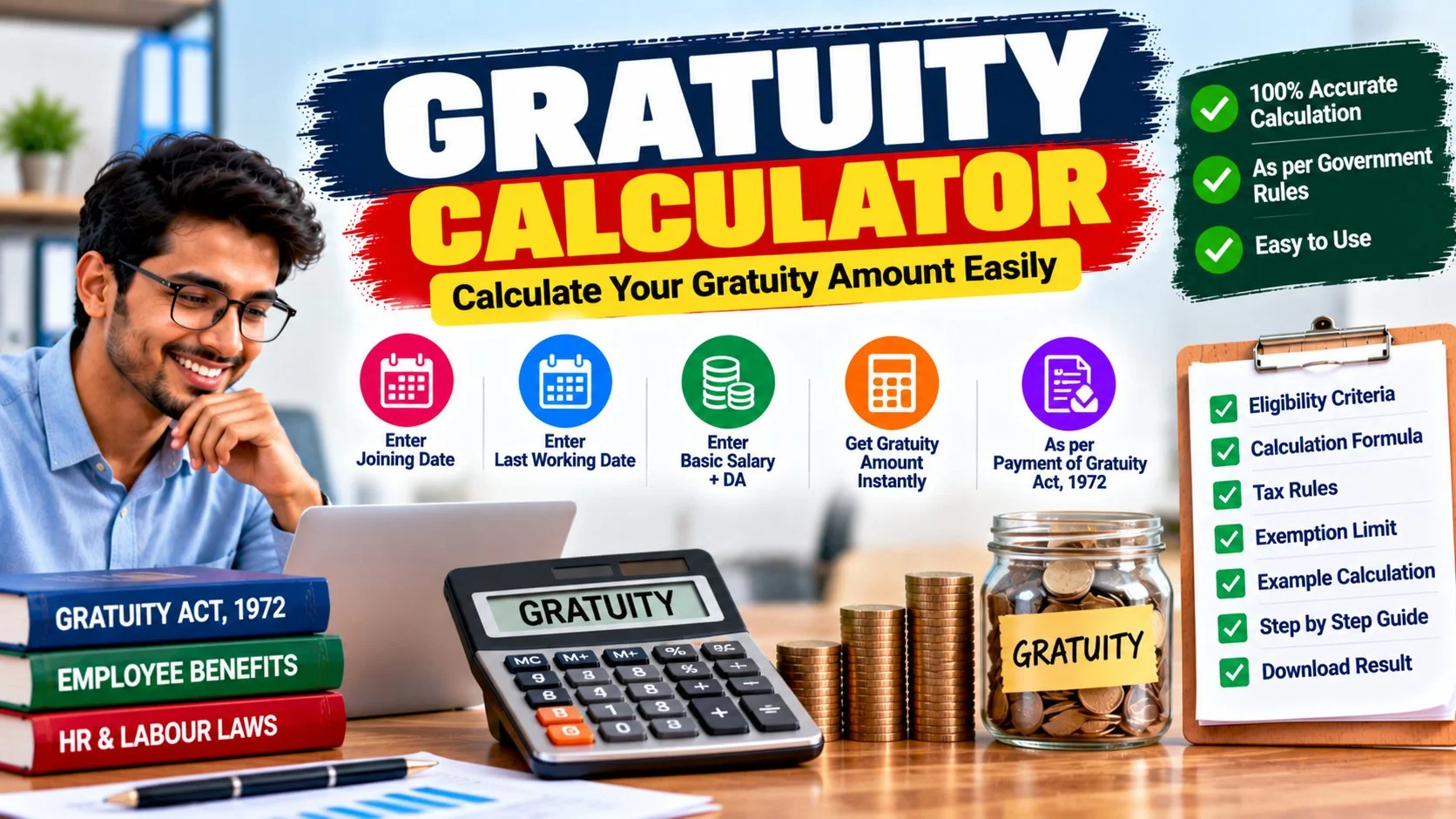
Gratuity Calculator: Find Your Exact Amount
Enter your last drawn basic salary plus dearness allowance, and your completed years of service. The gratuity calculator below applies the statutory formula, handles the 6-month rounding rule, and shows your tax-free vs taxable split against the ₹20 lakh exemption limit.
Gratuity Calculator
The gratuity calculator handles the two things people always get wrong: the 6-month rounding rule (7 years 8 months counts as 8 years; 7 years 4 months stays 7), and the ₹20 lakh lifetime exemption cap across all employers. Try your own numbers — most people are surprised, in a good way.
What Is Gratuity?
Gratuity is a lump-sum payment your employer owes you as a thank-you for long service. It’s governed by the Payment of Gratuity Act, 1972, which applies to every factory, mine, oilfield, plantation, port, railway company, and every shop or establishment employing 10 or more people. Once the Act applies to an establishment, it sticks — even if headcount later drops below 10.
Here’s what makes gratuity unusual: unlike your salary, it’s not paid monthly. It becomes payable when you retire, resign, die, or become disabled — one lump sum at the end. And unlike most retirement benefits, a big chunk of it is tax-free.
Gratuity Calculation Formula Explained

For employees covered under the Payment of Gratuity Act:
Gratuity = (Last Drawn Salary × 15 × Years of Service) ÷ 26
Let’s decode each part, because the details matter:
- Last Drawn Salary = Basic + Dearness Allowance only. Not CTC, not HRA, not conveyance, not special allowance. This is the #1 mistake — people plug in their CTC and get an inflated figure, then feel cheated when the real amount arrives.
- 15 = 15 days’ wages for each completed year of service (half a month’s pay per year).
- 26 = working days in a month (30 days minus 4 Sundays). This is the statutory assumption, not your company’s actual working days.
- Years of Service = completed years, with the 6-month rounding rule applied.
Worked example
Let’s run Priya’s case through the gratuity calculator: she resigns after 12 years and 8 months. Her last drawn basic + DA is ₹45,000/month.
- Eligible years: 12 years 8 months → 8 months exceeds 6, so 13 years
- Gratuity = (45,000 × 15 × 13) ÷ 26 = ₹87,75,000 ÷ 26 = ₹3,37,500
- Tax: fully within the ₹20 lakh limit → zero tax
When the ₹20 lakh cap kicks in
Plugging a senior manager’s case into the gratuity calculator: he retires after 30 years with basic + DA of ₹1,20,000:
- Gratuity = (1,20,000 × 15 × 30) ÷ 26 = ₹20,76,923
- Tax-free: ₹20,00,000 (the statutory cap)
- Taxable: ₹76,923 (added to salary income, taxed at slab rate)
Who Is Eligible for Gratuity?
The headline rule: 5 years of continuous service with the same employer. But there are important nuances:
The 4-years-and-240-days trick deserves emphasis: courts have held that an employee who worked 240 days in the fifth year is deemed to have completed 5 years of continuous service. If HR tells you “you only did 4 years 10 months, no gratuity” — check the working-days count. You might be eligible after all.
Note that gratuity and provident fund are separate benefits — you get both. If you’re also sorting out your PF, our EPF withdrawal guide covers that process step by step.
Is Gratuity Taxable? The ₹20 Lakh Rule
Here’s the tax treatment under Section 10(10) of the Income Tax Act:
| Employee type | Tax-free limit | What’s taxable |
|---|---|---|
| Government employees | Fully exempt (no cap) | Nothing |
| Covered under Gratuity Act | Least of: actual gratuity, ₹20 lakh, or formula amount | Excess over ₹20 lakh |
| Not covered under the Act | Least of: actual gratuity, ₹20 lakh, or (avg salary × 15 × years) ÷ 30 | Excess over exempt amount |
Key points most people miss:
- The ₹20 lakh limit is lifetime, across all employers — not per job. If you got ₹12 lakh tax-free from employer A, only ₹8 lakh remains tax-free from employer B.
- The exemption applies under both old and new tax regimes — the new regime doesn’t take this away.
- For employees not covered under the Act (small establishments), the formula uses ÷ 30 instead of ÷ 26, and salary means average of last 10 months.
- Any taxable portion is added to your salary income and taxed at your slab rate. It’ll show on your Form 16 with the exempt/taxable breakup.
How to Claim Your Gratuity
Claiming is straightforward, but timelines matter:
- Apply in writing to your employer within 30 days of gratuity becoming payable (retirement/resignation date). Use Form I under the Act’s rules.
- Employer must pay within 30 days of your application. If they don’t, they’re liable for simple interest on the delayed amount.
- If the employer disputes or delays: approach the Controlling Authority (usually the Assistant Labour Commissioner) in your area. They can adjudicate the claim.
- Nomination matters: file your gratuity nomination (Form F) with HR while employed — it decides who gets the money if something happens to you, and the 5-year rule is waived on death.
For the tax-saving side of your retirement planning, don’t forget that gratuity pairs with 80C instruments — our 80C deduction list shows every option to bring down your taxable income in the year you receive gratuity.
Gratuity vs Other Retirement Benefits
People often mix these up. Quick clarity:
- Gratuity vs PF: PF is your own contribution (+ employer’s) with interest; gratuity is entirely employer-paid. You get both.
- Gratuity vs pension: Gratuity is a one-time lump sum; pension (like Atal Pension Yojana or NPS) pays monthly. Different purposes, both valuable.
- Gratuity vs leave encashment: Leave encashment has its own ₹25 lakh exemption (for non-government employees); gratuity’s is ₹20 lakh. They’re calculated and taxed separately.
Gratuity in Special Situations
Job change before 5 years
No statutory gratuity — but check your appointment letter. Some companies (especially MNCs and PSUs) offer gratuity-like ex-gratia or have more generous policies. It never hurts to ask HR during exit negotiations.
Death during service
The 5-year rule is waived. The nominee receives gratuity calculated on the salary at the time of death, with a minimum linked to service length. This is why Form F nomination isn’t paperwork to postpone — it’s the difference between your family getting money in weeks versus fighting in court.
Company merger or acquisition
Continuous service usually carries over if the new entity is the legal successor. But verify — get it in writing during the transition. Acquirers have been known to “reset” service clocks, and employees who don’t object in time lose years of gratuity eligibility.
Fixed-term and contract workers
Since the Code on Social Security 2020 (effective November 2025), fixed-term employees qualify after just 1 year with 240 working days. If you’re on contract and HR says “gratuity doesn’t apply to contractors,” push back — the law changed.
Employer Obligations (What Your Company Must Do)
Gratuity isn’t a favour — it’s a legal duty. Employers must:
- Pay within 30 days of gratuity becoming payable or of your written claim
- Pay interest on delays — simple interest from the due date till payment
- Insure the liability: establishments are expected to obtain gratuity insurance (though many don’t — a red flag about the company’s financial planning)
- Display the rules: the Act requires a notice with the controlling authority’s details at the workplace
- Cannot forfeit gratuity except for wilful misconduct causing financial loss, or offences involving moral turpitude — and even then, only partially, with due process
Before approaching anyone, verify your amount with the gratuity calculator above so you know the exact figure you’re owed. If your employer refuses or delays without reason, the Controlling Authority (Assistant Labour Commissioner) can order payment with interest. The process is free for employees.
Gratuity Nomination: The Form Everyone Ignores
Form F — the gratuity nomination form — is probably the most neglected piece of HR paperwork in India. Here’s why it matters more than you think: if you die in service, your gratuity goes to your nominee without the 5-year eligibility rule, without court succession hassles, without delay. Without a nominee, your family faces legal heir certificates and months of process during the worst time of their lives.
File it on day one of your job. Update it after marriage, after children, after divorce — life changes, nominations should too. It takes five minutes at the HR desk. There’s no reason to postpone it, and every reason not to.
Common Gratuity Myths, Busted
- “Gratuity is a bonus.” No — it’s a statutory right after 5 years, not a favour. Your employer can’t choose not to pay it.
- “Only permanent employees get it.” Fixed-term workers with 1 year + 240 days qualify under the 2020 Code. Contract staff, check your days.
- “CTC includes gratuity, so I’ve already got it.” CTC accounting doesn’t change the law — gratuity becomes payable only on exit after eligibility, regardless of how CTC was structured.
- “Small companies don’t have to pay.” The Act applies at 10+ employees, and once applicable, it stays applicable even if headcount drops.
- “Gratuity is fully tax-free, always.” Only up to ₹20 lakh lifetime. Above that, it’s taxable salary income. High earners with long service do cross the cap.
- “I need a lawyer to claim.” The Controlling Authority process is designed for employees without lawyers. Most claims resolve on paperwork alone.
Gratuity Calculator: Quick-Reference Summary
Everything above in 60 seconds — and the gratuity calculator does it instantly: gratuity = (Basic + DA) × 15 × years ÷ 26. You need 5 years of continuous service (or 4 years + 240 days in year five). Extra months beyond 6 round up to a full year. Up to ₹20 lakh is tax-free across your lifetime and all employers; government employees have no cap. Your employer must pay within 30 days of your claim or owe interest. File Form F nomination on day one. Verify HR’s figure with the calculator above before signing your settlement — it takes two minutes and has saved countless employees from underpayment.
Frequently Asked Questions
What is the gratuity calculation formula?
For employees covered under the Payment of Gratuity Act: Gratuity = (Last Drawn Basic Salary + DA) × 15 × Years of Service ÷ 26. “Last drawn salary” means basic + dearness allowance only — not CTC, HRA, or other allowances. Service years follow the 6-month rounding rule.
Is gratuity taxable in 2026?
Up to ₹20 lakh is tax-free for private-sector employees (lifetime limit across all employers) under Section 10(10). Government employees get full exemption with no cap. Any amount above ₹20 lakh is added to salary income and taxed at your slab rate. The exemption works under both old and new tax regimes.
How many years are required for gratuity eligibility?
Five years of continuous service with the same employer. But there’s a well-established exception: 4 years plus 240 working days in the 5th year counts as 5 years. On death or disablement, the 5-year requirement is waived entirely. Fixed-term workers qualify after 1 year with 240 working days.
What is the 15/26 in the gratuity formula?
15 represents 15 days’ wages for each completed year of service (half a month’s pay per year). 26 is the statutory number of working days in a month (30 days minus 4 Sundays). Together, 15/26 means you earn roughly 57.7% of one month’s basic+DA for every year you worked.
Can I get gratuity if I resign before 5 years?
Generally no — resignation before completing 5 years (or 4 years + 240 days) means no statutory gratuity. Exception: if your employer’s policy is more generous than the Act, or under the death/disablement waiver. Some companies pay ex-gratia, but that’s voluntary, not a legal right.
How is gratuity calculated for 7 years 8 months of service?
The gratuity calculator applies the rounding automatically: the 8 months exceed 6 months, so it rounds up to 8 years. Formula: (Basic + DA) × 15 × 8 ÷ 26. If it were 7 years and 4 months, it would stay at 7 years. The 6-month cutoff is strict — exactly 6 months and a day rounds up; 6 months flat does not.
What is the maximum gratuity I can receive tax-free?
₹20 lakh, lifetime, across all employers combined. This limit was raised from ₹10 lakh in 2019. Government employees have no cap — their entire gratuity is exempt.
Does the employer have to pay gratuity within a deadline?
Yes — within 30 days of it becoming payable (or of your written application). Delay beyond 30 days attracts simple interest on the outstanding amount, and you can complain to the Controlling Authority (Assistant Labour Commissioner).
Is gratuity included in CTC?
Many employers show gratuity as part of CTC, which is misleading — it’s a statutory liability they owe you after 5 years, not a monthly benefit. When comparing job offers, mentally separate gratuity from in-hand salary; you only see that money years later.
What happens to gratuity if the company shuts down?
Gratuity remains payable — it’s a statutory dues that ranks as a preferential claim in liquidation. In practice, recovery from a shut company can be slow and may need the Controlling Authority or courts. This is another reason to file your nomination (Form F) and keep employment records.
Final Word
Gratuity is one of the few genuinely free lunches in Indian employment law — your employer pays it, up to ₹20 lakh is tax-free, and the formula is transparent enough to verify yourself. The tragedy is how many employees never check the maths. Now you can: run your numbers through the gratuity calculator above, compare with what HR quoted, and if there’s a gap, ask questions before signing your full-and-final settlement.
And remember the two traps the gratuity calculator helps you avoid: using CTC instead of Basic+DA in the formula, and forgetting the ₹20 lakh cap is lifetime across employers. Avoid those, and you’ll never leave gratuity money on the table. For the rest of your exit-benefit planning — PF withdrawal, 80C optimisation in the payout year — our EPF guide and 80C deduction list have you covered.