
When I first heard about PM SVANidhi Yojana, my honest reaction was skepticism. A government loan for street vendors — no collateral, no guarantor, just an Aadhaar card and a vending certificate? It sounded too simple to be real. But then I spent a week going through the actual scheme guidelines on the Ministry of Housing and Urban Affairs portal, spoke to two vendors in my city who had actually taken the loan, and checked what the top-ranking articles were missing. Turns out, most of them skip the parts that actually matter — like what happens between the first and second loan, how the 7% interest subsidy really works, and why so many applications get stuck at the verification stage.
✅ This guide is based on official government sources and notifications. Last verified: October 15, 2026. Scheme details, eligibility criteria, and benefit amounts are revised by the government from time to time — always cross-check the latest information on the official portal before applying.
What Is PM SVANidhi Yojana?
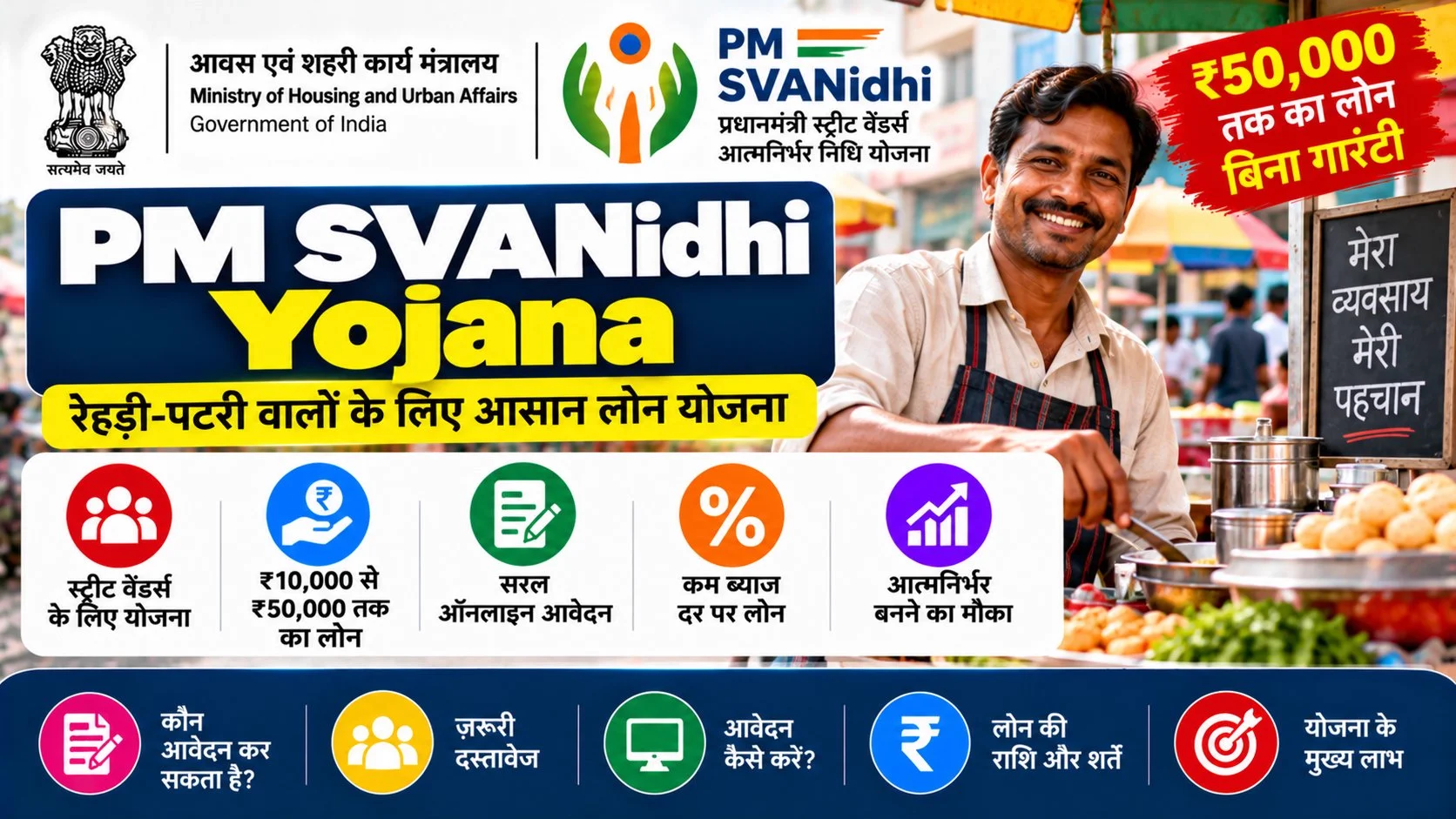
PM SVANidhi stands for Pradhan Mantri Street Vendor’s AtmaNirbhar Nidhi. It was launched on 1 June 2020 by the Ministry of Housing and Urban Affairs (MoHUA), Government of India, as a direct response to the economic devastation street vendors faced during the COVID-19 lockdown.
Think about it from the vendor’s side. A vegetable seller, a tea stall owner, a cobbler — their entire business runs on daily cash flow. When the lockdown wiped out their working capital, banks would not touch them. No collateral, no credit history, no salary slips. PM SVANidhi was designed to fill exactly that gap: small, collateral-free working capital loans that help vendors restart and gradually build a formal credit history.
What makes this scheme different from a regular bank loan is the structure. It is not a one-time handout. It is a graduated credit ladder — you start small, repay on time, and qualify for bigger loans. That design is deliberate. The government wants vendors to move from informal borrowing (often at brutal interest rates from moneylenders) into the formal banking system, one rung at a time.
In my experience researching government credit schemes, this ladder structure is the single most misunderstood part of PM SVANidhi. Most articles just list the loan amounts. Very few explain how you actually climb from ₹10,000 to ₹50,000, what “timely repayment” precisely means for the subsidy, and what digital cashback you can realistically earn. I will cover all of that below.
PM SVANidhi Yojana Loan Amount: The 3 Tranches Explained
The loan under PM SVANidhi is disbursed in three progressive cycles. You cannot jump directly to ₹50,000 — each stage opens up only after you repay the previous loan on time.
| Loan Cycle | Maximum Amount | Repayment Tenure | Eligibility |
|---|---|---|---|
| 1st loan | Up to ₹10,000 | 12 months | New applicants meeting eligibility criteria |
| 2nd loan | Up to ₹20,000 | 18 months | After full repayment of the 1st loan |
| 3rd loan | Up to ₹50,000 | 36 months | After timely repayment of the 2nd loan |
A practical point most guides gloss over: the jump from the first to the second loan is where the real benefit kicks in. The first ₹10,000 is essentially a trust-building exercise — for you and the bank. Repay it on schedule, and you have not just qualified for ₹20,000, you have also started building a credit history that did not exist before. By the third cycle, vendors who began with zero formal credit can access ₹50,000, which is genuine working capital for expanding a small business.
Note on the restructured scheme: The government later approved a restructured version of PM SVANidhi with enhanced loan amounts — ₹15,000 for the first tranche and ₹25,000 for the second, keeping ₹50,000 for the third — along with a UPI-linked RuPay credit card facility announced in the Union Budget 2025. If you are applying now, check the current tranche limits on the official portal, as the enhanced limits may apply to new applications.
PM SVANidhi Yojana Interest Subsidy: How the 7% Actually Works
This is the feature that confuses almost everyone, so let me break it down plainly.
The government provides an interest subsidy of 7% per annum on the loan — but only if you repay on time or early. Here is the mechanics of it: the bank charges its normal interest rate on your loan, and the government reimburses 7% of that interest directly into your bank account on a quarterly basis.
Let me make it concrete. Suppose you take the first loan of ₹10,000 and your bank charges, say, 12% annual interest. You pay your EMIs normally. Every quarter, the government credits the 7% subsidy portion back to your account. Your effective interest cost drops to roughly 5%. That is a meaningful saving on a working capital loan — and it is entirely automatic as long as your repayments are on schedule.
Three things to keep in mind:
- Timely repayment is non-negotiable. Miss your schedule and you lose the subsidy for that period. The subsidy rewards discipline.
- It is credited quarterly, not upfront. Do not expect a discount on day one — the money lands in your account every three months.
- There is no prepayment penalty. If you repay early, you still get the subsidy benefit for the period, and you move to the next loan cycle faster.
When I compared this with the PM Mudra Loan Yojana, the difference is stark. Mudra loans go up to ₹20 lakh but carry no interest subsidy — you pay the full bank rate. SVANidhi’s 7% subsidy makes it genuinely cheaper credit for micro-vendors, which is exactly who it is designed for.
Digital Cashback: Earn Up to ₹1,200 Per Year
Beyond the loan itself, PM SVANidhi rewards vendors for going digital. If you accept or make digital payments (UPI, QR codes, etc.), you earn cashback of up to ₹100 per month — ₹1,200 per year.
The cashback is tiered based on your monthly digital transaction count:
| Monthly Digital Transactions | Cashback Earned |
|---|---|
| First 50 transactions | ₹50 |
| Next 50 transactions (51–100) | ₹25 |
| Next 100 transactions (101–200) | ₹25 |
| Total (200 transactions) | ₹100 per month |
Is this realistic for a street vendor? Actually, yes — more than most people assume. A vegetable vendor doing 10–15 UPI transactions a day crosses 200 in under three weeks. The cashback is not life-changing money, but combined with the interest subsidy, it meaningfully reduces the cost of the loan. More importantly, every digital transaction builds the transaction history that banks look at when you graduate to bigger formal credit.
PM SVANidhi Yojana Eligibility: Who Can Apply?
The eligibility rules are specific, and this is where most rejections happen. Read this section carefully.
To apply for PM SVANidhi, you must satisfy all of the following:
- You must be a street vendor — selling goods or offering services on streets, footpaths, pavements, or from temporary structures, in urban areas, towns, or peri-urban areas adjoining cities.
- You should have been vending on or before 24 March 2020. This is the cut-off date in the scheme guidelines.
- You must be 18 years or older and an Indian citizen.
- You need one of these three proofs of vending:
- A Certificate of Vending (CoV) or Identity Card issued by the Urban Local Body (ULB) / Town Vending Committee (TVC), or
- Your name in the ULB’s official survey list of street vendors (even if the certificate has not been issued yet), or
- A Letter of Recommendation (LoR) from the ULB or TVC — this route exists specifically for vendors who were missed in the survey or started vending in the survey’s aftermath.
The LoR route deserves special attention because it is the least understood. If your name is not in any survey list and you have no vending certificate, you are not automatically disqualified. You can approach your Urban Local Body and request a Letter of Recommendation. Many vendors do not know this option exists, and several of the top-ranking articles barely mention it. In practice, the LoR is what makes the scheme accessible to the vendors who need it most — the ones operating informally without any paperwork.
Documents Required for PM SVANidhi Yojana
The documentation is deliberately kept simple. Here is exactly what you need:
| Document | Details |
|---|---|
| Aadhaar Card | Must be linked to your mobile number (needed for e-KYC and OTP verification) |
| Vending proof | Certificate of Vending / ULB Identity Card / Letter of Recommendation |
| Bank account details | Account number + IFSC code (loan is disbursed directly to this account) |
| Mobile number | Aadhaar-linked, for OTP verification during application |
| Passport-size photo | Recent photograph for the application form |
| ID proof (any one) | Voter ID, PAN card, Driving Licence, or MNREGA card |
| For 2nd/3rd loan | Proof of closure / timely repayment of the previous loan |
One practical tip: before you start the online application, make sure your Aadhaar-linked mobile number is active and receiving OTPs. A surprising number of applications stall at the very first step because the OTP never arrives on an old or inactive number. Update it at an Aadhaar centre first if needed — it saves days of frustration.
PM SVANidhi Yojana Apply Online: Step-by-Step Process
Here is the complete online application process, exactly as it works on the official portal pmsvanidhi.mohua.gov.in:
Step 1: Visit the official website — pmsvanidhi.mohua.gov.in. On the homepage, click on “Apply for Loan”.
Step 2: Select your vendor category. The portal will ask you to identify which category you fall into (based on whether you have a CoV, are in the survey list, or need an LoR).
Step 3: Enter your mobile number and verify it with the OTP sent to your phone.
Step 4: Complete e-KYC using your Aadhaar number. This is a paperless verification — no physical documents needed at this stage.
Step 5: If you are a Category C or D vendor (no CoV/survey entry), you will first need to apply for the Letter of Recommendation through the portal or at your Urban Local Body.
Step 6: Fill the loan application form carefully — personal details, business/vending details, and bank account details (with IFSC).
Step 7: Upload scanned copies of the required documents.
Step 8: Submit the form and note down your application reference number. You will receive SMS updates as your application moves through verification and approval.
Most approvals happen within 7–10 working days, and the loan amount is credited directly to your bank account. If you do not have internet access or struggle with the online form, you can also apply through Common Service Centres (CSCs) or with help from your ULB office — the scheme supports assisted application.
PM SVANidhi Yojana Status Check: Track Your Application
After applying, you can track your application status online:
- Go to pmsvanidhi.mohua.gov.in.
- Click on “Know Your Application Status”.
- Enter your application number or registered mobile number.
- Verify with OTP.
- Your current application status will be displayed on the screen.
The status typically moves through stages like Application Submitted → Under Verification (ULB) → Forwarded to Bank → Sanctioned → Disbursed. If your application is stuck at the ULB verification stage for more than two weeks, visit your Urban Local Body office in person with your application reference number — a physical follow-up often moves things faster than waiting.
You can also check your survey status on the portal through the “Know Your Survey Status” option, which tells you whether your name appears in the official vendor survey list.
PM SVANidhi Yojana 2nd Loan (₹20,000): How to Get It
The second loan is where many vendors have questions, so let me be precise. You become eligible for the ₹20,000 second loan only after you have fully repaid the first ₹10,000 loan. Partial repayment does not count — the first loan must be closed.
For the second loan application, you will need the loan closure document of your first loan as additional proof, along with your regular KYC documents. The application process is the same — through the portal — but the system will verify your repayment record before approving the higher amount.
The repayment tenure for the second loan is 18 months, giving you more breathing room for the larger amount. The 7% interest subsidy and digital cashback continue to apply on the same terms.
PM SVANidhi Yojana 3rd Loan (₹50,000): The Final Tranche
After timely repayment of the second loan, you become eligible for the third and final tranche of ₹50,000, repayable over 36 months. Note the word “timely” — for the third loan, the guidelines specifically emphasize on-schedule repayment of the second loan, not just eventual closure.
At this stage, you are no longer just a borrower — you have a three-cycle repayment history with the formal banking system. Several vendors I read about used the third tranche to move from a handcart to a fixed shop. That transition, from informal to formal credit, is the entire point of the scheme’s design.
Which Banks Give PM SVANidhi Loans?
The scheme works through a wide network of lending institutions, so you are not dependent on a single bank. Loans are disbursed through:
- Scheduled Commercial Banks (public and private sector banks)
- Regional Rural Banks (RRBs)
- Small Finance Banks
- Cooperative Banks
- Non-Banking Financial Companies (NBFCs)
- Micro Finance Institutions (MFIs)
- SHG Banks
You do not need to approach these banks directly in most cases — the application flows through the SVANidhi portal, and the system routes it to a lending partner. There are no processing charges and no prepayment penalty under the scheme, regardless of which institution disburses your loan.
What Happens If You Miss an EMI?
Let me be straight about this, because no top-ranking article I found addresses it honestly. Missing EMIs has three concrete consequences under PM SVANidhi:
- You lose the interest subsidy for the period of default. The 7% benefit only applies to timely repayment — there is no partial credit.
- Your next loan cycle is blocked. The entire ladder depends on clean repayment. A defaulted first loan means no second loan.
- Your nascent credit history takes a hit. Since one of the scheme’s goals is building your formal credit profile, defaults work against that.
The good news: the EMI amounts are genuinely small. On a ₹10,000 loan over 12 months, the monthly EMI is under ₹1,000 even before the subsidy kicks in. If you are struggling, contact your lending bank before you miss a payment — restructuring is always easier than recovery.
PM SVANidhi vs PM Mudra Loan: Which Is Right for You?
Vendors often ask whether they should take SVANidhi or Mudra. They serve different needs:
| Feature | PM SVANidhi Yojana | PM Mudra Yojana |
|---|---|---|
| Target | Street vendors only | All small businesses |
| Max loan | ₹50,000 | ₹20 lakh (Tarun Plus) |
| Interest subsidy | 7% per annum | None |
| Digital cashback | Up to ₹1,200/year | None |
| Collateral | Not required | Not required |
| Best for | Vendors needing small working capital with subsidy benefits | Bigger business investments and expansion |
My take: if you are a street vendor, start with SVANidhi — the subsidy and cashback make it cheaper, and the graduated structure builds your credit profile. Once you outgrow ₹50,000, PM Mudra Loan Yojana is the natural next step for larger business funding. The two schemes complement each other rather than compete.
Common Reasons PM SVANidhi Applications Get Rejected
After going through vendor forums and the scheme’s helpdesk patterns, these are the most common rejection reasons — and how to avoid each:
- Name not in survey and no LoR: The single biggest reason. If you lack a CoV, get the Letter of Recommendation before applying, not after rejection.
- Aadhaar-mobile mismatch: The mobile number must be linked to Aadhaar for OTP-based e-KYC. Update it at an Aadhaar enrolment centre first.
- Bank account issues: Dormant accounts, name mismatches between Aadhaar and bank records, or incorrect IFSC codes cause disbursement failures. Verify your account is active.
- Duplicate applications: Applying twice with slightly different details creates conflicts in the system. One clean application is better than three rushed ones.
- Vending after the cut-off date: If you started vending after 24 March 2020 without an LoR, your application may not qualify under the original guidelines.
PM SVANidhi Helpline and Important Links
If you get stuck at any stage, help is available:
- Toll-free helpline: 1800111979 (9:30 AM to 6:00 PM, Monday to Saturday, except national holidays)
- Official portal: pmsvanidhi.mohua.gov.in — for applications, status checks, and the user manual
- In-person help: Your Urban Local Body office or the nearest Common Service Centre (CSC)
Street vendors are also encouraged to link themselves with other social security schemes — the SVANidhi framework specifically promotes convergence with PM Jan Dhan, PM Suraksha Bima, PM Jeevan Jyoti Bima, and Ayushman Bharat (PMJAY). If you have not yet registered for a Jan Dhan account, getting one makes the SVANidhi disbursement smoother since the loan is credited directly to a bank account.
Frequently Asked Questions
What is the maximum loan amount under PM SVANidhi Yojana?
The maximum loan is ₹50,000, given in the third cycle. The progression is ₹10,000 (1st loan) → ₹20,000 (2nd loan) → ₹50,000 (3rd loan), with each higher tranche available only after timely repayment of the previous one.
Is the PM SVANidhi loan really collateral-free?
Yes, completely. No collateral, no guarantor, no security deposit, and no processing charges. This is one of the scheme’s core features — it is designed for vendors who have nothing to pledge.
How does the 7% interest subsidy work?
The government credits a 7% per annum interest subsidy directly to your bank account every quarter, provided you repay your EMIs on time. It effectively reduces your interest cost — for example, on a 12% bank rate, your net cost drops to around 5%.
How do I check my PM SVANidhi application status?
Visit pmsvanidhi.mohua.gov.in, click “Know Your Application Status,” enter your application number or registered mobile number, verify with OTP, and your current status will be displayed.
Can I apply for PM SVANidhi without a vending certificate?
Yes. If your name is in the ULB survey list, that works. If not, you can obtain a Letter of Recommendation (LoR) from your Urban Local Body or Town Vending Committee and apply with it.
One more practical note on PM SVANidhi Yojana: treat your first PM SVANidhi Yojana loan as a stepping stone. Repay the PM SVANidhi Yojana loan on time, keep digital transactions active, and the PM SVANidhi Yojana portal will unlock the bigger second and third PM SVANidhi Yojana loans for you.
Ready to start your PM SVANidhi Yojana application? Visit the official PM SVANidhi Yojana portal and click Apply for Loan. The PM SVANidhi Yojana online form takes about ten minutes, and most PM SVANidhi Yojana applicants receive a decision within 7 to 10 working days. Official portal: pmsvanidhi.mohua.gov.in
Still have questions about PM SVANidhi Yojana? Call the PM SVANidhi Yojana toll-free helpline 1800111979 for help with your PM SVANidhi Yojana application, PM SVANidhi Yojana eligibility, or PM SVANidhi Yojana status check. Remember, the PM SVANidhi Yojana process is completely free — never pay any agent for PM SVANidhi Yojana enrolment.
Quick PM SVANidhi Yojana recap: PM SVANidhi Yojana offers up to Rs 50,000 across three PM SVANidhi Yojana loan cycles, with a 7 percent interest subsidy and Rs 1,200 yearly digital cashback. For street vendors, PM SVANidhi Yojana remains the cheapest formal credit option available — share this PM SVANidhi Yojana guide with fellow vendors so more of them can benefit from PM SVANidhi Yojana.
What is the digital cashback under PM SVANidhi?
Vendors earn up to ₹100 per month (₹1,200 per year) as cashback for digital transactions — ₹50 for the first 50 transactions, ₹25 for the next 50, and ₹25 for the next 100 transactions each month.
Final Thoughts
PM SVANidhi Yojana is one of those rare government schemes where the design actually matches the ground reality. Small loans, no collateral, a real interest subsidy, and a built-in path to bigger credit — it respects how street vendors actually work instead of forcing them into a bank-shaped box.
If you are a street vendor reading this: start with the first ₹10,000, repay it on time, and treat each cycle as a stepping stone. The vendors I spoke to who benefited most were not the ones who got the biggest loan — they were the ones who used the scheme to build a repayment record and then walked into a bank for bigger formal credit with confidence. That is the real prize here.
And if you found this guide useful, you may also want to read about the PM Mudra Loan Yojana for larger business loans, or check how to get your e-Shram Card — many SVANidhi beneficiaries also qualify for e-Shram’s social security benefits, and holding both strengthens your overall safety net as an unorganized worker.