

Where do you park your money for zero risk and guaranteed returns? For crores of Indians, the answer has stayed the same for decades: post office schemes. Backed by the Government of India, these small savings schemes offer fixed interest rates, tax benefits, and full principal protection no market ups and downs, no surprises.
But here is the problem most investors face: there are 9 different post office schemes, each with its own interest rate, lock-in period, and tax rules. Pick the wrong one and you could lock your money for years at a lower return than you deserve. Pick the right one and your money grows steadily while you sleep.
In this guide, you will find every post office scheme compared side by side with the latest interest rates for the October–December 2026 quarter, a clear breakdown of which scheme suits which goal, and honest answers to the questions everyone asks. No jargon, no fluff — just the numbers and facts you need.
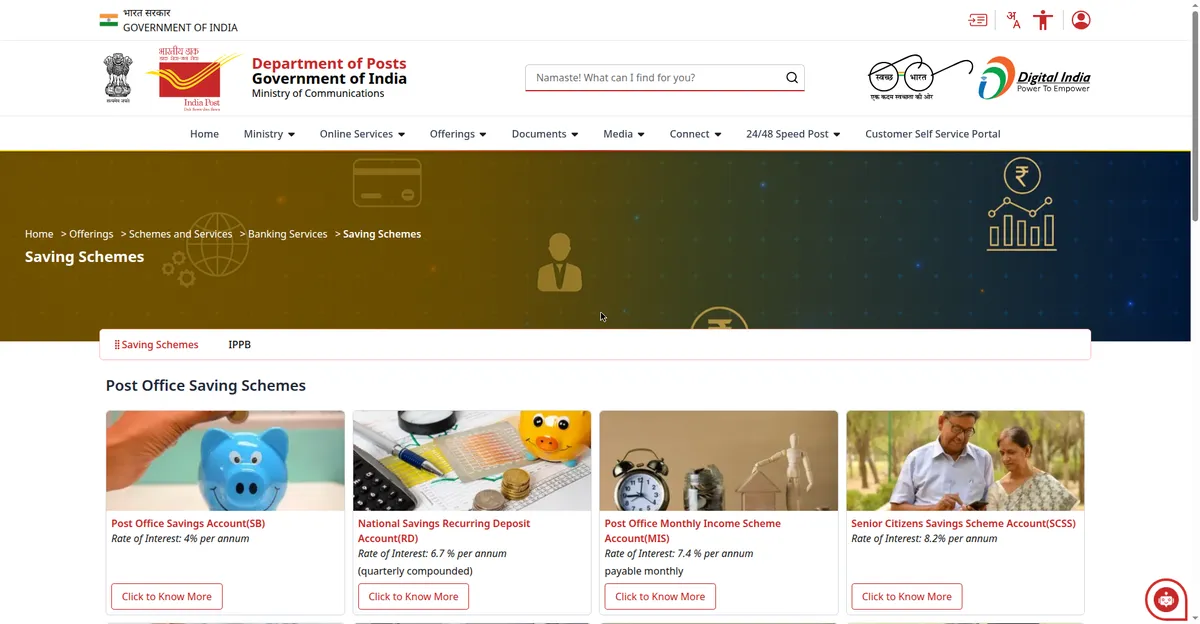
Post Office Interest Rates 2026 (October–December Quarter)
The government reviews small savings interest rates every quarter. For the October–December 2026 quarter (Q3 of FY 2026-27), the Finance Ministry has kept all rates unchanged — the 10th consecutive quarter without any change, as per the official notification dated September 30, 2026.
Here are the current rates at a glance:
| Post Office Scheme | Interest Rate (Oct–Dec 2026) |
|---|---|
| Senior Citizens Savings Scheme (SCSS) | 8.2% |
| Sukanya Samriddhi Yojana (SSY) | 8.2% |
| National Savings Certificate (NSC) | 7.7% |
| Kisan Vikas Patra (KVP) | 7.5% (doubles in 115 months) |
| 5-Year Time Deposit | 7.5% |
| Monthly Income Scheme (MIS) | 7.4% |
| Public Provident Fund (PPF) | 7.1% |
| 3-Year Time Deposit | 7.1% |
| 2-Year Time Deposit | 7.0% |
| 1-Year Time Deposit | 6.9% |
| 5-Year Recurring Deposit (RD) | 6.7% |
| Post Office Savings Account | 4.0% |
SCSS and SSY share the top spot at 8.2% — but both have strict eligibility rules. SCSS is only for senior citizens, and SSY is only for a girl child below 10 years of age. For everyone else, NSC at 7.7% is the highest open-to-all rate.
Compare All Post Office Schemes 2026: Complete Table
Interest rate alone does not tell the full story. Lock-in period, tax treatment, and payout style matter just as much. This table puts all 9 post office schemes side by side so you can compare everything in one place:
| Scheme | Interest Rate | Min / Max Deposit | Tenure | Interest Payout | Tax Benefit | Best For |
|---|---|---|---|---|---|---|
| PPF (Public Provident Fund) | 7.1% compounded yearly | ₹500 – ₹1.5 lakh / year | 15 years | On maturity | EEE (fully tax-free) | Long-term tax-free wealth |
| NSC (National Savings Certificate) | 7.7% compounded yearly | ₹1,000 minimum, no maximum | 5 years | On maturity | 80C on investment | 5-year tax saving |
| KVP (Kisan Vikas Patra) | 7.5% compounded yearly | ₹1,000 minimum, no maximum | 115 months | On maturity (doubles money) | No 80C; interest taxable | Simple doubling of money |
| SCSS (Senior Citizens Savings Scheme) | 8.2% per annum | ₹1,000 – ₹30 lakh | 5 years (extendable 3 yrs) | Quarterly | 80C; interest taxable | Retirees (60+) |
| SSY (Sukanya Samriddhi Yojana) | 8.2% compounded yearly | ₹250 – ₹1.5 lakh / year | 21 years (deposits 15 yrs) | On maturity | EEE (fully tax-free) | Girl child education |
| MIS (Monthly Income Scheme) | 7.4% per annum | ₹1,000 – ₹9 lakh (single) / ₹15 lakh (joint) | 5 years | Monthly | No 80C; interest taxable | Regular monthly income |
| TD (Time Deposit) | 6.9% (1-yr) / 7.0% (2-yr) / 7.1% (3-yr) / 7.5% (5-yr) | ₹1,000 minimum, no maximum | 1, 2, 3 or 5 years | Yearly | 80C on 5-yr TD only | Short to medium term |
| RD (Recurring Deposit) | 6.7% compounded quarterly | ₹100 / month minimum, no maximum | 5 years | On maturity | No 80C; interest taxable | Small monthly savings habit |
| PO Savings Account | 4.0% per annum | ₹500 minimum, no maximum | No lock-in | Credited yearly | Interest up to ₹10,000 exempt u/s 80TTA | Emergency / liquid cash |
Tip: on mobile, scroll the table sideways to see all columns.
All 9 Post Office Schemes Explained in Detail
Now let us look at each scheme closely — who can open it, how the money grows, and the fine print you should know before investing.
1. Public Provident Fund (PPF) — 7.1%
PPF is the most popular long-term savings scheme in India, and for good reason: it is one of the few investments with EEE tax status — your deposits get 80C deduction, the interest is tax-free, and the maturity amount is tax-free too.
- Who can open: Any Indian resident (one account per person)
- Deposit: Minimum ₹500 per year, maximum ₹1.5 lakh per year
- Tenure: 15 years, extendable in blocks of 5 years
- Example: Investing ₹1.5 lakh every year for 15 years at 7.1% grows to approximately ₹40.7 lakh — completely tax-free
- Withdrawals: Partial withdrawal allowed from the 7th year; loan facility from the 3rd to 6th year
For a 30% tax-bracket investor, PPF’s tax-free 7.1% works out to roughly the same as earning over 10% in a fully taxable instrument. That is why financial planners rarely suggest anything else for the debt portion of a long-term portfolio.
2. National Savings Certificate (NSC) — 7.7%
NSC is the best 5-year tax-saving option in the post office basket. The interest compounds annually and is paid out at maturity, which keeps things simple.
- Who can open: Any Indian resident; minors through guardians
- Deposit: Minimum ₹1,000, no maximum limit
- Tenure: 5 years, fixed
- Example: ₹1 lakh invested today becomes approximately ₹1,44,903 after 5 years
- Tax: Investment qualifies for 80C deduction. The yearly interest is deemed reinvested, so it also earns 80C benefit (except in the final year, when it is taxable)
- Withdrawals: No premature withdrawal except on death of the holder or court order — so invest only money you will not need for 5 years
3. Kisan Vikas Patra (KVP) — 7.5%
KVP is the simplest scheme to understand: your money doubles in a fixed period. At the current 7.5% rate, any amount you invest doubles in 115 months (about 9 years and 7 months).
- Who can open: Any Indian resident, including minors
- Deposit: Minimum ₹1,000, no maximum limit
- Tenure: 115 months (fixed by the notified rate)
- Tax: No 80C benefit; the interest is fully taxable as per your slab
- Withdrawals: Premature encashment allowed after 30 months
KVP works well if you want a no-fuss, guaranteed doubling of money without tracking yearly deposits. The trade-off is the tax treatment — there are better options if you are specifically saving tax.

4. Senior Citizens Savings Scheme (SCSS) — 8.2%
SCSS offers the highest interest rate among all post office schemes at 8.2%, paid out every quarter as regular income. A ₹5 lakh deposit earns ₹10,250 every three months — that is ₹41,000 a year hitting your account like clockwork.
- Who can open: Indian residents aged 60 and above (55+ if retired on superannuation or VRS)
- Deposit: Minimum ₹1,000, maximum ₹30 lakh
- Tenure: 5 years, extendable once by 3 years
- Tax: Investment qualifies for 80C; interest is taxable, and TDS applies if yearly interest crosses ₹50,000
- Withdrawals: Premature closure allowed after 1 year (1.5% penalty) and after 2 years (1% penalty)
For retirees, very few instruments beat this combination of safety, quarterly income, and 8.2% returns. Bank FDs for senior citizens rarely cross 7.5% in 2026.
5. Sukanya Samriddhi Yojana (SSY) — 8.2%
SSY matches SCSS at 8.2% and adds full EEE tax exemption on top — making it arguably the single best small savings scheme in India for those who are eligible.
- Who can open: Parents/guardians of a girl child below 10 years (one account per girl, maximum two accounts per family)
- Deposit: Minimum ₹250 per year, maximum ₹1.5 lakh per year, for 15 years
- Tenure: 21 years from account opening (or marriage of the girl after 18)
- Example: ₹1.5 lakh invested yearly for 15 years grows to over ₹65 lakh at maturity — entirely tax-free
- Withdrawals: 50% of the balance can be withdrawn after the girl turns 18 for education expenses
- Tax: EEE — deposits, interest, and maturity all tax-free
If you have a daughter under 10, opening an SSY account is close to a no-brainer. No other government scheme combines 8.2% with complete tax exemption.
6. Post Office Monthly Income Scheme (MIS) — 7.4%
MIS does exactly what its name says: it pays you interest every month. Invest a lump sum once, and receive a fixed monthly payout for 5 years, with your principal returned at the end.
- Who can open: Any Indian resident
- Deposit: Minimum ₹1,000; maximum ₹9 lakh (single account) or ₹15 lakh (joint account)
- Tenure: 5 years
- Example: A ₹9 lakh single deposit pays approximately ₹5,550 every month for 5 years
- Tax: No 80C benefit; monthly interest is taxable as per your slab (no TDS is deducted)
- Withdrawals: Premature closure between 1–3 years costs a 2% deduction; after 3 years, 1%
MIS suits retirees and conservative investors who want a predictable monthly income without touching their principal. Think of it as creating your own monthly salary from your savings.
7. Post Office Time Deposit (TD) — 6.9% to 7.5%
The post office TD works like a bank FD with tenures of 1, 2, 3, and 5 years. The longer you lock in, the higher the rate — the 5-year TD at 7.5% currently beats most large banks’ FD rates.
- Who can open: Any Indian resident
- Deposit: Minimum ₹1,000, no maximum limit
- Rates: 1-year 6.9% | 2-year 7.0% | 3-year 7.1% | 5-year 7.5%
- Tax: Only the 5-year TD qualifies for 80C deduction; interest on all TDs is taxable
- Withdrawals: Premature closure allowed with penalty — interest is reduced as per rules for the completed period
Interesting fact: in October 2026, the 1-year post office TD at 6.9% pays more than SBI, HDFC Bank, ICICI Bank, and Axis Bank FDs of similar tenure. For pure safety seekers, that is worth knowing.
8. Post Office Recurring Deposit (RD) — 6.7%
RD is the classic “start small, stay disciplined” scheme. Deposit a fixed amount every month for 5 years and watch it compound quarterly.
- Who can open: Any Indian resident
- Deposit: Minimum ₹100 per month (in multiples of ₹10), no maximum
- Tenure: 5 years
- Example: ₹5,000 per month for 5 years at 6.7% grows to approximately ₹3.56 lakh
- Tax: No 80C benefit; interest is taxable
- Withdrawals: Premature closure allowed after 3 years
RD will not make you rich, but it builds the savings habit — and for first-time savers, that habit matters more than the rate.
9. Post Office Savings Account — 4.0%
The basic savings account pays 4% per annum — modest, but it keeps your emergency cash liquid and accessible, with interest up to ₹10,000 exempt under Section 80TTA.
- Who can open: Any Indian resident
- Deposit: Minimum ₹500 to open, no maximum
- Tenure: No lock-in — withdraw anytime
Which Post Office Scheme Is Best for You?
Instead of asking “which scheme gives the highest rate,” ask “which scheme fits my goal.” Here is a straight answer for the five most common goals:
Goal 1: Retirement planning (20–30 year horizon)
Best pick: PPF. Nothing beats 15 years of tax-free compounding for retirement. A 30-year-old investing ₹1.5 lakh yearly could build a tax-free corpus of around ₹40 lakh by 45, then extend in 5-year blocks. If you are already 60+, SCSS at 8.2% with quarterly payouts is the obvious choice.
Related reading: if retirement income is your focus, also check our guide on Atal Pension Yojana for a government-backed monthly pension option.
Goal 2: Daughter’s education or marriage
Best pick: SSY, no contest. 8.2% plus full tax exemption over 21 years is unmatched. Start early — every year you delay is compounding you lose forever. Even ₹25,000 a year from the time your daughter is born builds a serious education fund.
Goal 3: Regular monthly income
Best pick: MIS at 7.4%. It is built for exactly this — park a lump sum, collect monthly interest, get your principal back after 5 years. Senior citizens can alternatively use SCSS for higher quarterly payouts.
Goal 4: Saving tax under 80C
Best picks: PPF, NSC, or 5-year TD. PPF wins if you have a 15-year horizon (tax-free maturity). NSC wins for a fixed 5-year commitment. The 5-year TD works if you want FD-style simplicity with 80C benefit. Remember the overall 80C limit is ₹1.5 lakh per year across all instruments.
Goal 5: Short-term parking (1–3 years)
Best pick: 1-year or 3-year TD. At 6.9–7.1%, these currently beat most big-bank FDs while carrying zero risk. Do not lock short-term money in NSC or PPF — the lock-ins will trap you.
Post Office Schemes vs Bank FD in 2026
This is the comparison everyone asks about. Here is how they stack up right now:
| Factor | Post Office Schemes | Bank FDs (Large Banks, Oct 2026) |
|---|---|---|
| Best rates | Up to 8.2% (SCSS/SSY) | 6.3%–7.0% (SBI, HDFC, ICICI) |
| Safety | Sovereign guarantee (Government of India) | DICGC insured up to ₹5 lakh per bank |
| Tax perks | PPF/SSY fully tax-free; others get 80C | Only 5-year tax-saver FD gets 80C |
| Flexibility | Fixed tenures, limited premature exit | Tenures from 7 days; easier premature withdrawal |
| Best for | Guaranteed, tax-efficient long-term growth | Short-term parking with easy liquidity |
The honest summary: post office schemes win on rates and tax benefits for money you can lock away. Bank FDs win on flexibility for money you might need soon. Most smart savers use both — post office for goals, bank FDs for emergencies.
Tax Benefits on Post Office Schemes: EEE vs 80C Explained
Tax treatment can change your real returns dramatically, so understand these two terms:
- EEE (Exempt-Exempt-Exempt): Only PPF and SSY have this. Your investment is exempt (80C deduction), the interest is exempt, and the maturity amount is exempt. Zero tax at every stage.
- 80C deduction: NSC, SCSS, and 5-year TD investments qualify for deduction up to ₹1.5 lakh per year — but the interest earned is taxable as per your income slab.
- Fully taxable: KVP, MIS, RD, and 1/2/3-year TD offer no deduction, and interest is taxed at your slab rate.
Why does this matter? Take PPF at 7.1% tax-free versus a taxable 7.5% instrument. For someone in the 30% slab, the taxable 7.5% leaves only about 5.25% after tax — PPF wins easily despite the lower headline rate. Always compare post-tax returns, not headline rates.
Want Higher Returns Than Post Office Schemes?
Let us be straight with you: post office schemes are unbeatable for safety, but 7–8% will not build serious wealth over decades. Inflation eats a chunk of it, and taxes eat more on most schemes.
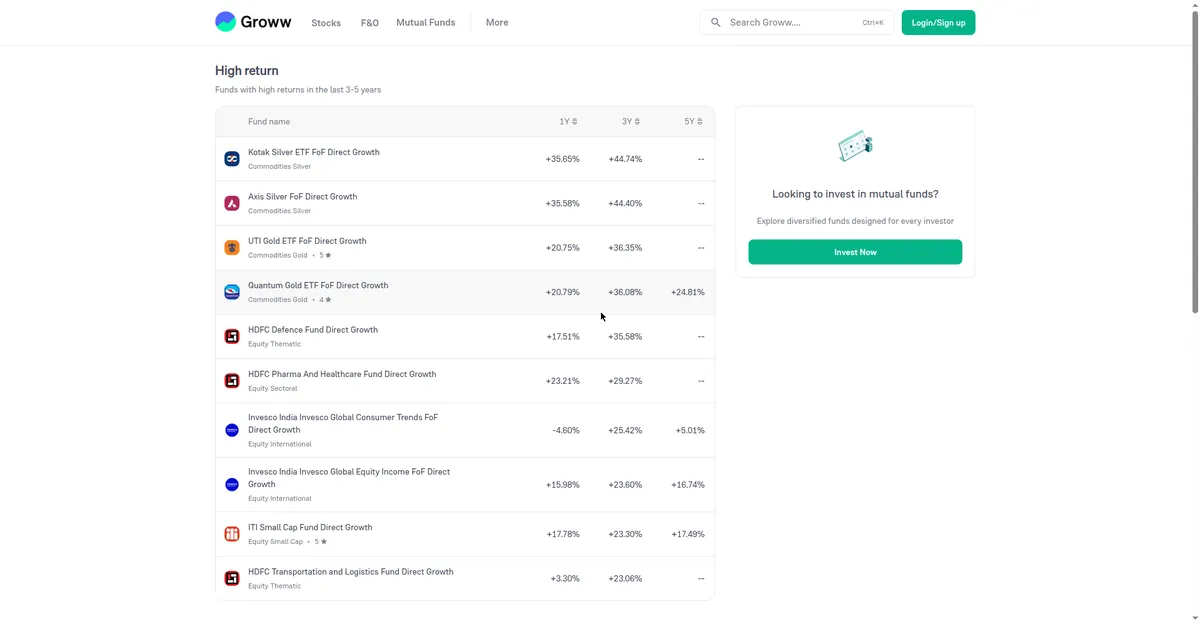
If you have a horizon of 7+ years and can tolerate market ups and downs, equity mutual funds through SIPs have historically delivered 10–12% annualised over long periods. Many investors split their money: post office schemes for the safe, guaranteed portion, and mutual funds for the growth portion.
To invest in mutual funds or stocks, you need a demat account — brokers like Upstox and Zerodha let you open one online in minutes with zero or low account opening charges. A common approach: keep your emergency fund and short-term goals in post office schemes, and run a monthly SIP for long-term wealth creation.
How to Open a Post Office Scheme Account in 2026
Opening any of these accounts is straightforward:
- Visit your nearest post office with Aadhaar card, PAN card, and two passport-size photographs (some schemes can also be opened online via India Post internet banking).
- Fill the account opening form for the scheme you have chosen and submit your KYC documents.
- Make your first deposit — by cash, cheque, or online transfer — meeting the scheme’s minimum amount.
- Collect your passbook or account statement as proof. For PPF and SSY, you can also manage the account online once linked.
Keep your nomination details updated — it saves your family enormous hassle later.
Frequently Asked Questions
Which post office scheme gives the highest interest rate in 2026?
SCSS (Senior Citizens Savings Scheme) and SSY (Sukanya Samriddhi Yojana) offer the highest rate at 8.2% per annum for the October–December 2026 quarter. However, SCSS is restricted to senior citizens and SSY to girl children below 10. For general investors, NSC at 7.7% is the highest available rate.
Is PPF better than NSC?
It depends on your horizon. PPF (7.1%, 15 years, fully tax-free) is better for long-term retirement savings. NSC (7.7%, 5 years) gives a higher rate but a shorter tenure, and only the investment (not the interest) gets 80C benefit. For 15-year goals, PPF’s tax-free compounding usually wins on post-tax returns.
Can I open multiple post office scheme accounts?
Yes — you can hold different schemes simultaneously (for example, PPF + NSC + 5-year TD). The main restriction is one PPF account per person and one SSY account per eligible girl child. SCSS has a combined maximum of ₹30 lakh across all your SCSS accounts.
Are post office schemes really 100% safe?
Yes. All post office small savings schemes carry the sovereign guarantee of the Government of India — your principal and declared interest are backed by the government itself, making them among the safest investments available in the country.
What happens to my post office scheme if interest rates change?
Rates are reviewed quarterly, but your existing deposits keep the rate that applied when you opened the account (for fixed-rate schemes like NSC, KVP, SCSS, MIS, and TDs). Only new deposits get the revised rate. PPF and SSY rates apply to the entire balance each quarter.
Post office RD vs bank RD — which is better?
The post office 5-year RD at 6.7% (compounded quarterly) is competitive with most bank RDs in 2026, and carries a sovereign guarantee. Compare the exact rate your bank offers before deciding — but for most savers, the difference is small enough that convenience should decide.
Final Word
Post office schemes remain the backbone of safe investing in India — and in 2026, with rates frozen at attractive levels for 10 straight quarters, they are paying more than most bank FDs while keeping your money 100% secure.
The right choice comes down to your goal: SSY for your daughter, SCSS for retirement income, PPF for tax-free long-term wealth, NSC for 5-year tax saving, and MIS for monthly payouts. Match the scheme to the goal, stay invested for the full tenure, and let compounding do the heavy lifting.
Bookmark this page — interest rates are reviewed every quarter, and this guide is updated with the latest notified rates so you always see current numbers.