
When my neighbor in Lucknow had her second daughter last year, the first question relatives asked wasn’t about the baby’s health. It was about money. “Ab do betiyon ki padhai ka kharcha kaise chalega?” That one sentence stayed with me, because it captures exactly why the kanya sumangala yojana exists. Uttar Pradesh’s government is putting real cash — ₹25,000 per girl, in six installments — directly into the bank accounts of eligible families, from the day a daughter is born till the day she walks into college. If you’re a parent in UP, this is one scheme you genuinely should not miss.
✅ This guide is based on official government sources and notifications. Last verified: October 15, 2026. Scheme details, eligibility criteria, and benefit amounts are revised by the government from time to time — always cross-check the latest information on the official portal before applying.
What Is the Kanya Sumangala Yojana?
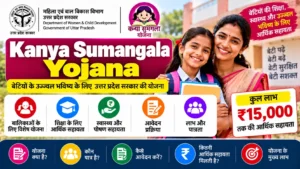
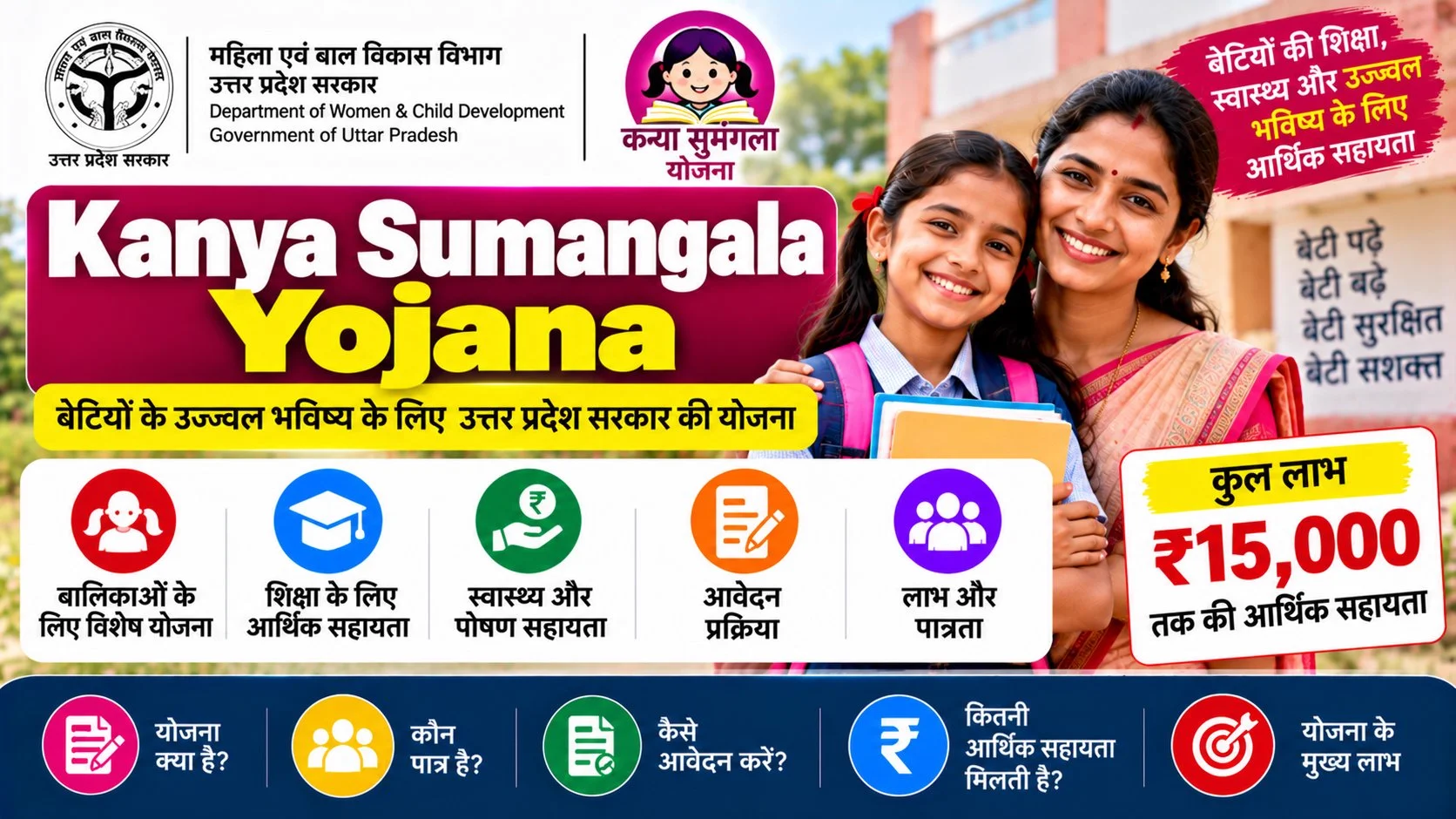
The Mukhyamantri Kanya Sumangala Yojana, usually shortened to MKSY, is Uttar Pradesh’s flagship conditional cash transfer scheme for girl children. Chief Minister Yogi Adityanath launched it on October 25, 2019, and the Department of Women Welfare, Government of UP, runs it.
The idea is simple and honest. Families in UP — especially those with modest incomes — often see a daughter’s birth as a financial burden. The government decided to flip that thinking: every time your daughter crosses a milestone in life, from her first vaccination to her college admission, money lands in your account. That small shift changes how families plan for their daughters.
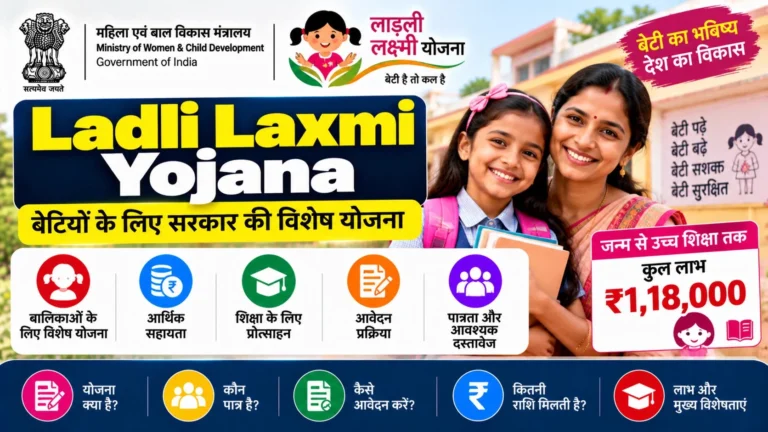
When I first started looking into girl-child schemes across states, I’ll admit I mixed this one up with Madhya Pradesh’s Ladli Lakshmi Yojana. They sound similar, but they are different schemes with different rules. Kanya Sumangala is strictly for Uttar Pradesh re
One final tip about Kanya Sumangala Yojana: apply for each Kanya Sumangala Yojana stage as soon as your daughter qualifies. Don’t wait to claim multiple Kanya Sumangala Yojana installments together — timely Kanya Sumangala Yojana applications get processed faster.
Want to check your Kanya Sumangala Yojana status? Visit mksy.up.gov.in and log in with your registered mobile number. The Kanya Sumangala Yojana portal shows whether your Kanya Sumangala Yojana application is pending, approved, or needs correction.
Quick Kanya Sumangala Yojana recap: Kanya Sumangala Yojana pays ₹25,000 in six stages from birth to graduation, for up to two daughters per UP family. If your daughter was born after April 2019, Kanya Sumangala Yojana money is waiting — share this Kanya Sumangala Yojana guide with eligible parents.
Bookmark this Kanya Sumangala Yojana guide and apply for the Kanya Sumangala Yojana stage your daughter qualifies for today.
sidents, and its ₹25,000 payout structure is unique. In my experience researching these schemes, MKSY is one of the better-designed ones because the money follows the girl through her entire education journey instead of arriving as a single lump sum that gets spent on anything else.
The total assistance was originally ₹15,000 when the scheme launched. In the financial year 2024-25, the UP government raised it to ₹25,000. That’s a serious jump — nearly 67% more — and it tells you the state is committed to the program. All payments go through DBT (Direct Benefit Transfer) into an Aadhaar-linked bank account, so there are no middlemen.
Kanya Sumangala Yojana Amount: ₹25,000 in 6 Installments
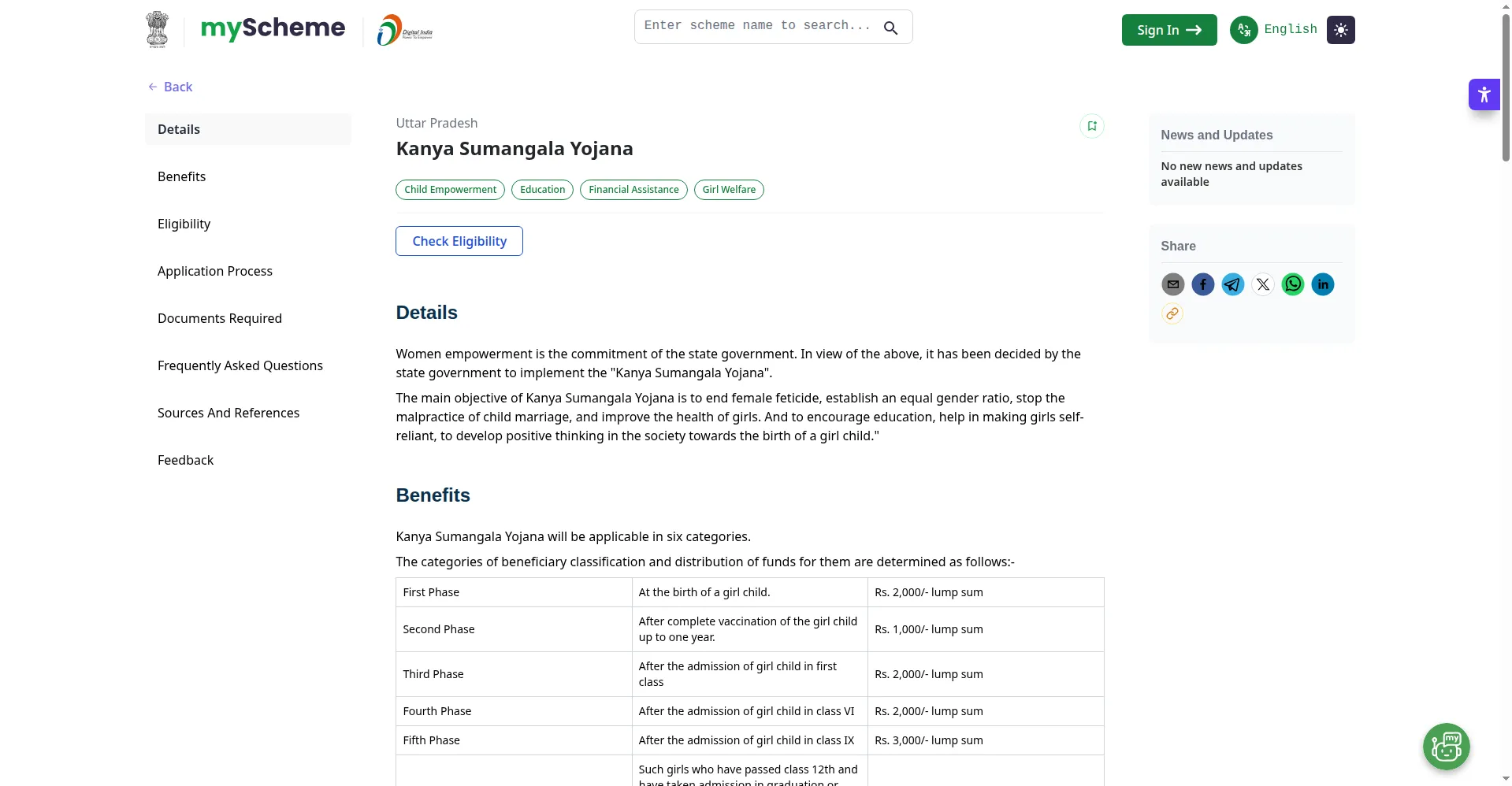
This is the part most people search for, so let me lay it out clearly. The ₹25,000 is not paid at once. It arrives in six stages, each tied to a milestone in your daughter’s life:
| Stage | Milestone | Amount |
|---|---|---|
| 1 | Birth of the girl child | ₹5,000 |
| 2 | Completing full vaccination by age 1 | ₹2,000 |
| 3 | Admission to Class 1 | ₹3,000 |
| 4 | Admission to Class 6 | ₹3,000 |
| 5 | Admission to Class 9 | ₹5,000 |
| 6 | Admission to graduation or diploma course | ₹7,000 |
Notice how the amounts grow as the girl gets older. The last installment — ₹7,000 for college or diploma admission — is the biggest, because that’s exactly the stage where most girls in low-income families drop out. The design nudges parents to keep their daughters studying.
One thing I want to be straight about: you don’t get all six installments automatically. You apply stage by stage, and each claim needs its own documents (like the vaccination card for stage 2 or the school admission proof for stage 3). I’ll walk you through that below.
Why This Scheme Matters More Than It Looks
UP has one of the largest populations in India, and historically one of the trickiest sex ratios. The scheme’s objectives go beyond money: end female foeticide, improve the birth rate of girls, cut child marriage, improve girls’ health and nutrition, and keep girls in school.
The numbers suggest it’s working at scale. As of early 2026, more than 26.81 lakh girls have benefited, and the UP budget for 2026-27 set aside ₹400 crore for the scheme. That’s not a pilot project — that’s a program running at full speed.
Here’s something most articles skip: because the payments are conditional on milestones like vaccination and school admission, the scheme quietly pushes families toward better health and education behavior. The ₹2,000 at age one only comes if the full vaccination schedule is complete. That single condition has probably done more for infant immunization in UP’s low-income families than a dozen awareness campaigns.
Kanya Sumangala Yojana Eligibility: Who Can Apply?
Before you get excited about the ₹25,000, check these conditions carefully. The scheme is strict about them, and applications get rejected when even one is missed:
- Permanent resident of Uttar Pradesh. The girl child and the family must be permanent residents of UP. You’ll need proof — ration card, Aadhaar card, voter ID, or a domicile certificate.
- Family income up to ₹3 lakh per year. Your family’s total annual income must not exceed ₹3,00,000. An income certificate is mandatory.
- Maximum two daughters per family. Benefits cover up to two girl children per family. There’s an exception: if a family has one girl child first and then twin girls in the second delivery, all three girls are eligible.
- Girl born on or after April 1, 2019. The scheme covers girls born from this date onward.
- Legally adopted daughters count. A daughter adopted through proper legal process is fully eligible.
- Aadhaar-linked bank account. Payments come via DBT, so the beneficiary’s bank account must be linked with Aadhaar.
- Stage-wise conditions. For education-linked installments, the girl must be enrolled in a recognized school or college.
A common confusion I keep seeing: people ask whether the family can have sons too. The rule is about the number of daughters covered — up to two girls per family can get the benefit. The twin exception is the only way a third girl qualifies.
Documents Required for Kanya Sumangala Yojana
Keep these ready before you start the online application. Missing documents are the number one reason applications stall:
- Aadhaar card of the parent/guardian and the girl child
- Birth certificate of the girl child
- Income certificate (family income up to ₹3 lakh)
- Residence or domicile certificate of Uttar Pradesh
- Passport-size photograph of the girl child
- Vaccination card (for the stage-2 claim)
- Bank passbook copy (Aadhaar-linked account)
- School admission certificate (for Class 1, 6, 9, and graduation-stage claims)
Pro tip from my research: get the income certificate and domicile certificate made before you sit down to apply. These two take the longest to obtain from the tehsil office, and everything else you probably already have at home.
How to Apply Online for Kanya Sumangala Yojana (Step by Step)
The official portal is mksy.up.gov.in. You can also apply offline through Common Service Centres (CSC) or Anganwadi centers, but online is faster and you can track everything yourself. Here’s the full process:
Step 1: Register on the Portal
Go to mksy.up.gov.in and look for the citizen registration or login section. New users need to register with a mobile number. You’ll get an OTP — keep your phone handy.
Step 2: Fill in Personal and Family Details
Enter the applicant’s details (usually the mother or guardian), family information, and the girl child’s details exactly as they appear on official documents. Spelling mismatches between your application and the Aadhaar card are a classic rejection trigger, so double-check every name.
Step 3: Select the Benefit Stage
Choose which installment you’re claiming — birth, vaccination, Class 1, Class 6, Class 9, or graduation/diploma admission. You can only claim the stage your daughter currently qualifies for.
Step 4: Upload Documents
Upload clear scans or photos of all required documents. Blurry uploads get rejected, so take the photos in good light and check each one before submitting.
Step 5: Submit and Note Your Application Number
After submitting, you’ll get an application or registration number. Save it — you’ll need it to check your kanya sumangala yojana status later.
Step 6: Track Status Online
Log back into mksy.up.gov.in anytime to see whether your application is pending, approved, or if the department has asked for corrections.
If online feels overwhelming, walk into your nearest Jan Seva Kendra (CSC) with your documents. They’ll file it for you for a small service fee. Anganwadi workers in your area can also guide you — this scheme runs through the Women Welfare Department, and they know the process well.
Kanya Sumangala Yojana Status Check
After applying, checking your status is simple:
- Visit mksy.up.gov.in.
- Log in with your registered mobile number and OTP.
- Go to the application dashboard or status section.
- You’ll see whether your application is under verification, approved, or if documents need correction.
If your application shows “objection” or “correction required,” don’t panic. It usually means a document was unclear or a detail didn’t match. Fix it and re-upload — most such cases get cleared in the next verification round.
How Kanya Sumangala Compares With Other Girl-Child Schemes
UP isn’t the only state doing this. Here’s how MKSY stacks up against two well-known alternatives, so you can see what makes it different:
| Feature | Kanya Sumangala (UP) | Ladli Lakshmi (MP) | Sukanya Samriddhi (Central) |
|---|---|---|---|
| Type | Direct cash benefit | Direct cash benefit | Savings account (you deposit) |
| Total benefit | ₹25,000 | ₹1,43,000 | Depends on deposits + interest |
| Income limit | ₹3 lakh/year | Non-taxpayer families | None |
| Who pays | Government pays you | Government pays you | You save, govt adds interest |
| Best for | UP families needing milestone support | MP families | Any family that can save regularly |
The smart move? If you’re in UP and eligible, take the Kanya Sumangala money and open a Sukanya Samriddhi account for long-term savings. They don’t conflict — one is free government money, the other is your own disciplined saving with tax-free interest. Together they build a solid fund for your daughter’s future.
Families in Madhya Pradesh reading this should look at the Ladli Behna Yojana instead — different state, different scheme, but the same spirit of supporting women financially.
How the Money Actually Reaches You: DBT Explained
A lot of parents ask me, “paisa aayega kaise?” Fair question. Every Kanya Sumangala installment travels through DBT — Direct Benefit Transfer. That means the Women Welfare Department pushes the money straight from the government treasury into the beneficiary’s bank account. No agent, no middleman, no cash handover at any office.
For DBT to work, three things must line up: your bank account must be active, it must be linked with the Aadhaar number given in the application, and the name on the bank account should match the applicant’s name. If any of these is off, the payment bounces back and your status shows a payment failure. The fix is simple — visit your bank branch, link Aadhaar, and the department re-initiates the transfer in the next payment cycle.
Payments are processed in batches, not instantly on approval. So if your application shows “approved” but the money hasn’t arrived, give it a few weeks before worrying. The PFMS (Public Financial Management System) handles the actual transfer, and batch cycles can take time, especially around quarter-ends when volumes are high.
Special Cases: Twins and Adopted Daughters
Two situations confuse people the most, so let me clear them up.
Twins: Normally only two daughters per family are covered. But if your first child was a single girl and your second delivery brought twin girls, the scheme makes an exception — all three daughters become eligible. This is the only way a family can claim for three girls. Twin boys, or twins in the first delivery followed by another girl, don’t get this exception under the stated rules.
Adopted daughters: A girl child adopted through the legal process is treated exactly like a biological daughter under this scheme. You’ll need the legal adoption deed or court order as an extra document. Informal or unregistered “adoptions” don’t qualify — the paperwork must be legal and complete.
In both cases, apply through the same mksy.up.gov.in portal and mention the special circumstance clearly in the application. The verification officer will ask for the supporting documents, so keep them ready upfront rather than waiting for an objection.
Common Reasons Applications Get Rejected
I’ve gone through enough scheme forums to spot the patterns. Avoid these:
- Income above ₹3 lakh. Even slightly over the limit disqualifies you. The income certificate is verified.
- Name mismatches. The girl’s name spelled differently on the birth certificate vs. Aadhaar vs. application form.
- Wrong stage claimed. Applying for the Class 6 installment when your daughter is in Class 5, for example.
- Non-Aadhaar-linked bank account. DBT fails silently if the account isn’t linked. Link it first.
- Blurry document uploads. The verification officer can’t read it, so it gets sent back.
- Applying for a third daughter (without the twin exception).
Helpline and Official Contacts
If you’re stuck, the scheme has official helplines: 1800-833-0100 and 1800-180-0300 (toll-free). You can also visit the District Women Welfare Office in your district — every district in UP has one, and they handle MKSY queries directly.
The only official website is mksy.up.gov.in. Be careful of lookalike sites asking for money or “registration fees.” The government never charges a fee to apply for this scheme. If anyone asks for payment to “approve” your application, that’s a scam — report it.
Frequently Asked Questions
What is the total amount given under Kanya Sumangala Yojana?
A total of ₹25,000 per eligible girl child, paid in six installments from birth to graduation or diploma admission. The amount was raised from ₹15,000 to ₹25,000 in 2024-25.
Who is eligible for Kanya Sumangala Yojana?
Permanent resident families of Uttar Pradesh with annual income up to ₹3 lakh, for up to two daughters per family (three in the twin exception case). The girl must have been born on or after April 1, 2019, and the family needs an Aadhaar-linked bank account.
How can I apply online for Kanya Sumangala Yojana?
Register on the official portal mksy.up.gov.in, fill in personal and family details, select the benefit stage, upload documents, and submit. You can also apply offline at CSC centres or through Anganwadi workers.
How do I check my Kanya Sumangala Yojana status?
Log in to mksy.up.gov.in with your registered mobile number and OTP, then open the application dashboard to see whether your application is pending, approved, or needs correction.
Can I apply for my third daughter?
Only in one exception: if your first delivery was a single girl and the second delivery was twin girls, all three are eligible. Otherwise, the limit is strictly two daughters per family.
Is there any fee to apply?
No. Applying for Kanya Sumangala Yojana is completely free. Never pay anyone who claims they can get your application approved for a fee.
Final Thoughts
The kanya sumangala yojana won’t make anyone rich — ₹25,000 spread over 18 years is modest. But that’s missing the point. The scheme’s real power is behavioral: it rewards the birth of a girl, rewards her vaccination, and rewards every school admission. Each installment is the government saying, “keep going, she’s worth it.”
If you’re an eligible parent in UP, apply for the stage your daughter qualifies for right now, and set a reminder for the next one. Pair it with a Sukanya Samriddhi account for long-term growth. And if this guide helped you, share it with another family in UP who might not know the scheme exists — that one share could be worth ₹25,000 to someone’s daughter.
Read also: Sukanya Samriddhi Yojana 2026 | NSP Scholarship Apply Online | Vahali Dikri Yojana