
What happens to a farmer’s income when they turn 60 and can no longer work the fields? For most of us with salaried jobs, there’s a PF or pension plan running quietly in the background. For a small farmer with two acres of land, there was nothing — until the government stepped in with a pension scheme built specifically for them.
✅ This guide is based on official government sources and notifications. Last verified: October 15, 2026. Scheme details, eligibility criteria, and benefit amounts are revised by the government from time to time — always cross-check the latest information on the official portal before applying.
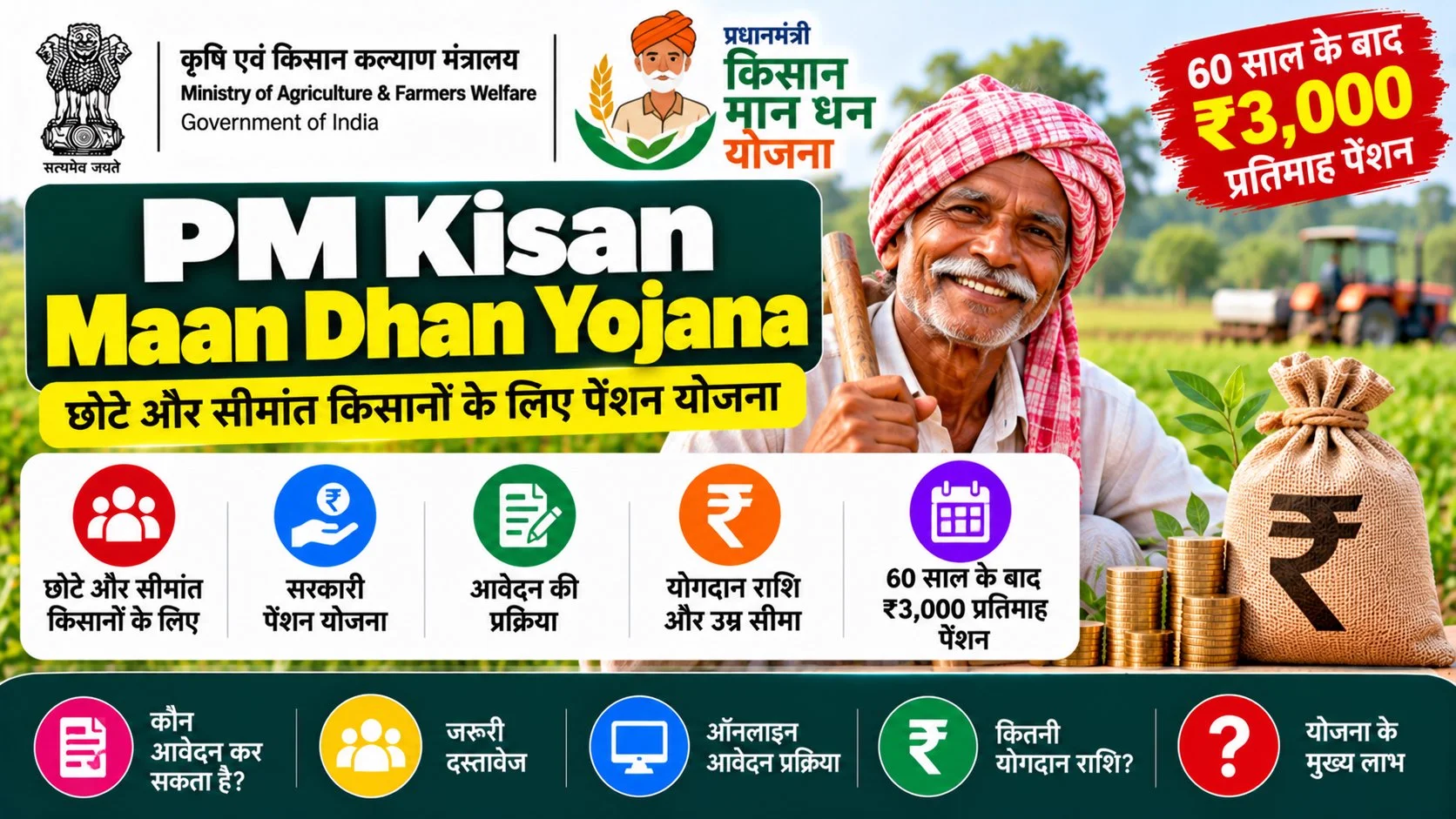
The PM Kisan Maan Dhan Yojana (PM-KMY) promises a fixed ₹3,000 every month after the age of 60 to small and marginal farmers. The farmer contributes a small amount every month — starting at just ₹55 — and the government matches it rupee for rupee. It sounds almost too simple, so I went through the official scheme documents, the LIC pension fund details, and the enrolment process to figure out exactly how it works, who qualifies, and what the fine print says. Here’s everything in one place.
What Is PM Kisan Maan Dhan Yojana?
PM Kisan Maan Dhan Yojana is a voluntary and contributory pension scheme launched by the Government of India on September 12, 2019. It’s designed for one specific group: small and marginal farmers who own up to 2 hectares of cultivable land as per land records.
The deal is straightforward. You enrol between the ages of 18 and 40, pay a monthly contribution (₹55 to ₹200 depending on your entry age), and the Central Government contributes the exact same amount on your behalf. When you turn 60, you start receiving a guaranteed pension of ₹3,000 per month for life.
The pension fund is managed by the Life Insurance Corporation of India (LIC), which also handles the actual pension payouts. Think of it as the government and LIC running a retirement savings plan where your money is matched 100% — every rupee you put in is doubled before it even starts growing.
One more thing about PM Kisan Mandhan Yojana: the earlier you join PM Kisan Mandhan Yojana, the less you pay each month. An 18-year-old farmer pays just Rs 55 under PM Kisan Mandhan Yojana, while a 40-year-old pays Rs 200 — the PM Kisan Mandhan Yojana contribution chart rewards those who join PM Kisan Mandhan Yojana early.
Ready to enrol in PM Kisan Mandhan Yojana? Visit your nearest CSC and ask for PM Kisan Mandhan Yojana registration on the official maandhan.in portal. The PM Kisan Mandhan Yojana enrolment is free, takes about fifteen minutes, and your PM Kisan Mandhan Yojana Kisan Card is issued immediately.
Confused about PM Kisan Mandhan Yojana? The PM Kisan Mandhan Yojana helpline can guide you on PM Kisan Mandhan Yojana eligibility, PM Kisan Mandhan Yojana documents, or your PM Kisan Mandhan Yojana application status. Remember, PM Kisan Mandhan Yojana enrolment through CSC is completely free — never pay any agent for PM Kisan Mandhan Yojana registration.
Quick PM Kisan Mandhan Yojana recap: PM Kisan Mandhan Yojana gives Rs 3,000 every month after 60, the government matches your PM Kisan Mandhan Yojana contribution 1:1, and your spouse gets Rs 1,500 family pension. If you are a small or marginal farmer, PM Kisan Mandhan Yojana is the simplest pension available — share this PM Kisan Mandhan Yojana guide with fellow farmers.
Bookmark this PM Kisan Mandhan Yojana guide and check the PM Kisan Mandhan Yojana contribution chart for your entry age. PM Kisan Mandhan Yojana works best when combined with PM-KISAN — start your PM Kisan Mandhan Yojana enrolment at the nearest CSC today.
If you’re searching for “pm kisan mandhan yojana apply” or “kisan mandhan pension 3000”, this article covers the complete picture: eligibility, the contribution chart, how to register, what happens to your money in every scenario, and how it compares with other schemes.
PM-KMY at a Glance
| Feature | Details |
|---|---|
| Scheme name | Pradhan Mantri Kisan Maan Dhan Yojana (PM-KMY) |
| Launched | September 12, 2019 |
| Monthly pension | ₹3,000 (after age 60) |
| Entry age | 18 to 40 years |
| Monthly contribution | ₹55 to ₹200 (based on entry age) |
| Government contribution | Equal matching amount (50:50) |
| Pension fund manager | Life Insurance Corporation of India (LIC) |
| Who can join | Small & marginal farmers with up to 2 hectares of cultivable land |
| Family pension | 50% (₹1,500/month) to spouse after farmer’s death |
| Registration | Nearest Common Service Centre (CSC), free of charge |
PM Kisan Mandhan Eligibility: Who Can Join?
This is where most people get confused, so let’s be precise. The eligibility rules come straight from the official scheme guidelines.
You ARE eligible if:
- You are a small or marginal farmer with cultivable landholding of up to 2 hectares as per the land records of the concerned State/UT.
- Your age is between 18 and 40 years at the time of enrolment.
- You have a valid Aadhaar card and a savings bank account (or a PM-KISAN account).
You are NOT eligible if:
- You own more than 2 hectares of cultivable land (you’d count as a medium or large farmer).
- You are already covered under the National Pension System (NPS), Employees’ State Insurance Corporation (ESIC), or Employees’ Provident Fund Organisation (EPFO).
- You are an income taxpayer.
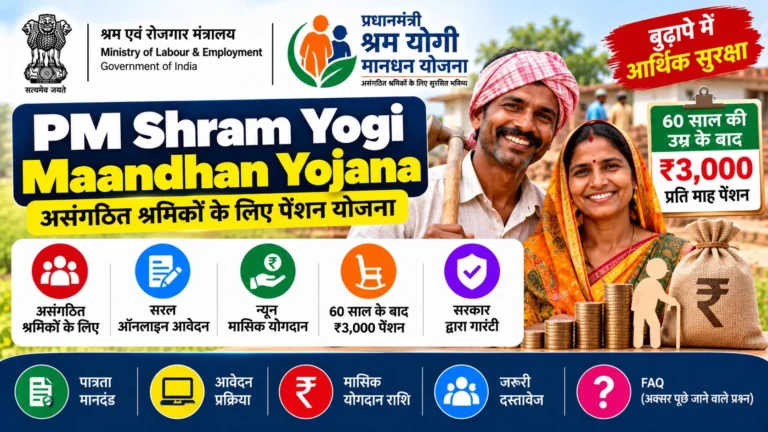
- You are already enrolled in the Pradhan Mantri Shram Yogi Maan Dhan Yojana (PM-SYM) or the Pradhan Mantri Laghu Vyapari Maan Dhan Yojana — you can only pick one of these government pension schemes.
One point worth noting: if both husband and wife are eligible farmers in their own right, each can enrol separately and each gets their own ₹3,000 pension. The spouse can also take a separate PM-KMY pension by making a separate contribution.
Kisan Mandhan Contribution Chart: How Much Do You Pay?
Your monthly contribution depends on one thing only: your age when you join. Join young, pay less. Join at 40, pay the maximum. Either way, the government adds the same amount on top.
Here are the official figures:
| Age at Entry | Your Monthly Contribution | Government Contribution | Total Credited/Month |
|---|---|---|---|
| 18 years | ₹55 | ₹55 | ₹110 |
| 20 years | ₹61 | ₹61 | ₹122 |
| 25 years | ₹80 | ₹80 | ₹160 |
| 30 years | ₹105 | ₹105 | ₹210 |
| 35 years | ₹150 | ₹150 | ₹300 |
| 40 years | ₹200 | ₹200 | ₹400 |
To put this in perspective: an 18-year-old farmer pays just ₹55 a month — less than ₹2 a day — and the government adds another ₹55. That’s ₹110 going into the pension fund every month for 42 years, and at 60 the farmer starts receiving ₹3,000 every single month. Even someone joining at 40 pays only ₹200 a month.
A few practical details about payments:
- The contribution falls due on the same date as your enrolment date every month.
- You don’t have to pay monthly if it’s inconvenient — you can choose to pay quarterly, half-yearly, or yearly.
- If you miss a payment, you can regularise it later by paying the outstanding amount along with applicable interest.
- If you are a PM-KISAN beneficiary, you have the option to let your PM-KMY contribution be auto-debited directly from your PM-KISAN bank account — no separate payment to remember. Read our PM Kisan 24th installment guide to keep your PM-KISAN account active, since that keeps this auto-debit option working smoothly.
PMKMY Benefits: What You Actually Get
Let’s go beyond the headline ₹3,000 figure and look at every benefit the scheme offers, including the scenarios nobody talks about.
1. Guaranteed ₹3,000 monthly pension
From the month you turn 60, you receive ₹3,000 every month for the rest of your life. This is a minimum assured pension — it doesn’t depend on market returns or interest rates. LIC manages the fund and disburses the pension.
2. 100% government matching
For every rupee you contribute, the Central Government contributes an equal amount. This 50:50 sharing effectively doubles your savings rate from day one — something no bank FD or private pension plan offers.
3. Family pension for your spouse
If the farmer passes away after starting to receive pension (after age 60), the spouse gets 50% of the pension — ₹1,500 per month — as family pension. This applies only to the spouse.
4. Spouse can continue the scheme
If the farmer dies before reaching 60, the spouse has the option to continue the scheme by paying the remaining contributions until the original vesting date. If there’s no spouse, or the spouse doesn’t continue, the total contribution plus interest is paid to the nominee.
5. Exit with your money back
Life is unpredictable, and the scheme accounts for that:
- If you exit within 10 years of joining, you get back your contributions along with savings bank interest.
- If you exit after 10 years but before age 60, you get your contributions back with the accumulated interest actually earned by the pension fund or savings bank interest, whichever is higher.
- You can exit after a minimum of 5 years of regular contributions.
6. Life cover angle
Because LIC manages the fund, the structure carries an insurance-like safety net for the family in case of the farmer’s early death — the nominee receives the accumulated contributions with interest rather than the money being locked away.
How to Apply: PM Kisan Mandhan Yojana Registration Step by Step
Registration for “kisan mandhan yojana registration” queries — here’s the exact process. There is no online self-registration portal for farmers directly; enrolment happens through Common Service Centres (CSCs) and is free of charge.
Step 1: Visit your nearest CSC
Find the Common Service Centre closest to your village or town. CSCs are the government’s assisted-service kiosks — the operator there handles the entire enrolment on the Maandhan portal for you.
Step 2: Carry these documents
- Aadhaar card (mandatory)
- Savings bank account details — account number and IFSC (your PM-KISAN account works fine)
- Mobile number linked to Aadhaar (for OTP verification)
- Land records may be verified to confirm small/marginal farmer status
Step 3: Pay the first contribution in cash
You pay your first monthly contribution in cash to the CSC Village Level Entrepreneur (VLE). The amount depends on your entry age (₹55 to ₹200 as per the chart above).
Step 4: Sign the enrolment-cum-auto-debit mandate
You’ll sign a form authorising auto-debit of future contributions from your bank account. This is what keeps the scheme running without you having to visit the CSC every month.
Step 5: Get your Kisan Pension Account Number (KPAN)
Once enrolled, the system generates your KPAN and a Kisan Card is issued. Keep these safe — they’re your proof of enrolment and you’ll need the KPAN for any future queries about your account.
That’s it. From the second month onward, contributions are auto-debited, the government adds its matching share, and LIC manages the growing fund until you turn 60.
PM-KMY vs PM-KISAN vs Other Pension Schemes
A common confusion: PM-KMY and PM-KISAN are two different schemes that happen to serve the same farmers. Here’s how PM-KMY compares with the other options a farmer might consider:
| Scheme | What You Get | What You Pay | Key Difference |
|---|---|---|---|
| PM Kisan Maan Dhan (PM-KMY) | ₹3,000/month pension after 60 | ₹55–₹200/month (govt matches) | Contributory; only for small/marginal farmers 18–40 |
| PM-KISAN Samman Nidhi | ₹6,000/year income support | Nothing | Direct benefit, not a pension; all landholding farmers |
| PM Shram Yogi Maan Dhan | ₹3,000/month pension after 60 | ₹55–₹200/month (govt matches) | For unorganised workers, not farmers — pick only one |
| Atal Pension Yojana (APY) | ₹1,000–₹5,000/month pension after 60 | Varies by age & pension slab | Open to all citizens 18–40; administered via banks |
| National Pension System (NPS) | Market-linked pension | Min ₹500/month (Tier I) | Market returns, not guaranteed; PM-KMY members can’t join NPS |
The practical takeaway: if you’re a small farmer, PM-KISAN and PM-KMY work best together — one gives you yearly income support now, the other builds your pension for later. And you can even route the PM-KMY contribution through your PM-KISAN account. If you’re comparing pension options more broadly, our E-Shram card guide covers the unorganised-worker side of government social security.
Things to Know Before You Enrol
A few honest points that official brochures mention in small print:
- It’s a long commitment. Joining at 18 means 42 years of contributions. The amounts are tiny, but the auto-debit needs a bank account that stays active. Keep your account funded.
- Defaults can be fixed. If you miss contributions, you can regularise by paying the dues with interest — the scheme doesn’t throw you out for a missed month.
- Pension starts only at 60. Unlike PM-KISAN’s yearly payout, this money is locked for retirement. Don’t enrol expecting short-term returns.
- One pension scheme at a time. You cannot be in PM-KMY and PM-SYM (Shram Yogi) simultaneously. Choose the one that matches your primary occupation.
- Land records matter. Eligibility hinges on land records showing up to 2 hectares of cultivable land. If your records aren’t updated, sort that out first.
- Keep your KPAN safe. It’s your enrolment proof. Without it, tracking your account or raising issues becomes difficult.
Is It Worth It? The Real Cost vs Benefit Math
Let’s do the honest math, because “₹3,000 pension for ₹55 a month” deserves a closer look. Take a farmer who joins at age 18:
- Monthly contribution: ₹55 (plus ₹55 from the government = ₹110/month into the fund)
- Total paid by the farmer over 42 years: ₹55 × 12 × 42 = ₹27,720
- Total credited to the fund (with government match): ₹55,440 before any growth
- Pension received: ₹3,000/month = ₹36,000/year
That means the farmer recovers their entire lifetime contribution in less than one year of pension (₹27,720 ÷ ₹36,000 = about 9 months). Everything after that is pure gain — and the pension continues for life. Even for someone joining at 40: total contribution is ₹200 × 12 × 20 = ₹48,000, recovered in about 16 months of pension.
Compare that with putting the same ₹55/month in a savings account at 3% interest — after 42 years you’d have roughly ₹60,000–₹70,000 total, which would run out in about two years of ₹3,000 monthly withdrawals. The government match is what makes PM-KMY genuinely powerful: it’s an instant 100% return on every contribution.
The trade-off is liquidity. This money is locked until 60 (with the exit provisions described above), so it should sit alongside — not instead of — your emergency savings.
Who Should Think Twice Before Joining?
PM-KMY is an excellent scheme, but it’s not for everyone. Be honest with yourself on these points:
- If you’re already in NPS, EPFO, or ESIC — you’re excluded by rule, and honestly you already have better-structured retirement coverage.
- If you need the money before 60 — the exit provisions return your money with interest, but the real value of the scheme is the lifelong pension. Joining with a plan to exit in 5 years wastes the opportunity.
- If your bank account isn’t stable — auto-debit failures can create contribution gaps. While you can regularise missed payments with interest, a dormant or frequently-changing account makes this messy. Fix your banking first.
- If you’re over 40 — you’re simply not eligible. Look at Atal Pension Yojana instead, which has a similar structure and is open to all citizens in the 18–40 age band through banks.
For the eligible small or marginal farmer with a steady bank account, though, there’s very little reason not to enrol. The monthly amounts are small, the government doubles your money, and LIC — India’s largest insurer — manages the fund.
Frequently Asked Questions
What is the PM Kisan Mandhan Yojana pension amount?
The pension amount is ₹3,000 per month, paid after the farmer attains the age of 60. It is a minimum assured pension managed and disbursed through LIC.
What is the age limit for PM Kisan Mandhan Yojana?
Farmers between 18 and 40 years of age can enrol. Contributions continue until age 60, when the pension begins.
How much do I need to contribute every month?
Between ₹55 and ₹200 per month, depending on your entry age. An 18-year-old pays ₹55; a 40-year-old pays ₹200. The government contributes an equal matching amount.
Can I apply for PM Kisan Mandhan Yojana online by myself?
There is no direct self-registration portal for farmers. Enrolment is done through your nearest Common Service Centre (CSC) with your Aadhaar card and bank account details. The CSC operator completes the process on the Maandhan portal free of charge.
What happens to my money if I die before 60?
Your spouse can continue the scheme by paying the remaining contributions. If the spouse doesn’t continue, the total contribution with interest is paid to the nominee. If death occurs after 60, the spouse receives 50% of the pension (₹1,500/month) as family pension.
Can I exit the scheme early and get my money back?
Yes. After a minimum of 5 years of regular contributions, you can exit. You receive your contributions back with savings bank interest (or the actual fund-earned interest if higher, for exits after 10 years).
Final Word
PM Kisan Maan Dhan Yojana is one of those rare schemes where the math genuinely favours the beneficiary: a 100% government match on every rupee, a guaranteed ₹3,000 monthly pension, LIC managing the fund, and an exit route that returns your money with interest. The monthly cost — ₹55 to ₹200 — is deliberately set low enough that even the smallest farmer can participate.
The catch, if you can call it that, is discipline: decades of small auto-debited contributions and a pension that only starts at 60. But for a farmer with no PF, no NPS, and no employer pension, this is the closest thing to a retirement plan the government offers. If you or someone in your family is an eligible small or marginal farmer between 18 and 40, a visit to the nearest CSC is genuinely worth the trip.
For more farmer-focused government schemes, check our PM Kisan Samman Nidhi guide and the E-Shram card registration guide for unorganised workers.