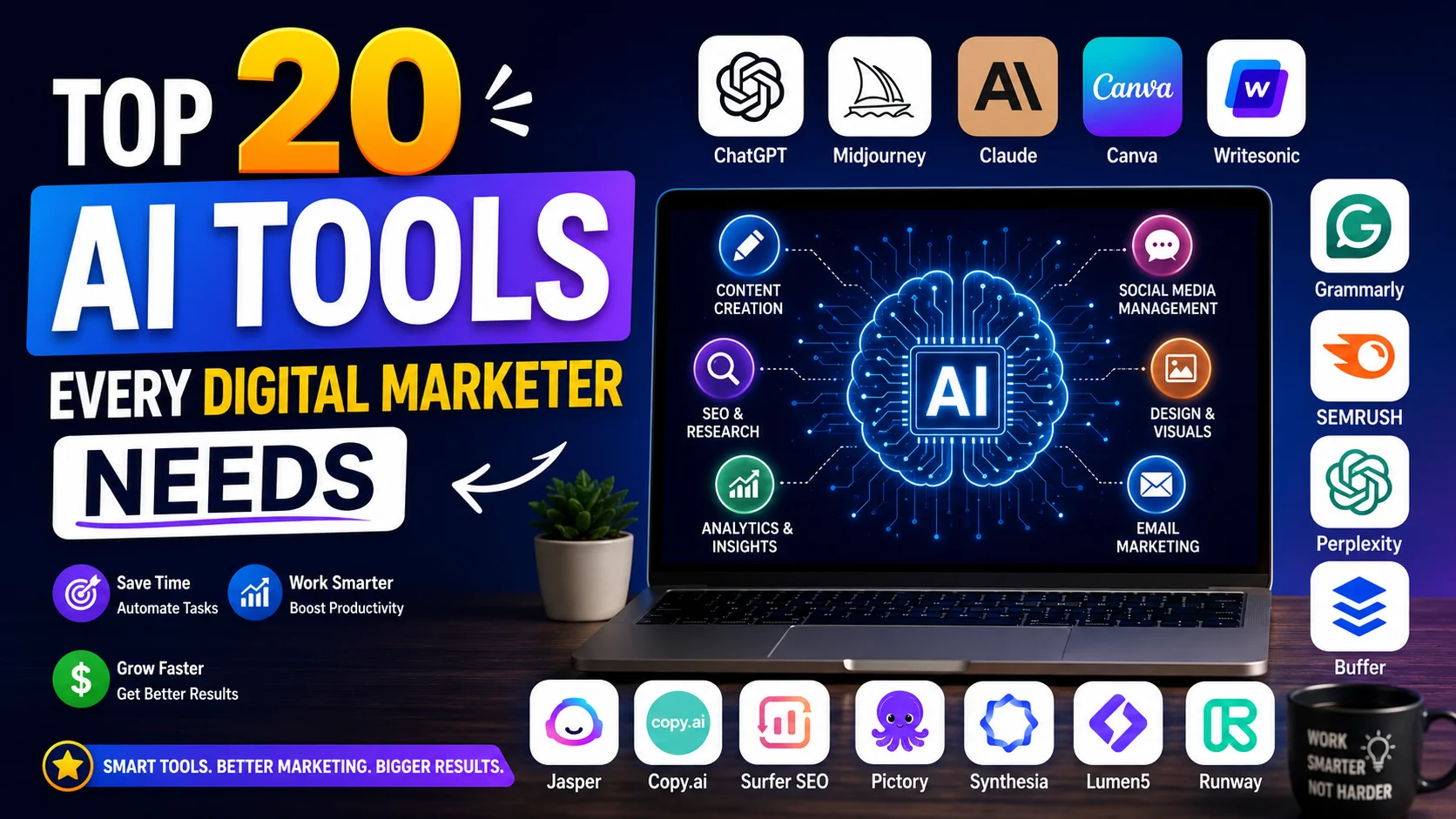

I’ll admit it: when the AI tool wave first hit my Slack, I went overboard. I signed up for 30+ tools in a month, half on free trials, half on a credit card I’m still paying off. Two years and many wasted subscriptions later, I finally know which 20 actually move the needle for a working digital marketer.
These are the tools I (or other marketers I trust) use weekly — not the ones with the loudest Twitter launches. I’ve grouped them by what they actually do in your marketing workflow, and I’ve called out the free vs paid line on every single one.
By the end, you’ll have a complete AI marketing stack you can build for anywhere between ₹0 and ₹5,000/month — and you’ll know which tool to reach for at each stage of your work.
How I Picked These 20 (My 4-Point Filter)
There are 200+ “AI marketing tools” if you Google it. I didn’t pick randomly. Every tool on this list passed four tests:
That’s the filter. Now the list.
Quick Reference: All 20 Tools at a Glance
| # | Tool | Category | Free? | Paid From |
|---|---|---|---|---|
| 1 | ChatGPT | Writing | Yes | ~$20/mo |
| 2 | Claude | Writing | Yes | ~$20/mo |
| 3 | Google Gemini | Writing + Research | Yes | Bundled in Workspace |
| 4 | Jasper AI | Marketing Copy | Trial | ~$49/mo |
| 5 | Copy.ai | Workflows | Yes | ~$49/mo |
| 6 | Surfer SEO | Content SEO | No | ~$89/mo |
| 7 | Frase | SEO Research | Trial | ~$15/mo |
| 8 | Perplexity | Research | Yes | ~$20/mo |
| 9 | Midjourney | Image Gen | No | ~$10/mo |
| 10 | DALL·E | Image Gen | Limited | Included in ChatGPT Plus |
| 11 | Canva AI | Design | Yes | ~₹500/mo in India |
| 12 | Adobe Firefly | Design | Limited | Bundled in CC |
| 13 | Runway ML | Video | Trial | ~$15/mo |
| 14 | Synthesia | AI Avatars | No | ~$22/mo |
| 15 | Descript | Video / Audio | Yes | ~$24/mo |
| 16 | ElevenLabs | AI Voice | Yes | ~$5/mo |
| 17 | Buffer (AI) | Social | Yes | ~$6/mo per channel |
| 18 | Ocoya | Social + Copy | Trial | ~$15/mo |
| 19 | AdCreative.ai | Ads | Trial | ~$29/mo |
| 20 | Notion AI | Productivity | Limited | ~$10/mo add-on |
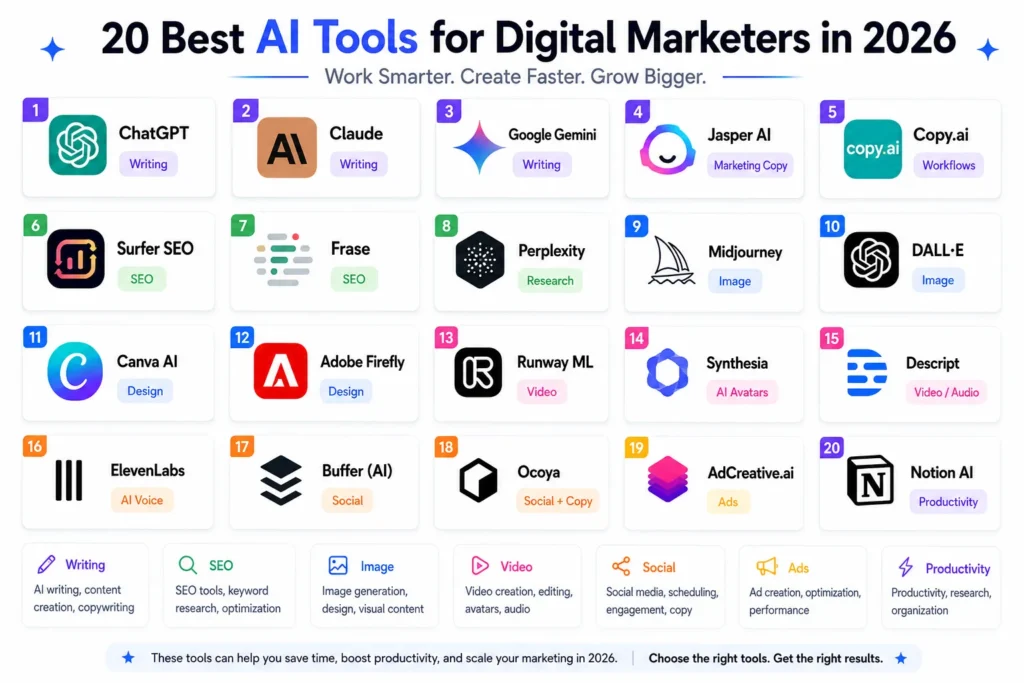
Now let’s go through them, category by category.
The 20 AI Tools, Organized by What They Do
Writing & Content Creation
1. ChatGPT (OpenAI): The Swiss army knife. Brainstorming, blog drafting, email replies, data analysis, code snippets, customer support scripts. The free tier uses GPT-4o mini; ChatGPT Plus unlocks the latest GPT-4 class models, image generation (DALL·E), and advanced data analysis.
- Best for: Day-to-day marketing writing, ideation, repurposing long-form into short.
- Free tier: Yes, generous.
- Honest limitation: It hallucinates confidently. Always fact-check anything that goes public.
2. Claude (Anthropic): Where I go for nuanced long-form work. Claude handles tone, voice, and reasoning better than ChatGPT for things like thought leadership, research-heavy articles, and brand-sensitive copy. Also great at summarising large documents and PDFs.
- Best for: Long-form drafts, brand voice matching, document analysis.
- Free tier: Yes, daily limits.
- Honest limitation: Smaller plugin ecosystem than ChatGPT.
3. Google Gemini (Google): The smart pick if your team lives in Google Workspace. Gemini lives inside Docs, Sheets, Gmail, and Drive — so you can ask it to draft in Docs, summarise in Gmail, and analyse data in Sheets without copy-pasting. Strong on India-relevant content, including Hindi and Hinglish.
- Best for: Workspace-native teams, India/Hindi content, fast in-doc AI help.
- Free tier: Yes, with Gemini 2.0 Flash.
- Honest limitation: Sometimes less polished for marketing copy compared to Claude or ChatGPT.
4. Jasper AI: The first marketing-specific AI that still holds up. Trained heavily on marketing copy, with brand voice memory, campaign workflows, and team collaboration. Templates for email sequences, ad copy, landing pages, product descriptions.
- Best for: Marketing teams that need brand-voice consistency across 10+ assets/month.
- Free tier: No permanent free tier; trial only.
- Honest limitation: Expensive if you’re solo. Better ROI at team scale.
5. Copy.ai: Workflow-based AI for marketers. The strength is the repeatable workflow builder — blog post → social snippets → email follow-up → LinkedIn carousel copy, all from one source. If you ship the same content shape every week, this saves hours.
- Best for: Content repurposing pipelines, agencies, repeatable workflows.
- Free tier: Yes, limited.
- Honest limitation: Learning curve to get the workflow mindset right.
SEO & Research
6. Surfer SEO: The content optimization tool I trust most. It analyses the top-ranking pages for your target keyword and tells you exactly what to include — terms, structure, length, NLP entities. I use it to audit every blog before publishing.
- Best for: On-page SEO, content briefs, topical authority building.
- Free tier: No.
- Honest limitation: Pricey. Pays for itself if you publish 4+ posts/month, painful if you publish one a month.
7. Frase: Stronger on the research side than Surfer. Builds a content brief from the SERP in 5 minutes — headings, questions, statistics, related entities — and then lets you write inside the brief. Excellent for content strategists.
- Best for: Content briefs, SERP analysis, agencies managing many clients.
- Free tier: Trial only.
- Honest limitation: Lighter on writing than on research.
8. Perplexity: The AI search engine I open before ChatGPT. It gives cited answers — so you get the source links inline with every claim. Perfect for research, fact-finding, and competitive analysis where you need to verify, not just generate.
- Best for: Research, source-backed answers, fact-checking AI drafts.
- Free tier: Yes, generous.
- Honest limitation: Not a writing tool. Use it for research, then draft elsewhere.
Image & Design
9. Midjourney: Still the best-in-class for AI image generation. Photorealism, brand aesthetics, social creatives, ad mockups — Midjourney’s output quality is consistently a step ahead. Now accessible via web app (no more Discord-only).
- Best for: Hero blog images, social creatives, ad mockups, brand visuals.
- Free tier: No.
- Honest limitation: No free tier at all — pure paid.
10. DALL·E (OpenAI): Integrated into ChatGPT, so it wins on convenience. Open the chat, describe the image, iterate inline. Quality is good but generally less photorealistic than Midjourney. Strong for quick iterations and embedded in a writing workflow.
- Best for: Quick visuals, image variations, in-ChatGPT workflow.
- Free tier: Limited (via ChatGPT).
- Honest limitation: Output polish trails Midjourney for brand work.
11. Canva AI (Magic Studio): The everyday design tool for non-designers. Canva now has AI built in for image generation, background removal, text-to-design, and Magic Resize across formats. Most Indian marketers already use Canva — Magic Studio just makes it smarter.
- Best for: Social posts, presentations, marketing collateral, Indian SMBs.
- Free tier: Yes, with AI limits.
- Honest limitation: Not for high-end bespoke image generation.
12. Adobe Firefly: Adobe’s answer to Midjourney, deeply integrated with Photoshop and Illustrator. Trained on licensed data, so output is safer for commercial brand use. If your brand lives in Creative Cloud, this is the natural pick.
- Best for: Photoshop users, brand-safe image generation, enterprise.
- Free tier: Limited, with Adobe ID.
- Honest limitation: Full power needs a Creative Cloud subscription.
Video & Audio
13. Runway ML: The leader in AI video generation. Type a prompt or upload an image, get a 4-10 second cinematic video. Gen-3/4 quality is genuinely good. Used by indie filmmakers and ad agencies for short cinematic clips.
- Best for: Short video ads, social clips, cinematic B-roll, music video snippets.
- Free tier: Trial only.
- Honest limitation: Short clips only. Not a full video editor.
14. Synthesia AI avatar videos — you type a script, an avatar speaks it in 140+ languages. Hugely popular for explainer videos, training content, internal comms, multilingual marketing. India-language support is a real strength.
- Best for: Explainer videos, training, multilingual marketing, internal comms.
- Free tier: No (trial demo only).
- Honest limitation: Avatar feel is better than 2024 but still detectable to a trained eye.
15. Descript: Text-based video and audio editing. You edit the transcript, and the video changes. Game-changer for podcasters, YouTubers, and anyone who’s intimidated by traditional timeline editors. Also does AI voice cloning (Overdub) and filler-word removal.
- Best for: Podcasters, YouTubers, course creators, anyone scared of Premiere.
- Free tier: Yes, 1 hour of transcription/month.
- Honest limitation: Learning curve if you already know traditional editing.
16. ElevenLabs: The most realistic AI voice generation I’ve heard. 29+ languages, voice cloning, emotional range. Great for ads, explainer voiceovers, podcast intros, and accessibility. Free tier is enough for short voiceovers.
- Best for: Voiceovers, multilingual audio, ads, audiobooks, accessibility.
- Free tier: Yes, ~10,000 characters/month.
- Honest limitation: Voice cloning has clear ethical and legal guardrails — only clone voices you have permission for.
Social Media Management
17. Buffer (with AI Assistant): The most-loved social scheduling tool, now with built-in AI for caption writing, idea generation, and post rewrites. If you’re already on Buffer, the AI features are now good enough that you don’t need a separate copy tool for day-to-day.
- Best for: Consistent multi-channel social publishing.
- Free tier: Yes, 3 channels.
- Honest limitation: AI features are good, not great — for heavy copy work, pair with ChatGPT or Claude.
18. Ocoya: A “social media + copywriting + analytics” all-in-one. The AI can draft posts in your brand voice, generate hashtags, and schedule across 9+ platforms. Popular with solo marketers and small agencies.
- Best for: Cross-platform social + ad copy in one tool.
- Free tier: Trial only.
- Honest limitation: Smaller community than Buffer/Hootsuite — fewer tutorials out there.
Ads & Creative
19. AdCreative.ai: Generates conversion-focused ad creatives in minutes. You give it your brand assets, target audience, and platform, and it produces 50+ ad variations with copy + creative combinations. Performance marketers running paid social love it.
- Best for: Performance marketers, paid social campaigns, A/B testing at scale.
- Free tier: Trial only.
- Honest limitation: Works best for direct response. Brand-building campaigns need human creative direction.
Productivity & Workflow
20. Notion AI: AI embedded directly inside your Notion workspace. Summarise meeting notes, draft docs, extract action items, translate, rewrite in a new tone. If you already live in Notion (and most marketers I know do), the $10/month add-on pays for itself in the first week.
- Best for: Meeting notes, content planning, knowledge management, content calendars.
- Free tier: Limited AI trials; full AI is a paid add-on.
- Honest limitation: Only useful if you already use Notion as your main workspace.
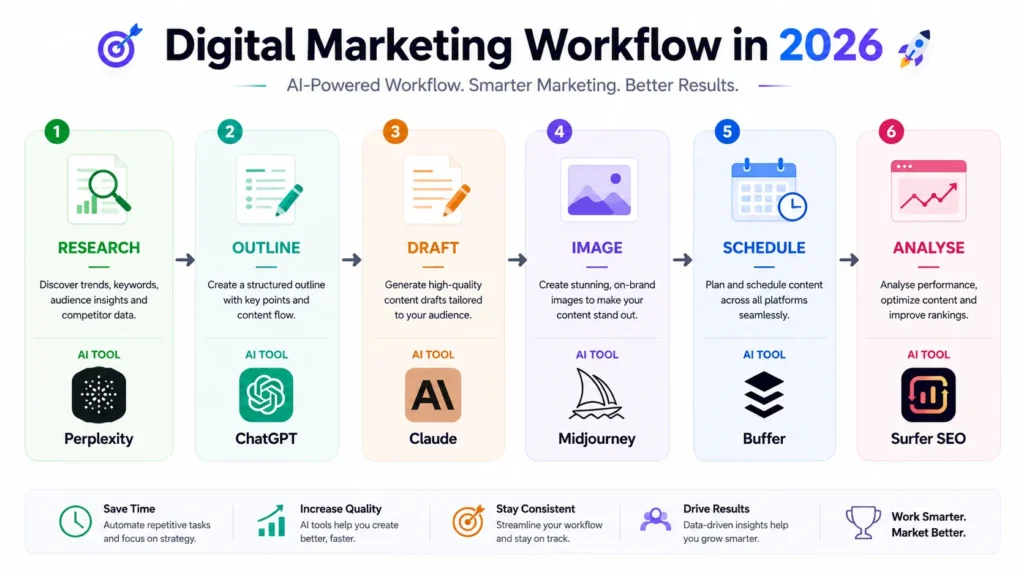
My Personal Daily AI Stack (5 I Use Every Day)
Out of 20, here are the 5 I genuinely can’t work without anymore.
That stack runs me roughly $50–$60/month combined and replaces what would have been three freelancers and a junior writer five years ago.
Free vs Paid: How to Build a ₹0 / ₹1,000 / ₹5,000 Stack
The ₹0 stack (for absolute beginners):
- ChatGPT (free)
- Claude (free)
- Gemini (free)
- Perplexity (free)
- Canva (free)
- DALL·E via ChatGPT
- Buffer (free, 3 channels)
- Descript (free, 1 hr/month)
- ElevenLabs (free tier)
- Notion (free personal plan, AI trials)
That gives you a working marketing stack with zero monthly cost. Real limit: you won’t get the deep features, and you’ll hit usage caps.
The ₹1,000 stack (for serious solo marketers):
- ChatGPT Plus (~$20)
- Canva Pro (~$12)
- Buffer Essentials (~$6/channel)
- Plus the free tier of everything else
The ₹5,000 stack (for freelancers / small teams):
- ChatGPT Plus (~$20)
- Claude Pro (~$20)
- Midjourney (~$10)
- Surfer SEO (~$89, the priciest line)
- ElevenLabs Starter (~$5)
- Buffer Essentials (~$18 for 3 channels)
- Plus free Perplexity, Canva Pro, Notion AI trials
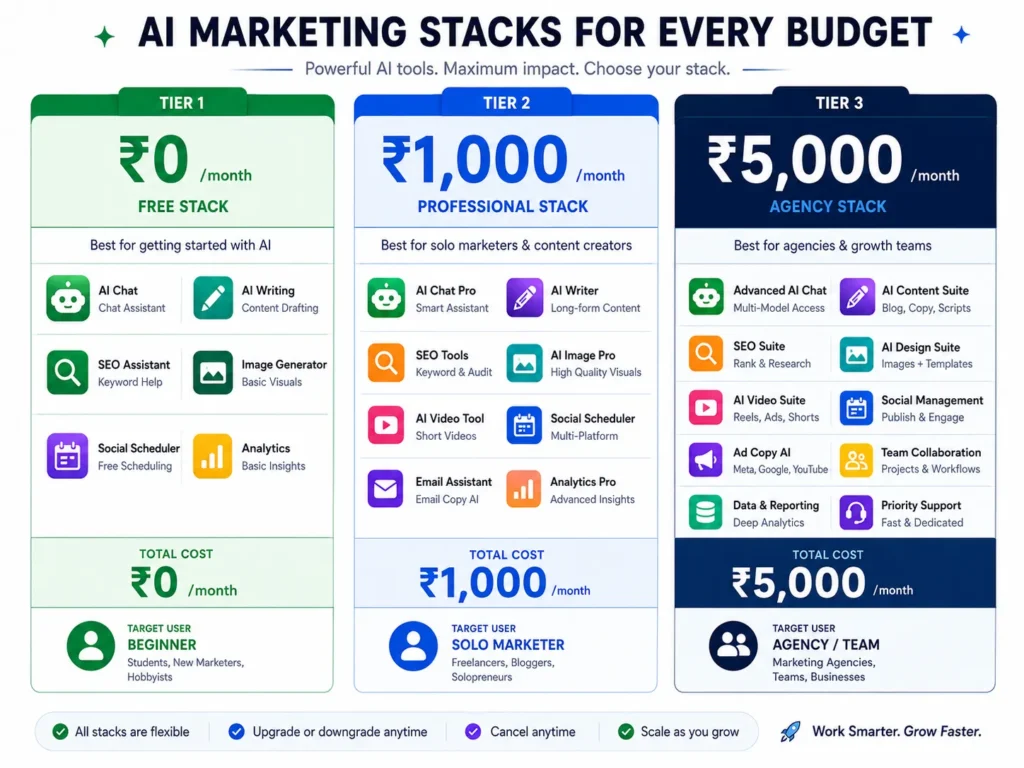
That ₹5,000 stack is what I run. It produces a serious amount of output. The marginal return on the ₹10,000 stack is small unless you’re at agency scale.
5 Mistakes Marketers Make With AI Tools
1. Subscribing to everything. The “I’ll try it for a month” trap. Audit your subscriptions quarterly. If a tool didn’t move a real needle in 30 days, cancel.
2. Using AI output without editing. The single biggest reputation risk. AI-generated content has tells — filler words, generic intros, overly balanced lists. Always rewrite the opening and conclusion in your own voice.
3. Ignoring data privacy. Uploading client briefs, customer data, or unreleased campaign details into random AI tools can be a compliance nightmare. Use the paid tier with data-not-used-for-training guarantees, or anonymise first.
4. Treating AI as a strategy, not a tool. AI doesn’t tell you what to market, to whom, or why. That’s still your job. AI is a multiplier on your thinking, not a replacement for it.
5. Optimising for prompt tricks, not fundamentals. A perfect prompt won’t save a bad offer, a weak landing page, or a confused positioning. Get the fundamentals right first. AI amplifies what’s already there.
FAQ — Questions Indian Marketers Ask Most
Q1. Are these AI tools safe for confidential client work?
Answer: Depends on the tier. Free tiers of most tools (ChatGPT, Claude, Gemini) may use inputs for training by default — turn that off in settings, or upgrade to a paid/business tier that contractually guarantees your data isn’t used. For highly sensitive client work (legal, medical, financial), use self-hosted open-source models (Llama, Mistral) on your own infra.
Q2. Can I use AI-generated content for Google SEO without penalty?
Answer: Yes — but with nuance. Google’s official position since 2023 is that they reward high-quality content regardless of how it’s produced. AI content is fine as long as it demonstrates E-E-A-T (experience, expertise, authoritativeness, trustworthiness), is factually accurate, and adds original value. Pure AI-spin rewrites of competitor content will get filtered.
Q3. What’s the best free AI tool for a beginner?
Answer: ChatGPT. It’s the most versatile, the best documented, the largest community, and the free tier is genuinely useful. Start there. Add Perplexity and Canva next. That’s your free foundation.
Q4. Do I really need all 20?
Answer: No. Most marketers I know actively use 4-7. The list is a reference, not a checklist. Pick one tool per function you actually do weekly. If you never make videos, skip Runway, Synthesia, and Descript.
Q5. Will AI replace digital marketers?
Answer: AI replaces the parts of digital marketing that were already commoditised — first-draft writing, basic design, generic ad copy. It does not replace strategic thinking, brand building, customer empathy, original research, or creative direction. The marketers who use AI will replace the marketers who don’t. That’s the honest version.
Q6. Which AI tool is best for Indian-language content?
Answer: For Hindi, Hinglish, and major Indic languages, the strongest picks right now are Google Gemini (best Workspace integration + Indic support), Sarvam AI for genuinely India-specific use cases, and ElevenLabs for Indic-language voiceovers. For pure content writing in Hindi, Gemini and ChatGPT both handle Hinglish well. Pure Hindi grammar and nuance is improving fast across all of them.
Conclusion
You don’t need 20 AI tools. You need 5 you actually use.
The marketers winning in 2026 aren’t the ones with the biggest stack — they’re the ones who’ve picked the right defaults and show up every day.
If this helped, bookmark the table and use it as your quarterly stack-audit checklist. Got a tool I missed that you can’t live without? Drop it in the comments — I’ll add the best-upvoted one to a “Honourable Mentions” follow-up post.