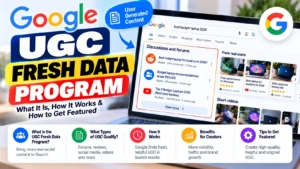
Two days ago, Google quietly published documentation for something the SEO world has been whispering about: the Google UGC Fresh Data Program. If you run a forum, a community site, a Q&A platform — or even just a blog with a lively comments section — this one deserves your attention. In plain terms, it’s a way for approved platforms to push their fresh user-generated content directly to Google, instead of sitting around waiting for Googlebot to show up. In this guide, I’ll break down exactly what the Google UGC Fresh Data Program is, who’s eligible, how the application works, and — the question almost nobody else is answering — what it actually means for small bloggers like you and me.
What Is the Google UGC Fresh Data Program?
Let’s strip away the jargon first. The Google UGC Fresh Data Program is an authenticated data-ingestion pipeline — a fancy way of saying it’s an official, secure channel through which approved websites can send their newest user-generated content straight to Google Search.
Here’s the problem it solves. Think about a busy discussion forum. Thousands of new threads and replies appear every hour. Google’s crawlers are good, but they can’t be everywhere at once. By the time Googlebot discovers a trending thread, the conversation may have already moved on. That delay matters, because some of the most valuable content on the web right now is fresh, fast-moving community discussion — product questions answered in real time, breaking-news threads, troubleshooting conversations that get solved within minutes.
The program flips the model around. Instead of Google pulling content by crawling, the platform pushes content to Google the moment it’s created. Google’s own documentation describes it as a pipeline for “trending UGC only” — so this isn’t a firehose for your entire archive. It’s specifically designed for fresh, actively-discussed user content.
A few things it is not:
- It is not the same as Google’s Indexing API. That’s a separate system, and I’ll compare the two in detail below.
- It is not a replacement for normal crawling. Your site still gets crawled the usual way.
- It is not a ranking boost program. Getting your content to Google faster doesn’t mean Google will rank it higher. More on that in the caveats section — it’s important.
The official documentation lives on Google Search Central at developers.google.com/search/docs/appearance/ugc-fresh-data-program, published around October 8, 2026. SEO news outlets including Search Engine Land picked up the story within a day, which tells you how significant the SEO community thinks this is.
Why Did Google Build This?
To understand the program, it helps to understand what Google is worried about. Over the past couple of years, there’s been a visible shift in how people search. When someone wants a real opinion about a product, a fix for a weird error message, or an honest discussion about a topic, where do they go? Increasingly, they add “reddit” to their queries or head straight to forums and communities. Google noticed. You’ve probably noticed the surge of forum threads and discussion results in regular search results too.
The trouble is that Google’s crawling infrastructure was designed for a web of relatively stable pages. A blog post published today looks mostly the same next week. A forum thread with 400 replies? It can change completely in an hour. Traditional crawling — even fast crawling — struggles with that velocity.
There’s also the AI angle. Google’s AI Overviews and AI Mode need fresh, trustworthy human discussion to answer questions well. Training and grounding on stale forum snapshots isn’t ideal. A direct pipeline of fresh UGC, complete with engagement signals (which replies got upvoted, which answers the community trusted), gives Google much richer material to work with.
So the program serves Google’s interests as much as publishers’. That’s worth remembering, because it explains the strict requirements — Google is picky about who gets a direct line into its index.
How It Actually Works (The Technical Flow)
Let me walk through the mechanics in plain language. If you’re not technical, don’t worry — I’ll keep each step human-readable.
Step 1: You apply and get approved
Nothing happens automatically. You submit an application through a Google form, Google reviews your platform, and — if you meet the bar — you’re accepted into the program. Google says responses take roughly 6–8 weeks, and acceptance is not guaranteed. I’ll cover the full application process in its own section below.
Step 2: You authenticate with OAuth 2.0
Once approved, your platform connects to Google using OAuth 2.0 — the same secure authorization standard behind “Sign in with Google” buttons. This is what makes it an authenticated pipeline: Google knows exactly which platform is sending data, which prevents spam and impersonation. No anonymous pushes allowed.
Step 3: You push fresh content as it’s created
When new user-generated content appears on your platform — a new discussion thread, a fresh social media post, a batch of replies — your system sends it to Google through the pipeline. According to Google’s documentation, content pushed this way is processed “ideally within minutes.” Compare that to normal crawling, where discovery can take hours or days depending on your site’s crawl budget and popularity.
Step 4: Your structured data gets validated
This is a critical piece. Google requires your UGC pages to carry validated JSON-LD structured data using SocialMediaPosting or DiscussionForumPosting schema types, along with interaction statistics (think: reply counts, upvote numbers, view counts). Google validates this markup. If your structured data is broken or missing, the pipeline doesn’t work properly. This is Google’s quality filter — it ensures the content arriving through the fast lane is well-formed and machine-readable.
Step 5: Engagement signals update separately
Here’s a detail most early coverage missed: the content itself moves fast (minutes), but engagement counters — the upvotes, reply counts, and interaction stats — update within 72 hours. So Google gets the existence of new content almost immediately, and the social proof around it catches up over the next three days. That two-speed design makes sense: Google wants to know about trending discussions instantly, then refine its understanding as the community reacts.
Fresh Data Program vs Indexing API vs Normal Crawling
This is where most people get confused, so let’s lay it out clearly. These are three completely separate systems.
| Aspect | UGC Fresh Data Program | Indexing API | Normal Crawling |
|---|---|---|---|
| Purpose | Push fresh trending UGC + engagement signals to Google | Notify Google about new/updated job postings and livestream pages (limited page types) | General discovery of all web content |
| Who can use it | Approved platforms only (application required) | Any site owner (for eligible page types) | Everyone, automatically |
| Direction | Push (you send to Google) | Push (you notify Google) | Pull (Google fetches from you) |
| Speed | Content within minutes; engagement stats within 72 hours | Prompt crawling of notified URLs | Hours to days (varies by site) |
| Authentication | OAuth 2.0 required | API key / service account | None needed |
| Structured data | Validated JSON-LD required (SocialMediaPosting / DiscussionForumPosting + interaction stats) |
JobPosting / BroadcastEvent markup expected | Optional (but recommended) |
| Guarantees ranking? | No. Faster ingestion only. | No. Faster crawling only. | No. |
The biggest misconception I’ve seen in early discussions: people treating this as “the Indexing API for forums.” It’s not. The Indexing API is a notification system for specific page types that any site owner can use. The Fresh Data Program is an invitation-style pipeline, built specifically for high-volume UGC platforms, carrying not just URLs but the content and its engagement context.
Are You Eligible? Run This Self-Check
Google hasn’t published a simple “you need X monthly visitors” threshold — and I’d be suspicious of anyone claiming an exact number. What Google has documented are qualitative requirements. I’ve turned them into a self-assessment checklist. Be honest with yourself as you go through it.
| Requirement | What Google Expects | Self-Check Question |
|---|---|---|
| High UGC volume | A large, steady stream of user-created posts and discussions | Does your platform generate new user content daily — threads, posts, replies at real scale? |
| Significant user base | A substantial community of active contributors | Do you have an active community, or is it mostly you publishing? |
| Public pages, stable URLs | Content on public URLs that don’t constantly change; no private feeds or user profiles as the content unit | Does each discussion live at its own permanent public URL? |
| OAuth 2.0 capability | Your platform can implement OAuth 2.0 authentication | Do you (or your developer) have the technical ability to implement OAuth? |
| Validated JSON-LD | SocialMediaPosting or DiscussionForumPosting markup plus interaction statistics, passing validation |
Can your pages output valid structured data with reply/upvote counts? |
| Active moderation | Real content moderation catching spam, abuse, and low-quality content | Is someone actively moderating your community’s content? |
| User reporting tools | Users can flag problematic content themselves | Can your users report a post or comment? |
| Public creator profiles | Content creators have public profiles Google can associate with content | Do your contributors have public profile pages? |
If you answered “no” to most of these — especially the volume and user-base questions — this program probably isn’t built for you right now. That’s not an insult; the program is aimed at platforms, not publishers. There’s a whole section below on what small bloggers should do instead, so keep reading.
How to Apply for the Google UGC Fresh Data Program
Google’s application process runs through an official form — there isn’t a self-serve signup button in Search Console (at least, not that Google has announced). Here’s how to approach it based on what’s been documented:
- Confirm you meet the requirements first. Run through the eligibility checklist above honestly. Applying when you clearly don’t qualify wastes everyone’s time — including yours, since you’ll wait weeks for a “no.”
- Get your structured data in order. Before you even open the application form, make sure your discussion and post pages carry valid
DiscussionForumPostingorSocialMediaPostingJSON-LD, including interaction statistics. Test everything in Google’s Rich Results Test. If your markup doesn’t validate now, it won’t magically validate after approval. - Document your moderation setup. Be ready to describe how you moderate content and what reporting tools users have. Google cares about this because it’s handing you a fast lane into its index — it needs to trust that lane won’t fill with spam.
- Prepare your platform details. You’ll need to present your platform clearly: what it is, the scale of UGC, the size of your user base, and confirmation that your content lives at stable public URLs. Think of it as making a concise case for why your platform’s fresh content deserves priority ingestion.
- Submit the Google form. Find the application form linked from the official documentation page (Google’s UGC Fresh Data Program docs). Fill it out completely and accurately.
- Wait 6–8 weeks. Google says that’s the typical response window. Don’t expect an instant reply, and don’t assume silence means approval is coming — or that it isn’t.
- If approved, implement the technical integration. Approval is the starting line, not the finish. You’ll need to build the OAuth 2.0 authentication and the content-push integration on your end. This is real development work, not a toggle in a dashboard.
One thing I want to stress: Google has been explicit that acceptance is not guaranteed. Meeting the requirements makes you a candidate, not a member. Apply with that expectation set correctly.
What Happens After You Apply?
Let’s talk about the realistic timeline, because “6–8 weeks” deserves unpacking.
First, that window is just for Google’s response — not for going live. If you’re accepted, you then have to actually build the integration: OAuth flows, the push mechanism, structured data validation across your templates. Depending on your engineering resources, that could take days or months.
Second, Google will likely validate your implementation before the pipeline goes fully live. Expect a testing phase where Google checks that your structured data validates, your authentication works, and the content you’re pushing matches what’s actually on your public pages. Any mismatch between pushed data and live pages would be a fast way to lose trust — and possibly access.
Third, even after everything is running, remember the core caveat: participation does not guarantee that your content appears in Search results, or that it ranks well. The program solves discovery speed, not ranking. Your content still has to earn its place the same way as everything else — through quality, relevance, and the signals Google has always used.
What This Means for Small Bloggers (The Honest Angle)
Okay, let’s address the elephant in the room. If you’re a solo blogger or run a small niche site — which describes most of my readers — you almost certainly don’t qualify for this program right now. No shame in that. The program is designed for platforms with serious UGC volume: think large forums, community Q&A sites, social platforms.
So why should you care? Three reasons.
First, it reveals where Google is heading. Google is investing heavily in fresh, human discussion content. That’s a signal about what Google values. If your blog has an active comments section, a community element, or discussion-driven content, you’re swimming with the current — not against it. Nurture that. Reply to comments. Build discussion. Google is literally building infrastructure to ingest this stuff faster, which tells you it’s important to them.
Second, the technical requirements are a free SEO checklist. Validated DiscussionForumPosting markup, stable URLs, active moderation, public author profiles — every single one of these is good practice for any site with user content, program or no program. Implementing proper structured data on your comments and forum pages helps Google understand your content better through normal crawling too.
Third, watch the second-order effects. As big UGC platforms get faster ingestion, competition for discussion-type queries will intensify. If you write “best of” roundups or answer questions that forums also answer, expect forum threads to show up faster and more often. Your edge as a small publisher remains the same as ever: genuine expertise, original experience, and depth that a 40-reply thread can’t match.
The worst reaction would be to ignore this because “it doesn’t apply to me.” The best reaction is to read it as a weather report: this is the direction of the wind. Adjust your sails accordingly.
Limitations and Honest Caveats
I’d rather you hear the downsides from me than discover them after investing weeks of work:
- No ranking guarantee. I’ve said it three times now because it matters: faster ingestion ≠ better rankings. Google still decides what deserves to rank.
- Acceptance isn’t guaranteed. You can meet every documented requirement and still be declined. Google hasn’t published its selection criteria beyond the baseline requirements.
- It’s built for platforms, not publishers. A blog with 200 comments a month isn’t the target. Don’t contort your site into something it’s not just to chase eligibility.
- Implementation is real engineering work. OAuth 2.0, push integrations, structured data at scale — this isn’t a plugin install. Budget developer time honestly.
- Ongoing compliance. Getting in is one thing; staying in requires maintaining moderation quality, valid markup, and data accuracy. Google can presumably revoke access if the pipeline fills with junk.
- Don’t try to game it. If you’re thinking about manufacturing “UGC” to exploit a fast lane into Google’s index — don’t. Google built authentication and validation into this pipeline precisely to catch that, and the downside of getting caught far outweighs any short-term gain.
Frequently Asked Questions
1. Is the Google UGC Fresh Data Program the same as the Indexing API?
No. They’re completely separate systems. The Indexing API lets any site owner notify Google about new or updated job posting and livestream pages. The Fresh Data Program is an application-only pipeline for approved high-volume UGC platforms to push trending user content and engagement signals directly to Google. Different purpose, different audience, different mechanics — the comparison table earlier in this guide lays out every difference.
2. Does joining the program guarantee my content will rank on Google?
No — and Google is explicit about this. The program only speeds up discovery and ingestion of your fresh content. Once Google has it, the content competes for rankings under the same quality and relevance standards as everything else. Think of it as getting your content to the starting line faster, not getting a head start in the race.
3. I’m a solo blogger. Can I apply for the Google UGC Fresh Data Program?
Technically you could submit the form, but realistically the program targets platforms with high UGC volume and significant user bases — large forums, Q&A communities, social platforms. A typical solo blog won’t meet the bar. Instead, focus on the underlying lessons: implement proper structured data, keep URLs stable, moderate your comments, and build genuine discussion on your site. Those help you regardless.
4. How long does the application process take?
Google states a 6–8 week response window for applications. That’s just for the decision — if approved, you’ll then need additional time to build the technical integration (OAuth 2.0, content push, structured data validation). And remember: a response isn’t necessarily an approval. Acceptance is not guaranteed.
5. What exactly counts as “trending UGC”?
Google describes the program as covering “trending UGC only,” which means fresh, actively-discussed user content — new threads, recent posts, ongoing discussions — rather than your full historical archive. The emphasis is on velocity: content that’s being created and engaged with right now. Your years-old forum threads are already handled fine by normal crawling.
6. Is there a cost to join the Google UGC Fresh Data Program?
Google hasn’t announced any fee for the program itself. The real “cost” is the engineering investment: implementing OAuth 2.0, building the push integration, maintaining validated structured data at scale, and running genuine content moderation. For a platform that already has most of this infrastructure, the marginal cost is modest. For one that doesn’t, it’s a serious project.
Final Thoughts
The Google UGC Fresh Data Program is one of those rare announcements that’s genuinely interesting even if you’ll never use it directly. It confirms, in Google’s own infrastructure choices, that fresh human discussion is becoming more central to search — not less. For platform owners who qualify, it’s a real opportunity to get trending content discovered in minutes instead of hours. For the rest of us, it’s a weather report worth reading carefully.
My advice? If you run a qualifying platform, start the application sooner rather than later — early programs like this tend to be most generous to early applicants, and the 6–8 week clock starts when you submit. If you’re a blogger or small publisher, take the underlying lessons seriously: structured data, stable URLs, real moderation, and genuine community engagement. For more on how AI is reshaping content discovery, read our AI search visibility guide.
Found this guide useful? Share it with someone running a forum or community site — they’re the ones who need to act on it this week.