A few months ago, something strange showed up in my Google Search Console. My impressions were steady – even climbing a little – but my clicks were quietly falling off a cliff. My rankings hadn’t dropped. My content hadn’t changed. So where were my visitors going?
The answer was sitting right at the top of the search results, in a box I’d been ignoring: the AI-generated answer.
Google’s AI Overviews had started answering my readers’ questions directly, and my carefully written posts were reduced to tiny citation links most people never clicked. That was the week I stopped thinking about SEO the old way and started taking AI search visibility seriously.
If you run a blog – especially here in India, where Google’s AI Mode and AI Overviews are now part of everyday searching – this shift affects you directly.
This guide walks you through exactly what AI search visibility means, how AI engines choose which sites to cite, the myths you should ignore, and nine practical tactics I’ve tested that actually improve your AI search visibility.
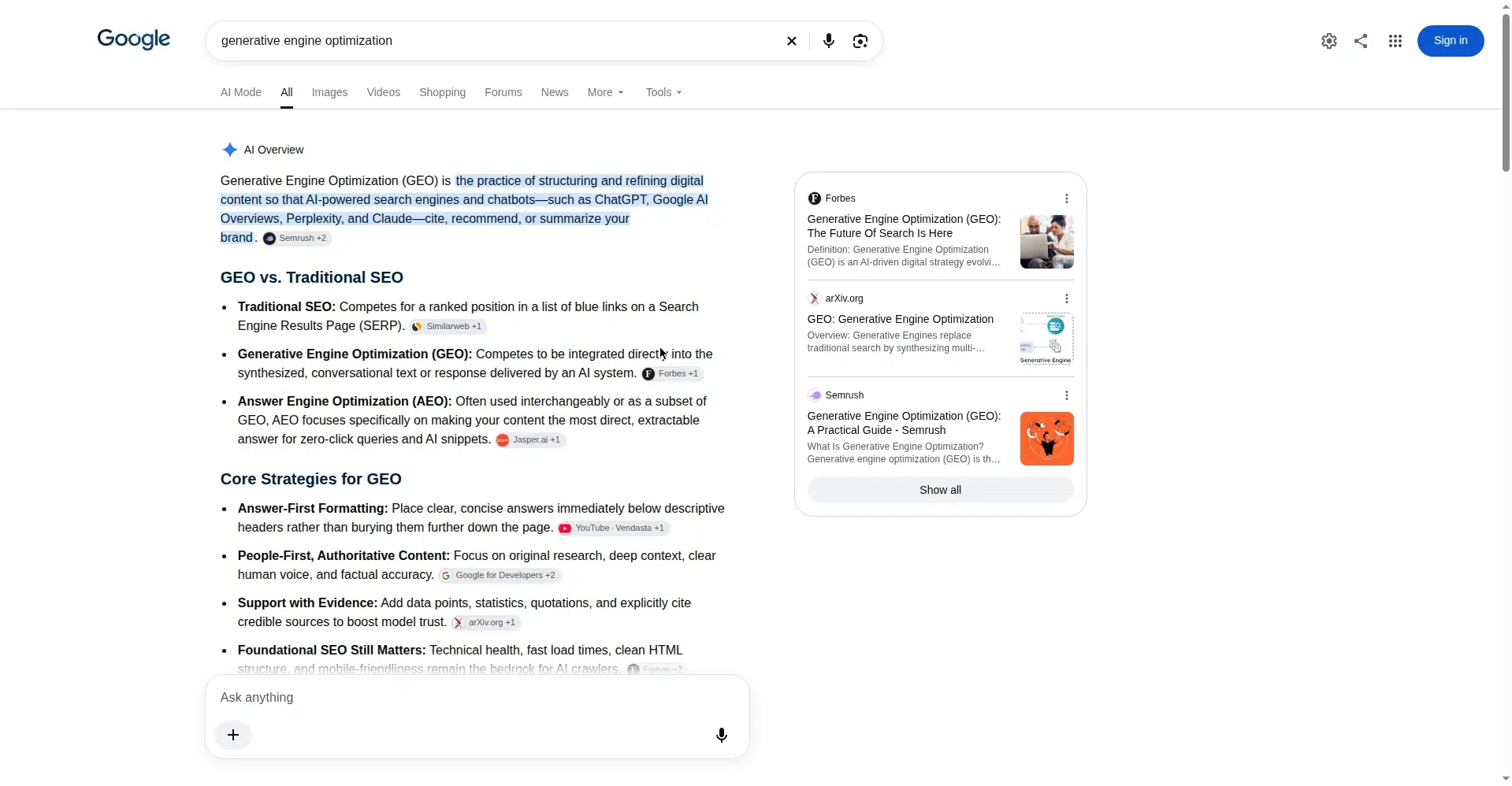
What Is AI Search Visibility?
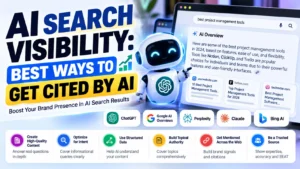
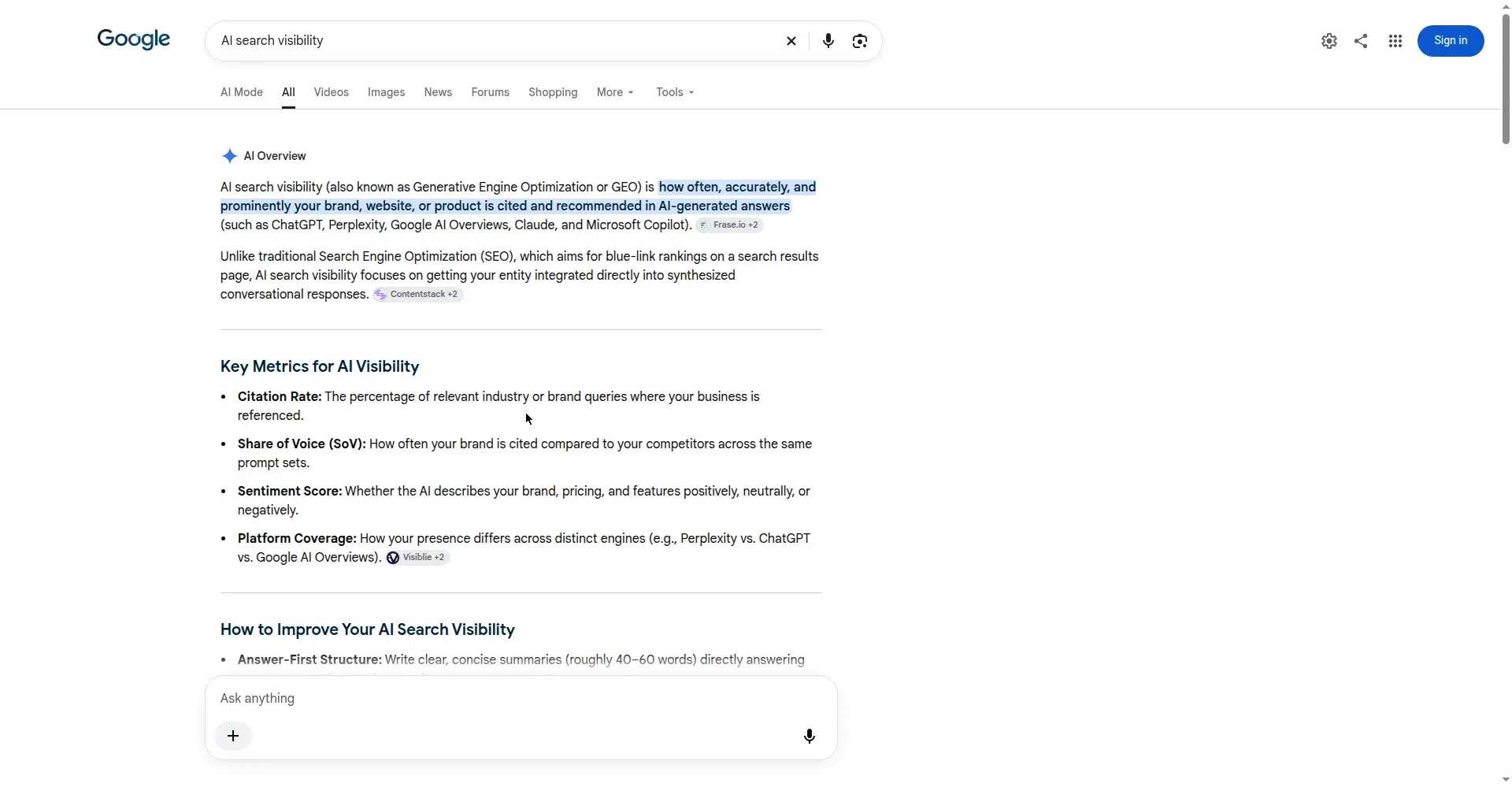
AI search visibility is the measure of how often your brand, website, or content gets mentioned, cited, or recommended by AI-powered search tools like ChatGPT, Google AI Overviews, Gemini, and Perplexity when people ask questions related to your topic.
Think of it this way. Classic SEO was about ranking in the blue links. AI search visibility is about being the source the AI quotes when it writes the answer itself.
When someone asks ChatGPT “what’s the best budget phone under ₹15,000?” and it names three phones with links to the blogs it read, the blogs that appear in that answer have high AI search visibility. The ones that don’t appear have zero AI search visibility, no matter how well they rank on Google.
This matters because the click itself is changing hands. More than 60% of Google searches now end without a single click, because the AI answer on the page already satisfied the searcher. If your content isn’t inside that answer, you’re invisible to most of those searchers.
Why AI Search Visibility Matters More Than Ever
Let me put some numbers on the table so you can see this isn’t hype.
Gartner projects that classic organic search traffic will fall by roughly 25% as AI-generated answers resolve queries directly on the results page. A 2026 Pew Research Center survey found that 60% of US adults found AI summaries helpful — and helpful things get used more, not less.
The scale of the AI side is hard to overstate. ChatGPT now serves around 900 million weekly active users, according to OpenAI, and holds roughly 17.1% of the search market by some measures. Perplexity alone handles over 500 million queries a month.
SparkToro tracked AI-referred sessions growing 527% between January and May 2025. These are not early-adopter toys anymore; they’re mainstream information habits.
Here’s the part that hit me hardest when I first read the research: AI engines don’t cite the same pages Google ranks.
One analysis found that Google AI Overviews pull from about 13 sources per answer on average — and 59.6% of those citations come from URLs sitting outside the top-20 organic results. Only 12% of the URLs AI cites also rank in Google’s top 10.
Translation: ranking #1 on Google and being cited by AI are two different games, and winning one doesn’t guarantee the other.
And it gets more fragmented. An analysis of 3.7 million AI citations found that 91% of cited URLs appear in only one large language model. Being visible in ChatGPT tells you almost nothing about your visibility in Perplexity or Gemini. You have to earn your place on each platform separately.
That’s exactly why I treat AI search visibility as its own discipline now — related to SEO, but with its own rules, its own measurement, and its own wins.
SEO vs AEO vs GEO vs SXO: Clearing Up the Alphabet Soup
Every week there’s a new acronym. Let me save you the confusion with a straight comparison, because I’ve seen too many bloggers waste money on courses that just rename old SEO advice.
| Term | Full Form | What It Optimizes For | Core Idea |
|---|---|---|---|
| SEO | Search Engine Optimization | Ranking in classic search results | Be the best blue link |
| AEO | Answer Engine Optimization | Being the direct answer (featured snippets, voice assistants) | Be the single spoken or boxed answer |
| GEO | Generative Engine Optimization | Being cited inside AI-generated answers | Be a trusted source the AI quotes |
| SXO | Search Experience Optimization | The full journey after the click | Convert the visitor who arrives |
Here’s the honest take: these overlap far more than the gurus admit. Google’s own Search Central documentation puts it plainly: “optimizing for generative AI search is optimizing for the search experience, and thus still SEO.” Good content, clear structure, real expertise, and trustworthy sourcing help you everywhere.
The difference is in the details. Classic SEO rewards the best page for a query. GEO rewards the most quotable, well-sourced, clearly stated facts across the web – including pages that never rank #1.
That 59.6% figure I mentioned earlier is the proof: AI engines happily cite page #34 if it states the fact cleanly and backs it up.
How AI Engines Actually Pick What to Cite
When I first tried to improve my AI search visibility, I made the classic mistake: I assumed it worked like Google rankings, just with a chatbot on top. It doesn’t. Here’s what the research actually shows about how these systems choose sources.
They cite more sources than you’d expect. Google AI Overviews reference around 13 sources per answer on average. That’s a lot of slots and good news for smaller blogs, because it means there are more chances to get in.
They look past the top results. As I noted, nearly 60% of AI Overview citations come from outside the top 20 organic results. AI models value clear, factual, well-structured statements wherever they find them. A crisp answer buried on page 4 can beat a vague answer ranking #2.
Each platform has its own taste in sources. This was the finding that changed my content strategy most. ChatGPT leans heavily on Wikipedia-style encyclopedic content — about 47.9% of its citations. Perplexity prefers community discussion, with Reddit-style content making up roughly 46.7% of its citations.
Google AI Overviews favor YouTube, at around 23.3%. So the same article performs differently on each platform depending on how it’s written and where it’s discussed.
Visibility doesn’t transfer between models. Remember: 91% of cited URLs show up in only one LLM. I learned this the hard way when a post of mine kept getting cited by Perplexity but never appeared in ChatGPT answers. You can’t optimize once and be done; you need a presence strategy per platform.
What does all of this mean in practice? AI engines are looking for content that is easy to quote, easy to verify, and easy to trust. Everything in the tactics section below flows from that one insight.
The llms.txt Myth: Why That File Won’t Save You
I have a confession: one of the first things I did when I panicked about AI search was to add an llms.txt file to my site. Bloggers on X were calling it “the robots.txt for AI” — a markdown file that supposedly tells AI crawlers what your site is about and gets you cited more.
It did nothing. And the data explains why.
Google’s Search Central stated in June 2026 that Google ignores llms.txt entirely. An Ahrefs study of 137,210 domains found that 97% of llms.txt files received zero crawler requests in an entire month — the bots simply don’t fetch it.
SE Ranking analyzed roughly 300,000 domains and found no significant correlation between having the file and getting AI citations. Only 7.4% of Fortune 500 companies even have one, and no major AI company has confirmed using llms.txt for citations.
I kept mine up for a while out of pure hope before deleting it. Here’s my honest advice: don’t spend an afternoon on llms.txt. Spend that afternoon writing one quotable, statistics-backed section instead. That will do more for your AI search visibility than the file ever could.
9 Proven Tactics to Improve Your AI Search Visibility
Everything below is something I’ve either tested myself or verified against published research. No theory-only advice.
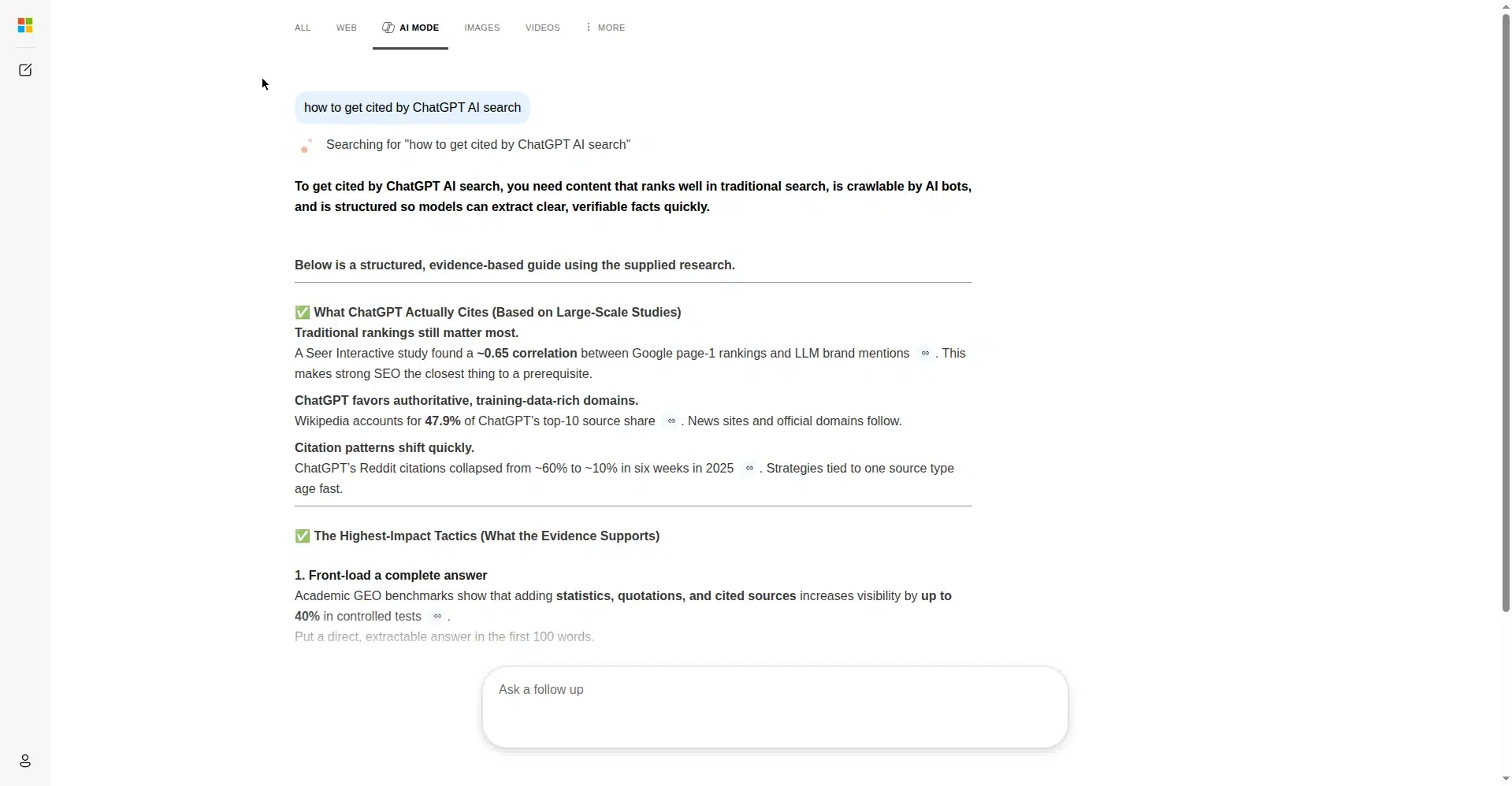
1. Write Quotable 40–60 Word Answers Early in Each Section
AI engines love short, self-contained answers they can lift directly. When I rewrote my top posts to open each major section with a crisp 40–60 word direct answer — before going deeper — my citation rate in AI Overviews visibly improved.
The pattern is simple: state the answer plainly, in complete sentences, with the key entity named. Don’t bury the answer under three paragraphs of buildup. The AI (and the skim-reader) both reward the writer who answers first and explains after.
2. Add Real Statistics and Cite Authoritative Sources
Research from Princeton-linked 2026 studies on generative engine optimization found that adding statistics improved AI visibility by about 40%, and citing authoritative sources improved it by a similar 40%. These were among the strongest effects measured.
This matches my experience completely. Posts where I included specific numbers — with named sources like Gartner, Pew Research Center, or official documentation — earned far more AI search visibility than posts with the same advice written vaguely.
AI models are trained to prefer verifiable claims. A sentence like “60% of searches end without a click” with a source beats “most searches end without a click” every time.
3. Quote Real Experts
The same body of research found that including expert quotes boosted AI visibility by roughly 28%. Quotes are naturally quotable — they have a named human attached, a clear opinion, and a distinct voice. All three things make them easy for an AI to cite with attribution.
You don’t need celebrity interviews. Quote a founder’s blog post, a researcher’s finding, or a practitioner’s documented result — with credit and a link. I regularly quote official statements, like Google’s Search Central guidance, and those quoted passages are exactly the parts that end up in AI answers.
4. Add FAQ Schema to Every Article
FAQ sections do double duty. Readers love them, and FAQ schema markup makes each question-answer pair trivially easy for AI systems to extract and quote. Most of my AI citations come from FAQ-style passages, because they’re already structured as direct answers.
Write each FAQ answer as a complete, standalone response of 40–80 words. Don’t write “as mentioned above” or “it depends” without the actual answer — the passage has to make sense when lifted out of context, because that’s exactly how the AI will use it.
5. Use Structured Data (JSON-LD)
One vendor study reported that pages with structured data earned roughly 3.1 times more AI citations — treat that as a vendor claim rather than gospel, but the direction is consistent with everything else we know. Article schema, FAQ schema, and HowTo schema give machines an unambiguous map of your content.
I add JSON-LD to every post now through Rank Math, which handles most of it automatically. It takes two minutes per post and removes all guesswork about what your page is about.
6. Keep Your Entity Consistent Everywhere
An “entity” is how AI systems understand a thing — your brand, your name, a product. If your site calls you “Punit Patel” in one place, “Punit” in another, and the site title says something else entirely, you’re making the AI’s job harder.
Keep your name, brand, and key facts identical across your site, your social profiles, and any directories or guest posts. Consistent entities get recognized; inconsistent ones get ignored. This is unglamorous work, but it’s the foundation everything else sits on.
7. Publish Fresh, Dated Content
AI engines strongly prefer current information, especially for anything time-sensitive — prices, dates, scheme deadlines, tool features. Show visible publish and update dates on your posts, and actually update the content when facts change.
I’ve seen updated posts regain AI citations within weeks of a refresh. The date signals freshness to both the model and the reader. Undated content looks abandoned, and abandoned content doesn’t get quoted.
8. Get Mentioned on Third-Party Sites
Remember that Perplexity cites Reddit-style community content for nearly half its answers? You can’t earn AI visibility from your own blog alone. Get your brand mentioned in places AI models already trust: relevant Reddit threads, Quora answers, product review sites, business directories, and forums in your niche.
I’m not telling you to spam. Answer genuinely, be useful, and let the mentions accumulate naturally. Third-party mentions act as independent verification of your entity — when three different sites describe you the same way, the AI trusts the description.
9. Let AI Crawlers Access Your Site
This one is almost embarrassingly simple, and many bloggers get it backwards by blocking bots out of fear. If you want AI engines to cite you, their crawlers need to read your site. Check your robots.txt and make sure you’re not blocking GPTBot, PerplexityBot, ClaudeBot, or Google’s AI crawlers.
Allowing crawlers doesn’t hand your content to competitors — it makes your content eligible to be cited with a link back to you, which is the foundation of AI search visibility. A citation with a link is free traffic. Blocking the crawler just makes you invisible.
How to Measure AI Search Visibility
You can’t improve what you don’t measure, and AI search visibility needs its own scoreboard — Search Console won’t show it.
The method I use: build a fixed list of 25–50 prompts your ideal reader would actually ask — the buyer-style questions, not just keywords. Run them weekly across ChatGPT, Gemini, Perplexity, and Google AI Mode.
For each prompt, record whether your brand or site gets mentioned, whether it gets cited with a link, and how you rank against competitors mentioned in the same answer. Track four numbers over time: mention rate, citation rate, share of voice, and sentiment of the mention.
It’s manual at first, and that’s fine — a spreadsheet and one focused hour a week beats an expensive tool you never open.
When you’re ready to scale, dedicated tools automate this tracking. The honest landscape, with entry pricing as reported by the vendors themselves (roughly $15 to $199 per month, or about ₹1,250 to ₹16,500):
- Semrush AI Visibility Toolkit and Ahrefs Brand Radar — solid if you already pay for those suites
- Profound, Peec AI, Otterly.AI, Scrunch — purpose-built AI visibility trackers with prompt-level monitoring
- Botric, Wellows, AthenaHQ — newer entrants worth evaluating
- SearchScore — offers a free visibility check, a good starting point before spending anything
My advice for Indian bloggers: start with the free check and the manual spreadsheet. Pay for a tool only when you’re tracking enough prompts that the manual work genuinely costs you more time than the subscription.
What NOT to Do
A quick list of traps, because I’ve stepped in most of them:
- Don’t stuff keywords. The Princeton-linked research found keyword stuffing reduced AI search visibility by about 10%. AI models penalize the exact trick that used to work on old search algorithms.
- Don’t chase the llms.txt trend (or any single “hack”). The data is clear — it doesn’t move citations.
- Don’t abandon classic SEO. Remember Google’s line: optimizing for AI search is still SEO. The bloggers who win at AI visibility are the ones with genuinely good content, not the ones with clever tricks.
- Don’t expect overnight results. Citation patterns shift over weeks, not days. Measure weekly, judge monthly.
Final Word: Start With One Post
Here’s what I’d do if I were starting over today. Pick your single best-performing post – the one with the most impressions in Search Console.
Rewrite its key sections to open with crisp 40–60 word answers. Add two or three statistics with named sources. Add an FAQ section with schema. Update the date. Then watch what happens over the next month.
AI search visibility isn’t a separate universe from good blogging. It’s what happens when genuinely useful, well-structured, verifiable content meets machines that are hungry for exactly that.
Write the content worth citing, make it easy to quote, and measure what happens. The bloggers who adapt now — while most are still ignoring those AI answer boxes – will own the citations later.
Start with one post this week. Your future traffic — and your AI search visibility — will thank you.
Frequently Asked Questions About AI Search Visibility
What is AI search visibility in simple terms?
AI search visibility means how often AI tools like ChatGPT, Gemini, Perplexity, and Google AI Overviews mention or link to your website when answering user questions. High AI search visibility means the AI recommends you; low AI search visibility means you’re invisible in AI answers even if you rank on Google.
How is AI search visibility different from SEO?
SEO focuses on ranking in classic search results. AI search visibility focuses on being cited inside AI-generated answers. Research shows only 12% of AI-cited URLs also rank in Google’s top 10, so the two require overlapping but distinct strategies.
How can I check my AI search visibility for free?
Ask the actual questions your audience would ask in ChatGPT, Gemini, Perplexity, and Google AI Mode, and note whether your site gets mentioned or cited. Repeat with a fixed set of 25–50 prompts weekly and track your AI search visibility trend in a spreadsheet. SearchScore also offers a free visibility check.
Does llms.txt improve AI search visibility?
No. Google has confirmed it ignores llms.txt, an Ahrefs study found 97% of such files got zero crawler requests in a month, and SE Ranking found no correlation with AI citations. Spend that time writing quotable, well-sourced content instead.
How long does it take to improve AI search visibility?
In my experience, expect 4–8 weeks of consistent work — quotable answers, statistics with sources, FAQ schema, fresh updates — before citation patterns visibly shift. Measure weekly and judge the trend monthly.
Which AI platform should Indian bloggers prioritize?
Google AI Overviews and AI Mode matter most for search traffic in India, since Google dominates Indian search. ChatGPT matters for brand mentions given its massive user base. Perplexity is worth watching if your audience is research-heavy. Track all three rather than betting on one.
Do I need paid tools for AI visibility tracking?
Not at first. A fixed prompt list, a spreadsheet, and one hour a week will teach you more than a dashboard you don’t understand. Consider paid tools (roughly ₹1,250–₹16,500/month) only when manual tracking becomes too time-consuming.

![100+ Happy Diwali Wishes in Gujarati [2026]](https://punitpatel.in/storage/2026/10/happy-diwali-wishes-gujarati-featured-768x432.webp)