Have you noticed that some Google searches now answer the question before you even reach the traditional blue links? That is the problem I would investigate first when an informational page starts losing clicks even though its rankings have not changed dramatically. Google AI Overviews have changed the shape of the search results page.
Instead of simply deciding which ten pages deserve a ranking, Google can now synthesize information from multiple sources and present an AI-generated response with links to supporting webpages. Google says these experiences are built on its existing Search ranking and quality systems, using techniques such as retrieval-augmented generation and query fan-out.
That changes the SEO question.
It is no longer enough to ask:
“How do I rank #1?”
A better question is:
“How do I become one of the sources Google considers useful enough to surface, cite, and send users to?”
That distinction sits at the heart of Google AI Overviews SEO.
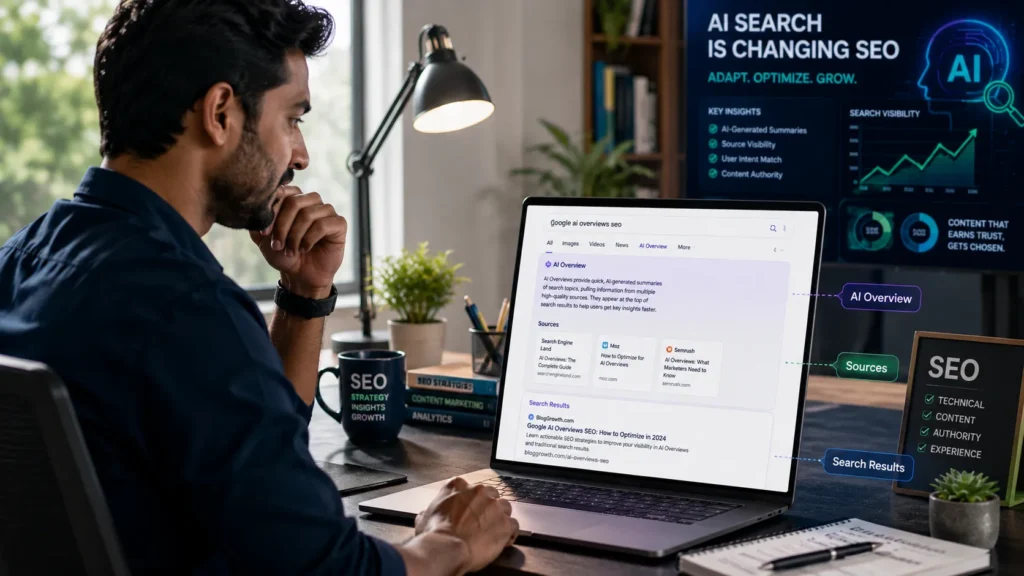
And there is an important point that gets lost in much of the AI-search discussion: Google itself does not say that publishers need a secret AI-optimized format, special AI markup, or a completely separate “GEO algorithm.” Google explicitly says the foundational SEO practices still apply and that there are no additional technical requirements specifically for appearing in AI Overviews or AI Mode.
So the winning strategy is not to abandon SEO.
It is to make traditional SEO much harder to fake.
What Is Google AI Overviews SEO?
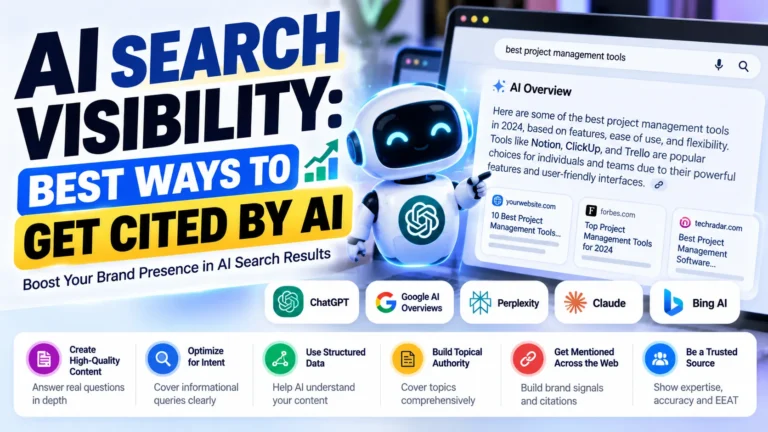
Google AI Overviews SEO is the practice of improving a website’s ability to appear as a supporting source, link, citation, or relevant result within Google’s AI-generated search experiences, especially AI Overviews and AI Mode.
The important distinction is this:
You are not optimizing an answer that Google must copy. You are creating a source that Google’s search systems can discover, understand, trust, retrieve, and present when it helps answer the user’s query.
Google describes AI search as being grounded in its Search index. Its current documentation explains that AI experiences can use retrieval-augmented generation (RAG) to retrieve relevant pages and query fan-out to run related searches across subtopics before building a response.
For an SEO professional, query fan-out is particularly interesting.
Imagine someone searches:
“Best laptop for video editing under ₹80,000.”
The original query may be expanded into related searches around:
- video editing performance
- processor benchmarks
- GPU requirements
- RAM recommendations
- display quality
- battery performance
- thermals
- laptops under ₹80,000
- current models and prices
That means a page can be relevant to the final AI answer even when it is not optimized around the exact wording of the original query.
This is one reason semantic SEO matters more in AI-driven search.
Why Google AI Overviews Matter for SEO
Google has been expanding AI Overviews well beyond its original U.S. rollout. Google announced expansion to India and several other markets in 2024, and later said AI Overviews had expanded to more than 100 countries and territories, reaching more than one billion users monthly at that stage.
Google has also continued moving toward a more AI-driven search experience with AI Mode.
Google says AI Overviews are designed to help people understand complicated questions quickly and provide links for further exploration, while AI Mode is intended for more complex exploration, reasoning, and comparison-oriented searches. Both can use query fan-out.
That creates three practical SEO consequences.
1. Search visibility can happen in more than one layer
Your page can potentially receive exposure through:
- the AI Overview
- conventional organic results
- People Also Ask
- featured snippets
- images
- video results
- news results
- other search features
- AI Mode
The SERP is becoming less like a single ranking list and more like a collection of visibility surfaces.
2. Rankings and clicks can move differently
A page may retain a strong organic ranking while receiving fewer clicks because the user gets enough information from an AI-generated summary.
That is not a theoretical concern.
Seer Interactive’s research using roughly 10,000 informational keywords found that queries where AI Overviews appeared already had lower organic CTR characteristics, and its analysis reported a year-over-year decline from 1.41% to 0.64% for the specific AIO-present query group it studied. At the same time, the research found that the presence of AI Overviews was not necessarily the only cause, because these query types tended to be lower-click queries even before AIOs appeared.
This is a useful warning against simplistic claims such as:
“AI Overviews killed SEO.”
The reality is much more nuanced.
3. Being cited can become part of the value proposition
Google has repeatedly emphasized links and source discovery inside its AI search experiences. Google has also said that AI Overview clicks can be higher quality, meaning visitors may spend more time on the websites they reach.
So the goal isn’t merely traffic preservation.
A strong AI-search strategy should pursue:
visibility → citation → qualified click → engagement → conversion
How Google AI Overviews Actually Finds Sources
This is where many SEO articles become too simplistic.
A common assumption is:
Google generates an AI Overview and chooses the highest-ranking page.
That is not a sufficient model.
Google’s documentation says generative AI search can retrieve relevant pages from the Search index and use query fan-out to investigate related subtopics. AI Overviews and AI Mode may use different models and techniques, so their responses and link sets can vary.
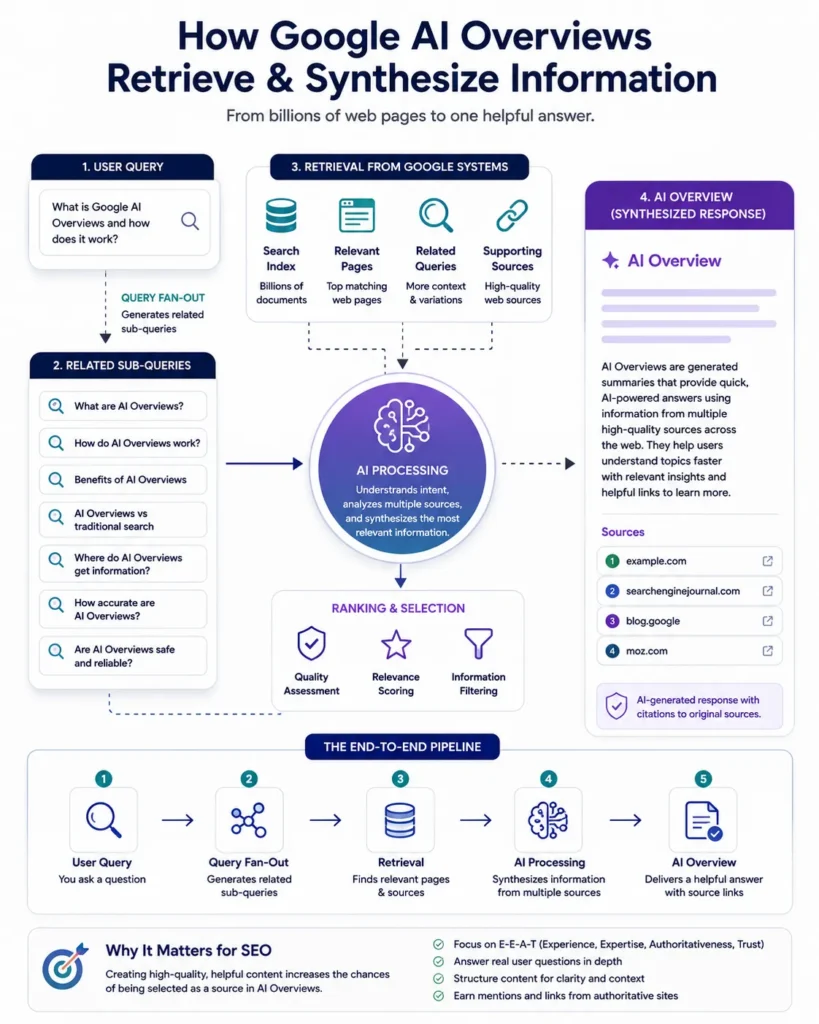
I would therefore think about AI Overview visibility as a retrieval problem plus a relevance problem plus a trust problem.
A page needs to be:
- Discoverable
- Indexable
- Relevant
- Understandable
- Useful
- Supported by credible evidence
- Distinct enough to add information
- Clearly connected to the query and its subtopics
This is why writing a 2,500-word article filled with repeated keywords is not enough.
The 12 Best Google AI Overviews SEO Strategies
1. Start With Search Intent, Not the Keyword
The first thing I would do with a target keyword is remove the keyword from the screen and ask:
What job is the searcher trying to complete?
For example:
could represent several intents:
- learning what AI Overviews are
- understanding how AI Overviews affect SEO
- finding optimization techniques
- protecting organic traffic
- tracking AI search visibility
- learning about GEO
- improving content for AI citations
- understanding Google AI Mode
- troubleshooting lost traffic
If your article answers only one of these questions, it may be relevant but incomplete.
Build your content around the search journey, not a single phrase.
Search journey for this topic
| Stage | Searcher question | Content requirement |
|---|---|---|
| Awareness | What are Google AI Overviews? | Clear explanation |
| Understanding | How do AI Overviews work? | Retrieval, citations, fan-out |
| Evaluation | Does AI Overviews affect SEO? | Traffic and visibility analysis |
| Implementation | How do I optimize for AI Overviews? | Practical SEO process |
| Measurement | How do I know if I’m appearing? | Search Console and analytics |
| Advanced | How do I improve AI visibility? | Entity, semantic, and authority strategy |
This approach gives your article more topical depth without forcing keywords into every paragraph.
2. Build Topic Coverage Around Entities and Relationships
Traditional keyword research often gives you a list.
Semantic SEO needs a map.
For Google AI Overviews SEO, the central entity is:
Google Search
Connected entities include:
- Google AI Overviews
- Google AI Mode
- Gemini
- Google Search Central
- Google Search Console
- Google Analytics
- Google Search ranking systems
- retrieval-augmented generation
- query fan-out
- semantic search
- natural language processing
- structured data
- crawling
- indexing
- search snippets
- featured snippets
- EEAT
- helpful content
- topical authority
- search intent
The value comes from explaining how these entities relate.
For example:
Search Console → impressions → queries → rankings → CTR → AI-search exposure → traffic → conversions
That is far more meaningful than a random list of “AI SEO keywords.”
3. Make Every Important Answer Easy to Extract
This is one of my favorite practical improvements.
Do not bury a direct answer inside a 700-word introduction.
When a reader asks:
“Does Google require special SEO for AI Overviews?”
answer immediately:
No. Google says there are no additional technical requirements or special optimizations specifically required for AI Overviews or AI Mode. A page still needs to meet Google’s normal Search technical requirements and follow its people-first content and quality guidance.
Then explain the nuance.
This structure works well for both users and search systems:
Question → direct answer → explanation → evidence → example
You can use the same structure for:
- definitions
- how-to steps
- eligibility questions
- comparisons
- pricing questions
- troubleshooting
- pros and cons
That does not mean “write for a chatbot.”
It means write clearly for humans.
4. Stop Writing Commodity Content
Google’s current generative AI guidance puts unusually strong emphasis on content that is unique, useful, and non-commodity. Google specifically recommends providing a unique point of view and notes that firsthand experience can offer value beyond simply summarizing what already exists.
This is one of the biggest opportunities for smaller publishers.
Suppose ten competitors publish:
“What is Google AI Overviews?”
You can explain:
- how AI Overviews differ from featured snippets
- how retrieval works
- which query types are likely to trigger them
- how to audit pages for AI-search readiness
- what to measure in Search Console
- how AI Overview visibility affects CTR
- which content formats deserve priority
- what Google officially says about GEO and AEO
Now your page isn’t just another definition.
It has information gain.
Good examples of information gain
Instead of:
“Create high-quality content.”
Write:
“For pages affected by AI Overviews, split your keyword set into AIO-heavy informational queries, traditional organic queries, commercial queries, and branded queries. Then compare impressions, CTR, and conversion rate across those groups.”
That is actionable.
5. Use Firsthand Experience Carefully
There is a strange problem in AI-assisted publishing.
Everyone wants content to sound experienced, so writers invent “I tested this” stories.
That is exactly the wrong direction.
Experience needs to be real.
Google’s current guidance explicitly discusses first-hand perspectives as a source of unique value.
So when publishing an article like this, add real observations only when you can verify them.
For example:
“I tracked 40 informational keywords for six weeks and found…”
is useful only if you actually tracked those keywords.
A safer and more credible editorial approach is:
“In my SEO workflow, I treat AI Overview visibility as a separate search surface and compare it with conventional organic performance.”
That’s an approach, not an invented case study.
For your own site, add genuine screenshots, audits, experiments, traffic comparisons, and before/after examples wherever possible.
6. Strengthen Topical Authority With Content Clusters
One article about AI Overviews cannot establish complete topical authority.
Think in clusters.
Pillar page
Supporting articles
- What Are Google AI Overviews?
- Google AI Mode Explained
- AI Overviews vs Featured Snippets
- How Google AI Search Works
- What Is Generative Engine Optimization?
- AEO vs GEO vs SEO
- How to Track AI Search Visibility
- Google Search Console SEO Guide
- Semantic SEO Guide
- Entity SEO Guide
- Topical Authority Guide
- How to Recover Lost Organic Traffic
- Search Intent Optimization Guide
Then connect them contextually.
For example:
“Before changing your content strategy, understand search intent and how semantic SEO helps Google interpret relationships between topics.”
The internal link should point to a genuinely useful supporting article.
This creates a semantic neighborhood around your main topic.
7. Improve Entity Clarity
Entity SEO becomes especially useful when a topic contains many similar concepts.
For example:
Google AI Overviews is not the same thing as:
Gemini
And:
Google AI Mode is not the same thing as:
AI Overviews
And:
GEO is not a replacement for:
SEO
Google’s own documentation says AEO and GEO are industry terms used for improving visibility in AI search, but from Google’s perspective, optimizing for generative AI search is still fundamentally part of optimizing the search experience.
Your article should therefore define entities precisely rather than treating every AI-search concept as interchangeable.
8. Get Technical SEO Right Before Chasing AI Visibility
This part is not exciting, but it is essential.
Google says that, to be eligible as a supporting link in AI Overviews or AI Mode, a page must be indexed and eligible to appear in Google Search with a snippet. Google also says there are no additional technical requirements specifically for AI features.
That means your basic SEO foundation still matters.
Check:
- robots.txt
- indexing
- canonical URLs
- XML sitemap
- internal links
- mobile usability
- JavaScript rendering
- page speed
- HTTP status codes
- duplicate URLs
- title tags
- headings
- crawlability
- structured data where appropriate
Do not spend hours searching for an “AI Overview schema.”
There is no magic schema that guarantees inclusion.
Google explicitly advises continuing to follow foundational SEO practices instead.
9. Use Structured Data for Understanding, Not Manipulation
Structured data still has value.
But its role is frequently exaggerated in AI SEO discussions.
Schema markup can help Google understand information represented on a page and can support eligible search appearances. However, structured data isn’t a secret command saying:
“Google, put this page in the AI Overview.”
Google’s current AI-search documentation does not identify a special AI Overview schema requirement.
Use structured data because it accurately describes your content.
For a normal editorial website, relevant structured data might include:
- Article
- BreadcrumbList
- Organization
- WebSite
- Person where appropriate
- Product for genuine product pages
- FAQPage only where applicable and supported
The rule is simple:
Markup should describe reality, not manufacture relevance.
10. Write for Query Fan-Out
This is one of the most important advanced concepts in Google AI Overviews SEO.
Google says query fan-out can issue multiple related searches across subtopics and data sources while generating an AI response.
That means your article should answer the obvious question and the questions surrounding it.
For a page targeting:
“Google AI Overviews SEO”
you should naturally address:
- What are AI Overviews?
- How does AI Overview work?
- Does SEO still matter?
- How do websites appear?
- What technical requirements apply?
- Does Google use RAG?
- What is query fan-out?
- What is AI Mode?
- What is GEO?
- What is AEO?
- How does AI search affect CTR?
- How should SEOs measure visibility?
- What content makes a page valuable?
- How should internal linking change?
- Does structured data matter?
- Does author experience matter?
These aren’t keyword variations for the sake of rankings.
They are the conceptual branches of the topic.
That is the deeper semantic strategy.
11. Make the Page More Useful Than the AI Summary
This is probably the single most important editorial principle.
If Google can summarize your article in three sentences, ask:
Why would somebody still click?
The answer should be obvious.
Your page should contain value that is difficult to compress into a generic summary.
Examples include:
- original research
- proprietary data
- screenshots
- calculators
- templates
- comparisons
- expert commentary
- first-hand testing
- step-by-step instructions
- downloadable resources
- case studies
- local knowledge
- updated statistics
- original diagrams
- practical workflows
Google’s recent search guidance continues to emphasize original, high-quality information and firsthand perspectives. Google has also been introducing ways to help users discover original content and preferred sources in AI search.
That is a major signal for publishers.
The future belongs to pages with reasons to be visited, not pages that merely contain answers.
12. Optimize for the Click After the Citation
Being mentioned in an AI Overview is not the end goal.
A citation that receives no qualified visits is less valuable than one that attracts the right audience.
So improve the destination experience.
When someone lands on your page, answer:
“What should I do next?”
For a tutorial, show the process.
For a comparison, show the decision criteria.
For a finance page, show the calculation.
For a government-scheme guide, show eligibility, documents, application steps and official links.
For an SEO guide, show examples and workflows.
This is where UX and SEO become inseparable.
Google AI Overviews SEO vs Traditional SEO
| Area | Traditional SEO | AI Overview SEO |
| Main objective | Rank in organic results | Earn visibility across AI and organic search |
| Keyword strategy | Keyword + intent | Topic + entities + intent + related subqueries |
| Content | Relevant and useful | Relevant, useful, and information-rich |
| Technical SEO | Essential | Still essential |
| Structured data | Helps search understanding | Useful, but not a special AIO ranking hack |
| Internal links | Improve discovery and context | Strengthen topical relationships |
| Authority | Backlinks, brand, trust | Authority plus source usefulness and distinctiveness |
| Measurement | Rankings, CTR, traffic | Visibility, CTR, traffic, conversions, and AI-search exposure |
| Content moat | Better optimization | Original information and firsthand value |
The key point is that the second column is not a replacement for the first.
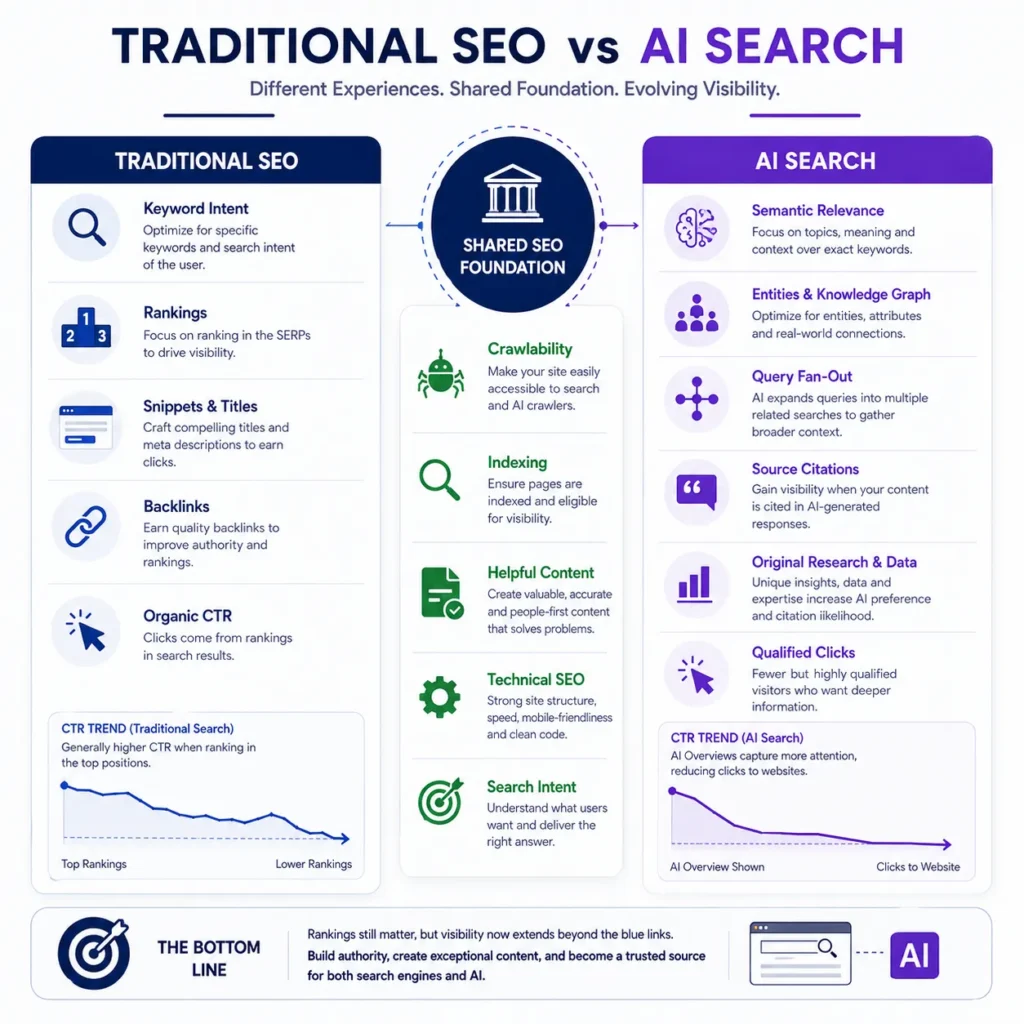
It is an extension of it.
Does Ranking #1 Guarantee an AI Overview Citation?
No.
Google does not state that the number-one organic result automatically becomes the AI Overview source.
AI Overviews can use multiple supporting webpages, and Google says its AI experiences can retrieve additional pages through related queries and other search mechanisms.
This changes how I would interpret rankings.
A URL ranking #4 can still be highly relevant to one component of an AI-generated answer.
Likewise, a URL ranking #1 may not be the strongest source for every sub-question.
So don’t build your entire AI-search strategy around one simplistic objective:
“Get to position one.”
Build a stronger objective:
“Become one of the most useful sources for the topic.”
What About GEO and AEO?
You will see three terms repeatedly:
SEO
Search Engine Optimization.
The broad discipline of improving visibility and performance in search engines.
AEO
Answer Engine Optimization.
Usually refers to optimizing content for answer-oriented search experiences.
GEO
Generative Engine Optimization.
A broader industry term for improving visibility in generative AI systems and AI-powered search.
These concepts overlap heavily.
Google explicitly says that, from its perspective, optimizing for generative AI search is still SEO because generative AI features are grounded in its Search systems.
So I would not create three disconnected strategies.
Instead:
SEO foundation → semantic content → entity clarity → original value → AI-search visibility
That model is easier to manage and less vulnerable to marketing buzzwords.
Should You Create an llms.txt File for Google AI Overviews?
Do not treat llms.txt as a requirement for Google AI Overviews.
Google’s current generative AI guidance specifically warns against unnecessary AI-oriented tactics such as creating AI text files like llms.txt as an optimization requirement. Google’s recommendation is to prioritize the fundamentals and create useful, reliable, people-first content.
That is a good example of where SEO practitioners need to separate:
interesting industry experiments
from
documented Google requirements.
How to Measure Google AI Overviews SEO
This is where the SEO workflow has changed significantly.
Google announced new Search Generative AI performance reports in Search Console in June 2026, providing dedicated views for visibility within generative AI features such as AI Overviews and AI Mode. Google said these reports were initially rolling out to a subset of websites while being tested before broader availability.
That means your measurement framework should evolve.
Track these metrics
1. Impressions
Are your pages gaining visibility?
2. Organic CTR
Are searchers still clicking?
3. Query groups
Which types of keywords are affected?
4. Average position
Has conventional ranking changed?
5. AI-search visibility
Are your URLs being surfaced in generative results?
6. Qualified organic traffic
Is the traffic commercially useful?
7. Engagement
Do visitors actually consume your content?
8. Conversions
Are AI-search visitors becoming leads, subscribers, customers or users?
The most useful dashboard is not:
“How many AI Overview mentions did we get?”
It is:
“Which AI-search-visible topics generate business value?”
A Practical Google AI Overviews SEO Workflow
Here is the workflow I would use for a site.
Step 1: Export your existing queries
Use Google Search Console to identify:
- high-impression queries
- pages with declining CTR
- informational keywords
- featured-snippet queries
- long-tail queries
- high-conversion topics
Step 2: Segment the queries
Create groups for:
- informational
- commercial
- transactional
- navigational
- branded
- local
- problem-solving
Then identify where AI Overviews appear.
Step 3: Audit the top pages
Ask:
- Does the page fully answer the intent?
- Does it cover related questions?
- Is the information current?
- Is there original value?
- Are sources credible?
- Is the author qualified?
- Are important entities explained?
- Are internal links relevant?
- Is the page technically accessible?
Step 4: Add information gain
Look at the top-ranking competitors.
Do not ask only:
“What headings do they have?”
Ask:
“What useful thing have all of them failed to provide?”
That question often reveals your best opportunity.
Step 5: Improve extraction and usability
Make key information easy to locate through:
- short paragraphs
- direct answers
- descriptive headings
- comparison tables
- lists
- examples
- supporting evidence
- clear summaries
Step 6: Build supporting content
Turn one successful article into a topical cluster.
Step 7: Measure again
Compare:
- visibility
- CTR
- rankings
- traffic
- conversions
- AI-search exposure
Do not judge the strategy from rankings alone.
7 Common Google AI Overviews SEO Mistakes
Mistake 1: Keyword stuffing
Repeating “Google AI Overviews SEO” 40 times does not make a page more authoritative.
Use the keyword where it makes sense, then build the semantic context around it.
Mistake 2: Rewriting Google’s own documentation
A page that simply paraphrases Search Central is unlikely to provide much information gain.
Use primary sources as evidence, then contribute your own analysis.
Mistake 3: Publishing generic AI-generated articles
AI-assisted drafting can accelerate research and editing, but publishing commodity text without meaningful originality creates little defensible value.
Mistake 4: Ignoring existing SEO
Google’s own guidance is clear that traditional SEO still underpins AI-search eligibility and visibility.
Mistake 5: Chasing every GEO hack
New AI SEO tactics appear constantly.
Some are useful experiments.
Few deserve to replace basic technical SEO, excellent information architecture, and strong content.
Mistake 6: Measuring only rankings
A ranking report may look healthy while CTR and business outcomes deteriorate.
Mistake 7: Forgetting the destination page
Getting exposure is only half the job.
The landing page needs to give users a strong reason to continue.
A Simple AI Overview Content Quality Checklist
Before publishing, I would score the page against these questions:
| Question | Yes/No |
| Does the article satisfy the primary search intent? | |
| Does it answer important related questions? | |
| Are the major entities clearly explained? | |
| Does it provide information gain? | |
| Are factual claims supported by reliable sources? | |
| Is the author or publisher credible for the subject? | |
| Is the page crawlable and indexable? | |
| Are internal links contextually useful? | |
| Does the page contain original examples or insights? | |
| Is the content easy to scan on mobile? | |
| Does the page provide a reason to click beyond the AI summary? | |
| Can performance be measured with Search Console and Analytics? |
A page that performs well against this checklist is much better positioned than one that simply contains a target keyword.
What I Would Change on an Existing Website
Imagine a website has 500 blog posts and notices that informational traffic is flattening.
I would not immediately publish another 500 articles.
I would first identify:
Which pages are exposed to AI-search displacement?
Then divide pages into four groups:
Group A: High traffic + high conversion
Protect and improve these pages first.
Group B: High traffic + low conversion
Improve intent matching and monetization.
Group C: Low traffic + strong topical value
Use internal links and supporting content to strengthen them.
Group D: Thin or redundant content
Merge, improve, redirect, or remove where appropriate.
This is more efficient than blindly producing more content.
Internal Linking Strategy for Google AI Overviews SEO
For a website like a digital marketing or SEO publication, I would build internal links around topical relationships.
Suggested pillar page
Google AI Overviews SEO
Supporting cluster
Anchor: Google AI Mode explained
Destination: AI Mode guide
Anchor: how semantic SEO works
Destination: Semantic SEO guide
Anchor: understanding search intent
Destination: Search Intent guide
Anchor: Google Search Console SEO
Destination: Search Console tutorial
Anchor: topical authority strategy
Destination: Topical Authority guide
Anchor: generative engine optimization
Destination: GEO guide
Anchor: entity SEO
Destination: Entity SEO guide
The anchor text should describe the linked page naturally.
Do not force exact-match anchors into every paragraph.
Recommended Content Cluster for PunitPatel.in
For a site publishing blogging, SEO, AI, SaaS, and digital-marketing content, this topic could become an excellent AI-search pillar.
A practical cluster would look like:
Pillar:
Google AI Overviews SEO
Cluster 1:
AI Search and Google Search
Cluster 2:
Semantic SEO
Cluster 3:
Entity SEO
Cluster 4:
Topical Authority
Cluster 5:
Google Search Console
Cluster 6:
GEO and AEO
Cluster 7:
Content optimization
Cluster 8:
Technical SEO
That structure gives Google more contextual evidence about what your website actually covers.
It also creates a stronger user journey.
Someone arriving from an article about AI Overviews can continue into semantic SEO, technical SEO, Search Console, or GEO without leaving the site.
The Future of SEO Is Not “AI vs SEO”
This is the mistake I would avoid most.
AI Overviews do not make SEO irrelevant.
Google’s official documentation says the opposite: generative AI features are rooted in Google’s core Search ranking and quality systems, and traditional SEO practices remain relevant.
What is changing is the search interface.
The user may now receive:
- a generated summary
- several supporting links
- follow-up prompts
- comparison information
- multimedia
- traditional organic results
- AI Mode responses
The website that wins will not necessarily be the website with the highest keyword density.
It will increasingly be the website that contributes something genuinely useful to the search ecosystem.
That could be:
expertise, original data, experience, strong research, a better explanation, a useful tool, a unique perspective, or a more complete resource.
What Google AI Overviews SEO Really Means
I would reduce the entire strategy to one principle:
Don’t try to write content that an AI can summarize. Build content that becomes more valuable when the AI points users to it.
That means keeping the SEO foundations intact while improving the parts that generic content usually lacks:
search intent, semantic depth, entity clarity, technical accessibility, original information, evidence, experience, topical authority, and user value.
Google’s own documentation makes the technical side surprisingly straightforward: pages need to be indexed and eligible for normal Search, and there are no special technical requirements specifically for AI Overviews or AI Mode.
The difficult part is editorial.
Can your page contribute something that isn’t already everywhere?
Can it answer the immediate question and the next five questions?
Can it demonstrate real expertise?
Can it give users a reason to click?
Can you measure whether that visibility creates meaningful outcomes?
Those are the questions I would use when auditing a site in 2026.
AI search is changing how people discover information, but the underlying SEO lesson is surprisingly familiar:
Be discoverable. Be relevant. Be trustworthy. Be useful. Add something original.
Then make the destination worth visiting.
FAQ: Google AI Overviews SEO
What is Google AI Overviews SEO?
Google AI Overviews SEO is the practice of improving a website’s ability to appear as a relevant supporting source within Google’s AI-driven search experiences while maintaining strong conventional SEO fundamentals.
Does Google require special SEO for AI Overviews?
No. Google says there are no additional technical requirements or special optimizations required specifically for AI Overviews or AI Mode. Pages still need to meet normal Search requirements and follow Google’s quality and spam policies.
How can I appear in Google AI Overviews?
Start with standard SEO: ensure the page is crawlable and indexable, satisfy search intent, publish useful and original information, establish topical relevance, and provide a strong user experience. There is no guaranteed technique for inclusion.
Does ranking #1 guarantee AI Overview visibility?
No. AI Overviews can use multiple supporting webpages and may retrieve additional information through related searches. Organic ranking and AI Overview visibility are related but not identical.
Does structured data help with AI Overviews?
Structured data can help search engines understand content when implemented accurately, but Google does not identify a special AI Overview schema requirement. Structured data should describe actual page content rather than be treated as an AI-ranking shortcut.
Is GEO different from SEO?
GEO, or generative engine optimization, is an industry term for improving visibility in generative AI search. Google says this work should still be understood as part of SEO and search optimization rather than as a completely separate discipline.
Does AI-generated content hurt AI Overview visibility?
The issue is not simply whether AI was used during drafting. The bigger concern is whether the published content is useful, original, accurate, reliable, and valuable to readers. Google’s current guidance emphasizes unique, non-commodity content and firsthand value.
Can AI Overviews reduce organic traffic?
They can affect click behavior on some query classes, although the impact varies by query, SERP and whether a site appears within the AI Overview. Independent research has found significant CTR changes on some AIO-present queries, but it also found that these queries tended to have lower CTR even before AI Overviews appeared.
How do I track AI Overview performance?
Use Google Search Console and Google Analytics. Google announced dedicated generative AI performance reporting in Search Console in June 2026, with the new reporting being rolled out to a subset of sites initially.
Should I create an llms.txt file for Google AI Overviews?
There is no need to treat llms.txt as a requirement for Google AI search. Google’s current guidance specifically recommends focusing on established SEO practices rather than unnecessary AI-specific files and hacks.
What is the most important Google AI Overviews SEO strategy?
Create content that is more useful than a generic summary: satisfy intent, cover related questions, provide original information, demonstrate expertise, use strong internal linking, and give users a reason to click through.