Have you ever published a genuinely useful article, optimized the title, fixed the technical SEO, added internal links, and still watched the page sit somewhere on page 5 while competitors with hundreds of backlinks occupied the top positions?
I know that problem is frustrating, especially when you’re running a new website or a small blog and don’t have the budget, relationships, or time for constant link building. The good news is that “no backlinks SEO” is not as unrealistic as it sounds. The important part is understanding what the strategy actually means.
I don’t treat no-backlinks SEO as “Google ignores links.” It doesn’t. Google explicitly says its ranking systems include link analysis systems and that PageRank remains part of its core ranking systems. Google also uses links to help understand what pages are about and to discover pages for crawling.
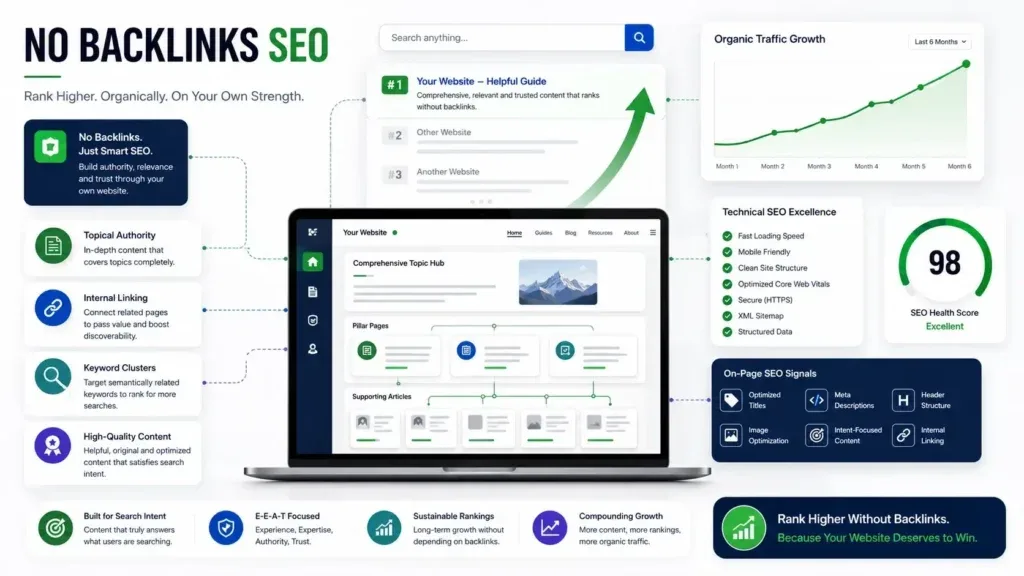
Instead, I treat No Backlinks SEO as a constrained SEO strategy: build rankings while deliberately avoiding active external link acquisition.
That distinction changes everything.
You stop asking:
“How many backlinks does my competitor have?”
And start asking:
“What ranking signals can I improve directly on my own website?”
That means improving search intent alignment, topical coverage, content usefulness, internal linking, crawlability, page experience, information gain, entity relevance, CTR, and content quality.
For some queries, particularly long-tail, informational, local, low-competition, and highly specific searches, that approach can work surprisingly well. For highly competitive commercial queries, however, refusing to build or earn external authority can place a real ceiling on performance.
This guide explains where the strategy works, where it doesn’t, and how I’d build a no backlinks SEO system from scratch.
What Does No Backlinks SEO Actually Mean?
There is an important semantic distinction here.
No backlinks SEO does not necessarily mean your website has zero backlinks.
It means you are not making backlink acquisition the active growth engine of your SEO strategy.
You may still naturally receive links from:
- Bloggers who reference your research
- Forums and communities
- Social profiles
- News websites
- Directories
- Resource pages
- Educational websites
- Customers
- Partners
- Other creators
Those are earned or incidental links.
The “no backlinks” constraint simply means you’re saying:
“I’m going to optimize what I control first.”
That includes the website itself.
Traditional SEO vs No Backlinks SEO
| Area | Traditional SEO | No Backlinks SEO |
|---|---|---|
| Content | Important | Extremely important |
| Backlinks | Often actively pursued | Not actively pursued |
| Internal links | Important | Core strategy |
| Search intent | Important | Core strategy |
| Topical authority | Important | Extremely important |
| Technical SEO | Important | Critical |
| Long-tail keywords | Useful | Major opportunity |
| Brand mentions | Useful | Helpful but not required |
| Digital PR | Common | Optional |
| Competitor link analysis | Common | Mainly used for research |
| Content depth | Important | Strategic differentiator |
| Site architecture | Important | Major ranking asset |
The advantage is control.
You don’t need to wait for another website owner to approve a link. You can improve your page today.
The disadvantage is that you’re voluntarily giving less attention to one of Google’s established ranking systems.
So this is not a magic replacement for authority building.
It’s a resource allocation strategy.
Do Backlinks Still Matter for Google SEO?
Yes.
This needs to be stated clearly because a lot of “backlinks are dead” content oversimplifies what Google has actually said.
Google’s current documentation states that it has systems that understand how pages link to each other, including PageRank. Google describes these systems as part of its ranking infrastructure.
Google also says links can help it:
- Discover pages.
- Understand the relevance of pages.
- Understand anchor text and relationships between pages.
Independent SEO research points in the same direction, although the relationship is more nuanced than “more backlinks = higher rankings.”
An Ahrefs analysis found that links still correlate with rankings, but the strength of that relationship varies by query type. Their research reported stronger relationships for higher-search-volume queries, while link importance has decreased for some lower-volume and less competitive queries compared with older studies.
That is exactly why no-backlinks SEO makes sense in some situations and makes very little sense in others.
A practical way to think about backlinks
Imagine two queries:
Query A: “how to compress a JPG below 100KB”
Query B: “best CRM software”
The first query can potentially be won through exceptionally good content, a useful tool, clear instructions, fast page experience, strong internal architecture, and excellent intent matching.
The second is a giant commercial ecosystem with established brands, strong domains, product signals, reviews, citations, brand awareness, and substantial external authority.
Trying to use exactly the same SEO strategy for both would be a mistake.
When Does No Backlinks SEO Work Best?
The strategy tends to be most viable when the keyword isn’t dominated by extremely powerful websites.
I look for five conditions.
1. The search intent is highly specific
A query such as:
“how to resize an image to 200 KB on mobile”
is much narrower than:
Specific queries give you more opportunities to produce an answer that fits the exact job the searcher needs to complete.
2. The SERP contains weak or incomplete results
This is one of the biggest opportunities.
Don’t just count backlinks.
Open the ranking pages and ask:
- Does the article answer the query completely?
- Is the information outdated?
- Does it miss practical steps?
- Does it answer only one interpretation of the query?
- Are examples missing?
- Is the page difficult to scan?
- Does it have poor UX?
- Is the author unclear?
- Is there no original data?
- Are important related questions unanswered?
A page can have 500 referring domains and still provide a mediocre answer.
That’s an opportunity.
3. The query has long-tail variations
Long-tail SEO is particularly interesting for websites avoiding active link building.
Suppose the seed topic is:
“Google Search Console.”
Instead of attacking that broad topic immediately, build coverage around:
- Google Search Console indexing issue
- Google Search Console pages not indexed
- how to request indexing
- Search Console crawl errors
- URL inspection tool explained
- Search Console impressions but no clicks
- Search Console indexing delay
- Google Search Console beginner guide
These pages create a semantic network.
4. You can provide something competitors don’t
This is where information gain matters.
Google’s guidance encourages original information, research, analysis, and substantial additional value instead of simply rewriting existing sources.
Your competitive advantage can be:
- Original screenshots
- Tests
- Calculators
- Interactive tools
- Templates
- Checklists
- Examples
- Comparison tables
- First-hand observations
- Updated documentation
- Original datasets
- Expert commentary
5. The site develops topical depth
One isolated article is rarely enough to establish topical authority.
A website about SEO should not publish one article about technical SEO and then jump randomly between celebrity news, recipes, and cryptocurrency.
Google’s people-first guidance specifically recommends having a primary purpose or focus for the site and creating content for an intended audience.
The No Backlinks SEO Framework
This is the part I consider most important.
When external authority isn’t your main lever, you need to make the website itself stronger.
I use this framework:
Search Intent → Content Quality → Topical Authority → Internal Links → Technical SEO → User Experience → SERP Feedback → Continuous Improvement
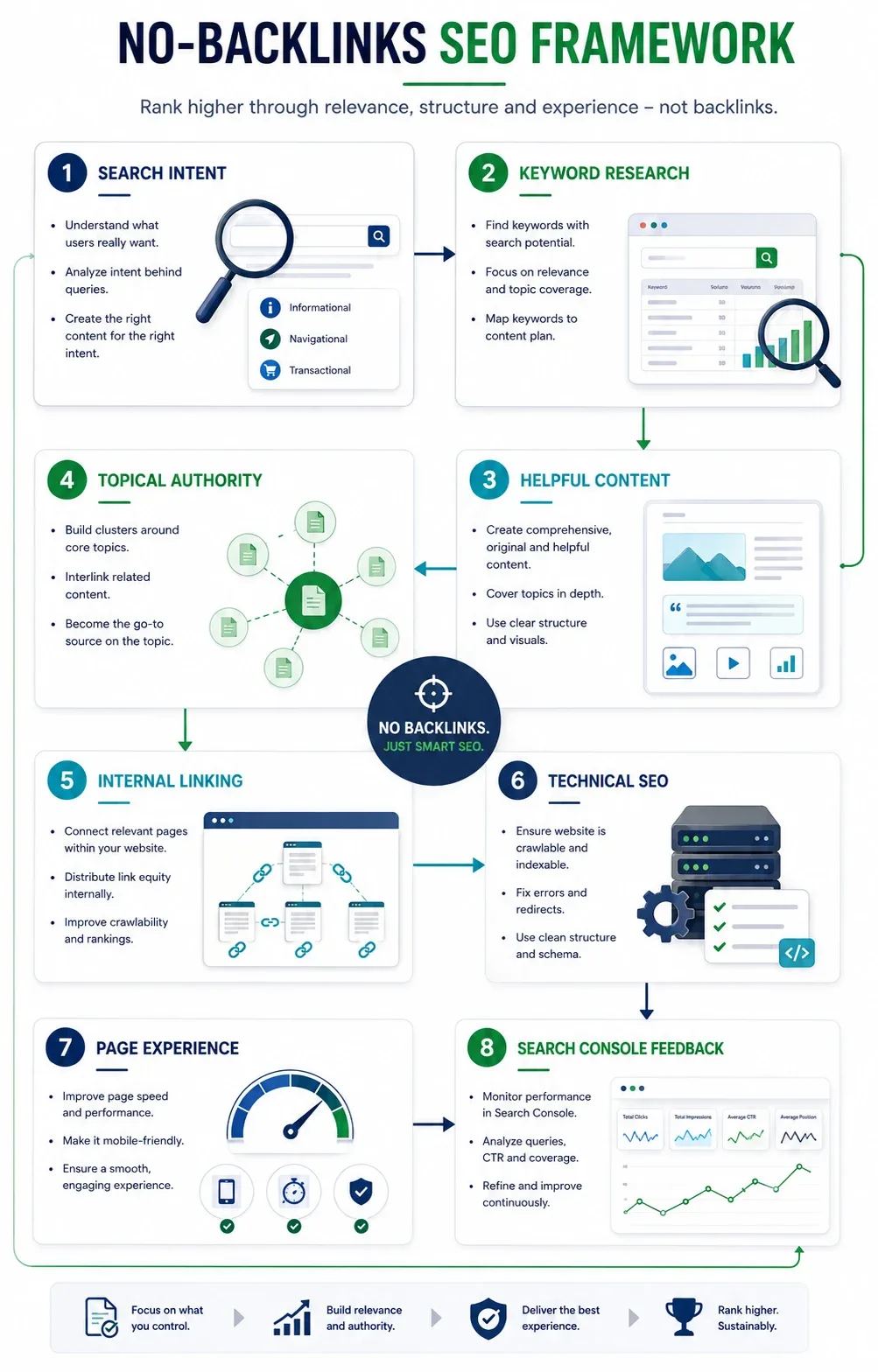
Let’s break it down.
1. Start With Low-Competition Keyword Research
The biggest mistake is starting with a keyword because it has high search volume.
A no-backlinks strategy should begin with ranking feasibility.
Look for keywords with:
- Clear intent
- Moderate or low competition
- Specific wording
- Long-tail variations
- Question-based searches
- Problem-solving intent
- Weak existing results
- Local intent where applicable
- Freshness opportunities
- Strong topical relevance to your existing site
Build keyword clusters instead of isolated keywords
For example, don’t create one article targeting “image compressor” and stop there.
Create a cluster:
Pillar:
Image Compressor
Supporting topics:
- Free Image Compressor
- Compress JPG Online
- Compress PNG Without Losing Quality
- Compress WebP Images
- Reduce Image File Size
- Image Compression for WordPress
- Image Compression for SEO
- Best Image Compression Settings
- How to Compress Images on Mobile
- Image Size vs Image Quality
- Lossy vs Lossless Compression
Now your site isn’t merely targeting keywords.
It is building a topic entity graph.
That is far more useful for long-term organic visibility.
2. Match the Exact Search Intent
This is where many articles lose despite having excellent keyword optimization.
Google isn’t trying to return pages that merely mention a keyword.
Its ranking systems are designed to surface relevant and useful results for the query.
Before writing, classify the query.
Informational intent
Examples:
- What is technical SEO?
- How do backlinks work?
- What is PageRank?
The reader wants an explanation.
Commercial investigation
Examples:
- Best image compressor
- Ahrefs vs Semrush
- Best SEO tools for beginners
The reader is comparing options.
Transactional intent
Examples:
- Buy SEO software
- Download SEO plugin
- Free image compressor online
The user wants to perform an action.
Examples:
- Google Search Console login
- Ahrefs
- WordPress
The user is looking for a specific destination.
Your article should fulfill the dominant intent before adding secondary information.
3. Create Content That Is Better, Not Just Longer
A 3,500-word article is not automatically better than a 1,200-word article.
I’ve found it useful to think in terms of answer density.
A good page should make the reader think:
“I don’t need to search again.”
That is the target.
For a no-backlinks SEO article, cover questions such as:
- Can a new website rank without backlinks?
- How does Google discover a new website?
- Are backlinks mandatory?
- What replaces link building?
- Can internal links help rankings?
- What keywords are easiest without backlinks?
- Does topical authority matter?
- How long does SEO take without backlinks?
- Are social shares backlinks?
- Can tools rank without link building?
- Should I ever start link building later?
That breadth reduces the chance that the reader leaves immediately to search for the next answer.
Google’s own content guidance encourages substantial, complete coverage and asks whether users will leave feeling they’ve learned enough to achieve their goal.
4. Build Topical Authority
This is arguably the biggest weapon in a no-backlinks SEO strategy.
Suppose your website wants to rank for:
SEO for WordPress
Don’t publish:
- One WordPress SEO article
- One Instagram article
- One travel post
- One AI news article
- One government scheme
- One cryptocurrency post
and expect a strong topical signal around WordPress SEO.
Instead, create a structured topical universe.
Example topical map
Parent topic: WordPress SEO
Child topics:
- On-page SEO
- Technical SEO
- WordPress indexing
- XML sitemaps
- Internal linking
- Schema markup
- Image SEO
- Core Web Vitals
- Website speed
- SEO plugins
- Canonical URLs
- Robots.txt
- Breadcrumbs
- Search Console
- SEO content writing
Supporting entities:
- WordPress
- Google Search
- Googlebot
- Google Search Console
- Yoast SEO
- Rank Math
- Schema.org
- Core Web Vitals
The goal is not to mention entities for the sake of “entity SEO.”
The goal is to demonstrate that your website understands how these concepts relate to each other.
5. Treat Internal Linking as a Major Asset
When you’re intentionally avoiding backlinks, internal linking becomes even more important.
Google says links can help it understand page relationships, relevance, and discover content.
Internal links don’t magically substitute for external authority.
But they can help you create a coherent site architecture.
A strong internal linking pattern
Imagine:
SEO Guide
links to:
→ Keyword Research
→ Technical SEO
→ On-Page SEO
→ Internal Linking
→ Content Clusters
→ Search Console
Then each supporting page links back to the pillar.
You can also connect related pages laterally.
For example:
Internal Linking Guide
→ Anchor Text Guide
→ Site Architecture Guide
→ Topic Cluster Guide
→ Crawlability Guide
This creates meaningful relationships between pages.
Don’t use random anchor text
Weak:
Click here
Better:
learn how to build internal links
Best:
WordPress internal linking strategy
The anchor should accurately describe the destination.
Google’s link guidance specifically recommends useful anchor text that helps people and Google understand the linked page.
6. Make Technical SEO Boringly Good
No backlinks SEO becomes much harder if Google can’t efficiently crawl, render, or understand your website.
I prefer to eliminate technical obstacles before chasing more content.
Technical SEO checklist
Check:
- HTTPS
- XML sitemap
- Robots.txt
- Canonical URLs
- Mobile usability
- Indexability
- HTTP status codes
- Redirect chains
- Broken internal links
- Duplicate pages
- Pagination
- JavaScript rendering
- Core Web Vitals
- Image optimization
- Clean URL structure
- Structured data where relevant
Google says Search Essentials include technical fundamentals, people-first content, and appropriate use of words users search for.
Its documentation also explains that properly linked pages are usually discoverable, while sitemaps can help, especially for new, large, or complex websites.
Don’t overcomplicate technical SEO
I have a simple rule:
Fix problems that prevent crawling, indexing, understanding, or a good user experience.
Don’t spend six hours tweaking an insignificant technical setting while your article fails to answer the user’s main question.
7. Improve Page Experience
A page can contain excellent information and still feel unpleasant.
That affects the reader’s behavior.
Watch for:
- Slow loading
- Aggressive popups
- Intrusive ads
- Poor mobile spacing
- Tiny fonts
- Giant paragraphs
- Autoplay media
- Layout shifts
- Difficult navigation
- Weak contrast
- Overloaded sidebars
Google says there isn’t one single “page experience signal.” Its systems consider a variety of signals and recommend looking at page experience holistically. Core Web Vitals remain an important practical area to monitor.
For a small site, this matters because you don’t have unlimited opportunities to earn trust.
Make every visit easy.
8. Create Original Assets That Earn Attention Without Chasing Links
Here’s an underused approach.
Instead of thinking:
“How can I get someone to link to my article?”
think:
“What can I publish that people cannot get from ten other articles?”
Consider:
Original calculators
Examples:
- Keyword density calculator
- Image compression calculator
- SEO ROI calculator
- Word count calculator
Interactive tools
Tools can satisfy intent faster than paragraphs.
Original datasets
For example:
“We analyzed 500 pages across 20 WordPress sites.”
Only publish such findings when you actually performed the analysis.
Screenshots
Real screenshots are often more useful than generic instructions.
Before-and-after demonstrations
Show:
- Old title
- New title
- Old structure
- New structure
- Old page speed
- Improved page speed
Templates
Give readers something usable.
A template can often produce more engagement than another 500 words of theory.
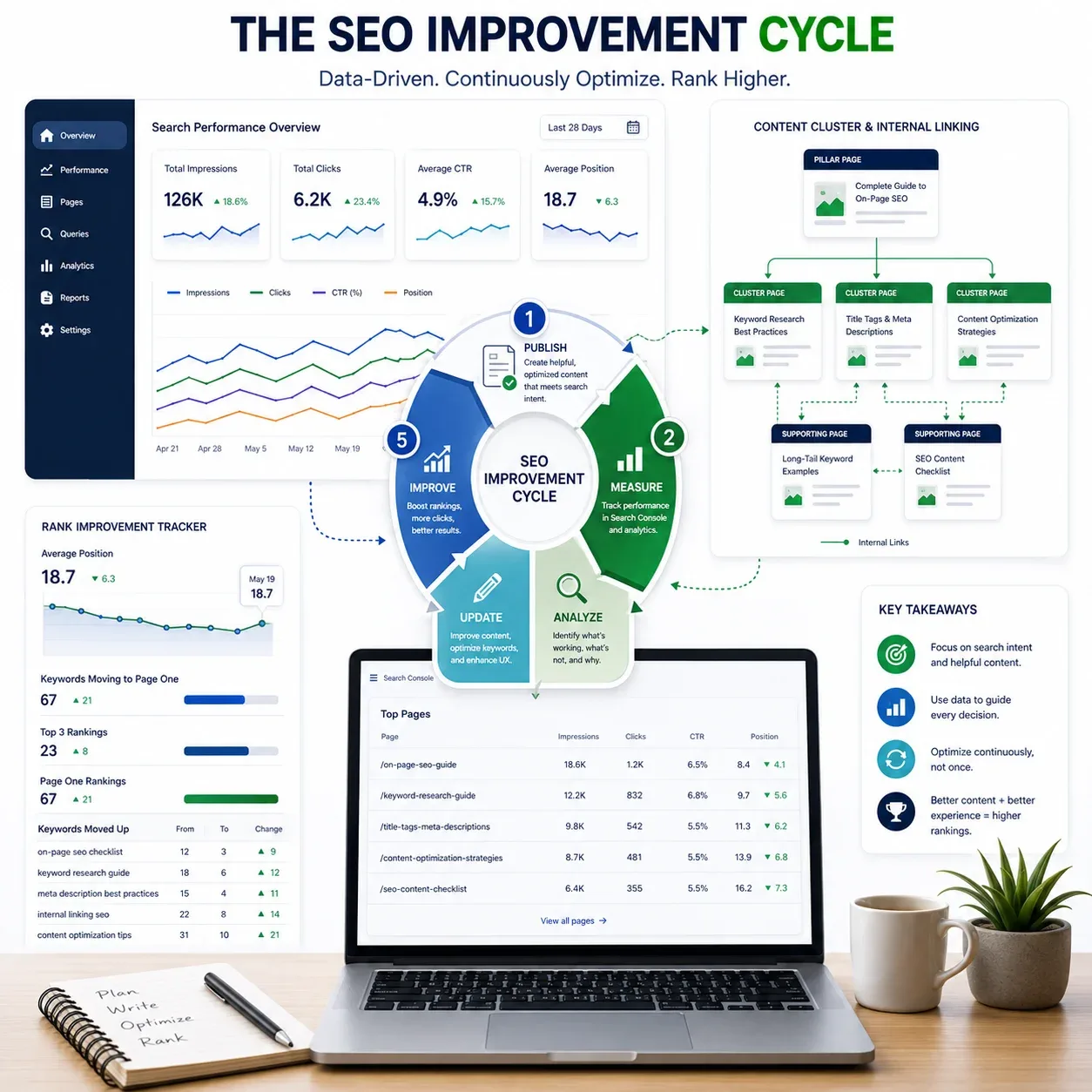
9. Use Search Console as Your Feedback Loop
Once your site has impressions, SEO becomes less about guessing.
Google Search Console gives you useful signals around search queries, clicks, impressions, and positions.
I use those signals to identify pages that already have search visibility but aren’t fully capturing demand.
Look for pages with:
High impressions + low CTR
Potential actions:
- Rewrite title
- Improve meta description
- Make the benefit clearer
- Align headline more closely with intent
- Add a stronger introductory answer
Then look at:
Average position 8–20
Those pages can become SEO opportunities.
Ask:
- What does the current page fail to cover?
- Are competitors answering related questions better?
- Is the internal linking weak?
- Is the title targeting the wrong intent?
- Does the page need original evidence?
- Are important entities and concepts missing?
Google says crawling and indexing are not guaranteed instantly, and Search Console can help you monitor search and indexing performance after publication.
Can a New Website Really Rank With No Backlinks?
Yes, but there is a major qualification:
Ranking is query-dependent.
A new website can potentially rank for highly specific, low-competition queries without deliberately acquiring external backlinks.
It becomes much harder when:
- The keyword has enormous commercial value
- The SERP is dominated by major brands
- Search intent is broad
- Competitors have strong brand recognition
- The query is highly competitive
- The topic requires significant authority
- The existing results are already excellent
This is why “I ranked without backlinks” anecdotes need context.
What keyword?
How competitive?
How old was the website?
How strong was the content?
Was it a branded query?
Did the page receive natural links?
What was the site’s internal authority?
Without those details, the claim tells you very little.
No Backlinks SEO vs Traditional Link Building
| Factor | No Backlinks SEO | Traditional Link Building |
| Cost | Lower potential external cost | Can be expensive |
| Control | High | Lower |
| Speed | Usually gradual | Can accelerate authority |
| Risk | Lower when focused on quality | Depends heavily on tactics |
| Scalability | Content and architecture dependent | Outreach dependent |
| Best for | Long-tail and niche topics | Competitive queries |
| Brand exposure | Indirect | Can be significant |
| Dependence on outreach | Low | High |
| Authority building | Mostly on-site | On-site + off-site |
| Best use | Sustainable foundation | Competitive growth layer |
I wouldn’t frame these approaches as enemies.
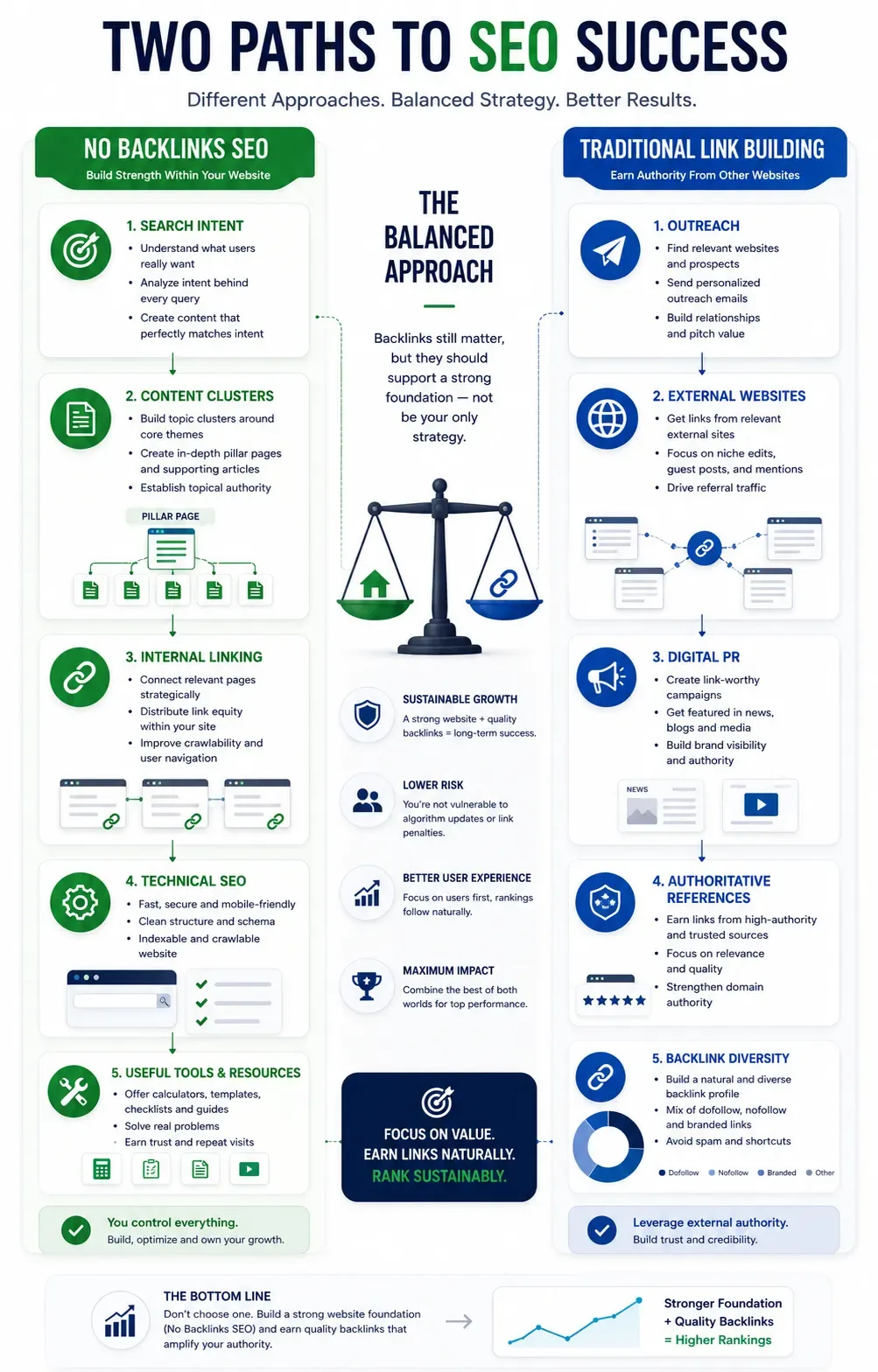
A smart SEO strategy can start with a no-backlinks foundation and introduce earned links later when the economics make sense.
What Actually Replaces Backlinks?
Nothing completely replaces a backlink.
That’s the honest answer.
But several other areas can compensate for the lack of active link acquisition to a certain degree.
Content relevance
Your page must directly address the query.
Your site should demonstrate broad and connected knowledge within its subject.
Important pages should receive strong internal links.
Technical accessibility
Google should be able to crawl and understand the site.
User satisfaction
The page should actually solve the searcher’s problem.
Information gain
Give readers something more than the standard summary. In 2026, this matters even more: Google’s AI Overviews cite web sources directly in their answers, and pages offering original data or genuinely new information are the ones that get cited.
Brand and entity clarity
Clearly communicate who created the content and why the site exists.
Google’s guidance emphasizes clear authorship, demonstrable expertise, and a people-first purpose.
Again, these aren’t a direct mathematical substitute for PageRank.
They are the rest of the SEO equation.
The “Zero Backlinks” Trap
There is one issue people often miss.
A website can avoid active link building while still benefiting from links.
Google’s documentation notes that newly launched sites with few external links can have more difficulty being discovered, which is one reason a sitemap can be particularly useful for new sites.
So don’t make the rule:
“I must never receive a backlink.”
Make the rule:
“I will not make backlink acquisition a prerequisite for publishing or growing my site.”
That is a much healthier strategy.
If another website naturally references your original research, don’t reject it because you’re pursuing “no backlinks.”
How I Would Build a No Backlinks SEO Website From Scratch
Here’s the practical workflow.
Phase 1: Choose a narrow subject
Don’t start with “digital marketing.”
Start with:
WordPress SEO for small publishers
or:
Image optimization tools for websites
or:
SEO for Indian bloggers
The narrower the initial topical boundary, the easier it becomes to build meaningful depth.
Phase 2: Create the pillar page
Build the comprehensive resource.
For example:
Complete WordPress SEO Guide
Then identify its child topics.
Phase 3: Publish supporting content
Create 15–30 tightly related pages before expanding into unrelated subjects.
Connect them through internal links.
Phase 4: Add original assets
Build:
- Screenshots
- Templates
- Tools
- Examples
- Mini case studies
- Checklists
- Comparison tables
Phase 5: Improve technical SEO
Make crawling, indexing, and navigation easy.
Google recommends logical URL structures and crawlable links; properly connected site architecture is a key part of discoverability.
Phase 6: Monitor Search Console
Look for:
- New impressions
- New queries
- Pages approaching page one
- High-impression, low-CTR pages
- Indexed versus unindexed content
- Queries you didn’t deliberately target
Phase 7: Update winners
Don’t abandon a page after publication.
Expand it around actual search behavior.
An Illustrative No-Backlinks SEO Case Study
This is an illustrative scenario, not a claim of a specific site’s performance.
Imagine a small website launching in the image optimization niche.
It chooses:
Primary topic: image compression
Instead of trying immediately to rank for:
image compressor
it creates focused pages around:
- compress JPG to 100KB
- reduce PNG file size
- compress images for WordPress
- WebP vs JPG
- image compression for SEO
- resize image without losing quality
- reduce image size for website
- best image dimensions for blog posts
The site then builds a central image compression guide and connects all supporting articles through contextual internal links.
It also adds an actual browser-based image compressor as a tool.
Now the website has something beyond text:
utility + content + topical relevance + internal architecture.
That combination creates a stronger proposition than simply publishing another generic 2,000-word article.
Could it outrank a huge software company for every keyword?
No.
Could it potentially win highly specific queries?
Absolutely; that is the realistic opportunity.
Why Tools Can Be Powerful for No Backlinks SEO
This deserves special attention.
A useful tool can satisfy search intent faster than an article.
Think about a search:
“compress image under 100KB”
The user probably doesn’t want a philosophical explanation of compression algorithms.
They want to upload an image and get a smaller file.
So the strongest page might combine:
- Tool
- Short answer
- Instructions
- Quality explanation
- Supported formats
- Privacy information
- FAQs
- Troubleshooting
- Related resources
This is a classic example of matching task intent, not merely keyword intent.
It also creates a natural content cluster around the utility.
Does Internal Linking Replace Backlinks?
No.
Internal links and backlinks serve different purposes.
A backlink is a link from another domain to your site.
An internal link connects pages within your own site.
Google uses links in its understanding of page relationships and relevance, but external and internal links don’t represent exactly the same type of authority.
A useful internal architecture can distribute your site’s own authority more effectively and help Google discover important pages.
But if you’re targeting a fiercely competitive keyword where leading websites have strong external authority, internal links alone may not close the gap.
That is one of the most important boundaries of no-backlinks SEO.
How Long Does No Backlinks SEO Take?
There is no reliable universal number.
Google itself says crawling can take from days to weeks and that requesting indexing does not guarantee immediate inclusion or ranking.
Ranking is a different issue from indexing.
A page can be:
Crawled → Indexed → Ranking → Improving → Stable
Those are separate stages.
For a new website, I’d measure progress using milestones rather than promising a specific number of days.
Early signal
Google starts discovering and indexing pages.
Next signal
Long-tail impressions begin appearing in Search Console.
Stronger signal
Pages move from positions 50–100 toward positions 20–30.
Major signal
Pages approach page one.
Business signal
Organic clicks begin contributing meaningful traffic or conversions.
This framework is much more useful than saying:
“You’ll rank in 90 days.”
SEO doesn’t work like a fixed delivery schedule.
Common No Backlinks SEO Mistakes
Mistake 1: Choosing impossible keywords
A new site targeting “SEO” is fighting a completely different battle from one targeting “SEO checklist for small WordPress blogs.”
Start where you have a reasonable path.
Mistake 2: Publishing hundreds of shallow articles
More URLs don’t automatically create authority.
Google warns against mass-produced content and search-engine-first publishing.
Mistake 3: Keyword stuffing
Repeating “no backlinks SEO” every few sentences makes the article worse.
Use semantic variants naturally:
- SEO without backlinks
- link building alternatives
- rank without external links
- organic search strategy
- topical authority
- internal linking
- search intent
- content relevance
Mistake 4: Ignoring internal linking
A website with excellent content but weak architecture wastes its own relevance.
Mistake 5: Forgetting technical SEO
If a page isn’t indexable, keyword density won’t save it.
Mistake 6: Using fake experience
This one matters.
Don’t invent:
- Fake traffic screenshots
- Fake client results
- Fake case studies
- Fake experiments
- Fake credentials
Google’s guidance explicitly encourages content that demonstrates real expertise and experience, and accurate authorship helps build trust.
In my own content strategy, I’d rather disclose the evidence behind a claim than manufacture a dramatic success story.
Mistake 7: Treating no backlinks as a religion
The objective isn’t “zero backlinks.”
The objective is ranking without depending on active link acquisition.
That’s a major difference.
Advanced Strategy: Build a “Search Demand Moat”
Here’s one of the more useful ways to think about this.
Your moat shouldn’t be:
“I wrote a longer article.”
It should be:
“My site answers the entire search journey.”
For a topic like image SEO:
Discovery stage
What is image SEO?
Learning stage
How does image compression work?
Evaluation stage
JPG vs WebP vs PNG
Problem-solving stage
Why are my images slowing down WordPress?
Action stage
Compress an image
Optimization stage
How to optimize image dimensions and quality
Technical stage
How image formats affect page performance
Maintenance stage
How to automatically optimize future uploads
One topic.
Multiple intents.
Multiple entities.
Multiple pages.
Multiple opportunities to rank.
This is how a website becomes difficult to replace.
Entity SEO: Why Context Matters
Semantic SEO is not about dumping related words onto a page.
The relationships matter.
For no-backlinks SEO, relevant entities might include:
- Google Search
- Google Search Central
- Googlebot
- PageRank
- Google Search Console
- WordPress
- Core Web Vitals
- Schema.org
- Ahrefs
- Semrush
- HTML
- XML Sitemap
- robots.txt
- canonical URL
- internal links
But don’t mention an entity merely because an SEO checklist told you to.
Mention it when it contributes meaning.
For example:
“Use Google Search Console to identify pages that are receiving impressions but failing to attract clicks.”
That is contextual.
By contrast:
“Google, WordPress, PageRank, Ahrefs, Semrush, Schema.org and XML are important for SEO.”
That is entity stuffing.
Semantic SEO works best when concepts naturally connect.
What About E-E-A-T?
E-E-A-T stands for:
Experience, Expertise, Authoritativeness, and Trustworthiness.
Google says E-E-A-T itself is not a specific ranking factor, but its systems use a mix of signals that help identify content demonstrating these qualities. Google also says trust is the most important aspect among them.
For an SEO website, that means your content should make the following obvious:
Who wrote it?
Show an accurate byline.
Create an author page with relevant experience and qualifications.
How was the information produced?
For experiments or testing, explain the methodology.
Why does the article exist?
Give the reader a genuine reason to consume it.
This is much stronger than simply placing “Expert SEO Guide” under your name.
A Practical No Backlinks SEO Checklist
Before publishing a page, I would run through this list:
Search intent is clearly identified
Primary keyword matches the page’s main purpose
Secondary questions are covered
The introduction answers the reader’s concern quickly
Original insights or examples are included
Important entities are used contextually
Internal links point to relevant supporting pages
Important pages link back to the relevant pillar
URL is short and descriptive
Title accurately represents the page
Meta description is useful and compelling
Images are compressed
Image alt text is descriptive
Page is mobile-friendly
Core Web Vitals are monitored
Canonical URL is correct
Robots directives are correct
Sitemap contains the canonical URL
Page can be crawled
Author information is clear
Claims are supported by appropriate sources
No fake experience or fabricated evidence is used
FAQ content reflects real user questions
Search Console is configured
Google’s Search Essentials recommends people-first content, clear language that aligns with how people search, and sound technical foundations.
Is No Backlinks SEO Better for Beginners?
For beginners, there is a strong argument for starting this way.
Why?
Because you learn the fundamentals first.
You learn:
- Keyword research
- Search intent
- Content architecture
- Internal linking
- Technical SEO
- Search Console
- CTR optimization
- Topical authority
- Page experience
- Conversion optimization
Those skills remain valuable even when you eventually introduce external link acquisition.
The mistake is thinking:
“I don’t have backlinks, therefore SEO doesn’t work.”
A better conclusion is:
“I haven’t yet built enough relevance, authority or competitive advantage for this query.”
That diagnosis gives you something to improve.
Should You Ever Build Backlinks?
Yes, when the query and business model justify it.
If you’ve already built:
- Excellent content
- Good internal architecture
- Strong technical SEO
- Clear topical authority
- Useful tools or resources
- Good UX
- Strong search intent alignment
and you’re consistently losing against competitors with much stronger external authority, then backlinks may become the next logical growth layer.
At that point, focus on quality and relevance, not volume.
Semrush‘s 2026 guidance similarly argues that link building remains relevant but should sit inside a broader SEO strategy rather than becoming the entire strategy.
Avoid buying huge quantities of irrelevant links.
Avoid automated link spam.
Avoid manipulative schemes designed only to manufacture authority.
Google maintains spam policies specifically because manipulative tactics can result in lower rankings or removal from Search.
My No Backlinks SEO Strategy in One Sentence
If I had to reduce this entire guide to one line, it would be:
Build such a useful, technically accessible, semantically complete, and internally connected website that you can win the queries where external authority is not the primary differentiator.
That’s the realistic promise.
Not:
“You don’t need backlinks.”
But:
“You don’t need to make backlinks the first thing you solve.”
Conclusion
No Backlinks SEO is not a loophole in Google’s algorithm.
It is a deliberate strategy for competing on the signals you can control.
Backlinks still matter. Google still uses link analysis and PageRank, and independent SEO research continues to find a relationship between external links and rankings, particularly in more competitive search environments.
But that doesn’t mean a small website should refuse to do SEO until it has hundreds of referring domains.
Start with the foundation.
Find realistic search opportunities.
Match intent precisely.
Create complete resources.
Build topical depth.
Connect your pages intelligently.
Make Googlebot’s job easier.
Make the reader’s job easier.
Use original tools, data, and examples wherever possible.
Watch Search Console.
Improve pages that already show potential.
Then reassess the competitive gap.
That approach gives you something much more valuable than a backlink count: a website that can generate organic visibility because it genuinely deserves to be found.
And when your site eventually earns backlinks naturally, they become an accelerator, not the foundation holding the entire SEO strategy together.
Frequently Asked Questions About No Backlinks SEO
Can I rank on Google without backlinks?
Yes. A website can rank for some queries without deliberately building backlinks, especially when the search query is specific and competition is manageable. However, links remain part of Google’s ranking systems, so avoiding link building can limit performance for highly competitive keywords.
Is SEO possible without link building?
Yes. SEO can include keyword research, search intent optimization, helpful content, technical SEO, internal linking, topical authority, page experience, and conversion optimization without making external link building a primary activity.
Are backlinks still important in 2026?
Yes. Google’s documentation continues to describe link analysis systems and PageRank as part of its ranking systems. The practical importance of links varies by query and competitive environment.
Can a new website rank without backlinks?
It can, particularly for narrow and low-competition queries. However, discovering a new site can also be harder when it has few external links, which is why Google recommends appropriate internal linking and notes that sitemaps can be especially useful for new or complex websites.
Can internal links replace backlinks?
No. Internal links and external backlinks serve different purposes. Internal links help Google understand relationships between pages and discover content, but they do not perfectly substitute for external authority signals.
How do I rank without backlinks?
Focus on low-competition keywords, precise search intent, comprehensive content, topical authority, strong internal linking, technical accessibility, page experience, and original information or tools.
What keywords are easiest to rank without backlinks?
Long-tail informational keywords, highly specific questions, niche problem-solving queries, and underserved search intents are generally better targets than broad, commercially competitive head terms.
A strongly focused site can provide better coverage of a subject and create stronger contextual relationships between related pages. Google also recommends having a primary site purpose and creating content for an intended audience.
How long does it take to rank without backlinks?
There is no dependable fixed timeline. Crawling and indexing can take days to weeks, while ranking depends on competition, content quality, technical factors, site history, and the query itself. Google explicitly says requesting indexing does not guarantee immediate inclusion or ranking.
A URL shared on social media can create a web reference, but social sharing should not be treated as a direct replacement for authoritative editorial backlinks. Social platforms can still support discovery, distribution, and brand exposure.