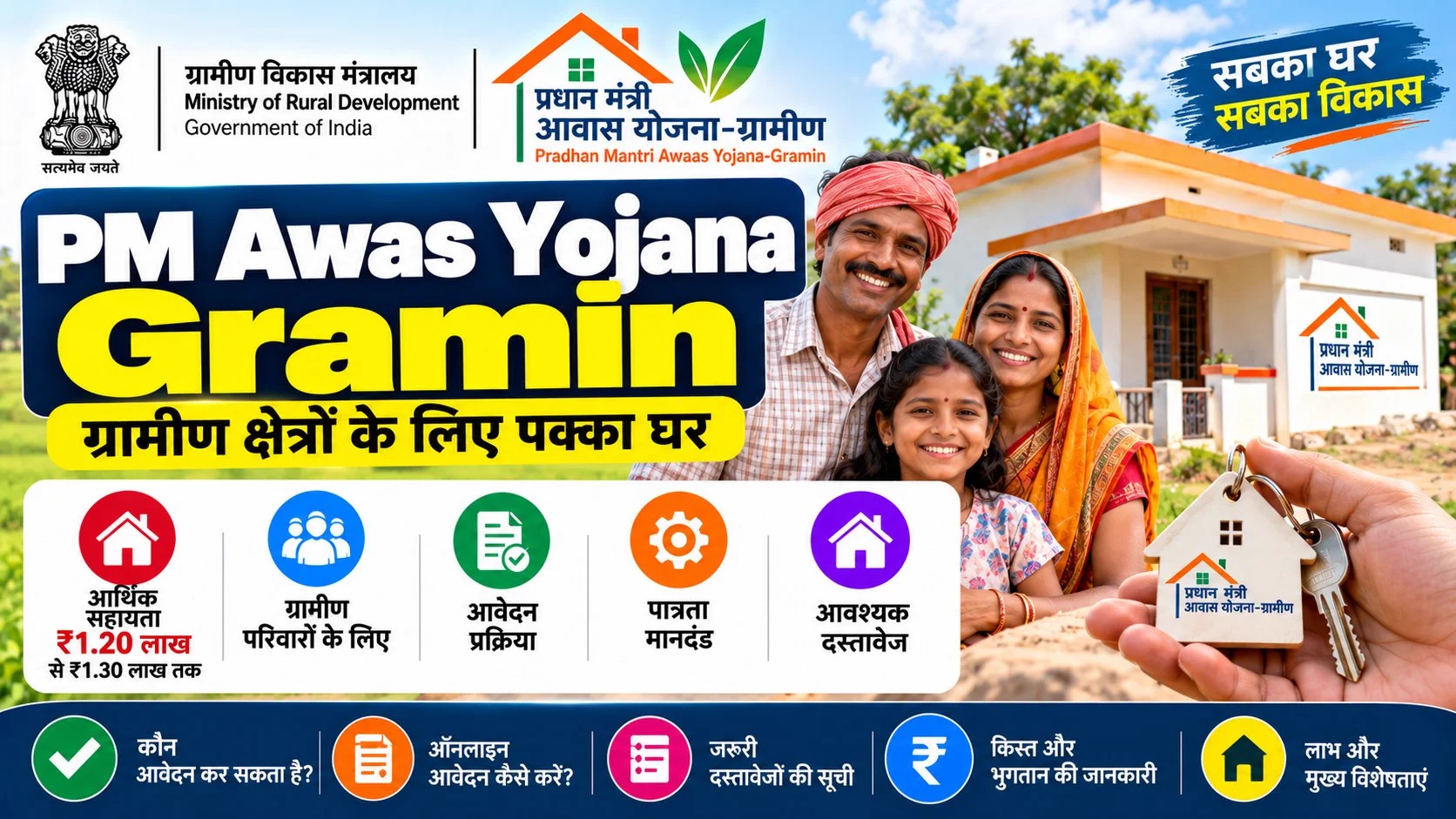

Do you live in a village and dream of replacing your kutcha house with a solid, pucca home? The PM Awas Yojana Gramin (PMAY-G) gives eligible rural families ₹1.20 lakh in direct financial assistance to build a pucca house — transferred straight to your bank account in three installments. No middlemen, no loans, no repayment.
In this complete guide, you will learn how to check the PMAY-G beneficiary list online with or without a registration number, who is eligible in 2026, what documents you need, how the Awaas+ survey works, and exactly when each installment of ₹40,000, ₹60,000 and ₹20,000 reaches your account.
✅ This guide is based on official government sources and notifications. Last verified: October 15, 2026. Scheme details, eligibility criteria, and benefit amounts are revised by the government from time to time — always cross-check the latest information on the official portal (pmayg.nic.in) before applying.
What is PM Awas Yojana Gramin?
The Pradhan Mantri Awas Yojana Gramin, commonly called PMAY-G or PM Awas Yojana Gramin, is the central government’s flagship rural housing scheme. It was launched on 1 April 2016, replacing the older Indira Awas Yojana (IAY) that had run since 1985.
The goal is simple: “Housing for All” in rural India. Every rural household that is houseless or living in a kutcha or dilapidated house should get a pucca house with basic amenities — a toilet, drinking water, electricity, and LPG connection.
Here are the scheme facts at a glance:
The PM Awas Yojana Gramin is the central government’s flagship rural housing scheme. In this PM Awas Yojana Gramin guide, you will learn how to check the beneficiary list, understand the PM Awas Yojana Gramin eligibility rules, and track your Rs.1.20 lakh PM Awas Yojana Gramin installments on the official portal: pmayg.nic.in.
| Detail | Information |
|---|---|
| Scheme name | Pradhan Mantri Awas Yojana Gramin (PMAY-G) |
| Launched | 1 April 2016 (replaced Indira Awas Yojana) |
| Implemented by | Ministry of Rural Development, Government of India |
| Financial assistance | ₹1.20 lakh (plain areas) / ₹1.30 lakh (hilly & difficult areas) |
| Minimum house size | 25 square metres |
| Payment mode | DBT (Direct Benefit Transfer) to beneficiary’s bank account |
| Official portal | pmayg.nic.in |
| Current phase target | 2 crore additional houses (FY 2024-25 to 2028-29) |
The government has already sanctioned crores of houses under the scheme since 2016, and the Union Cabinet has approved 2 crore additional houses for the 2024-25 to 2028-29 period. That means the scheme has a long runway — if you are eligible but not yet on the list, there is still time to get surveyed and included.
How Much Money Do You Get? Full Benefit Breakdown
The headline figure of ₹1.20 lakh is only the construction assistance. The real benefit package is bigger because the scheme converges with other government programmes. Here is the complete breakdown:
| Benefit Component | Amount | How It Reaches You |
|---|---|---|
| House construction assistance (plain areas) | ₹1,20,000 | DBT in 3 installments |
| House construction assistance (hilly/difficult areas) | ₹1,30,000 | DBT in 3 installments |
| Central government share | ₹75,000 | Part of the ₹1.20 lakh |
| State government share | ₹45,000 | Part of the ₹1.20 lakh |
| MGNREGA wage support | 90–95 person-days of wages | Through MGNREGA job card |
| Toilet construction (SBM-G) | ₹12,000 | Under Swachh Bharat Mission Gramin |
| Total possible benefit | ~₹1.60 lakh+ | Construction + wages + toilet |
PMAY-G Installment Breakdown: When Does the Money Come?
This is where most confusion happens. Many people hear “₹1.20 lakh” and expect the full amount at once. That is not how it works. The money comes in three installments, and each installment is released only after the previous stage of construction is verified with geo-tagged photographs.
| Installment | Amount | Released When |
|---|---|---|
| 1st installment | ₹40,000 | After sanction and verification — to start construction (foundation stage) |
| 2nd installment | ₹60,000 | After plinth/lintel level reached — verified with geo-tagged photos |
| 3rd installment | ₹20,000 | After house completion and final verification |
The exact installment trigger stages can vary slightly by state, but the pattern is the same everywhere: start → build → verify → get paid → build more → verify → get paid. This stage-wise release is deliberate — it ensures the money is actually used for the house and not diverted elsewhere.
Important: Your Aadhaar must be linked to an active bank account with DBT mapping done through NPCI. If the Aadhaar-bank link is missing, the installment will bounce back. Check this before your sanction comes through.
Who Is Eligible for PM Awas Yojana Gramin?
Eligibility is not decided by a simple application form. Beneficiaries are identified from the SECC 2011 database (Socio-Economic Caste Census) and the newer Awaas+ surveys, then verified by the Gram Sabha. Still, knowing the criteria helps you understand whether your family qualifies — and whether you should get surveyed.
| Criteria | Requirement |
|---|---|
| Residence | Must live in a rural area; citizen and permanent resident of India |
| Housing condition | Houseless, or living in a kutcha / dilapidated house |
| Existing house | No member of the family should own a pucca house anywhere in India |
| Income | Economically Weaker Section / Low Income Group (rural annual income generally below ₹3 lakh) |
| Government job | No family member should hold a government job or pay income tax |
| Vehicles & machinery | No four-wheeler, tractor, agricultural machinery, or fishing boat |
| Kisan Credit Card | KCC limit must be below ₹50,000 |
| Landholding | Must not own 2.5+ acres of irrigated land or 5+ acres of unirrigated land |
Good News: Some Old Exclusion Rules Were Relaxed
Under the current phase of PMAY-G, the government has relaxed some exclusion criteria that used to disqualify families:
- Two-wheelers and refrigerators no longer disqualify a family — this was a major change from the original SECC-2011 rules.
- The income ceiling has been rationalised, and families rejected in earlier rounds may now qualify.
- Modified exclusion parameters are being used for the new Awaas+ survey.
If your family was rejected earlier because of a scooter or a fridge, it is worth getting re-surveyed under the current rules.
Who Gets Priority?
When targets are limited, priority goes to the most vulnerable households first:
- Households with no adult member between 16 and 59 years of age
- Families headed by a woman with no able-bodied male adult
- Households with a disabled member and no other able-bodied adult
- SC/ST households and minorities
- Freed bonded labourers and widows
- Landless families depending on casual daily labour
Documents Required for PM Awas Yojana Gramin
Keep these ready before you visit the panchayat or do your Awaas+ self-survey:
| Document | Why It Is Needed |
|---|---|
| Aadhaar Card | Identity verification + e-KYC + DBT mapping |
| Bank passbook / account details | Installments are transferred via DBT to this account |
| Residence proof | Confirms rural residence (domicile/residence certificate) |
| Ration card / Family ID | Family composition verification |
| Caste certificate | For SC/ST priority categories |
| MGNREGA job card | To converge wage support for construction |
| Mobile number | Aadhaar-linked number for OTP and status SMS |
| Passport-size photograph | Application record |
| Self-declaration | Declaring no pucca house owned by the family |
How to Check PMAY-G Beneficiary List Online (3 Methods)
There are three ways to check whether your name is on the PM Awas Yojana Gramin list. Method 1 is the fastest if you have your registration number. Methods 2 and 3 work without it.
Method 1: Check by Registration Number (Fastest)
If you received a PMAY-G registration number at the time of application or survey, this gives instant results:
- Go to the official portal: pmayg.nic.in
- Click the “Stakeholders” tab in the top menu
- Select “IAY/PMAYG Beneficiary” from the dropdown
- Enter your Registration Number exactly as issued (usually 9–14 digits — no spaces or dashes)
- Enter the captcha code and click “Submit”
Your full beneficiary card appears: name, father’s/mother’s name, sanction amount, installments paid so far, and current construction status. Take a screenshot of this page — you may need it for complaints or RTI applications later.
Method 2: Advanced Search (Without Registration Number)
Do not have your registration number? Use the Advanced Search option:
- On the same “IAY/PMAYG Beneficiary” page, click “Advanced Search”
- Select your State → District → Block → Gram Panchayat
- Choose the scheme name: Pradhan Mantri Awaas Yojana Gramin
- Select the financial year
- Search by name, BPL number, account number, sanction order, or father’s/husband’s name
- Click “Search” — matching records appear on screen
Method 3: Village-Wise List from AwaasSoft Reports
To see the complete list of beneficiaries in your village:
- On pmayg.nic.in, hover over the “AwaasSoft” tab and click “Report”
- Under Social Audit Reports, click “Beneficiary Details for Verification”
- Select State, District, Block and Panchayat from the dropdowns
- Select the financial year and the Pradhan Mantri Awaas Yojana Gramin scheme
- Enter the captcha and click “Submit”
The full village list opens with registration number, beneficiary name, sanction amount, installments paid, and house status. You can download it as Excel or PDF. Use Ctrl+F to find your name quickly.
Tip: Old Indira Awas Yojana (IAY) registration numbers also work in the beneficiary search — the system recognises legacy IDs.
How to Apply: The Awaas+ Survey Explained
Here is something most articles get wrong: there is no central online application form for PMAY-G like there is for urban schemes. Rural registration happens through the survey route.
Older beneficiaries came from the SECC 2011 database. But many genuinely poor families were never counted in that 2011 survey, or their house condition worsened after it. For them, the Ministry of Rural Development launched the Awaas+ 2024 survey — and this survey is now the main door into the PMAY-G beneficiary list.
Awaas+ 2024 App: Self-Survey in 5 Steps
The free “AwaasPlus 2024” Android app lets eligible families survey themselves. It works in both online and offline mode and uses Aadhaar-based face authentication for e-KYC:
- Download and install: Get the official AwaasPlus 2024 app on your Android phone. (Download only from official links shared by your panchayat or the Ministry — never from random third-party sites.)
- Register / log in: Open the app and register using your Aadhaar details. Face authentication completes the e-KYC and links the survey to your identity.
- Fill household details: Enter income level, family composition, type of existing housing, and socio-economic details. The app also lets you select your preferred housing typology.
- Capture geo-tagged photos: Take time-stamped, geo-tagged photographs of your existing house and the proposed construction site. This is mandatory — it proves the location and current condition.
- Submit: Review everything and submit. You get a confirmation and reference number for tracking.
What Happens After the Survey?
- Your survey details go to the Gram Sabha for verification.
- The Gram Sabha publishes approved and rejected lists — there is a window for claims and objections.
- An Appellate Committee at the district level finalises the waiting list.
- Cleared households join the permanent wait list.
- Sanction follows as per the yearly target allotted to your panchayat — targets are assigned panchayat-wise each year.
Prefer the assisted route? Pre-registered surveyors can fill the survey for you on the same app. Or visit your Gram Panchayat office, Block office, or nearest CSC (Common Service Centre) with your Aadhaar, bank details, MGNREGA card, and self-declaration — the panchayat secretary or block officials will initiate your registration.
Warning: Beware of Agents
There is no application fee for rural registration through the panchayat. Beware of agents who charge money promising a “guaranteed” PMAY house — selection happens only through the verified survey lists. Never pay anyone for inclusion.
PMAY-G vs PMAY-Urban: Key Differences
Confused between the Gramin and Urban versions? Here is a quick comparison:
| Point | PMAY-Gramin | PMAY-Urban |
|---|---|---|
| Area covered | Rural areas only | Urban areas only |
| Assistance | ₹1.20 lakh (₹1.30 lakh hilly) via DBT | Up to ₹2.50 lakh; varies by component |
| How to apply | Through survey (SECC/Awaas+); panchayat/CSC route | Online application via Urban Local Body / portal |
| Official portal | pmayg.nic.in | pmay-urban.gov.in |
| Beneficiary selection | Survey-based, Gram Sabha verified | Application-based, ULB verified |
If you live in a town or city, read our detailed guide on PM Awas Yojana Urban 2.0 — apply online, eligibility and list check. For the general application process overview, see PMAY Online Form — complete application guide.
Common Problems and Solutions
“My name is not on the list, but I am eligible”
If your family meets the criteria but is missing from the list, the most likely reason is that you were never surveyed — the old SECC 2011 data missed many households. Solution: complete the Awaas+ self-survey or visit your Gram Panchayat to get included in the current survey round. Confirm the running survey cut-off dates with the panchayat or block office rather than trusting WhatsApp forwards.
“My installment has not arrived”
Check these in order: (1) Is your Aadhaar linked to an active bank account with NPCI DBT mapping? (2) Have the geo-tagged construction photographs for the next stage been uploaded by the field functionary? No photos = no release. (3) Contact your Gram Panchayat or Block office. You can also track the Fund Transfer Order (FTO) on the portal under AwaasSoft → FTO Tracking using your FTO number or PFMS ID.
“The portal shows ‘No record found'”
Three common causes: a mistyped registration number (check every digit), the record sitting under a different Block/Panchayat after a boundary change, or a deactivated record. Try the village-wise beneficiary report instead, or the Advanced Search with your name and father’s name.
“My status shows sanctioned but no money for months”
First check with your bank whether money was released but failed to credit (a DBT/bank issue — complain to the bank, then the banking ombudsman). If nothing was released at all, it is administrative — follow up with the Block Development Office and keep your sanction letter and beneficiary-card screenshot handy.
Frequently Asked Questions
How much money does PM Awas Yojana Gramin give?
PMAY-Gramin gives ₹1.20 lakh for house construction in plain areas and ₹1.30 lakh in hilly/difficult areas, paid in three DBT installments of ₹40,000, ₹60,000 and ₹20,000. On top of this, beneficiaries get 90–95 days of MGNREGA wages and ₹12,000 for toilet construction under Swachh Bharat Mission Gramin.
How can I check my name in the PMAY-G list?
Visit pmayg.nic.in → Stakeholders → IAY/PMAYG Beneficiary → enter your registration number. Without a registration number, use Advanced Search with your name, state, district, block and panchayat — or open AwaasSoft → Report → Beneficiary Details for Verification for the full village list.
Can I apply online for PM Awas Yojana Gramin?
There is no central online application form for the rural scheme. Registration happens through the Awaas+ survey — you can do a self-survey on the free AwaasPlus 2024 Android app with Aadhaar face authentication, or register offline at your Gram Panchayat, Block office or nearest CSC.
What is the Awaas+ survey?
Awaas+ is the government’s survey programme to identify eligible rural households missed by the old SECC 2011 data. The Awaas+ 2024 app supports both assisted surveys (by pre-registered surveyors) and self-surveys, with Aadhaar e-KYC, geo-tagged photos, and offline mode. Surveyed households verified by the Gram Sabha join the permanent wait list.
Who cannot apply for PMAY-G?
Families are excluded if any member holds a government job, pays income tax, owns a four-wheeler/tractor/agricultural machinery/fishing boat, holds a Kisan Credit Card with limit of ₹50,000 or more, owns 2.5+ acres of irrigated (or 5+ acres of unirrigated) land, or already owns a pucca house anywhere in India.
Is PM Awas Yojana Gramin still running in 2026?
Yes. The Union Cabinet has approved the scheme’s extension for FY 2024-25 to 2028-29 with a target of 2 crore additional rural houses. The Awaas+ survey is the current route for new households to get included, with yearly targets allotted panchayat-wise.
Final Words
The PM Awas Yojana Gramin is one of the most impactful rural schemes in India — ₹1.20 lakh directly into your bank account, in three verified installments, with no repayment. The two things that matter most: get surveyed (Awaas+ self-survey or through your panchayat) and keep your Aadhaar-bank DBT link active so installments never bounce.
Check your name on the list today using the steps above, and share this guide with family members in your village who may be eligible but were never surveyed. If you found this helpful, explore our other housing guides — PMAY Urban 2.0 for city residents and our PMAY online form guide.