Is your name missing from the Gujarat ration card list? Or have you applied for a new ration card and want to check your application status without visiting the mamlatdar office? You can now do all of this online in under five minutes through the official Gujarat Food and Civil Supplies Department portals.
✅ This guide is based on official government sources and notifications. Last verified: October 12, 2026. Scheme details, eligibility criteria, and benefit amounts are revised by the government from time to time — always cross-check the latest information on the official portal before applying.
In this guide, you will learn how to check the Gujarat ration card list village-wise, check your card status, apply for a new card, add or remove a family member’s name, download a digital copy, find your nearest fair price shop, and file a complaint if your ration is denied. Let’s start with the basics.
What Is Gujarat Ration Card?
A ration card in Gujarat is an official document issued by the state government that lets eligible families buy food grains and essential commodities at subsidised rates from fair price shops (also called FPS or ration shops). It also works as a widely accepted proof of identity and address for other government services.
The entire system in Gujarat is managed by the Food, Civil Supplies and Consumer Affairs Department, Government of Gujarat. Distribution happens through the Targeted Public Distribution System (TPDS) under the National Food Security Act (NFSA), 2013, which covers roughly 75% of the rural population and 50% of the urban population across India.
For crores of families, the ration card is not just a document. It is the difference between buying wheat and rice at market price and getting it free or at a fraction of the cost every single month.
Types of Ration Cards in Gujarat 2026
Gujarat issues ration cards in two broad groups: NFSA cards and non-NFSA cards. Which one you hold decides how much ration you get and at what price.
| Card Type | Who Gets It | Monthly Entitlement |
|---|---|---|
| AAY (Antyodaya Anna Yojana) | Poorest of the poor households identified by the state | 35 kg food grains per family |
| PHH (Priority Household) | Eligible low-income families under NFSA | 5 kg food grains per person |
| Non-NFSA / APL | Families above the NFSA eligibility cut-off | Limited or no subsidised grains; works mainly as ID proof |
Under NFSA, there is no separate BPL or APL category anymore. The central categories are only PHH and AAY. If your card was earlier marked BPL, it has most likely been mapped to one of these two NFSA categories.
Benefits: How Much Free Ration Do You Get Every Month?
This is the question almost every family asks. Under the Pradhan Mantri Garib Kalyan Anna Yojana (PMGKAY), which the central government has extended for five years from January 2024, NFSA beneficiaries receive their full food grain entitlement free of cost. That means zero payment at the fair price shop for your monthly quota.
| Family Size | AAY Card | PHH Card |
|---|---|---|
| 2 members | 35 kg | 10 kg |
| 4 members | 35 kg | 20 kg |
| 5 members | 35 kg | 25 kg |
| 7 members | 35 kg | 35 kg |
The grains typically include wheat and rice, and depending on state supply, items like sugar, salt, and edible oil may also be distributed through fair price shops. Your exact monthly quota is printed on your ration card and can also be checked online through the “Know Your Entitlement” page, which we cover below.
Gujarat Ration Card List 2026: Check Village-Wise Online
The Gujarat government publishes the complete beneficiary list on its transparency portal. You can drill down from district to taluka to village to fair price shop and see every ration card holder’s name. Here is the exact process:
- Visit the official portal at dcs-dof.gujarat.gov.in.
- On the homepage, click the link “વિસ્તાર મુજબની રેશન કાર્ડ વિગતો – એન.એફ.એસ.એ.” (Area-wise Ration Card Details – NFSA).
- Select your district, then your taluka, then your village or ward from the dropdown lists.
- Choose the fair price shop (FPS) linked to your area.
- Enter the captcha code shown on the screen and click Search.
- The list of ration card holders for that FPS appears. Click on any ration card number to see the family members registered under it.
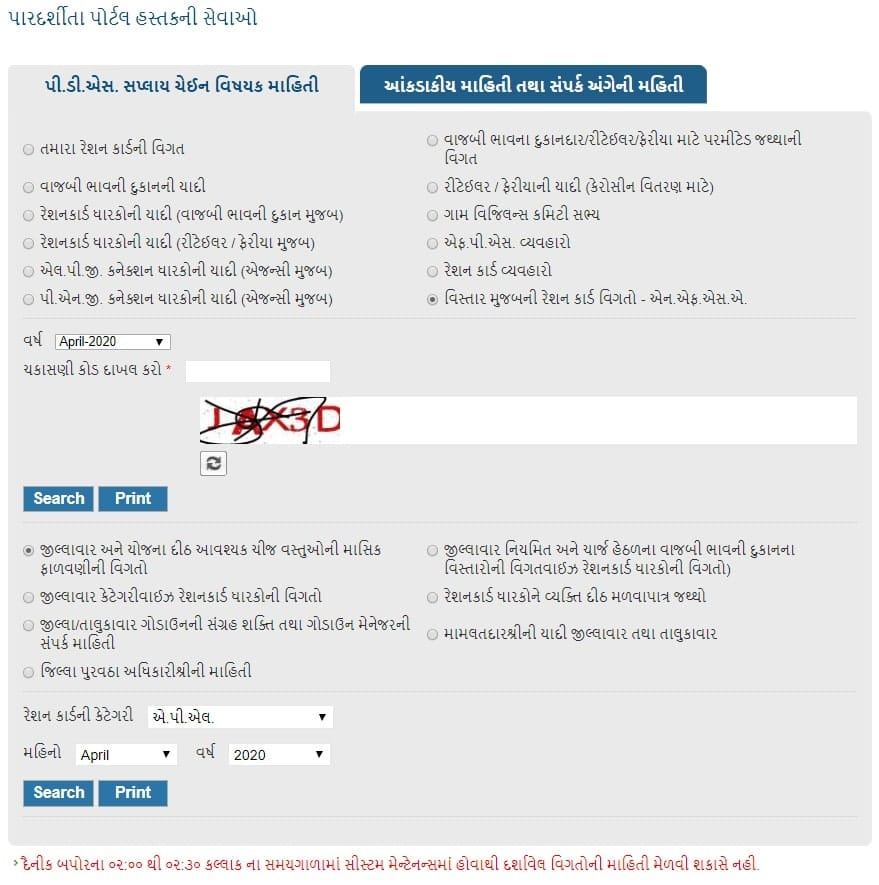
The area-wise ration card details page on the Gujarat Food and Civil Supplies transparency portal, where you select district, taluka and village to view the beneficiary list.
Alternate method: You can also check the abstract beneficiary list at ipds.gujarat.gov.in/Register/frm_RationCardAbstract.aspx. Select the month and year, enter the captcha, click Go, and then navigate district-wise down to your village.
Tip: If your name is missing from the list even though you hold a valid card, first confirm your card’s NFSA category using the status check method below. The village-wise list shows NFSA beneficiaries; non-NFSA (APL) cards may appear in a separate section.
How to Check Gujarat Ration Card Status Online
Applied for a new card or made a correction and wondering where things stand? The “Know Your Entitlement” page on the iPDS portal shows your application status as well as the exact quantity of ration your family is entitled to receive.
- Go to dcs-dof.gujarat.gov.in.
- Under the ration card section, click “તમને મળવાપાત્ર જથ્થો જાણો” (Know Your Entitlement).
- You can search in two ways: enter your ration card number with captcha, or select your NFSA status, GAS connection status, number of members, and card category from the dropdowns.
- Click View / જુઓ.
- Your card details, member list, and entitled quantity appear on the screen.
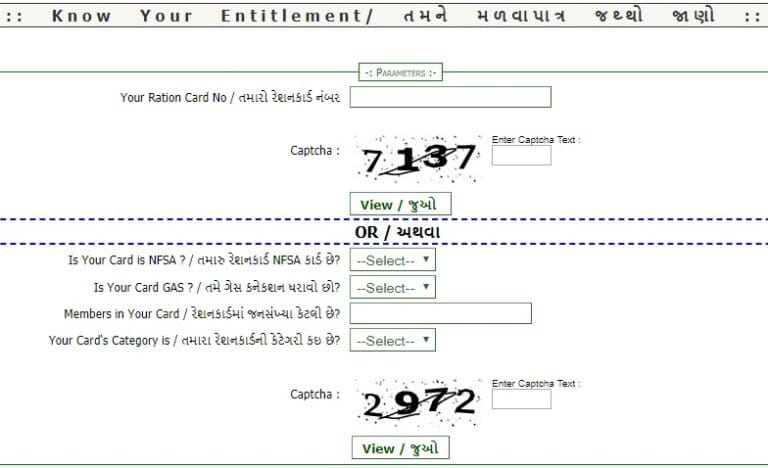
The Know Your Entitlement page where you enter your ration card number to check status and monthly quota.
To verify the raw card information directly, the department also offers a “Check / Verify your Ration Card information online” option under Services on the Transparency Portal. You can search using your old ration card number, bar-coded ration card number, Form-1 serial number, or EPIC (voter ID) number, then print the details for your records.
Eligibility Criteria for Gujarat Ration Card
Before you apply, make sure your family meets the basic conditions. The Gujarat government issues new ration cards based on household income and economic conditions:
- You must be a permanent resident of Gujarat.
- The applicant should be above 18 years of age and the head of the family (or an adult member applying on the family’s behalf).
- No member of the family should already hold a ration card in Gujarat or any other state. One family, one card.
- The family should be living and cooking separately as an independent household.
- For NFSA (PHH/AAY) categories, the family must fall within the income and exclusion criteria notified by the state. Households with an income-tax payer, a four-wheeler (other than for livelihood like a taxi or tractor), or a government employee drawing a regular salary are generally excluded from NFSA coverage.
- Valid identity and address proof (Aadhaar, voter ID, etc.) is compulsory for the application.
Note that the Gujarat government periodically verifies NFSA beneficiary lists. In a recent verification drive, lakhs of suspicious entries were flagged for re-checking, and ineligible cards are reclassified as non-NFSA. Keeping your details updated protects your benefits.
Documents Required for New Ration Card in Gujarat
Keep scanned copies of these documents ready before you start the application. Missing documents are the most common reason applications get delayed or rejected:
- Identity proof: Aadhaar card, voter ID (EPIC), PAN card, driving licence, or passport of the head of the family
- Address proof: Aadhaar card, voter ID, driving licence, electricity bill, telephone bill, or tenancy agreement (if rented)
- Age proof: Birth certificate, school leaving certificate, or Aadhaar
- Income proof: Income certificate issued by the competent authority (for NFSA category cards)
- Caste certificate: If applicable, issued by the competent authority
- Recent passport-size photograph of the applicant
- Mobile number and email ID for OTP verification and updates
- Bank passbook copy (first page with account details)
- Gas connection details: LPG connection number or surrender certificate, if applicable
- Self-declaration and certificate from the ward councillor / sarpanch / pradhan, if asked for
- Previous electricity bills as supporting address proof
How to Apply for a New Ration Card in Gujarat
New ration card applications in Gujarat are handled through the Food, Civil Supplies and Consumer Affairs Department. Follow these steps:
- Visit fcsca.gujarat.gov.in.
- Select the Food, Civil Supplies and Consumer Affairs Department from the department dropdown.
- Choose “I am a Consumer” and click on the “Apply for a New Ration Card” option.
- Download the application form, fill in the family details carefully, and attach the scanned documents listed above.
- Submit the form online (where the facility is available) or at your nearest mamlatdar office / zonal office with the physical documents.
- Note down the acknowledgement / application number. You will need it to track your status on the portal.
- Field verification may be conducted by the local supply office before the card is approved and issued.
The department generally processes complete applications within a few weeks, though timelines vary by district and workload. Track your application using the status-check method described earlier.
How to Add or Remove a Name in Gujarat Ration Card
Got married, had a child, or need to remove a member who has moved out? Name addition and deletion in Gujarat is done through the Digital Gujarat portal:
- Go to digitalgujarat.gov.in and log in with your credentials.
- Click the Services tab and select Citizen Services.
- Choose “Addition of Name in Ration Card” (or “Removal of Name in Ration Card” for deletion).
- Read the guidelines, keep the supporting documents ready (birth certificate for a newborn, marriage certificate for a spouse, death certificate for deletion, etc.).
- Click Apply Online, fill in the member’s details, upload the documents, and submit.
- Save the application number to track the request.

The “Addition of Name in Ration Card” service on the Digital Gujarat citizen services portal.
Duplicate or Separate Ration Card
Lost your ration card? Or has the family split and you need a separate card? Gujarat allows both:
- Duplicate card: Apply through the same department portal or your mamlatdar office, stating the loss. An FIR or self-declaration regarding the lost card may be asked for. A duplicate is issued with the same card number and members.
- Separate card: When a joint family splits into two households that cook separately, the separating members can apply for a new card. Proof of separate residence and cooking arrangement is required, and the names are deleted from the original card.
How to Download Digital Ration Card
Once your card details are verified on the portal, you can take a printout of the ration card information page and use it as a reference copy. For an officially issued digital copy, check the “Issued Documents” section of your DigiLocker account linked with Aadhaar, where the e-ration card appears after verification by the issuing department. Keep a printed copy with your important documents as backup.
Find Your Nearest Fair Price Shop (FPS)
Not sure which ration shop is linked to your card? The Gujarat portal has a built-in FPS locator:
- Go to dcs-dof.gujarat.gov.in.
- Click “Know your FPS and Know your Godown” on the main page.
- Select the FPS option.
- A map appears on the screen. Select your area to find the closest fair price shop, its dealer name, and licence details.
This is especially useful if you have recently shifted houses within the same city and want to confirm whether your card is mapped to the shop near your new address.
e-KYC and Aadhaar Seeding: Mandatory Update
The Gujarat Food and Civil Supplies Department requires Aadhaar seeding (e-KYC) for all NFSA ration card members. If e-KYC is pending for any member, the card can be flagged during verification drives and benefits may be paused.
- Visit your fair price shop with the Aadhaar cards of all family members to complete biometric e-KYC.
- Alternatively, check with your mamlatdar or zonal supply office about e-KYC camps in your area.
- After completion, verify on the portal that all members show as e-KYC done.
If your Aadhaar is not yet linked with your mobile number, get that updated first at an Aadhaar enrolment centre, since OTP-based verification is used in several of these services. For the linking process, see our guide on how to link Aadhaar with PAN, which explains the general Aadhaar linking workflow.
One Nation One Ration Card: Use Your Card Anywhere in India
Gujarat is part of the One Nation One Ration Card (ONORC) scheme. This means if you are a migrant worker or have temporarily moved to another state for work, you can lift your NFSA food grain quota from any fair price shop in India using Aadhaar-based biometric authentication. You do not need a new card in the new state.
To use portability, your card must be Aadhaar-seeded and your mobile number should be updated. At the FPS in the other state, the dealer authenticates you with your fingerprint or iris, and the system deducts the quota from your home state’s allocation. This has been a lifeline for lakhs of migrant workers from Gujarat working in Maharashtra, Rajasthan, and Madhya Pradesh.
How to File a Complaint About Ration Card Issues
Denied ration at the shop? Wrong quantity? Dealer asking for extra money? File an online complaint directly with the department:
- Visit dcs-dof.gujarat.gov.in/register-complaint-eng.htm.
- Fill in your name, address, mobile number, and email.
- Select “Complaint Regarding (Ration Card)”, choose whom the complaint is against and what it is for, and write a clear description.
- Upload supporting photos or documents if you have them (for example, the shop receipt or a photo of the notice board).
- Enter the verification code and click Submit.
- To check the complaint status later, use the “Status of Your Complaint” option on the same portal.
You can also register complaints through the E-Citizen section on fcsca.gujarat.gov.in, or contact the mamlatdar / zonal officer of your area in person.
Gujarat Ration Card Helpline Numbers
- 1967 – National food security helpline (toll-free)
- 1800-233-5500 – Gujarat Food & Civil Supplies toll-free helpline
- 1800-233-0222 – Gujarat State Consumer helpline
Keep your ration card number handy when you call so the helpline executive can pull up your record quickly.
Common Reasons Ration Card Applications Get Rejected
If your application was rejected, it is usually one of these fixable issues:
- Duplicate application: A family member already holds a card. Only one card per family is allowed.
- Address mismatch: The address on your ID proof does not match the address in the application.
- Missing income proof: Required for NFSA category cards; applications without it are liable to be rejected.
- Unclear scanned documents: Blurry or cropped scans get sent back. Scan at a readable resolution.
- Ineligible for NFSA: Income-tax payer in the family, four-wheeler ownership, or government employment can push the family into the non-NFSA category instead of outright approval under NFSA.
- e-KYC pending: Incomplete Aadhaar seeding for members can hold up approval.
Fix the issue and re-apply, or visit the mamlatdar office with the corrected documents. Most rejections are procedural, not final.
Frequently Asked Questions
How can I check my name in the Gujarat ration card list 2026?
Visit dcs-dof.gujarat.gov.in, click “વિસ્તાર મુજબની રેશન કાર્ડ વિગતો – એન.એફ.એસ.એ.”, select your district, taluka, village and fair price shop, enter the captcha, and click Search. Then click on your ration card number to see all family members.
What is the Gujarat ration card helpline number?
You can call the toll-free numbers 1967 (national helpline), 1800-233-5500 (Gujarat Food & Civil Supplies), or 1800-233-0222 (Gujarat State Consumer helpline) for any ration card related query or complaint.
How much free ration do I get per month in Gujarat?
Under NFSA and PMGKAY, AAY card holders get 35 kg of food grains per family per month free of cost, while PHH card holders get 5 kg per person per month free of cost.
Can I use my Gujarat ration card in another state?
Yes. Under the One Nation One Ration Card (ONORC) scheme, your Aadhaar-seeded NFSA card works at any fair price shop across India through biometric authentication.
How do I add my newborn child’s name to the ration card?
Log in to digitalgujarat.gov.in, go to Services > Citizen Services > “Addition of Name in Ration Card”, fill in the child’s details, upload the birth certificate, and submit. Track the request with the application number.
Is e-KYC mandatory for Gujarat ration card holders?
Yes, Aadhaar seeding (e-KYC) is mandatory for all NFSA ration card members. Cards with pending e-KYC can be flagged during verification drives, so complete it at your fair price shop or supply office as soon as possible.
Conclusion
The Gujarat ration card list, status check, application, and complaint systems are all online now. Whether you want to find your name village-wise on dcs-dof.gujarat.gov.in, check your monthly entitlement on the iPDS portal, or add a family member through Digital Gujarat, you rarely need to stand in a queue anymore.
Start by checking your name in the list and confirming your card category. Then make sure every family member’s e-KYC is complete so your free monthly ration under PMGKAY continues without interruption. And if a dealer ever denies your rightful quota, the online complaint portal and the toll-free helplines 1967 and 1800-233-5500 are there for exactly that reason.
Bookmark this guide and share it with family members in your village or society. For most households, the ration card remains the single most valuable government document they hold. Keep it updated, and it will keep working for you.
📖 Related: Mari Yojana Gujarat Portal — Gujarat sarkari yojana portal ke baare me padhein.
📖 Related: Shramik Basera Yojana — shramik housing scheme ke baare me padhein.