
Have you ever reached the point where college admission is confirmed, but then started calculating tuition fees, hostel costs, books, instruments, and other expenses and wondered, “Gujarat government students ke liye kaunsi scheme available hai?” That is exactly where many students stop looking for help because the information is spread across different government departments and portals.
✅ This guide is based on official government sources and notifications. Last verified: October 12, 2026. Scheme details, eligibility criteria, and benefit amounts are revised by the government from time to time — always cross-check the latest information on the official portal before applying.
I would not start by searching for one “best scholarship.” I would first identify the student’s course, category, family income, academic performance, and financial requirement. That simple approach makes it much easier to find the scheme that actually fits.

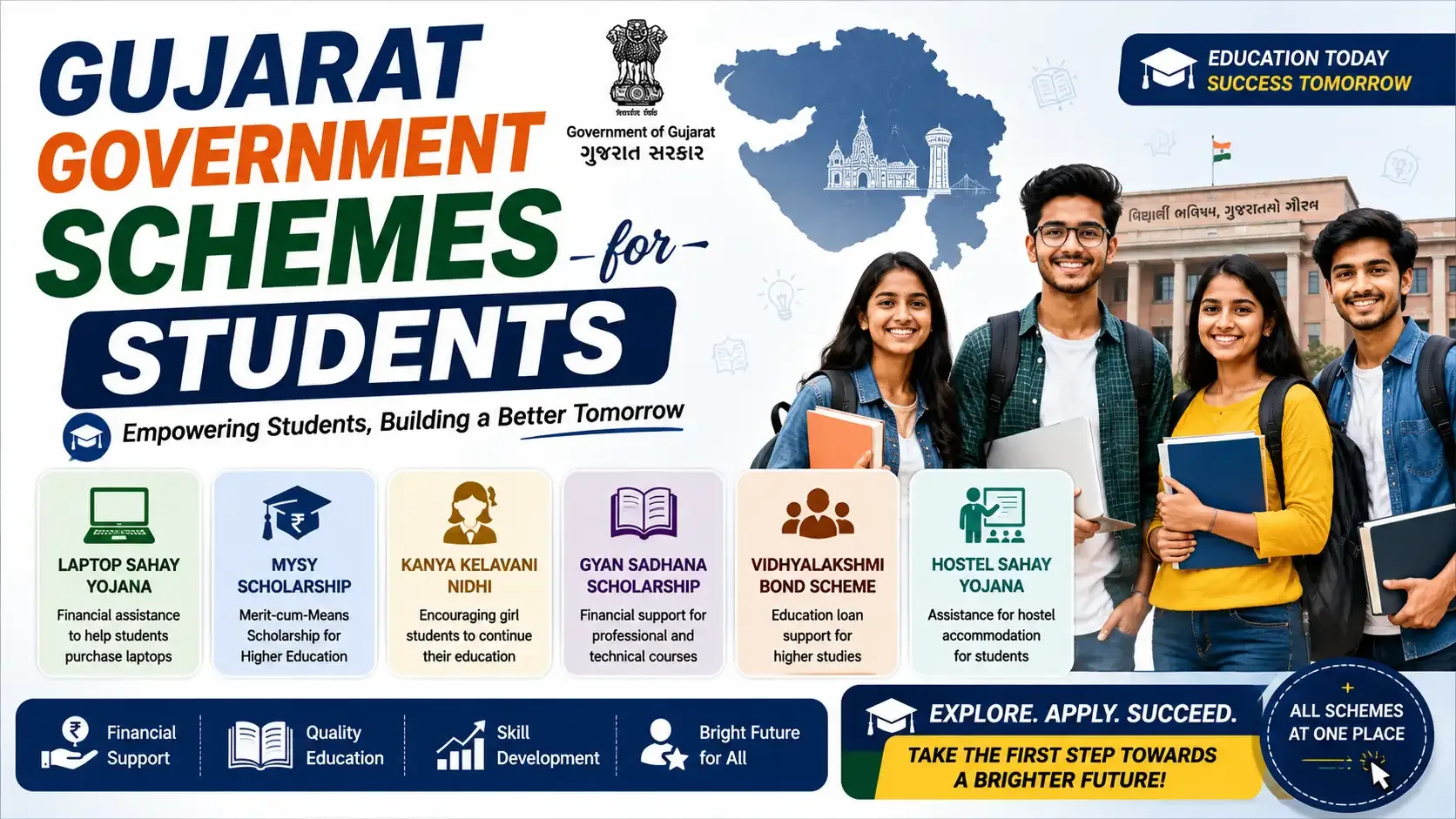
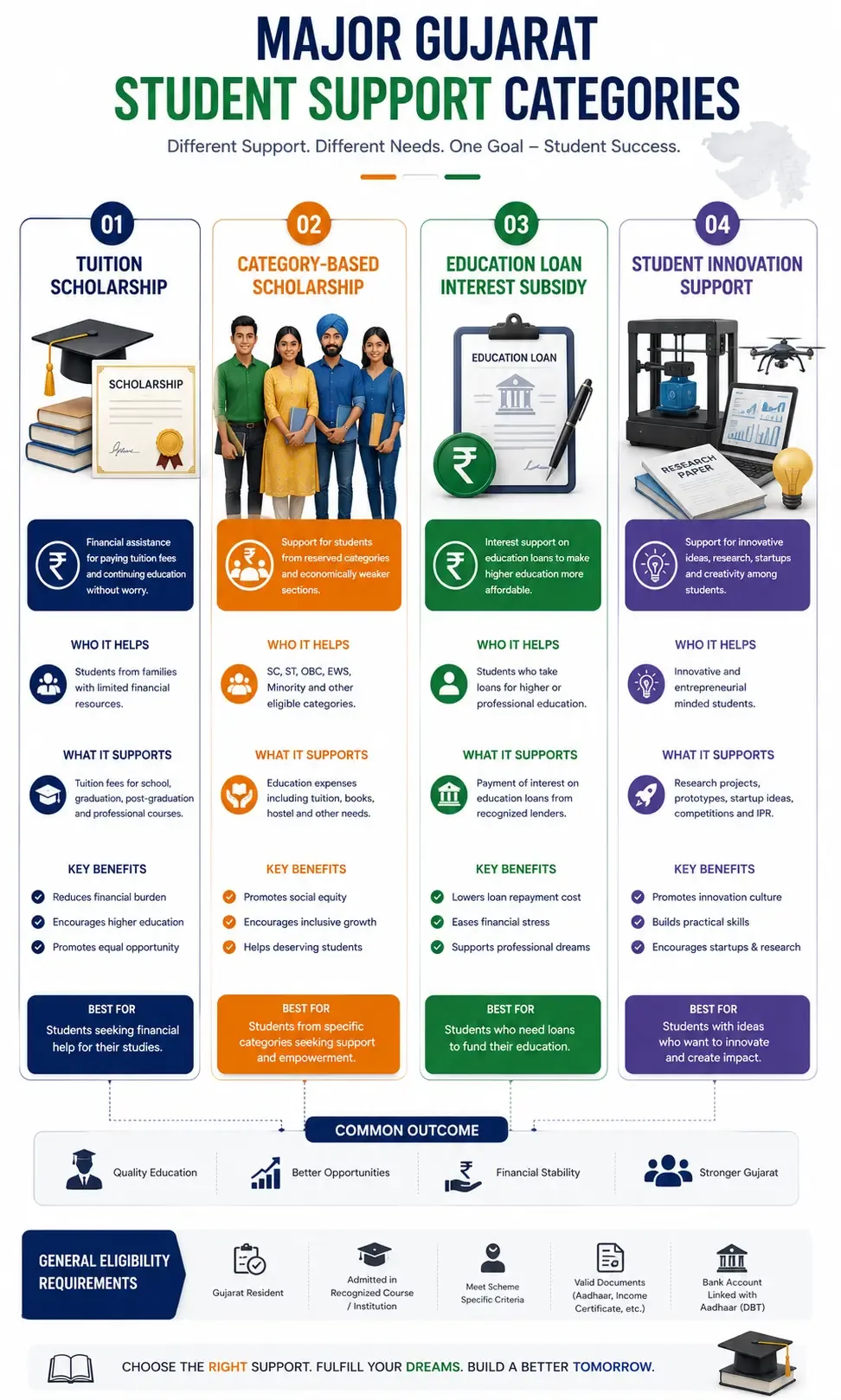
The Government of Gujarat has a wide student-support ecosystem covering merit-cum-means scholarships, category-based scholarships, tuition assistance, hostel and food support, education-loan interest subsidy, digital-device support, research fellowships and student innovation programmes. Digital Gujarat acts as an important access point for several pre-matric and post-matric scholarship services, while the Knowledge Consortium of Gujarat (KCG), Education Department and Social Justice and Empowerment Department manage or list other student-focused initiatives.
This guide brings those pieces together so you can quickly understand which Gujarat government scheme may apply to you, what it offers, where to apply, and which documents you should prepare before starting an application.
Important: Scholarship eligibility, application windows, income ceilings, course lists and assistance amounts can be revised through government resolutions. Always verify the latest notification on the official portal before submitting an application.
Quick Answer: Which Gujarat Government Scheme Is Right for You?
The easiest way to narrow the options is to start with your situation.
| Student situation | Scheme/support worth checking | Main purpose |
|---|---|---|
| Meritorious student from a lower-income family | MYSY | Higher-education financial assistance |
| Student looking for the Gujarat Chief Minister Scholarship | CMSS | Financial assistance for eligible higher education |
| SC student | SC Welfare scholarships | Pre-matric, post-matric and course-specific assistance |
| SEBC / EBC / NT-DNT student | Developing Castes Welfare schemes | Scholarships and educational support |
| Student with disability | Divyang student scholarship | Educational financial support |
| Higher-education student with a bank education loan | Education Loan Interest Subsidy | Interest support on eligible education loans |
| First-year college/polytechnic student | NAMO e-Tablet Scheme | Low-cost educational tablet support |
| Student with an innovative startup idea | SSIP 2.0 | Innovation, prototype and entrepreneurship support |
| PhD researcher in Gujarat | SHODH | Research stipend and contingency support |
| SC student in medical/engineering/diploma course | BCK-12 | Financial assistance for eligible courses |
| SC student living in a college hostel | BCK-10 | Food-bill assistance |
The important point is that these are not all interchangeable scholarships. Some are tuition assistance, some are maintenance or academic allowances, some support a particular social category, and some are broader education programmes rather than traditional scholarships.
1. Mukhyamantri Yuva Swavalamban Yojana (MYSY)
For many Gujarat students searching for financial help after Class 10 or Class 12, Mukhyamantri Yuva Swavalamban Yojana (MYSY) is one of the first schemes to investigate.
The official MYSY portal is operated by the Education Department, Gujarat State, and provides student services, application information, notices, help-centre information, and government resolutions.
MYSY is designed around a merit-cum-means approach, so academic performance and family income both matter.
Commonly referenced eligibility requirements include academic thresholds and an annual family-income ceiling, with course-specific conditions. Government and institutional material has historically described an income ceiling of ₹6 lakh and an academic requirement around 80 percentile for relevant routes, but students should check the latest MYSY notification for their admission year and course rather than relying on an old screenshot or social-media post.
What can MYSY help with?
Depending on the eligible course and applicable rules, MYSY support can include:
- Tuition-fee assistance
- Hostel assistance in eligible circumstances
- Assistance for books or instruments
- Support for selected professional and higher-education courses
The amount is not identical for every student. Course, admission route, and government rules determine the applicable assistance.
That distinction matters because I often see students searching for “MYSY ₹50,000 scholarship” as though every applicant receives exactly the same amount. That is not a safe way to interpret the scheme.
For example, institutional scholarship information currently describes assistance for degree engineering at up to ₹50,000 or 50% of tuition fees, whichever is lower, while diploma and other programmes can have different ceilings.
Who should check MYSY first?
MYSY deserves a close look if you are:
- A Gujarat student entering higher education
- From a family within the applicable income limit
- Academically eligible under the current notification
- Studying an eligible diploma, degree or professional course
- Looking for government assistance toward education expenses
Official portal: mysy.guj.nic.in
2. Chief Minister Scholarship Scheme (CMSS)
The Hon. Chief Minister Scholarship Scheme (CMSS) is another major Gujarat student-support programme.
Its official portal belongs to the Education Department, Gujarat State, and provides fresh and renewal application functionality along with student-status facilities and help information.
One important reason CMSS deserves its own section is that students sometimes confuse it with MYSY.
They are related in the broader Gujarat higher-education support ecosystem, but they are not simply two names for the same application.
The CMSS portal asks students to enter details such as the qualifying standard, board/university information, admission year, enrolment or seat number, marks/percentile, and Aadhaar-linked payment details.
Why CMSS matters
The scheme can be particularly relevant for students entering higher education through routes covered by the scheme, including eligible diploma and degree pathways.
Government-related material has also described CMSS as supplementary to the existing MYSY framework in certain contexts. Historical announcements and eligibility structures have changed over time, which is why the current CMSS notification should always take priority over older articles.
CMSS application tip
Before applying, keep the qualifying marksheet and admission information exactly consistent with your application.
A common practical problem is a mismatch between:
- Name on marksheet
- Name on Aadhaar
- Admission record
- Seat/enrolment number
- Bank account information
This can create verification or payment problems even when the student otherwise qualifies.
Official portal: scholarships.gujarat.gov.in
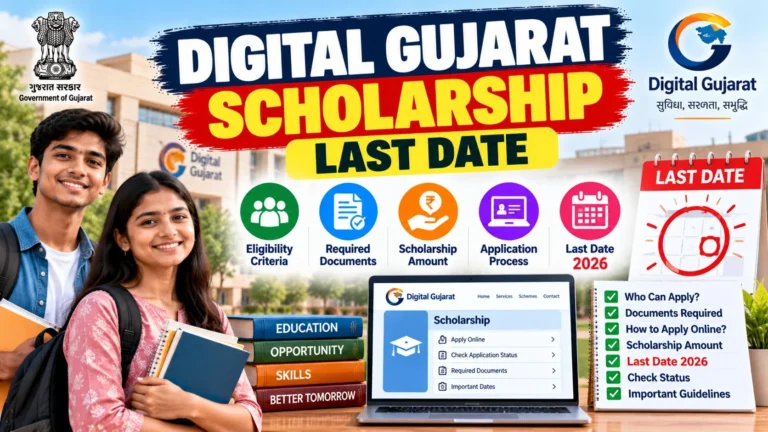
3. Digital Gujarat Scholarship
If you are looking for a Gujarat government scholarship online, Digital Gujarat is one of the most important portals to know.
The Department of Science and Technology describes Digital Gujarat as a flagship citizen-service platform providing online and assisted-counter access to government services. Its services include pre-matric and post-matric scholarship schemes.
This is particularly useful because students from different social and economic categories may encounter different scholarship schemes.
Digital Gujarat can also be accessed through physical assisted service locations such as Jan Seva Kendra and e-Gram centres, which is useful for students who do not have reliable access to a computer or internet connection.
What should students understand about Digital Gujarat?
Digital Gujarat is best thought of as an application and service platform, not one single scholarship.
The actual scheme may be administered by a department such as:
- Scheduled Caste Welfare
- Developing Castes Welfare
- Social Defense
- Other participating government departments
So searching only for “Digital Gujarat scholarship” can be a little misleading.
The smarter workflow is:
Identify your scheme → check eligibility → prepare documents → apply through the specified portal → complete institution/department verification → monitor status.
4. Post-Matric Scholarships for SC Students
Students belonging to the Scheduled Caste category should not stop at MYSY or CMSS.
The Director, Scheduled Caste Welfare, Government of Gujarat lists several educational schemes for SC students, including pre-matric scholarships, post-SSC scholarships, the Government of India Post-Matric Scholarship, professional-course assistance, food-bill assistance, and other educational support.
One significant scheme is the GOI Post Matric Scholarship for SC Students (BCK-6.1).
The current department information states that eligible SC students must satisfy the Government of India Post-Matric Scholarship conditions and gives an income limit of ₹2.50 lakh for the listed scheme.
The assistance includes group-wise academic allowances:
| Group | Hosteller | Day Scholar |
| A | ₹13,500 | ₹7,000 |
| B | ₹9,500 | ₹6,500 |
| C | ₹6,000 | ₹3,000 |
| D | ₹4,000 | ₹2,500 |
Approved tuition and other approved fees can also be admissible under the scheme conditions, with disability allowance provisions where applicable. Applications are made online through Digital Gujarat.
Why this matters
For a student eligible under a category-specific scholarship, the potential support can be materially different from a general merit-based scheme.
That is why I recommend comparing the category-based scheme and merit-based scheme before assuming one programme is automatically the best option.
5. SC Scholarship for Girls: Bhagwan Budhdh Scholarship
The State’s Post SSC Scholarship to SC girls students, listed as the Bhagwan Budhdh Scholarship (BCK-5), is specifically designed for eligible Scheduled Caste girls pursuing post-SSC education.
The department currently lists course and academic conditions, including percentage/percentile requirements for certain diploma and graduate routes, and states that the scheme follows applicable post-matric conditions.
The listed academic allowance is:
| Group | Hosteller | Day Scholar |
| A | ₹13,500 | ₹7,000 |
| B | ₹9,500 | ₹6,500 |
| C | ₹6,000 | ₹3,000 |
| D | ₹4,000 | ₹2,500 |
Approved tuition and other applicable fees may also be admissible under the scheme rules.
Applications are made online through Digital Gujarat.
For students who qualify, this is exactly why reading the department’s scheme list matters instead of searching only for generic “Gujarat scholarship.”
6. SC Students: Medical, Engineering and Diploma Assistance
There are also course-specific benefits.
Under Financial Assistance to SC Students Studying in Medical, Engineering and Diploma (BCK-12), the Gujarat Scheduled Caste Welfare Department lists assistance for eligible SC students in medical, engineering and diploma programmes.
The current listed assistance is:
- Medical: ₹15,000
- Degree Engineering: ₹10,000
- Diploma: ₹5,000
The department states that the assistance is given in the first year only, subject to the scheme conditions, and lists an annual family-income limit of ₹6 lakh. Applications are online through Digital Gujarat.
This is a good example of why students should not search only by the word “scholarship.”
The correct question is:
“Is there a Gujarat government benefit specifically for my category and course?”
Sometimes the answer is yes, even when a general scholarship article does not mention the programme.
7. Food Bill Assistance for SC Students
Hostel costs can become a serious part of the education budget.
The Gujarat Scheduled Caste Welfare Department lists Food Bill Assistance to SC Students (BCK-10) for eligible SC students who reside in a hostel affiliated with their college.
The current department page lists:
₹1,500 per month for up to 10 months, subject to the stated eligibility requirements and an income limit of ₹6 lakh. Applications are submitted online through Digital Gujarat.
For a student living away from home, this kind of support can be just as useful as tuition assistance because education costs are not limited to the college fee.
8. Scholarships for SEBC, EBC, NT-DNT and Other Students
Students from the SEBC, EBC, Nomadic and Denotified Tribes (NT-DNT) and minority communities should also check the educational schemes administered through the Director, Developing Castes Welfare.
The department’s educational scheme list includes:
- Pre-SSC scholarships
- Post-SSC scholarship to girls
- Post-SSC scholarship for boys
- Scholarship for higher-secondary students
- Technical and professional course scholarships
- Medical and engineering food-bill assistance
- Assistance for medical and engineering instruments
- Minority scholarships
- Merit-cum-means scholarships
- Study-abroad related assistance
- Competition/examination preparation assistance
- M.Phil. and PhD scholarships
- Book-bank support
One listed Post SSC Scholarship for Boys provides different monthly scholarship rates based on course groups and whether the student is a hosteller or day scholar. The published department information also distinguishes rural and urban income ceilings for that scheme.
Because some of these department pages contain legacy scheme structures and historical tables, students should treat the current government notification as the final authority for the academic year in which they apply.
9. Pre-Matric Scholarship for SC Students
Scholarship support does not necessarily begin after Class 10.
The Gujarat Scheduled Caste Welfare Department lists the Pre-Matric Scholarship for SC Students (BCK-2/71).
The department currently states that:
- The student must belong to the Scheduled Caste category.
- There is no income limit for the listed scheme.
- Assistance differs according to standard and gender.
For example, the published annual amounts include ₹750 for Classes 1–5, ₹750 for boys in Classes 6–8, ₹1,000 for girls in Classes 6–8, and ₹1,000 for Classes 9–10. The online process is handled through the school principal via Digital Gujarat.
This is a useful reminder for parents too: “student scholarship” does not always mean college scholarship.
10. Divyang Students Scholarship
Students with disabilities can find separate assistance under the Social Defense / Social Justice and Empowerment ecosystem.
The Gujarat Director of Social Defense lists a scholarship scheme for students with disabilities, with assistance rates varying by course and student status.
The department states that applications can be submitted online through Digital Gujarat, with the school, college, or student involved in the process depending on the situation.
For a student with a disability, I would check this category-specific scheme before deciding that a general scholarship is the only available option.
Also check whether the applicable scheme allows disability-related allowances in addition to the main academic assistance. Some Gujarat scholarship schemes explicitly include such provisions.
11. Education Loan Interest Subsidy Scheme
If scholarships don’t cover the full cost of a professional degree, the PM Vidyalaxmi Yojana offers collateral-free education loans up to ₹10 lakh.
Not every student can finance college entirely through a scholarship.
For students who need an education loan, the Gujarat Government’s Interest Subsidy Scheme on Education Loan can be particularly important.
The Knowledge Consortium of Gujarat describes the scheme as financial support for bright and needy students pursuing higher education. The current page states:
- Students should have passed Class 12 with 60 or more percentile
- Family income should be up to ₹6 lakh
- Eligible education loans must be from scheduled banks and satisfy the scheme’s date and other conditions
- Education-loan benefit can apply to loans up to ₹10 lakh
- The interest subsidy is credited to the applicant’s loan account under the scheme mechanism
The KCG page also states that students should not have availed the benefit of another government scheme where the relevant rules prohibit that combination.
Why I would check this early
Students frequently focus only on scholarships after admission.
But suppose a course costs several lakh rupees and your scholarship covers only part of it. The financing problem remains.
That is where an education-loan interest subsidy can become an important part of the overall funding plan.
12. NAMO e-Tablet Scheme
For students entering higher education, financial support is not always cash deposited into a bank account.
The NAMO e-Tablet Scheme is designed to help eligible first-year college and polytechnic students access an educational tablet at a nominal contribution.
The Knowledge Consortium of Gujarat says the scheme’s objective is to help meritorious students in higher education. Its published eligibility information states that students should have passed Class 12 from a recognised institution and board in Gujarat and be entering the first year of college; polytechnic students are also included.
The official KCG page describes the token amount as ₹1,000 and identifies the programme as a student-support initiative.
Students should confirm the current device-distribution process with their college and the latest government instructions because implementation details can change.
13. Student Startup and Innovation Policy (SSIP 2.0)
Are you a student who has an idea for an app, hardware product, service, research solution, or startup?
Then a traditional scholarship may not be the most relevant Gujarat government support.
The Student Startup and Innovation Policy (SSIP 2.0) was created to support student innovation and entrepreneurship through the education ecosystem.
The official SSIP portal describes support for individuals or groups with innovative ideas and also provides resources covering financial guidelines, IPR support, participating institutions, and proposal processes.
Government programme information describes SSIP 2.0 as an ecosystem connecting innovation, execution, business development, and market entry across schools, institutes, and universities.
The Gujarat innovation ecosystem also includes i-Hub, which describes programmes such as Startup Srujan and other incubation-oriented support.
What makes SSIP different?
A scholarship generally helps you continue your education.
SSIP can help you develop an idea.
That can include things such as:
- Proof-of-concept development
- Prototype building
- Innovation mentoring
- Entrepreneurship support
- Intellectual-property assistance
- Institutional incubation
So students searching for “government funding for startup ideas in Gujarat” should add SSIP to their research.
14. SHODH Scheme for PhD Researchers
For doctoral researchers, the relevant search term is not usually “student scholarship.”
It is research fellowship, PhD stipend, or research support.
Gujarat’s SHODH — Scheme of Developing High Quality Research is specifically aimed at full-time PhD research.
The current SHODH information describes financial assistance for eligible full-time PhD scholars registered with recognised universities in Gujarat. Public scheme information currently describes a ₹15,000 monthly stipend for two years plus ₹20,000 per year in contingency support, subject to the applicable rules.
The official SHODH portal has been migrated to shodh.gujarat.gov.in.
The important lesson here is simple:
The higher you go in education, the more your search should shift from “scholarship” to the specific type of financial support attached to your academic stage.
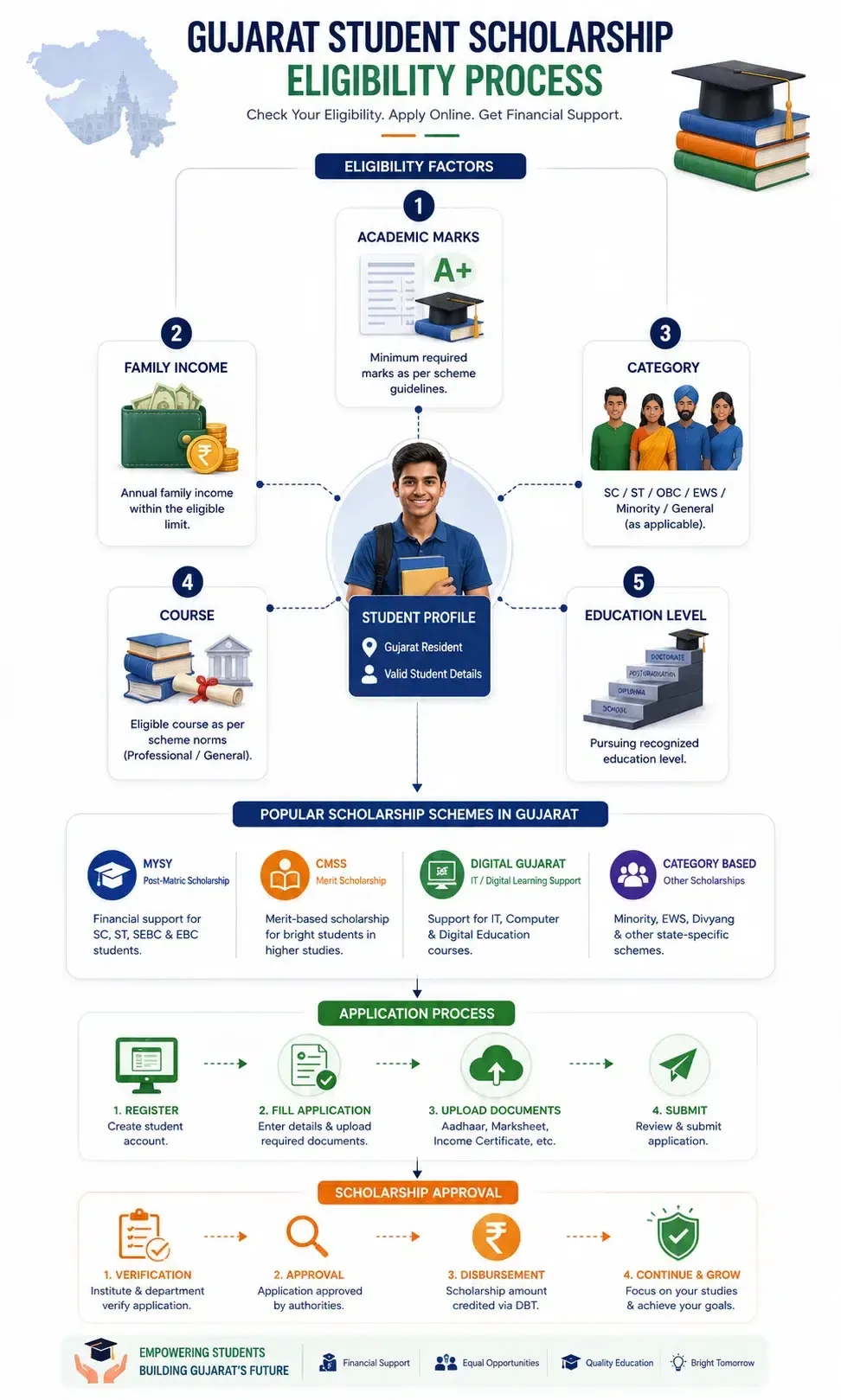
How to Apply for Gujarat Government Student Schemes
The application process depends on the scheme, but the overall workflow is usually similar.
Step 1: Identify your academic level
Start with:
- School
- Class 9–10
- Class 11–12
- Diploma
- Undergraduate degree
- Postgraduate degree
- Professional course
- PhD / research
Do not start by filling out a random scholarship form.
Step 2: Identify your category
Check whether you fall under a scheme for:
- General / economically weaker students
- SC
- ST
- SEBC
- EBC
- NT-DNT
- Minority
- Students with disabilities
- Other specifically covered groups
Step 3: Check family income
Income limits can be decisive.
For example, the current education-loan interest subsidy page lists ₹6 lakh as the family-income ceiling, while the SC Post-Matric Scholarship page lists ₹2.50 lakh for that specific scheme.
Never assume that the income limit of one Gujarat scholarship applies to another.
Step 4: Check course eligibility
A student studying B.Com, engineering, MBBS, diploma engineering, ITI, or PhD may face completely different eligibility conditions.
Some schemes are general.
Others are course-specific.
Step 5: Prepare documents
Depending on the scheme, documents can include:
- Aadhaar
- Marksheets
- Admission proof
- Fee receipt
- Income certificate
- Caste certificate, where applicable
- Disability certificate, where applicable
- Bank account details
- Bank passbook
- Bonafide certificate
- Hostel certificate
- Domicile or residence-related documents
- Passport-size photograph
- Previous scholarship details
The exact list should always come from the current scheme instructions.
Step 6: Apply through the correct portal
Common portals and platforms include:
MYSY: mysy.guj.nic.in
CMSS: scholarships.gujarat.gov.in
Digital Gujarat: digitalgujarat.gov.in
SHODH: shodh.gujarat.gov.in
SSIP: ssipgujarat.in
Step 7: Do not stop after submitting
Application submission is not the same as final approval.
Depending on the scheme, your application can pass through:
Application → Document verification → Institution verification → Department scrutiny → Approval → DBT/payment
That is why keeping the application number and checking student status is important.
Documents You Should Keep Ready
I recommend creating one digital folder before scholarship applications begin.
Put these files inside it:
| Document | Why it may be required |
| Aadhaar card | Identity / DBT |
| Bank passbook | Scholarship payment |
| Income certificate | Income-based eligibility |
| Caste certificate | Category-based schemes |
| Latest marksheet | Academic eligibility |
| Admission letter/receipt | Current-course verification |
| Fee receipt | Tuition assistance |
| Bonafide certificate | Student status |
| Hostel certificate | Hostel-related assistance |
| Disability certificate | Divyang-specific benefits |
| Passport photo | Application profile |
| Mobile number and email | Communication / OTP |
For CMSS specifically, the official application interface requires details such as Aadhaar information and states that Aadhaar should be correctly linked to the beneficiary’s bank account for DBT.
MYSY vs CMSS vs Digital Gujarat: What Is the Difference?
This is one of the most common points of confusion.
| Feature | MYSY | CMSS | Digital Gujarat |
| What is it? | Student financial-assistance scheme | Chief Minister scholarship scheme | Government service/application platform |
| Main audience | Eligible meritorious students meeting scheme criteria | Eligible students under CMSS rules | Students applying to multiple department schemes |
| Main use | Higher education assistance | Scholarship assistance | Application and service delivery |
| Portal | mysy.guj.nic.in | scholarships.gujarat.gov.in | digitalgujarat.gov.in |
| Category-specific? | Depends on scheme rules | Depends on CMSS rules | Yes, because several departments use it |
| Best first step | Check MYSY eligibility | Check CMSS eligibility | Identify the relevant department scheme |
The biggest mistake is treating Digital Gujarat as one single scholarship scheme.
It is a platform through which multiple government services, including scholarship services, are delivered.
Common Mistakes That Can Delay a Scholarship
Applying for the wrong scheme
A student may see the word “scholarship” and apply without checking the course or category conditions.
Always read the eligibility section first.
Using an old income limit
This is especially risky because articles and videos can remain online for years.
A 2022 or 2023 scholarship article is not automatically valid for the 2026 academic year.
Aadhaar and bank details mismatch
For DBT-based assistance, incorrect beneficiary information can cause payment trouble.
Ignoring renewal requirements
Getting a scholarship in first year does not always mean that the next year’s payment is automatic.
Check renewal criteria and deadlines.
Uploading unclear documents
A document may technically be uploaded but still fail verification because it is unreadable.
Use clear scans or photographs.
Waiting until the last day
Technical problems, verification queues, and missing certificates are much harder to fix when the deadline is close.
How to Increase Your Chances of a Smooth Application
There is no legitimate trick that guarantees scholarship approval.
What does help is making the application consistent and verifiable.
I would use this checklist:
- Read the official eligibility criteria.
- Check the income limit.
- Check the exact course.
- Check the required academic performance.
- Confirm the admission year.
- Match the name across documents.
- Verify Aadhaar and bank details.
- Scan documents clearly.
- Submit the application before the closing date.
- Complete college/help-centre verification where required.
- Save the acknowledgement and application number.
- Track status until the process is complete.
This sounds basic, but these are the areas that matter most when an application moves from an online form to actual verification.
What If Your Family Income Is Above the Scholarship Limit?
Do not immediately assume there is no support.
Look at the type of scheme, not only the word “scholarship.”
Possible alternatives include:
- Education-loan interest subsidy, if eligible
- Student innovation programmes
- Course-specific assistance
- Institution-level scholarships
- Merit scholarships offered by universities
- Category-specific support where applicable
- Research support for postgraduate/PhD students
For example, the Gujarat education-loan interest subsidy scheme has its own eligibility structure, while SSIP is focused on innovation rather than ordinary tuition support.
This is one of the most useful distinctions I would make when researching student benefits:
Financial assistance does not always look like a monthly scholarship.
A Realistic Example: Which Scheme Should a Student Check?
Imagine a Gujarat student has:
- Passed Class 12
- Taken admission in an eligible undergraduate course
- A family income within a relevant scheme’s ceiling
- Good academic performance
- A Gujarat educational background
The student should not immediately submit one random application.
I would compare:
MYSY → CMSS → category-based scholarship → institution scholarship → education-loan support
Then choose the programmes for which the student is genuinely eligible under the current rules.
Now change the situation.
Suppose the same student is an SC student living in a college hostel.
The research path changes:
SC Post-Matric Scholarship → course-specific SC assistance → food-bill assistance → other applicable schemes
The second student may have access to an entirely different combination of benefits.
That is why student profile mapping is more useful than a generic list of 50 schemes.
Gujarat Government Student Scheme Search Strategy
If I were building a scholarship research checklist from scratch, I would use five filters.
Filter 1: Education level
School → 11–12 → Diploma → Degree → PG → PhD
Filter 2: Category
General → SC → ST → SEBC → EBC → NT-DNT → Minority → Divyang
Filter 3: Financial condition
Income ceiling → loan requirement → hostel expense → tuition burden
Filter 4: Academic performance
Percentage → percentile → merit rank → qualifying examination
Filter 5: Course
Engineering → Medical → Pharmacy → Commerce → Arts → Science → Diploma → ITI → Research
This method reduces the amount of irrelevant information dramatically.
Important Official Portals for Gujarat Students
| Portal | Main purpose |
| mysy.guj.nic.in | MYSY student services |
| scholarships.gujarat.gov.in | Chief Minister Scholarship Scheme |
| digitalgujarat.gov.in | Government services including scholarship applications |
| shodh.gujarat.gov.in | SHODH research scheme |
| ssipgujarat.in | Student Startup and Innovation Policy |
| kcg.gujarat.gov.in | Higher-education programmes and schemes |
Digital Gujarat also provides assisted access through Jan Seva Kendra and e-Gram centres, making it useful for students who cannot comfortably complete online government services on their own.
📌 Also Read: NSP Scholarship 2026-27: Apply Online Before Oct 31 Deadline — National Scholarship Portal guide with OTR registration steps.
Frequently Asked Questions
Which Gujarat government scheme is best for students?
There is no single best scheme for every student. MYSY and CMSS can be relevant for eligible higher-education students, while SC, SEBC, EBC, minority, and Divyang students may have additional category-specific programmes.
What is the MYSY scholarship in Gujarat?
MYSY stands for Mukhyamantri Yuva Swavalamban Yojana. It is a Gujarat Education Department student-support scheme based on eligibility conditions including academic performance, family income, and course/admission criteria. The official portal is mysy.guj.nic.in.
What is CMSS in Gujarat?
CMSS stands for Chief Minister Scholarship Scheme. It is an Education Department scholarship programme with an official application portal at scholarships.gujarat.gov.in.
Can students apply for scholarships through Digital Gujarat?
Yes. Digital Gujarat provides online and assisted access to multiple government services, including pre-matric and post-matric scholarship services.
Is Digital Gujarat itself a scholarship?
No. Digital Gujarat is primarily a government digital-service platform. Different departments operate different scholarship schemes through it.
What scholarship is available for SC students in Gujarat?
The Gujarat Scheduled Caste Welfare Department lists multiple educational programmes, including the Pre-SSC Scholarship, Post-Matric Scholarship, SC girls’ post-SSC scholarship, professional-course assistance, food-bill assistance, and other schemes.
Is there financial support for SC medical and engineering students?
Yes. The BCK-12 scheme lists assistance for eligible SC students studying medical, degree engineering, and diploma courses. The currently published amounts are ₹15,000, ₹10,000, and ₹5,000 respectively, subject to the scheme’s conditions.
Is there food-bill assistance for hostel students?
The Gujarat Scheduled Caste Welfare Department lists food-bill assistance for eligible SC students staying in college-affiliated hostels. The current scheme page states ₹1,500 per month for up to 10 months, subject to eligibility.
Can students get education-loan interest assistance?
Yes. Gujarat’s Interest Subsidy Scheme on Education Loan supports eligible higher-education students. The current KCG page states eligibility based on factors including Class 12 performance, family income, and eligible bank education loans, with subsidy available on education loans up to ₹10 lakh.
Is there a Gujarat government scheme for student startups?
Yes. The Student Startup and Innovation Policy (SSIP 2.0) provides an innovation and entrepreneurship support ecosystem for students and participating educational institutions.
What scheme is available for PhD students in Gujarat?
Eligible full-time PhD researchers can check the SHODH — Scheme of Developing High Quality Research. The published scheme information describes stipend and contingency support for eligible scholars.
Can students get a government tablet in Gujarat?
Eligible first-year college and polytechnic students can check the NAMO e-Tablet Scheme. The KCG page describes the programme as higher-education support and lists a nominal ₹1,000 contribution.
Where should I check the latest scholarship rules?
Start with the relevant official portal or government department rather than relying solely on third-party blogs, YouTube videos, or social-media posts. Scheme conditions can change through government resolutions.
My Final Words
The biggest mistake students make when searching for Gujarat government schemes for students is looking for one universal scholarship.
There isn’t one.
There is an ecosystem.
A Class 10 student, an undergraduate engineering student, an SC hostel resident, a student with a disability, someone financing college through an education loan, a startup-minded student, and a PhD researcher can all have completely different routes to government support.
The practical way to approach it is to map five things:
Your course + academic performance + family income + category + current financial need.
Once those five pieces are clear, the search becomes much easier.
Start with the official portals for MYSY, CMSS, and Digital Gujarat, then move into category-specific schemes administered by the relevant Gujarat department. For higher-education financing, check the education-loan interest subsidy. For innovation, check SSIP. For doctoral research, check SHODH.
And before submitting anything, check the latest government notification for your academic year. That final verification step matters because scholarship amounts, income ceilings, eligible courses, and application dates can change.
Official sources used for this guide include the Gujarat Education Department/KCG, Digital Gujarat information published by the Gujarat Department of Science and Technology, the MYSY and CMSS portals, the Social Justice and Empowerment Department, the Director of Scheduled Caste Welfare, and the SSIP/SHODH programme portals.