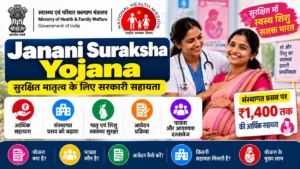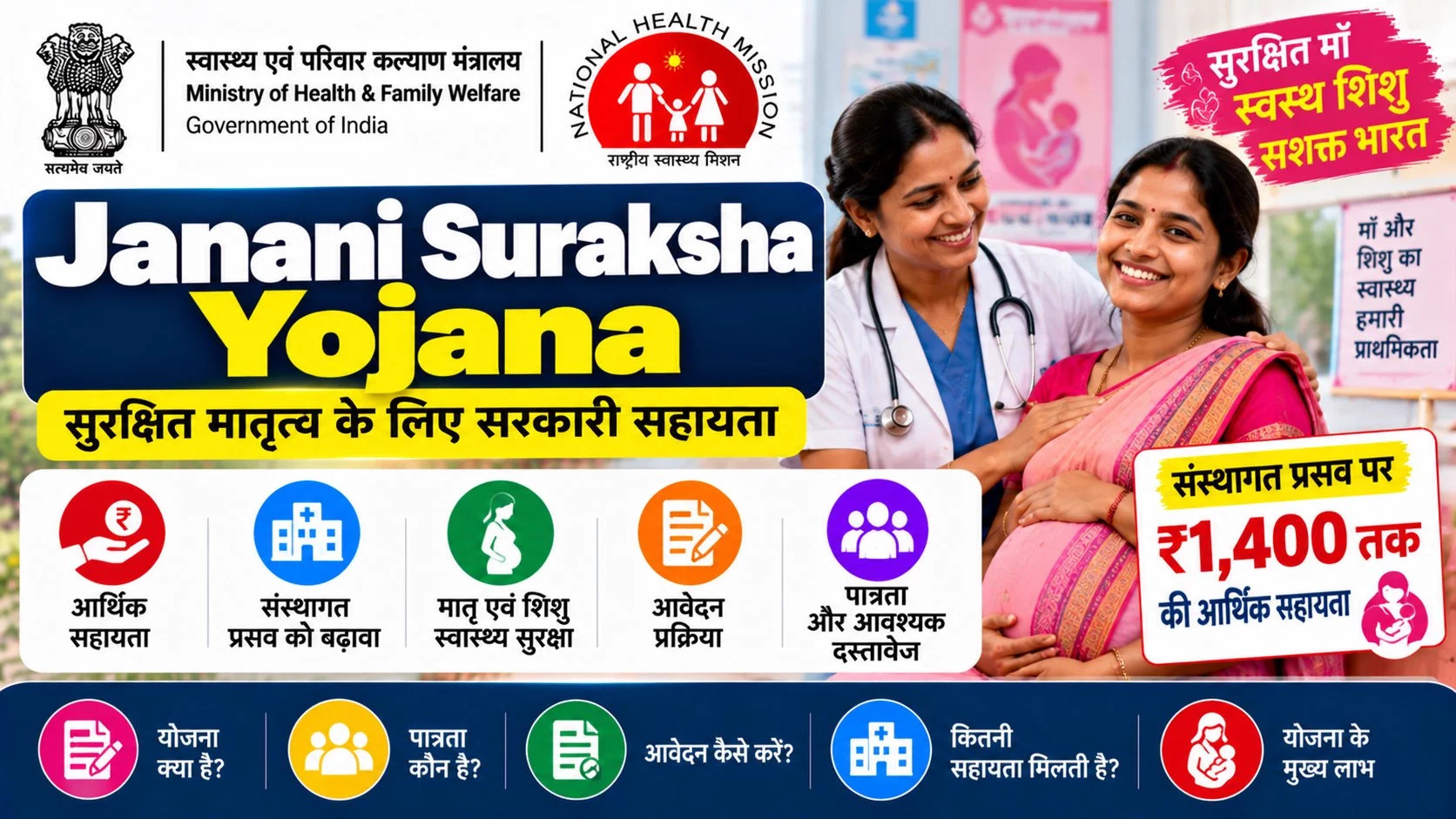

If you are pregnant and worried about hospital delivery costs, here is something you should know: the government pays you to deliver in a hospital. Under the Janani Suraksha Yojana, eligible mothers receive up to ₹1,400 in cash for choosing an institutional delivery — and the money lands directly in your bank account. I spent time going through the official National Health Mission guidelines to put together this complete guide, because most articles online either give half the information or quote outdated amounts.
✅ This guide is based on official government sources and notifications. Last verified: October 15, 2026. Scheme details, eligibility criteria, and benefit amounts are revised by the government from time to time — always cross-check the latest information on the official portal before applying.
What Is Janani Suraksha Yojana?
The Janani Suraksha Yojana (JSY) is a safe-motherhood scheme run by the Ministry of Health and Family Welfare, Government of India, under the National Health Mission (NHM). It was launched in 2005 with one clear goal: push institutional deliveries so that fewer mothers and newborns die during childbirth.
The logic is simple. When a woman delivers at home without skilled help, complications like excessive bleeding, infection, or obstructed labour can turn fatal within hours. In a hospital, trained staff can catch these problems early. But for poor families, hospital delivery felt expensive and out of reach. JSY flips the equation — instead of delivery costing you money, the government gives you cash assistance for delivering in a health facility.
Here is what makes JSY different from most government schemes: there is no complicated online application, no lottery, no waiting list. If you meet the eligibility criteria and deliver in a government or accredited health facility, the cash incentive is your right. The amount ranges from ₹600 to ₹1,400 depending on where you live, and it is paid through Direct Benefit Transfer (DBT) straight into your bank account.
One last tip about Janani Suraksha Yojana: register your Janani Suraksha Yojana pregnancy early with your ASHA worker. Early Janani Suraksha Yojana registration ensures you get your MCP card, complete all check-ups, and receive your Janani Suraksha Yojana payment without delays.
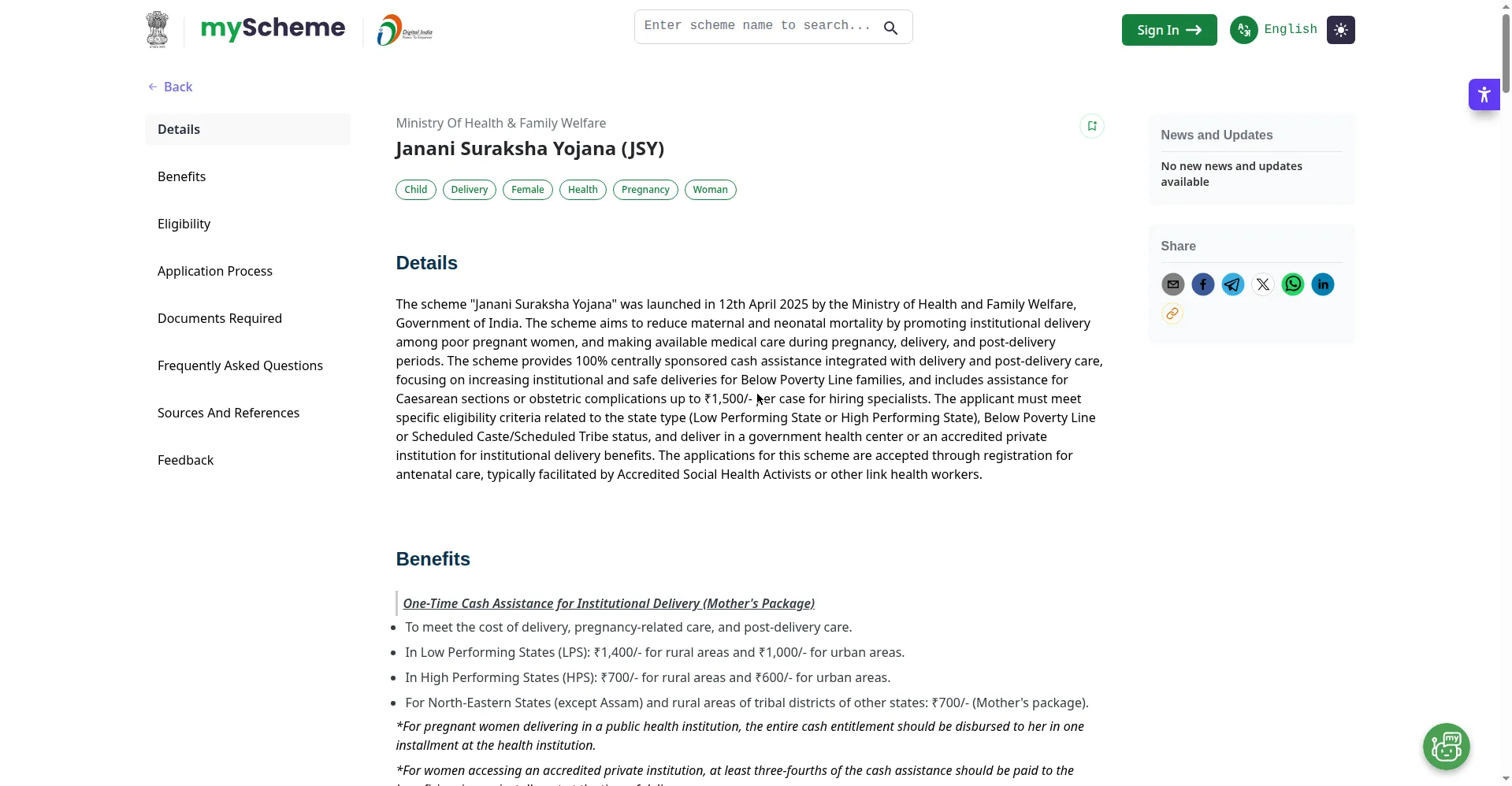
Want official Janani Suraksha Yojana details? Visit myscheme.gov.in and search for Janani Suraksha Yojana to read the official Janani Suraksha Yojana guidelines. The Janani Suraksha Yojana page lists state-wise helplines and the latest Janani Suraksha Yojana updates.
Quick Janani Suraksha Yojana recap: Janani Suraksha Yojana pays ₹1,400 (rural) or ₹1,000 (urban) in low-performing states, plus free delivery under JSSK. If you are expecting, Janani Suraksha Yojana is the first scheme to register for — talk to your ASHA about Janani Suraksha Yojana today.
Share this Janani Suraksha Yojana guide with expecting mothers in your family — Janani Suraksha Yojana benefits reach further when more women know about Janani Suraksha Yojana.
One thing I want to clear up right away, because this confuses a lot of people: JSY is not the same as Pradhan Mantri Matru Vandana Yojana (PMMVY). PMMVY pays ₹5,000 for the first child as maternity wage compensation, while JSY specifically rewards institutional delivery. You can actually receive benefits under both schemes if you are eligible. I will compare the two later in this article.
Janani Suraksha Yojana Amount: Complete Cash Incentive Chart
This is the question everyone asks first — how much money do I actually get? The answer depends on two things: which state you live in, and whether you are in a rural or urban area.
The government divides states into two groups. Low Performing States (LPS) are the ten states where institutional delivery rates were historically low, so the incentive is higher there to encourage hospital births. High Performing States (HPS) are all other states and Union Territories.
Here is the complete amount chart for the mother:
| Category | Rural Area (Mother) | Urban Area (Mother) |
|---|---|---|
| Low Performing States | ₹1,400 | ₹1,000 |
| High Performing States | ₹700 | ₹600 |
On top of this, the ASHA worker who helps you through the process gets her own separate incentive — I have broken that down in a dedicated section below, because it is a bigger amount than most people realise.
A few important notes about the amounts:
- These are per delivery. Each institutional delivery that meets the criteria qualifies for the incentive.
- States can add their own top-up. Several states add extra money from their own budgets on top of the central amount. So always check your state’s latest notification — the actual payout in your state might be higher than the table above.
- Transport support is separate. Where a woman has to travel to reach the delivery centre, a transport assistance of at least ₹250 can be paid on top of the main incentive.
- Payment comes after delivery. The cash is released after you deliver in the facility and the paperwork is complete — usually within 7 days of delivery.
Low Performing States (LPS) vs High Performing States (HPS)
Since your payout depends entirely on which group your state falls in, here is the official list. The ten Low Performing States are:
- Uttar Pradesh
- Uttarakhand
- Bihar
- Jharkhand
- Madhya Pradesh
- Chhattisgarh
- Assam
- Rajasthan
- Odisha
- Jammu and Kashmir
Every other state and Union Territory is treated as a High Performing State for JSY purposes. So if you live in Maharashtra, Gujarat, Karnataka, Tamil Nadu, West Bengal, Punjab, Haryana, Kerala, Telangana, Andhra Pradesh, or Delhi, you fall in the HPS group.
Why does this classification matter beyond the money? Because the eligibility rules are also different. In Low Performing States, all pregnant women delivering in government health institutions are eligible — no caste or income certificate needed. In High Performing States, only BPL, SC, and ST women qualify for the cash assistance. This is the single most misunderstood part of the scheme, and I see wrong information about it on half the websites out there.
Who Is Eligible for Janani Suraksha Yojana?
Let me lay out the eligibility criteria clearly, because getting this wrong is the number one reason applications get rejected.
In Low Performing States (the 10 states listed above)
- All pregnant women are eligible, regardless of age, income, or caste — as long as they deliver in a government health institution or an accredited private facility.
- There is no BPL or SC/ST requirement in LPS.
In High Performing States (all other states/UTs)
- Only women from BPL (Below Poverty Line) households, Scheduled Castes (SC), or Scheduled Tribes (ST) are eligible for the cash assistance.
- You will need a BPL ration card or a valid SC/ST caste certificate as proof.
Applies in both groups
- Women delivering in accredited private hospitals empanelled under the scheme are eligible, subject to the same BPL/SC/ST conditions in HPS.
- The delivery must happen in a recognised health facility — Sub-Centre, Primary Health Centre (PHC), Community Health Centre (CHC), First Referral Unit, district hospital, or state hospital.
Now, about age and number of children: the rules here have been relaxed over the years and still vary by state. Older guidelines mentioned restrictions like age 19+ and up to two live births, but in Low Performing States these limits were removed. My advice — and I mean this practically — is to confirm the current age and birth-order rule with your ASHA worker or PHC rather than assuming an old blog post is correct. State health societies issue their own clarifications, and the ground reality follows the state circular, not a five-year-old article.
Documents Required for Janani Suraksha Yojana
Keep these ready before your delivery date. Having documents in order is what separates a payment that arrives in 7 days from one that drags on for months:
- Aadhaar Card — mandatory, because the payment goes through DBT to your Aadhaar-linked bank account.
- Bank account passbook copy — the account must be active and ideally Aadhaar-seeded. This is where your ₹600–₹1,400 will land.
- BPL ration card or SC/ST caste certificate — required in High Performing States; not needed in Low Performing States.
- MCP Card (Mother and Child Protection Card) — issued during your antenatal check-ups. This tracks your pregnancy and is submitted along with the JSY card to claim benefits.
- JSY Card — issued by the ASHA worker or ANM after pregnancy registration.
- Hospital discharge certificate — submitted after delivery for payment processing.
- Address proof and a passport-size photograph — some states ask for these on their forms.
The single most common paperwork mistake I have seen people make: the bank account is in someone else’s name, or it is dormant. The DBT payment goes to the beneficiary’s own Aadhaar-linked account. If your account is not active or not linked to Aadhaar, fix that during pregnancy — not after delivery when you are trying to get paid.
How to Apply for Janani Suraksha Yojana (Step by Step)
Here is the honest truth about “JSY online apply” — there is no single national online portal for Janani Suraksha Yojana registration. Anyone telling you to fill a central online form is misleading you. Registration happens through the health system on the ground. Here is the actual process:
Step 1: Register your pregnancy early. Visit your nearest Anganwadi centre, contact your area’s ASHA worker, or go to the Primary Health Centre (PHC). Register the pregnancy, preferably in the first trimester. Early registration means better monitoring and ensures you do not miss any benefit.
Step 2: Get your MCP card and JSY card. The ANM (Auxiliary Nurse Midwife) or ASHA worker issues the Mother and Child Protection card after identifying the pregnancy. The JSY card is filled alongside — in most states the health worker fills the form, not you.
Step 3: Complete your antenatal check-ups. Attend the scheduled ANC visits. The ASHA worker tracks these — and remember, part of her incentive is tied to antenatal care, so she has a reason to make sure you show up.
Step 4: Submit your documents. Give copies of your Aadhaar, bank passbook, and BPL/caste certificate (if applicable in your state) to the health worker. Double-check that your bank account is Aadhaar-linked.
Step 5: Deliver in the health facility. When labour begins, the ASHA worker helps you reach the government hospital or empanelled facility. Deliver there — this is the core condition of the scheme.
Step 6: Receive payment via DBT. After delivery, the hospital submits the discharge details. The cash incentive is transferred directly to your bank account, generally within 7 days of delivery.
Some states do have their own NHM portals where parts of this process are digitised, but the ASHA/Anganwadi/PHC route works everywhere. If someone in your village tells you there is a website where you “apply online” for JSY, treat it with suspicion unless it is your state’s official NHM website.
Janani Suraksha Yojana Form PDF
Another common search: the JSY application form download. Here is what you need to know — there is no single national JSY form. Each state designs its own form, and in practice the ANM or health worker usually fills it after identifying a pregnant woman.
Most state forms collect the same basic information:
- Name and address of the applicant
- Pregnancy details and expected date of delivery
- Category (BPL / SC / ST)
- Health centre details
- Bank account information (for DBT)
- ASHA worker details
- Declaration and signature
If you want the form in advance, ask your ASHA worker or check your state’s NHM website — many states publish their JSY form PDFs there in both Hindi and English. Do not pay anyone for the form; it is free.
ASHA Worker’s Role and Incentive: The Full Breakdown
The ASHA (Accredited Social Health Activist) is the backbone of this scheme. She identifies pregnant women, ensures they get antenatal check-ups, escorts them to the facility for delivery, and follows up after birth. The government pays her separately for this work — and the amount is not small.
Here is the complete ASHA incentive chart:
| Category | Rural Area (ASHA) | Urban Area (ASHA) |
|---|---|---|
| Low Performing States | ₹600 | ₹400 |
| High Performing States | ₹600 | ₹400 |
The rural ₹600 is split into two parts — ₹300 for antenatal care support and ₹300 for accompanying the woman for institutional delivery. In urban areas, the ₹400 splits as ₹200 + ₹200. The design is deliberate: the ASHA is paid for the full journey, not just showing up on delivery day.
Why does this matter to you as a beneficiary? Because it means your ASHA worker has a financial reason to stay in touch with you through the pregnancy. If your ASHA is not visiting or not helping, you can raise it at the PHC — the system is built around her doing this job.
JSY + JSSK: Free Cashless Delivery Benefits You Should Know
Here is something most JSY articles completely miss, and it is worth more than the cash itself. Under the Janani Shishu Suraksha Karyakram (JSSK), every woman delivering in a government health institution is entitled to completely free and cashless delivery — including Caesarean sections.
JSSK covers:
- Free delivery, including C-section if needed
- Free drugs and consumables
- Free diagnostics (blood tests, ultrasound, etc.)
- Free diet during the hospital stay
- Free transport — from home to the hospital and the drop back home
- Exemption from all user charges
So the real package is: free delivery + free medicines + free food + free transport + ₹600–₹1,400 cash in hand. When you add it all up, the effective value of an institutional delivery under JSY + JSSK is far higher than the headline cash figure. If any hospital asks you to pay for delivery-related charges that JSSK covers, that is a grievance you can raise — I cover the complaint process below.
Home Delivery Benefit Under JSY
What if, for some reason, a woman delivers at home? The scheme has a provision for that too, though it is deliberately smaller to keep the incentive tilted toward hospitals. BPL women aged 19 years or above who deliver at home can receive ₹500 per delivery, available for up to two live births.
Be clear about this: the home delivery benefit is a safety net, not the goal of the scheme. The institutional delivery incentive (₹600–₹1,400) is higher precisely because hospital delivery is safer. If you are choosing home delivery only because you did not know about the hospital benefit, talk to your ASHA worker — the system is designed to make the hospital option easy.
Janani Suraksha Yojana vs Pradhan Mantri Matru Vandana Yojana
These two schemes get confused constantly, so here is a straight comparison:
| Feature | Janani Suraksha Yojana (JSY) | Pradhan Mantri Matru Vandana Yojana (PMMVY) |
|---|---|---|
| Purpose | Promote institutional (hospital) delivery | Wage compensation for the first child |
| Amount | ₹600 – ₹1,400 per delivery | ₹5,000 (in instalments) |
| Eligibility | LPS: all pregnant women; HPS: BPL/SC/ST | First living child (all categories, with conditions) |
| Run by | Ministry of Health & Family Welfare (NHM) | Ministry of Women & Child Development |
| Can you get both? | Yes — if you meet both schemes’ criteria, you can receive JSY and PMMVY benefits together. | |
The practical takeaway: register for both. They are run by different ministries through different channels, and one does not cancel the other.
Common Reasons JSY Payment Gets Delayed or Rejected
After going through the guidelines and the grievance patterns, these are the issues that come up again and again:
- Bank account not Aadhaar-linked. The DBT fails silently and the money bounces back. Fix this during pregnancy.
- Wrong eligibility assumption. In High Performing States, non-BPL general-category women are not eligible for the cash component. Check your state’s rule before counting on the money.
- Delivery in a non-empanelled private hospital. Only government facilities and accredited/empanelled private hospitals qualify. A random private nursing home does not.
- Missing MCP or discharge certificate. Without the paperwork chain (registration → MCP card → discharge slip), the payment file cannot be processed.
- Name mismatch. The name on your Aadhaar, bank account, and MCP card should match. Mismatches are a classic DBT failure point across all government schemes.
If your payment is delayed beyond the usual 7-day window after delivery, start with your ASHA worker, then the PHC medical officer. Every district has a grievance redressal mechanism for NHM schemes — beneficiaries can raise complaints about eligibility disputes or delayed payments through the district grievance cell.
Frequently Asked Questions
What is the Janani Suraksha Yojana amount in 2026?
The mother receives ₹1,400 (rural) or ₹1,000 (urban) in Low Performing States, and ₹700 (rural) or ₹600 (urban) in High Performing States. The ASHA worker separately receives ₹600 (rural) or ₹400 (urban). States may add their own top-up over these central amounts.
How can I apply for Janani Suraksha Yojana online?
There is no single national online portal for JSY. Registration is done through your ASHA worker, Anganwadi centre, or the nearest Primary Health Centre (PHC). Register your pregnancy early, submit your documents, deliver in a government or empanelled facility, and the incentive is paid via DBT within about 7 days of delivery.
Who is eligible for Janani Suraksha Yojana?
In the 10 Low Performing States (UP, Bihar, MP, Rajasthan, Odisha, Jharkhand, Chhattisgarh, Assam, Uttarakhand, J&K), all pregnant women delivering in government institutions are eligible. In all other states, only BPL, SC, and ST women qualify for the cash assistance.
What documents are needed for JSY?
Aadhaar card, bank account passbook (Aadhaar-linked), BPL ration card or SC/ST certificate (in High Performing States), MCP card, JSY card issued by the ASHA/ANM, and the hospital discharge certificate after delivery.
Does the ASHA worker also get money under JSY?
Yes. The ASHA receives ₹600 in rural areas and ₹400 in urban areas for supporting the beneficiary — split between antenatal care assistance and accompanying the woman for institutional delivery (₹300 + ₹300 rural; ₹200 + ₹200 urban).
Can I get both JSY and PMMVY benefits?
Yes. Janani Suraksha Yojana (under the Health Ministry) and Pradhan Mantri Matru Vandana Yojana (under the Women & Child Development Ministry) are separate schemes. If you meet both sets of eligibility criteria, you can receive benefits under both.
Final Thoughts
Janani Suraksha Yojana is one of those rare government schemes that is simple at its core: deliver in a hospital, get cash support, and get free medical care through JSSK on top. The amounts — ₹1,400 at the top end — will not make anyone rich, but combined with free delivery, free medicines, free food, and free transport, the real value is substantial for the families this scheme targets.
If you or someone in your family is expecting, the single most useful thing you can do this week is talk to your ASHA worker and register the pregnancy. Everything else — the cards, the check-ups, the hospital delivery, the DBT payment — flows from that one step. And if you are planning for the child’s future beyond birth, look into the Sukanya Samriddhi Yojana for a girl child — it is the natural next step after a safe delivery. Families in the unorganised sector should also check e-Shram card registration, which opens the door to other social security benefits.