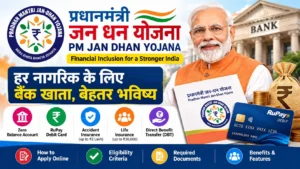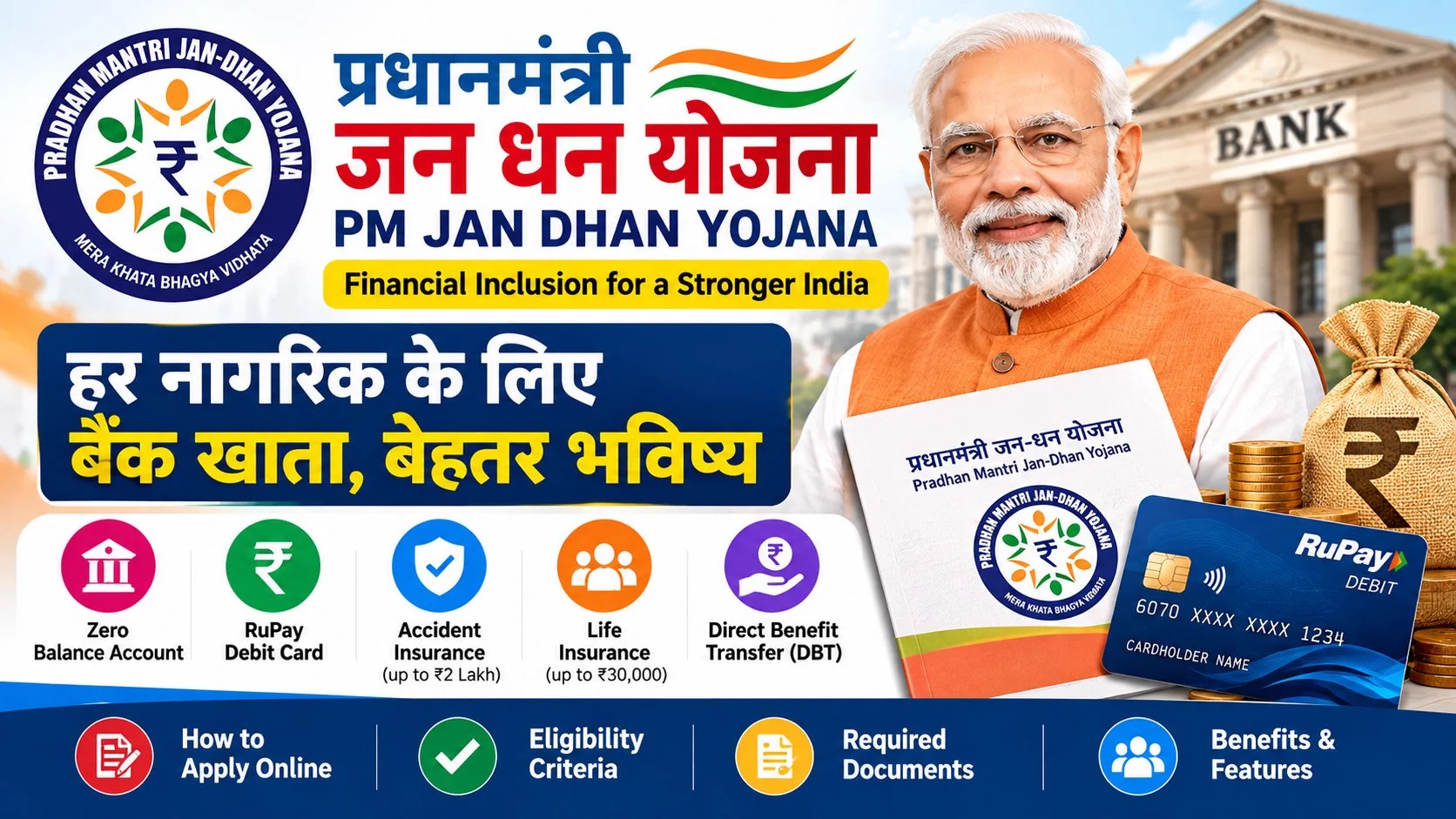

Think about this for a second: the government wants to send you money — a subsidy, a scholarship, a pension — but you don’t have a bank account. Where does that money go? For crores of Indians, this was reality until 2014. If you’re reading this because you (or someone in your family) still don’t have a bank account, or you’re tired of minimum-balance penalties eating your savings, this guide solves it. Here’s how to open a Jan Dhan Yojana account — a zero-balance bank account with a free RuPay debit card, up to ₹2 lakh accident insurance, and a ₹10,000 overdraft facility — and actually use every benefit it offers.
✅ This guide is based on official government sources and notifications. Last verified: October 15, 2026. Scheme details, eligibility criteria, and benefit amounts are revised by the government from time to time — always cross-check the latest information on the official portal before applying.
What Is PM Jan Dhan Yojana?
Pradhan Mantri Jan Dhan Yojana (PMJDY) is the Government of India’s National Mission for Financial Inclusion. Launched on 28 August 2014 by Prime Minister Narendra Modi, its goal was simple and massive: give every unbanked household and every adult access to a bank account and basic financial services — savings, remittance, credit, insurance, and pension — in an affordable manner.
It worked at a scale the world noticed. PMJDY holds a Guinness World Record for the most bank accounts opened in one week. As of October 2026, the official portal (pmjdy.gov.in) shows 59.49 crore beneficiaries banked, with ₹3,19,841.48 crore sitting in beneficiary accounts, served through 13.55 lakh Bank Mitras delivering branchless banking across the country. About 56% of these accounts belong to women, and roughly two-thirds are in rural and semi-urban areas.
The scheme was originally supposed to run till 2018, but the government extended it with a sharper focus — from “every household” to “every adult” — and sweetened the deal: the overdraft limit doubled from ₹5,000 to ₹10,000 and RuPay accident insurance doubled from ₹1 lakh to ₹2 lakh for new accounts.
Jan Dhan Yojana: Quick Facts
| Detail | Information |
|---|---|
| Scheme name | Pradhan Mantri Jan Dhan Yojana (PMJDY) |
| Launched | 28 August 2014 |
| Ministry | Department of Financial Services, Ministry of Finance |
| Account type | Basic Savings Bank Deposit Account (BSBDA) |
| Minimum balance | Zero — no minimum balance required |
| Age | 10 years and above (minors through guardian) |
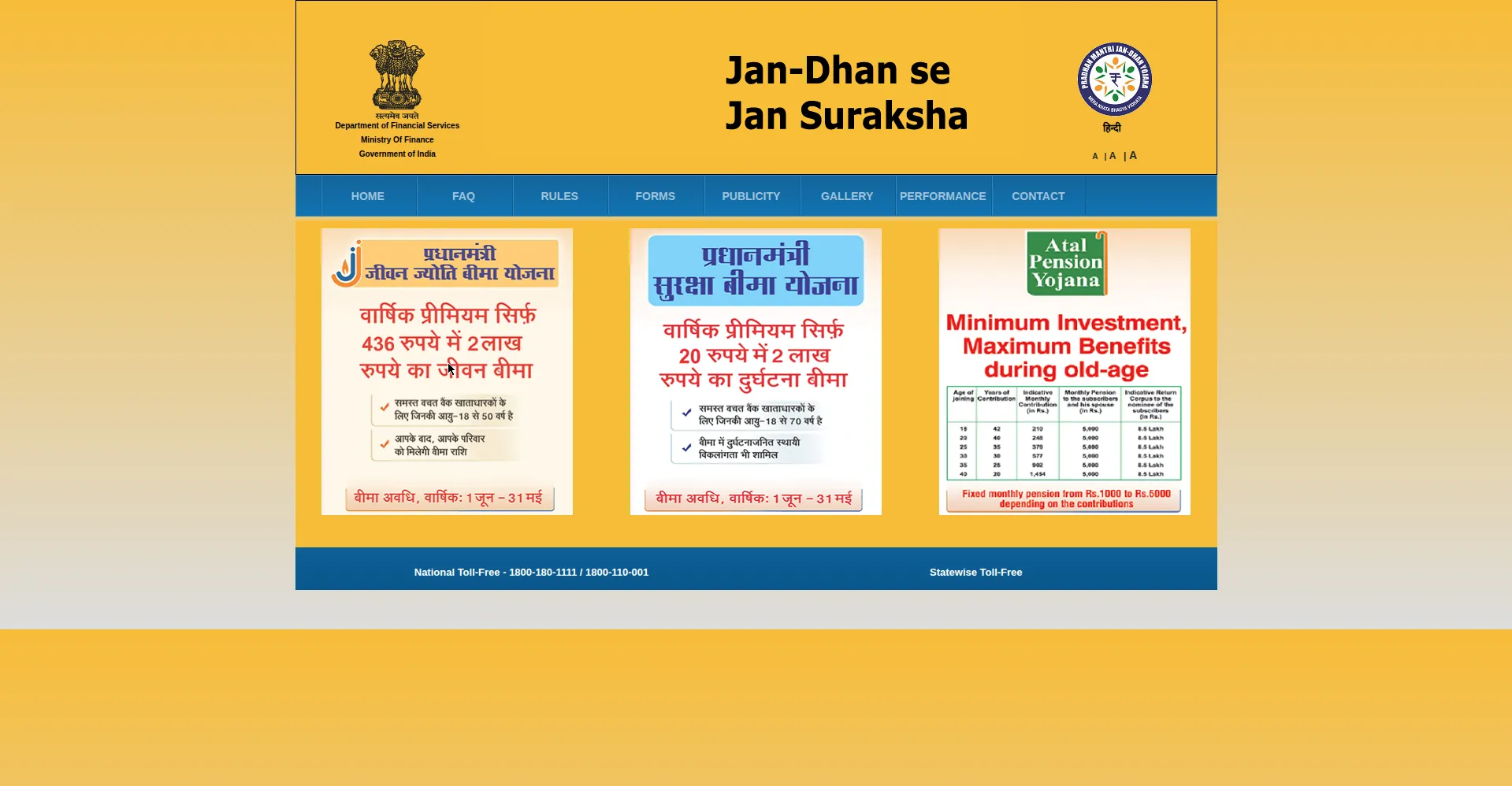
| Official website | pmjdy.gov.in |
| Toll-free helpline | 1800 11 0001 / 1800 180 1111 |
7 Benefits of Jan Dhan Account (Explained Simply)
1. Zero-balance account — no penalties, ever
This is the headline benefit. Regular savings accounts in most banks demand ₹1,000–₹10,000 minimum balance, and falling short means penalty charges. A Jan Dhan account has no minimum balance requirement and no maintenance charges. Your money stays yours, even if the balance is literally zero for months.
2. Free RuPay debit card
Every account holder gets a RuPay debit card free of cost. You can use it at ATMs and most shops/POS machines, just like any other debit card. There’s no annual fee for the basic card issued under the scheme.
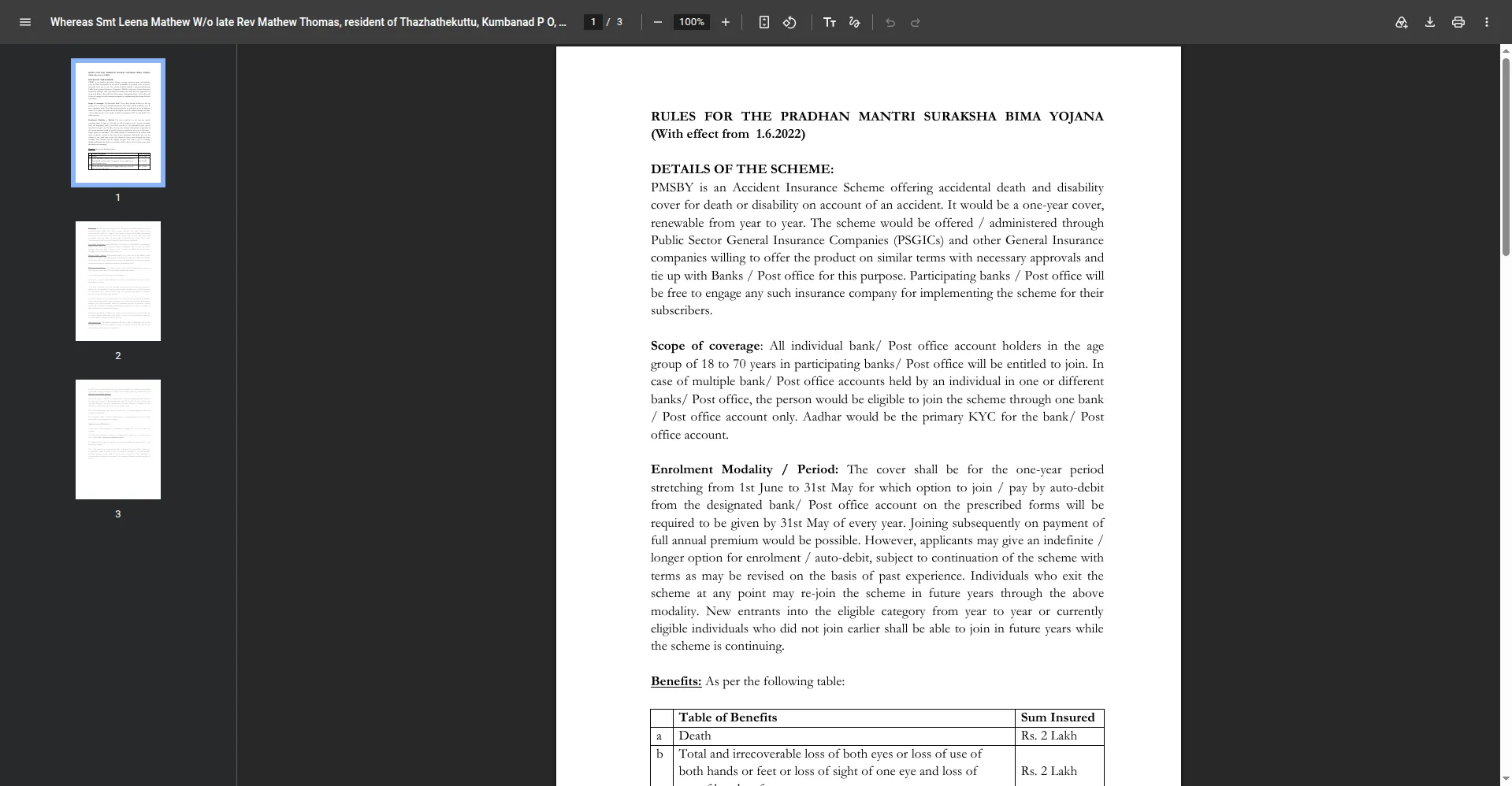
3. Accident insurance up to ₹2 lakh
This is the benefit most people don’t know about. The RuPay card carries in-built accidental death/disability insurance:
- ₹2 lakh — for PMJDY accounts opened after 28 August 2018
- ₹1 lakh — for accounts opened on or before 28 August 2018
One important condition: the card must have been used at least once in the 90 days before the accident (this keeps the card “active” for the insurance). I’ll explain the claim process below.
4. Overdraft facility up to ₹10,000
After 6 months of satisfactory account operation, eligible holders can get an overdraft (OD) of up to ₹10,000 — essentially a small pre-approved loan you can dip into when needed. Key rules: age 18–65, and there’s no condition at all for OD up to ₹2,000 in active accounts. This is genuine emergency credit for people who’d otherwise go to moneylenders.
5. Direct Benefit Transfer (DBT) straight to your account
Subsidies, scholarships, pensions, and scheme payments from the government land directly in the account — no middlemen, no delays. This is the “Dhan” in the JAM Trinity (Jan Dhan–Aadhaar–Mobile) that powers DBT across India.
6. Interest on your deposits
Jan Dhan accounts earn the same savings-account interest rate as regular accounts of that bank. Zero balance doesn’t mean zero growth.
7. Gateway to bigger schemes
Your Jan Dhan account is the entry ticket to Mudra loans, micro-insurance, and pension products. Most banks let you enroll for Atal Pension Yojana directly through the same account — one account, multiple safety nets. And if you’re a farmer, DBT payments like PM-Kisan installments can also flow into it.
Jan Dhan Account vs Regular Savings Account
| Feature | Jan Dhan Account | Regular Savings Account |
|---|---|---|
| Minimum balance | Zero | ₹1,000–₹10,000 (varies by bank) |
| Penalty on low balance | None | Charged monthly/quarterly |
| Debit card | Free RuPay card | Usually free 1st year, then annual fee |
| Accident insurance | Up to ₹2 lakh (in-built) | Not included |
| Overdraft | Up to ₹10,000 | Only with salary/premium accounts |
| Cheque book | Limited / on request | Usually provided |
| Best for | First-time account holders, DBT, low-income families | Regular savers, higher transactions |
Who Can Open a Jan Dhan Account? (Eligibility)
- Any Indian citizen aged 10 years or above. Minors (10–18) can open accounts operated by a guardian.
- No income limit. The scheme targets the unbanked, but anyone without a bank account can open one.
- One account per person under the scheme — if you already have a regular savings account, banks may convert it or ask you to use that instead.
- Joint accounts are allowed.
- There is no upper age limit for opening the account itself (the 18–65 range applies only to the overdraft facility).
Documents Required
| Situation | Documents needed |
|---|---|
| With Aadhaar | Aadhaar card only (e-KYC) + 1 passport photo |
| Without Aadhaar | Any one OVD: Voter ID, PAN card, Driving Licence, Passport, or NREGA Job Card + 2 photos |
| No valid documents at all | “Small account” — photo + thumbprint/signature (see limits below) |
| Minor (10–18) | Child’s birth proof + guardian’s KYC documents |
Address proof: If your current address differs from the one on your documents, a simple self-declaration of the current address is accepted in most banks.
How to Open a Jan Dhan Account: Step-by-Step (Bank Branch)
This is the most reliable method and works at any public or private sector bank branch.
Step 1: Visit the nearest bank branch. Carry your Aadhaar card (original + photocopy) and one passport-size photo. Ask for the PMJDY / Basic Savings Bank Deposit Account opening form — it’s free.
Step 2: Fill the form carefully. The critical fields: name exactly as on Aadhaar, date of birth, mobile number, and nominee details. A mismatch between your name on the form and Aadhaar is the #1 reason for delays.
Step 3: Submit the form with documents. The officer will verify originals and do e-KYC (fingerprint or OTP on your Aadhaar-linked mobile).
Step 4: You’ll get an account number and customer ID — often the same day. Ask for the RuPay debit card request to be punched in right then; the card is usually delivered to your address in 7–15 days, though many branches hand over an instant kit.
Step 5: Register for SMS alerts and mobile banking at the counter itself. Without SMS alerts you won’t know when DBT money arrives.
How to Open via Bank Mitra (No Branch Visit Needed)
Don’t have a bank branch nearby? The scheme’s 13.55 lakh Bank Mitras (Business Correspondents) bring the bank to your village or mohalla with a micro-ATM device.
Step 1: Find your nearest Bank Mitra — ask at the panchayat office, or check the bank’s website for the BC locator.
Step 2: The Mitra fills your details on a handheld device, captures your photo and fingerprint, and scans your Aadhaar.
Step 3: e-KYC completes on the spot. You get an account number via SMS, and the RuPay card follows by post.
Bank Mitras can also handle deposits, withdrawals, and balance enquiries later — they’re a full mini-branch for basic services.
Can You Open a Jan Dhan Account Online?
Honest answer: there’s no single “Jan Dhan apply online” button on pmjdy.gov.in — and any website claiming instant online Jan Dhan account opening without KYC is misleading you. What you can do online:
- Download the account opening form from pmjdy.gov.in (Hindi and English versions are under e-Documents), fill it at home, and carry it to the branch — saves 20 minutes at the counter.
- Use your bank’s own digital onboarding: most major banks (SBI, PNB, Bank of Baroda, HDFC, ICICI) let you open a Basic Savings/Jan Dhan-type account through their website or app with Aadhaar OTP + Video KYC. The account activates the same day and the RuPay card is couriered to you.
- After opening, everything else — balance check, DBT status, card blocking — is fully digital.
No Documents? The “Small Account” Option
If you genuinely have no officially valid documents, banks can still open a “Small Account” under relaxed KYC. Limits apply:
- Maximum balance: ₹50,000 at any time
- Withdrawals/transfers: ₹10,000 per month maximum
- Validity: 12 months (extendable by another 12 months if you show you’ve applied for valid documents)
You’ll need just a photograph and signature/thumbprint. Within the validity period, submit proper documents to convert it into a full Jan Dhan account.
RuPay Debit Card: Activation and ₹2 Lakh Insurance Claim
Your RuPay card arrives with a PIN mailer (or you set the PIN at the bank’s ATM). Use the card at least once every 90 days — even a ₹10 withdrawal counts — because the accident insurance is valid only if the card was used in the 90 days preceding the incident.
Insurance claim process (for the nominee):
- Inform the bank branch where the account is held, in writing, with the death certificate / disability certificate and FIR (for accidents).
- Submit the RuPay card copy, account details, and nominee ID proof.
- The bank forwards the claim to the insurance provider (New India Assurance for the RuPay scheme). The official pmjdy.gov.in portal even lists settled claims under “Claim settled under PMJDY”.
- Follow up with the branch; you can also call the toll-free helplines 1800 11 0001 / 1800 180 1111.
₹10,000 Overdraft: How to Actually Get It
The overdraft isn’t automatic — here’s the real process:
Eligibility: account operated satisfactorily for 6 months, holder aged 18–65, and ideally DBT credits flowing in (banks prefer accounts with regular transactions). Only one OD per household, preferably to the lady of the house.
How to apply:
- Visit your home branch after 6 months of account activity.
- Ask for the overdraft application form for PMJDY.
- The bank checks your transaction history and CIBIL-free internal assessment.
- On approval, the OD limit (up to ₹10,000) is marked against your account. Interest applies only on the amount you actually use, at the bank’s prevailing rate.
Reality check: banks are cautious with OD approvals. Accounts with regular DBT credits and some savings balance get approved fastest. If rejected, ask the manager the specific reason, fix it (usually: too few transactions), and reapply after 3 months.
How to Check Jan Dhan Account Balance (4 Methods)
| Method | How it works |
|---|---|
| Missed call | Give a missed call to your bank’s balance-enquiry number from the registered mobile (each bank has its own — ask your branch or check the bank’s website) |
| USSD (*99#) | Dial *99# from the registered mobile — works on basic feature phones, no internet needed |
| Mobile app / netbanking | Register on your bank’s app; Jan Dhan accounts get full app access |
| Bank Mitra / ATM | Micro-ATM with Bank Mitra, or any ATM with your RuPay card |
Linking Aadhaar for DBT (Don’t Skip This)
Opening the account isn’t enough — for government money to reach it, the account must be Aadhaar-seeded and DBT-enabled. At the branch, specifically ask: “Is my account DBT-enabled?” The officer maps your Aadhaar to the account in the NPCI mapper. You can verify seeding status on your bank’s website or by asking the branch. Without this step, subsidies can bounce or go to an old account.
Common Problems and Fixes
“Account opened but RuPay card never arrived.” Cards are dispatched centrally; delays of 3–4 weeks are common. Ask the branch for the dispatch reference, or request a re-issue (usually free the first time).
“DBT money not coming to my Jan Dhan account.” 9 times out of 10, Aadhaar seeding is missing or mapped to a different bank account. Get seeding done and confirm on the NPCI mapper.
“Bank is asking for minimum balance.” A Jan Dhan/BSBD account legally cannot have minimum-balance penalties. If a branch insists, show them the account type on your passbook and escalate to the branch manager — or call 1800 11 0001.
“Name mismatch between Aadhaar and account.” Get it corrected at the branch with your Aadhaar; mismatches block DBT and insurance claims later.
Jan Dhan Yojana in 2026: Latest Numbers
The scheme isn’t history — it’s still growing. The official counter on pmjdy.gov.in (October 2026) reads 59.49 crore accounts and ₹3.19 lakh crore in deposits. News reports from August 2026 (the scheme’s 12th anniversary) pegged it at 59.09 crore accounts with 32.92 crore held by women. The government’s current push: saturate remaining unbanked adults, deepen the Bank Mitra network, and use these accounts as the delivery rail for every new welfare scheme.
🔗 Related Government Schemes
Frequently Asked Questions
Jan Dhan account kaise khole?
Visit any bank branch with Aadhaar card and one photo, fill the PMJDY/BSBD account opening form, complete e-KYC, and your zero-balance account opens — usually the same day. You can also open via a Bank Mitra in your village, or start the process on your bank’s website/app with Aadhaar OTP and Video KYC.
Jan Dhan account me kitna paisa rakh sakte hain?
There is no upper limit on a regular Jan Dhan account — you can keep any amount and earn normal savings interest on it. (Only the special “Small Account” for people without documents is capped at ₹50,000.)
Is Jan Dhan Yojana still open in 2026?
Yes. The scheme was extended beyond 2018 and remains fully active. You can open a Jan Dhan account at any bank branch or Bank Mitra outlet right now.
What is the Jan Dhan Yojana overdraft interest rate?
The overdraft (up to ₹10,000) is charged interest only on the utilized amount, at the bank’s prevailing OD rate (typically around MCLR + spread — ask your branch for the exact figure). There are no hidden charges for OD up to ₹2,000 in active accounts.
How do I claim the ₹2 lakh RuPay insurance?
The nominee must approach the home branch with the death/disability certificate, FIR (for accidents), RuPay card copy, and ID proof. Key condition: the card must have been used at least once in the 90 days before the incident. The bank forwards the claim to the insurer.
Can I convert my existing savings account to Jan Dhan?
Many banks allow converting a regular savings account into a BSBD/Jan Dhan-type account on request — useful if you’re paying minimum-balance penalties. Ask your branch; the account number usually stays the same while the penalty clauses are removed.
The Bottom Line
A Jan Dhan account is the single highest-value free financial product an unbanked Indian can get: zero balance, free RuPay card, ₹2 lakh accident cover, ₹10,000 emergency credit line, and a direct pipe for every government benefit. Open one for every unbanked adult in your family, get Aadhaar seeding done on day one, and use the RuPay card once every few months to keep the insurance alive. That’s it — ten minutes of paperwork for a lifetime safety net.