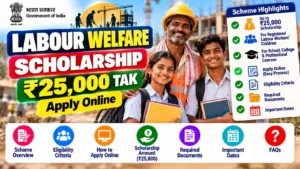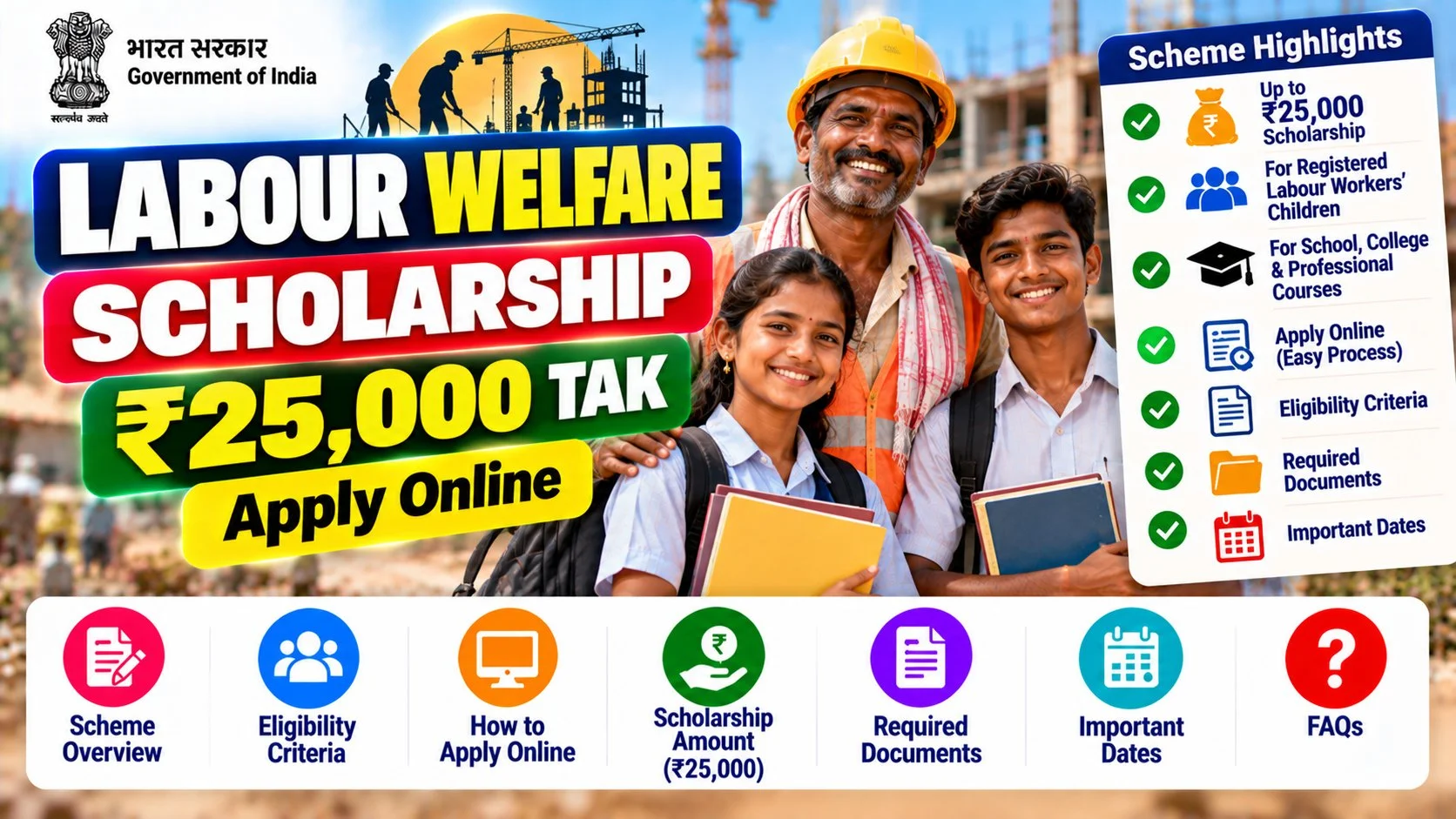

If your parent works as a beedi roller, cinema worker, or in a limestone, dolomite, iron ore, manganese or chrome ore mine, the Labour Welfare Scholarship 2026 can put up to ₹25,000 a year directly into your bank account for your studies. Applications are open right now on the National Scholarship Portal — but the Post-Matric deadline is 31 October 2026, and your college still needs time to verify your form after that.
✅ This guide is based on official notifications from the Ministry of Labour and Employment and the Labour Welfare Organisation. Last verified: October 13, 2026. Dates, amounts and rules can change — always cross-check the latest notice on scholarships.gov.in before applying.
What Is the Labour Welfare Scholarship?
The Labour Welfare Scholarship is a central government financial assistance scheme run by the Ministry of Labour and Employment through the Labour Welfare Organisation. On the National Scholarship Portal it is listed under its official name: “Financial Assistance for Education to the Wards of Beedi/Cine/IOMC/LSDM Workers” — available in both Pre-Matric and Post-Matric versions.
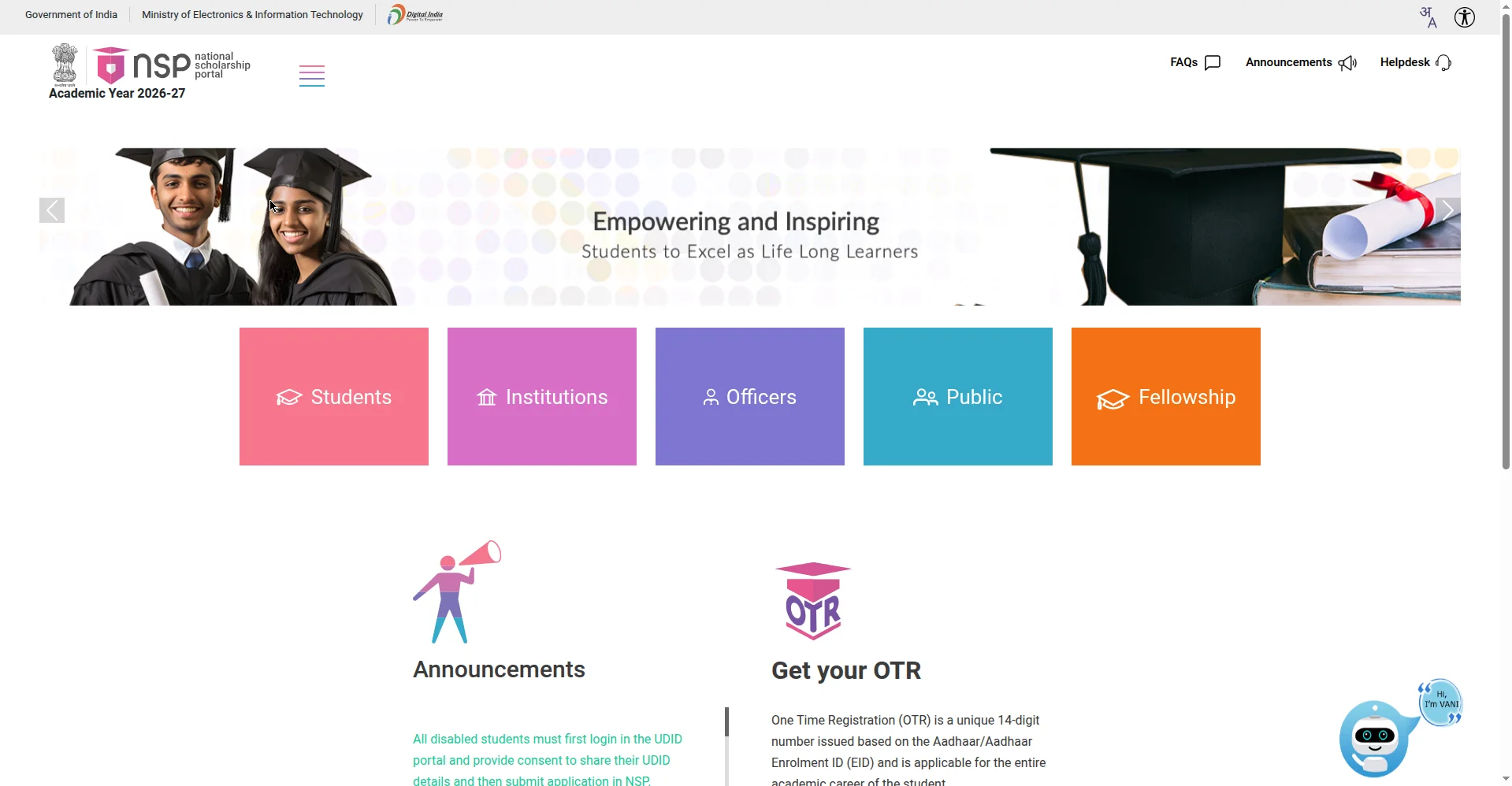
The National Scholarship Portal (scholarships.gov.in) homepage — all Labour Welfare Scholarship applications are filed here.
The idea is simple. Workers in beedi rolling, cinema halls, and notified mines (iron ore, manganese ore, chrome ore, limestone and dolomite — together called LSDM workers) often earn daily or piece-rate wages. Their children drop out after Class 10 because the family cannot afford higher education fees. This scholarship bridges that gap with yearly cash support that rises as the student moves to higher courses — from ₹3,000 a year in Class 11-12 up to ₹25,000 a year for professional degrees like B.E., MBBS or MBA.
What makes the Labour Welfare Scholarship 2026 different from most other scholarships is who it targets. It is not based on caste, religion or state domicile. It is based purely on your parent’s occupation. If one of your parents has worked for at least six months as a registered beedi, cine or mine worker, you qualify on the occupation test — and the rest comes down to income limits, your marks, and regular enrollment in a recognised institution.
More than 50,000 students benefit from this scheme every year, and the money is paid through Direct Benefit Transfer straight into the student’s own Aadhaar-linked bank account. There is no middleman and no agent involved at any stage.
Labour Welfare Scholarship 2026: Key Dates
Dates are the most important part of this labour welfare scholarship because the window is short and your institution also needs time. Missing the student deadline by even one day means waiting a full year.
| Event | Date |
|---|---|
| Post-Matric application deadline | 31 October 2026 |
| Institution verification deadline | 15 November 2026 |
| Pre-Matric application deadline | 31 August 2026 (closed) |
Notice the gap: students must submit by 31 October, but institutions get until 15 November to verify. That means you should not wait until 31 October. Apply at least a week early, then follow up with your college office to make sure they verify your form in their NSP login. If the institution does not verify, your application cannot move to the next level and no payment is made — no matter how eligible you are.
Labour Welfare Scholarship Amount: How Much Do You Get?
The yearly amount depends entirely on the course you are studying. It is a lump sum meant to cover tuition and maintenance together — there are no separate hostel or book allowances.
| Course / Class | Scholarship Per Year |
|---|---|
| Class 11 and Class 12 | ₹3,000 |
| ITI (Industrial Training Institute) | ₹6,000 |
| Polytechnic Diploma | ₹6,000 |
| Undergraduate Degree (B.A., B.Sc., B.Com, B.Sc. Agriculture) | ₹6,000 |
| Professional courses (B.E./B.Tech, MBBS, MBA, Law, MCA, BAMS) | Up to ₹25,000 |
The jump to ₹25,000 for professional courses is deliberate — engineering and medical fees are where most worker families give up. If you are doing B.E., MBBS, MBA, BAMS/BUMS, MCA, Law or similar professional degrees, this is one of the highest-value central scholarships available to you.
A few important rules about the money: you must apply fresh every academic year — the labour welfare scholarship does not auto-renew. Support is generally limited to a maximum of two children per worker family. And preference in selection goes to students with higher marks and lower family income, so apply even if you think competition is high — the income filter works in favour of genuinely needy families. Since the award is a lump sum covering both tuition and maintenance, plan your yearly education budget around the actual sanctioned amount for your course level.
Eligibility Criteria (Read Carefully)
Eligibility has four parts: your parent’s occupation, family income, your enrollment status, and your academic record. All four must be satisfied.
1. Parent’s Occupation
One of your parents must be a registered worker in any of these categories, with at least six months of continuous service:
- Beedi workers — including home-based beedi rollers registered with the welfare fund
- Cine workers — workers in cinema theatres and film-related establishments covered under the Cine Workers Welfare Fund
- Iron Ore Mine workers
- Manganese Ore Mine workers
- Chrome Ore Mine workers
- Limestone Mine workers
- Dolomite Mine workers
Contract workers and manual workers are counted, but only if they are officially registered — unregistered or casual workers without a worker ID card do not qualify. You will need the worker identity card or mine worker registration details as proof.
2. Family Income Limit
The income rule differs by worker type, so check which bracket your family falls in:
- Beedi and cine workers: total family monthly income must not exceed ₹10,000
- Manual, unskilled and clerical mine workers: eligible irrespective of wages — no income ceiling
- Supervisory and managerial mine staff: monthly income must be below ₹10,000
You will need an income certificate from a competent authority (such as the Tehsildar) wherever the income limit applies to you.
3. Student Enrollment
- You must be a regular student in a government-recognised school, college, ITI, polytechnic or university in India
- Post-Matric covers Class 11 upwards — through undergraduate, postgraduate and professional courses
- Students studying through correspondence or distance mode are not eligible
4. Academic Record
You must have passed your previous qualifying examination on the first attempt. Students who failed and are repeating a year do not qualify for that year. This rule is strictly enforced during verification.
Documents Required
Keep scanned copies of all of these ready before you open the application form. Blurry or expired documents are one of the top reasons for rejection.
- Worker ID card — beedi/cine/IOMC/LSDM worker identity card or mine worker registration showing at least 6 months of service
- Student Aadhaar card — mandatory, with Aadhaar authentication completed
- Income certificate — from Tehsildar or competent authority, wherever applicable
- Previous year marksheet — proof that you passed on the first attempt
- Bonafide certificate or fee receipt — from your current school/college confirming regular enrollment for 2026-27
- Bank passbook copy — first page showing account number and IFSC; the account must be in the student’s own name, Aadhaar-linked, in a nationalised or scheduled bank with Core Banking (CBS) and NEFT facility
- Passport-size photograph — recent
- Parent Aadhaar card — sometimes asked during verification
- Caste certificate — only if applicable to your category
The bank account rule deserves emphasis: the labour welfare scholarship is paid through the Aadhaar Payment Bridge (APB) system. If your Aadhaar is not linked to your bank account, or the account is in your parent’s name instead of yours, the payment will fail even after your application is approved. Fix this at your bank branch before applying.
How to Apply on the National Scholarship Portal (Step by Step)
All applications go through one portal only: the National Scholarship Portal at scholarships.gov.in. Do not apply through agents, cyber-cafe middlemen or unofficial websites — the NSP portal is the only authorised platform, and applying elsewhere is both useless and risky.
Step 1: Complete One Time Registration (OTR)
OTR is mandatory this year — you cannot fill any scholarship form without it. On the NSP homepage, find the OTR option and register using your Aadhaar number. You will need to enter your basic personal details, mobile number and email ID, then verify with the OTP sent to your Aadhaar-linked mobile number. After successful verification, the portal generates your OTR ID. Save it carefully — this single ID will be used for every scholarship application you ever file on NSP.
Step 2: Log In With Your OTR ID
Log in to the NSP portal using your OTR ID and password. This takes you to your student dashboard.
Step 3: Select the Correct Scheme
In the application section, look for the scheme titled exactly: “Financial Assistance for Education to the Wards of Beedi/Cine/IOMC/LSDM Workers – Post-Matric”. Selecting the wrong scheme (for example the Pre-Matric version, whose deadline has already passed) is a common mistake — read the scheme name fully before clicking.
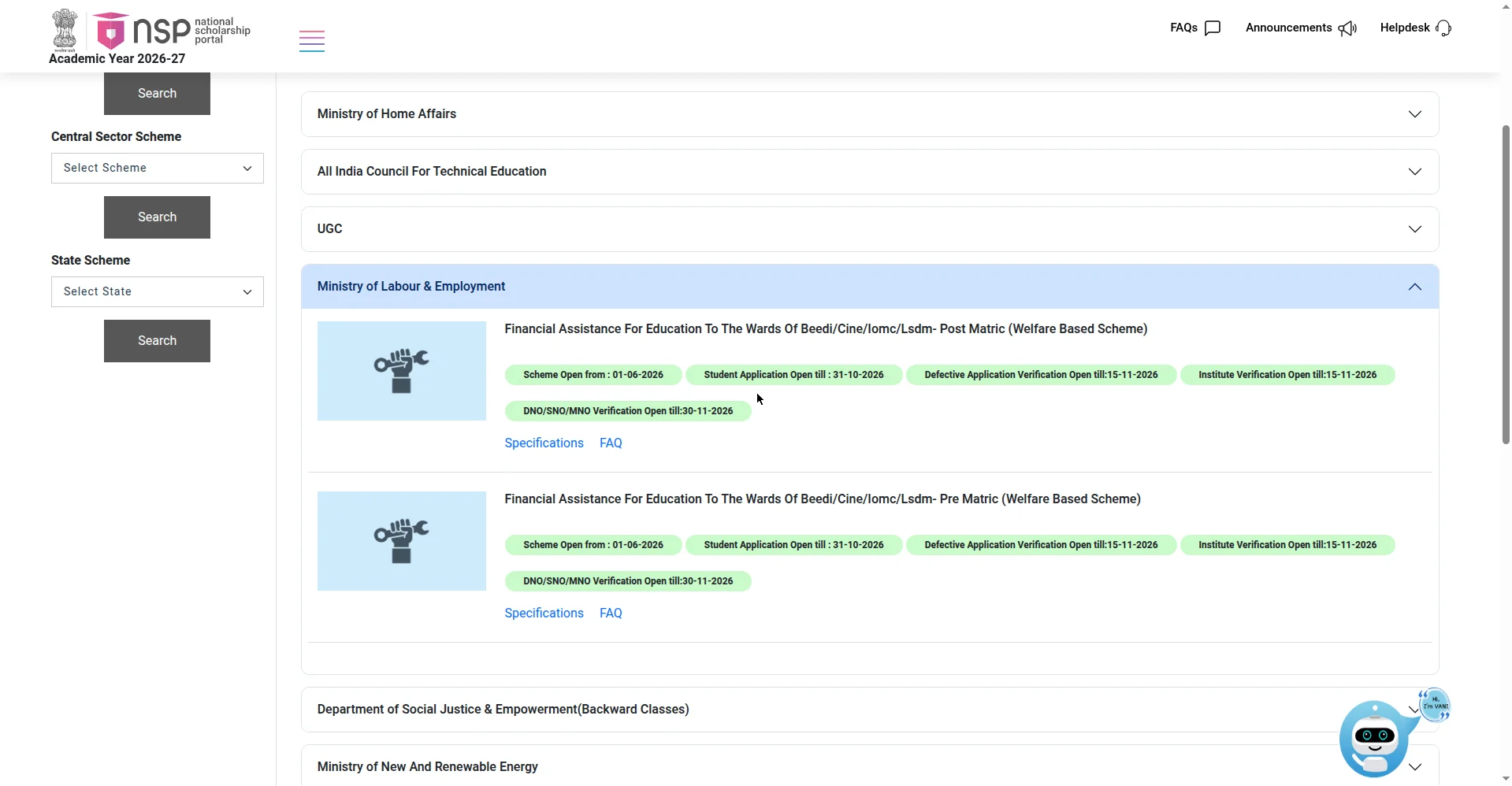
The Labour Welfare Scholarship schemes listed on NSP — select the Post-Matric version for the 2026-27 application window.
Step 4: Fill the Application Form
Enter your personal details, your parent’s worker details, income information, course and institution details. Double-check the bank account number and IFSC — a single wrong digit means a failed DBT payment later.
Step 5: Upload Documents
Upload clear scanned copies of every document listed above. The portal specifies accepted file formats and size limits — follow them exactly.
Step 6: Review and Submit Before 31 October 2026
Review the entire form once. Then submit. Save or print the acknowledgement receipt — you will need the application ID for tracking.
Step 7: Get Your Institution to Verify
This is where many students lose the scholarship. After you submit, your school or college must log in to NSP with their registered institute ID, scrutinise your application, and approve it online. Institutions have until 15 November 2026 to do this. Visit your college office in person, show them your acknowledgement, and confirm they have verified your form. Unless the institution verifies, your application cannot move forward for payment.
How the DBT Payment Works
Once your institution verifies and the Labour Welfare Organisation approves your application, the scholarship amount is transferred through Direct Benefit Transfer (DBT) via the Aadhaar Payment Bridge system directly into your bank account.
For the payment to succeed, four conditions must all be true: the bank account is in your own name (not your parent’s), your Aadhaar is linked to that account, the bank supports CBS and NEFT, and the account number and IFSC you entered in the form are correct. If any one of these fails, the payment bounces and getting it re-credited takes months of follow-up. It is far easier to verify these four things at your bank branch now than to chase a failed payment later.
Payment timelines vary by state and verification speed, but most approved students receive the amount within a few months of the institution verification deadline. You can track your application status by logging in to the NSP portal with your OTR ID.
Common Mistakes That Get Applications Rejected
- Skipping OTR: trying to apply without completing One Time Registration first — the form will not even open
- Wrong scheme selected: applying under Pre-Matric instead of Post-Matric, or under a different ministry’s scholarship
- Applying on the last day: portal slowdowns and OTP delays on 31 October are predictable — apply at least a week early
- Institution never verifies: the single biggest reason eligible students do not get paid — follow up with your college in person
- Bank account not Aadhaar-linked: or account in parent’s name — DBT fails silently
- Blurry documents: unclear scans of the worker ID card or marksheet lead to rejection at verification
- Not passed on first attempt: repeaters are ineligible — do not waste time applying for a year you repeated
- Using agents or unofficial sites: nobody can “guarantee” your scholarship — anyone asking for money is a fraud
Frequently Asked Questions
Who exactly counts as an LSDM worker’s child?
LSDM stands for Limestone, Dolomite and other specified mine workers — covering iron ore, manganese ore, chrome ore, limestone and dolomite mines. If your parent is a registered worker in any of these mines (or a beedi or cine worker) with at least six months of continuous service and a valid worker ID card, you meet the occupation test.
Can I apply if my family income is above ₹10,000?
It depends on the worker category. For beedi and cine worker families, ₹10,000 per month is a hard ceiling. But manual, unskilled and clerical mine workers are eligible irrespective of wages — there is no income limit for them. Supervisory and managerial mine staff must stay below ₹10,000 per month.
Is the Labour Welfare Scholarship 2026 only for school students?
No. The Post-Matric version — the one with the 31 October 2026 deadline — covers Class 11 and 12, ITI, polytechnic diplomas, undergraduate degrees, postgraduate courses and professional degrees like B.E., MBBS, MBA and Law. The Pre-Matric version (Class 1 to 10) had a separate 31 August deadline which has already closed for this year.
Do I need to apply again next year?
Yes. A fresh application is required every academic year. If you are promoted to the next class and still meet all eligibility conditions, you apply again on NSP with updated documents. Support is generally limited to two children per worker family.
What if my college refuses to verify my application?
First, confirm your college is registered on the NSP portal — unregistered institutions cannot verify. If registered, meet the designated nodal officer with your acknowledgement receipt and ask them to verify in their NSP login before 15 November 2026. You can also escalate to the Labour Welfare Organisation’s regional office if an institution is unresponsive.
How is this different from other NSP scholarships?
Most NSP scholarships are based on caste, minority status or state domicile. The Labour Welfare Scholarship is based on your parent’s occupation in specific industries. That also means it can often be combined with — not replaced by — other scholarships you may be eligible for, such as the Digital Gujarat Scholarship if you study in Gujarat. Check each scheme’s rules on holding multiple scholarships.
Final Words: Don’t Miss 31 October
The Labour Welfare Scholarship 2026 is one of the few central schemes built specifically for the children of beedi, cine and mine workers — families whose hard work rarely gets recognised in education policy. Up to ₹25,000 a year, paid directly to your bank account, with no agent and no middleman, is real money that can keep you in college for another year.
But the window is brutally short. With the Post-Matric deadline on 31 October 2026 and institution verification closing on 15 November 2026, every day you delay shrinks your margin for fixing mistakes. Complete your OTR on scholarships.gov.in today, gather your documents this week, submit early, and then walk into your college office and make sure they verify your form. That one in-person visit is the difference between an approved application and a lost year.
If this guide helped you, share it with classmates whose parents work in beedi, cinema or mining — most eligible families have never even heard of this scholarship. And if you are planning your education finances, also read our guides on the Sukanya Samriddhi Yojana for long-term savings and the Atal Pension Yojana for your parents’ retirement security.