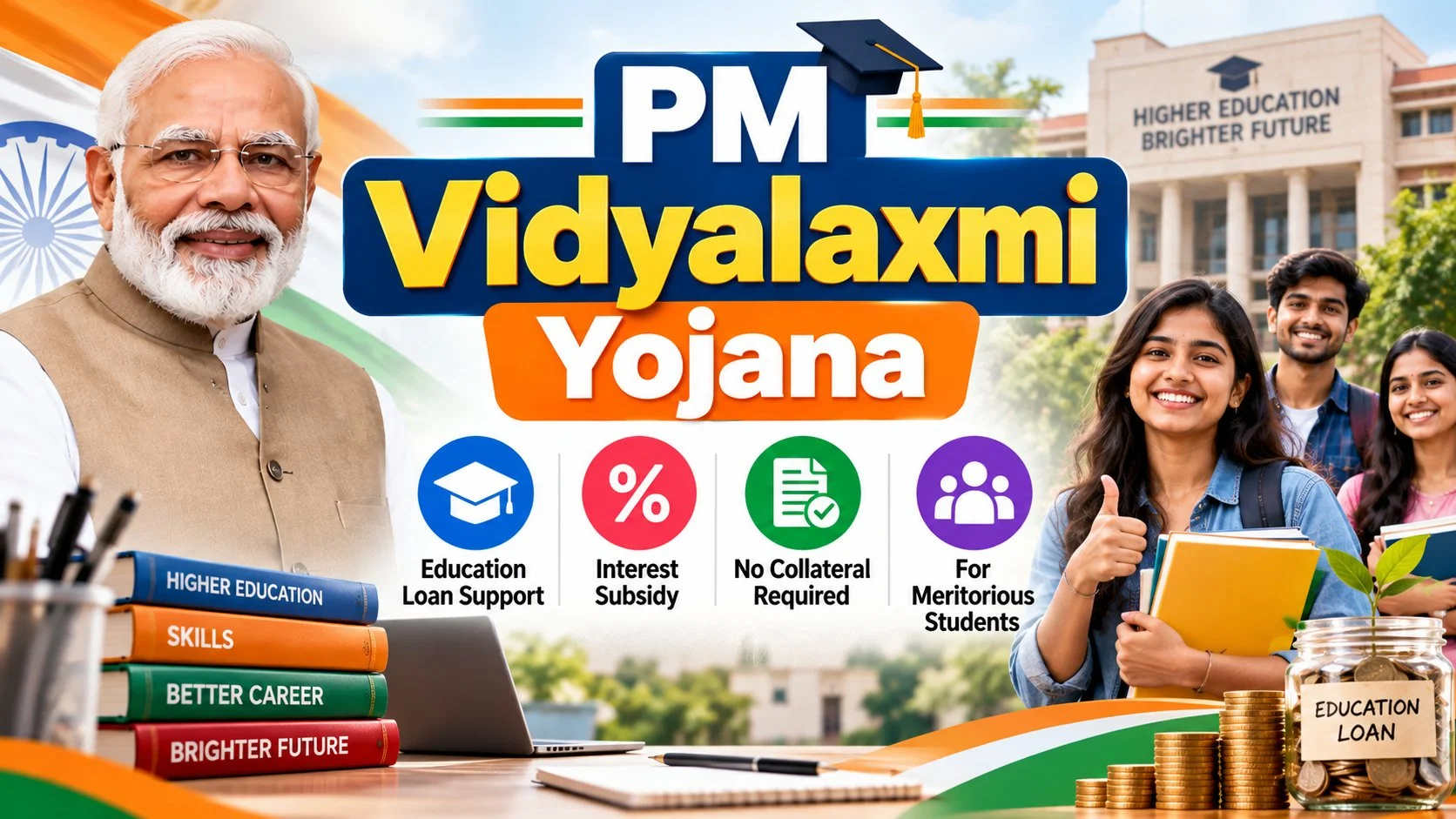

If you have cleared a competitive exam and earned a seat in an IIT, NIT, IIM, or any other top-ranked college, but the fees are making your family nervous, this is the scheme you need to know about. I have read through the official PM Vidyalaxmi Yojana guidelines, the portal details, and the latest Ministry of Education updates so you can apply without running around to five different bank branches.
✅ This guide is based on official government sources and notifications. Last verified: October 17, 2026. Scheme details, eligibility criteria, and benefit amounts are revised by the government from time to time — always cross-check the latest information on the official portal before applying.
PM Vidyalaxmi Yojana Kya Hai?
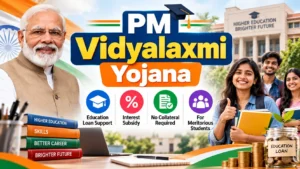
PM Vidyalaxmi Yojana is a central government education loan scheme that gives collateral-free and guarantor-free education loans to students who secure merit-based admission in top-quality higher education institutions (QHEIs). It was approved by the Union Cabinet on November 6, 2024, and announced in the Union Budget 2024. The scheme runs under the Department of Higher Education, in collaboration with the Department of Financial Services, as part of the National Education Policy (NEP) 2020 vision.
Here is the part most students miss: there is no family income limit for the loan itself. Whether your family earns ₹2 lakh or ₹20 lakh a year, you can still apply for a collateral-free loan if your admission is merit-based and your college is on the approved QHEI list. The income limits only apply to the interest subvention (interest subsidy) part of the scheme, which I will explain in detail below.
The loan is applied for through a single unified digital portal — pmvidyalaxmi.co.in — where you fill one Common Education Loan Application Form (CELAF), choose your bank, track your application, apply for interest subvention, and even raise grievances. The portal became operational on February 25, 2025. In its first year, the portal received over 6.5 lakh applications and sanctioned more than 3.3 lakh education loans, with ₹7,229.4 crore disbursed for the first year of courses, as per Ministry of Education data.
Key Features of PM Vidyalaxmi Yojana (At a Glance)
Before we go deep, here is a quick summary of what the scheme offers:
| Feature | Detail |
|---|---|
| Collateral | None required — fully collateral-free |
| Guarantor | None required — no third-party guarantor |
| Loan amount | No fixed upper limit; covers the full cost of the course (fees, hostel, mess, laptop, living expenses) |
| Credit guarantee | 75% government credit guarantee on loans up to ₹7.5 lakh (via NCGTC) |
| Interest subvention | 3% interest subvention on loans up to ₹10 lakh for family income up to ₹8 lakh/year (during moratorium) |
| Full interest subsidy | 100% interest subsidy for family income up to ₹4.5 lakh/year (under PM-USP CSIS component) |
| Repayment period | Up to 15 years, excluding the moratorium period |
| Moratorium | Course period + 1 year |
| Eligible institutions | Approximately 860 Quality Higher Education Institutions (QHEIs) — NIRF-ranked |
| Application | Fully online via the PM-Vidyalaxmi portal |
The government has allocated ₹3,600 crore for the scheme between 2024-25 and 2030-31, and expects around 7 lakh students to benefit during this period. As per a reply given in the Lok Sabha, education loans worth ₹15,634.78 crore had already been sanctioned to 1,12,817 students under the scheme since its launch.
PM Vidyalaxmi Yojana Eligibility
This is where most confusion happens, so let me make it simple. Eligibility under PM Vidyalaxmi has two layers: (1) eligibility for the loan itself, and (2) eligibility for the interest subvention. They are different, and you need to understand both.
Who can apply for the education loan
- You must be an Indian citizen.
- You must have secured admission on your own merit to an eligible Quality Higher Education Institution (QHEI) — for example, through an entrance exam like JEE, NEET, CAT, CUET, or another open competitive/merit-based admission process.
- You must be enrolled in an eligible degree or diploma programme.
- You must register on the portal using Aadhaar.
- You must remain enrolled and maintain satisfactory academic performance.
- There is no family income restriction for the loan itself.
Who is NOT eligible
- Students admitted through management quota or any similar quota are not eligible — merit admission is compulsory.
- Students admitted to foreign institutions, Indian campuses of foreign universities, or foreign campuses of Indian universities are excluded.
- Students already receiving other Central or State Government scholarships, interest subvention schemes, or fee reimbursement cannot get additional interest subvention under PM-Vidyalaxmi. (For example, if you already get an NSP scholarship that covers your costs, read the rules carefully — I have covered the NSP Scholarship 2026-27 in detail in a separate guide.)
- Students who discontinue the course midway or are expelled on disciplinary or academic grounds lose eligibility for further benefits.
- The interest subvention and credit guarantee benefits can be availed only once — for one undergraduate, postgraduate, or integrated course.
Who gets the 3% interest subvention
The 3% interest subvention has one extra condition: your annual family income must not exceed ₹8 lakh. If your family income is above ₹8 lakh, you can still take the collateral-free loan — you just will not get the 3% interest benefit.
There is also a 100% interest subsidy (not just 3%) for students with annual family income up to ₹4.5 lakh who are pursuing technical and professional courses — this comes under the PM-USP CSIS component, and the full interest during the moratorium period is covered.
| Annual Family Income | Loan | Interest Benefit |
|---|---|---|
| Up to ₹4.5 lakh | Collateral-free loan available | 100% interest subsidy during moratorium (technical/professional courses, under PM-USP CSIS) |
| ₹4.5 lakh to ₹8 lakh | Collateral-free loan available | 3% interest subvention on loans up to ₹10 lakh during moratorium |
| Above ₹8 lakh | Collateral-free loan available | No interest subvention, but the loan itself has no collateral or guarantor requirement |
One more important detail: the 3% interest subvention is available for up to one lakh fresh students every year. If eligible applicants exceed the available slots, selection is done through the sequential/priority-based method laid down in the scheme guidelines. My advice: apply early in the admission season instead of waiting for the last date.
PM Vidyalaxmi Yojana Interest Rate: How the 3% Subvention Actually Works
Let me explain this the way I would to a friend, because this is the single most misunderstood part of the scheme.
PM Vidyalaxmi does not set a fixed loan interest rate. The interest rate is decided by the bank you choose, as per its own education loan policy — typically around the bank’s base/MCLR-linked education loan rate. The scheme’s job is to reduce what you effectively pay.
Here is how the 3% subvention works in practice:
- The subvention applies to the interest that accrues during the moratorium period — that is, your course duration plus one year after the course ends.
- It applies only on the disbursed principal amount up to ₹10 lakh. If your loan is bigger (and it can be, since there is no cut-off on the highest loan amount), the 3% benefit covers only the first ₹10 lakh of the disbursed principal.
- The government pays this 3% directly — you do not have to claim it as a refund. It is credited to your education loan account through the DBT mechanism.
- So if your bank charges, say, 10% per annum, and you are eligible for the subvention, the government covers 3 percentage points — you effectively bear the remaining 7% during the moratorium.
The subvention is credited through the PM Vidyalaxmi Digital Rupee App (CBDC Wallet) — the Digital Rupee mechanism I will cover in a later section. As of July 22, 2026, the portal had 35,777 active CBDC wallets through which subsidies worth ₹57.66 crore had been disbursed, according to the Ministry of Education.
If you want to understand how loan interest interacts with your credit history before you borrow, read my guide on how to check your CIBIL score for free — banks do look at the credit record of the family, and knowing where you stand helps.
PM Vidyalaxmi Yojana College List (QHEIs)
The scheme is available only for students admitted to designated Quality Higher Education Institutions (QHEIs). The Government of India prepares this list based on the National Institutional Ranking Framework (NIRF), and it currently covers approximately 860 institutions across the country. The list is updated annually based on NIRF rankings.
Broadly, the eligible institution categories are:
| Institution Group | Examples |
|---|---|
| IITs | IIT Delhi, IIT Bombay, IIT Madras, IIT Kanpur, IIT Kharagpur, and all other IITs |
| IIMs | IIM Ahmedabad, IIM Bangalore, IIM Calcutta, IIM Lucknow, and all other IIMs |
| NITs | NIT Trichy, NIT Warangal, NIT Surathkal, and all other NITs |
| IIITs | All Indian Institutes of Information Technology |
| AIIMS | AIIMS Delhi and all other AIIMS institutions |
| Central Universities | Institutions run by the Government of India |
| Top state government institutions | Top 200 state/UT government institutions under NIRF |
| Other premier institutions | Top 100 NIRF-ranked institutions overall or category-wise — includes IISc, JNU, BHU, and other approved QHEIs |
Practical tip: before you fill the application form, open the PM-Vidyalaxmi portal and check whether your college or university appears in the latest QHEI list. I cannot stress this enough — I have seen students complete entire applications for institutions that were not on the list, and that is a completely avoidable waste of time.
Also note that some private institutions do appear on the list (the portal’s own data includes private-management institutions), while foreign institutions, Indian campuses of foreign universities, and foreign campuses of Indian universities are excluded. The final word is the portal’s current list, not anyone’s blog summary.
PM Vidyalaxmi Yojana Documents Required
Keep these ready before you start the online form. Having scanned copies in the correct format will save you at least an hour:
A quick note on the co-applicant: even though no guarantor is needed, banks usually still ask for a co-applicant (typically a parent) on the loan agreement for minor students or as per their internal policy. That is standard practice across education loans in India and should not worry you.
PM Vidyalaxmi Yojana Online Apply: Step-by-Step Process
This is the section I wrote most carefully, because the goal of this article is simple: you should be able to apply without anyone’s help. Follow these steps in order.
Step 1: Open the official portal
Go to pmvidyalaxmi.co.in — this is the only official portal. Do not apply through any agent website that claims to “process” Vidyalaxmi applications. The application is free.
Step 2: Register as a new student
Click on the student login/registration option and create an account. You will register using your Aadhaar number. Enter your name (exactly as on Aadhaar), mobile number, and email ID, set a password, and verify both the mobile number and email through OTP.
Step 3: Complete your student profile
After logging in, fill in your complete profile:
- Personal details — name, date of birth, gender, category, address.
- Academic details — Class 10, Class 12, and graduation details with marks.
- Institution details — select your college/university from the portal’s QHEI list.
- Course information — course name, duration, year of admission, total fee.
- Family income details — fill this carefully and honestly; it decides your subvention eligibility.
Step 4: Upload documents
Upload all the documents listed in the previous section. Check each scan: it should be readable, within the size limits the portal mentions, and in an accepted format (usually PDF or JPG). A blurry mark sheet is one of the most common reasons applications get sent back for correction.
Step 5: Select your bank and submit the Common Education Loan Application Form (CELAF)
This is the best part of the scheme’s design — one common form reaches multiple banks. Select your preferred participating banks from the dropdown (public sector banks, regional rural banks, cooperative banks, and private banks all participate). Review the full application one last time and click final submit. You will get a confirmation via SMS and email, along with a loan application number.
Step 6: Track your application
Log in to the portal and go to the application tracking section. Enter your loan application number to see whether the status is under review, approved, or disbursed. You can also download your application as a PDF. The stages are: student registration → document verification → institution verification → bank assessment → loan approval → disbursement as per the bank’s education loan policy.
Step 7: Claim the interest subvention (after loan sanction)
Once your loan is sanctioned, log in to the portal again and look for the interest subvention claim option. Upload your income certificate (and Annexure 6, if the portal asks for it). Submit, and save the confirmation. The subvention is then credited to your loan account through the Digital Rupee (CBDC) wallet mechanism. Note: for FY 2025-26, the interest-subsidy claim window on the portal has been listed as 1 September to 31 December 2026 [VERIFY: official portal] — do not miss the window for your academic year.
Step 8: Raise a grievance if something goes wrong
If a bank delays or rejects your application unfairly, the portal has a built-in grievance module. Initiate a grievance, provide your loan application number and details, upload supporting documents, and track it with the grievance ID. This is genuinely useful — it creates a record that the bank has to respond to.
PM Vidyalaxmi Yojana SBI: Which Banks Participate?
One of the most searched questions about this scheme is about SBI and PM Vidyalaxmi. Here is the clear answer: the scheme works through a unified portal connected to participating banks, which include public sector commercial banks, regional rural banks, cooperative banks, and private banks. You select your preferred bank when filling the common application form — you are not forced into one lender.
SBI, as India’s largest public sector bank, participates in the education loan ecosystem on the portal alongside other major lenders like Canara Bank and Union Bank of India. Union Bank of India, for instance, runs its own dedicated “Union Education Scheme – Pradhan Mantri Vidyalaxmi” page, which is the source of the official banner you can see below:

Official PM Vidyalaxmi banner from Union Bank of India, one of the participating banks. (Source: unionbankofindia.bank.in)
Which bank should you choose? A few practical points from my side:
- Compare the effective interest rate (after subvention) across banks — the scheme does not fix one rate.
- Check processing fees and prepayment charges — education loans usually have none, but confirm in writing.
- Look at the disbursement speed. Some banks disburse directly to the institution; confirm the mechanism with your chosen bank.
- The 75% credit guarantee up to ₹7.5 lakh applies through NCGTC regardless of which participating bank you pick — that is the scheme’s design, not a bank-specific offer.
Digital Rupee (CBDC) Disbursement: How the Subsidy Reaches You
PM Vidyalaxmi is among the first Indian schemes to route its interest subsidy through the Digital Rupee (CBDC). Here is how it works for you as a student:
- After your interest subvention is approved, you receive the subsidy through the PM Vidyalaxmi Digital Rupee App (CBDC Wallet).
- From the wallet, the subsidy amount is transferred directly to your education loan account — it reduces your loan liability instead of landing as cash you could spend elsewhere.
- Because the Digital Rupee is programmable money, the subsidy is earmarked for loan repayment; the design prevents misuse or diversion.
The scale is already significant: as of July 22, 2026, the portal had 35,777 active CBDC wallets through which subsidies worth ₹57.66 crore had been disbursed, as reported by the Ministry of Education. If you are new to the idea of a digital wallet from the government, treat it like a purpose-specific account — you do not need to be a crypto or UPI expert to use it.
Repayment: What Happens After Your Course Ends
Let me be honest here, because blogs usually skip this part: a Vidyalaxmi loan is still a loan. It is not free money, and it will appear in your credit history. Here is the repayment picture:
- You get a moratorium of course period + 1 year. During this time, you do not have to start EMI payments, though interest keeps accruing (and the 3% subvention, if you are eligible, reduces the burden in this period).
- After the moratorium, you repay over up to 15 years, as per the bank’s education loan policy.
- Because the loan is in your name, on-time repayment builds your credit history from day one — a genuine advantage when you later apply for a home loan or car loan. A default, on the other hand, will hurt your CIBIL score for years.
- The interest subvention and credit guarantee benefits apply only once — so if you take a second loan later for another degree, do not expect the same benefits.
- If you discontinue the course or are expelled on disciplinary or academic grounds, further benefits stop — but the loan liability you already have does not disappear.
One caution from experience with how banks operate: even under a government scheme, read your sanction letter line by line — interest rate type (fixed or floating), margin money, and the exact moratorium terms. The portal and the scheme give you rights; the sanction letter gives you the numbers.
PM Vidyalaxmi vs Other Education Loan Support Schemes
Students often confuse PM Vidyalaxmi with two related schemes — PM-USP CSIS (Central Sector Interest Subsidy) and PM-USP CGFSEL (Credit Guarantee Fund Scheme for Education Loans). Here is how they differ and fit together:
| Scheme | What It Gives | Key Condition |
|---|---|---|
| PM Vidyalaxmi (PMVL) | Collateral-free, guarantor-free loan + 3% interest subvention on loans up to ₹10 lakh | Merit admission to a QHEI; family income ≤ ₹8 lakh for the subvention |
| PM-USP CSIS | 100% interest subsidy during moratorium on loans up to ₹10 lakh (technical/professional courses) | Annual family income up to ₹4.5 lakh |
| PM-USP CGFSEL | 75% credit guarantee on education loans up to ₹7.5 lakh (no collateral needed) | Covers eligible loans; the guarantee is what lets banks lend without security |
The important rule: you cannot stack benefits. Students already receiving other Central or State Government scholarships, interest subvention schemes, or fee reimbursement are not eligible for additional interest subvention under PM-Vidyalaxmi. So if you qualify for a full fee waiver or another subsidy, check the rules before assuming you can take both.
If your family is also planning long-term savings for a daughter’s education, my guide on the Sukanya Samriddhi Yojana is worth a read alongside this one — saving and borrowing are two sides of the same planning coin. And if someone in the family works in the unorganised sector, check the Labour Welfare Scholarship guide too, since students cannot combine it with Vidyalaxmi subvention but should know which option gives them more.
Common Mistakes Students Make (Avoid These)
- Assuming ₹10 lakh is the loan limit. The guidelines clarify there is no cut-off on the highest loan amount — the loan depends on your actual course cost. Only the 3% subvention is capped at ₹10 lakh of disbursed principal.
- Applying before checking the QHEI list. Your college must be on the portal’s current QHEI list. Check first, apply second.
- Management-quota admissions. If you took admission through management quota, you are not eligible. This rule has no workaround.
- Blurry or mismatched documents. Name spellings must match across Aadhaar, mark sheets, and the admission letter. Fix discrepancies before applying, not after a rejection.
- Missing the subvention claim window. The loan application and the interest subvention claim are separate steps — sanction of the loan does not automatically start the subvention.
- Treating it as free money. It is a loan in your name. Budget for EMIs from the day you take it.
PM Vidyalaxmi Yojana — Frequently Asked Questions
1. What is the maximum loan amount under PM Vidyalaxmi Yojana?
There is no fixed maximum loan amount in the guidelines — the loan covers your full course cost (tuition, hostel, mess, books, laptop, living expenses) as charged by the QHEI. However, the 3% interest subvention applies only to the disbursed principal up to ₹10 lakh, and the 75% credit guarantee applies to loans up to ₹7.5 lakh.
2. Is the PM Vidyalaxmi education loan really without collateral and guarantor?
Yes. The scheme explicitly provides collateral-free and guarantor-free education loans. Banks lend with confidence because the Government of India provides a 75% credit guarantee (for loans up to ₹7.5 lakh) through NCGTC under the PM-USP CGFSEL component.
3. What is the interest rate under PM Vidyalaxmi Yojana?
The scheme does not fix one interest rate — each participating bank applies its own education loan rate. The benefit is the 3% interest subvention during the moratorium period (course period + 1 year) for students with family income up to ₹8 lakh, credited directly to the loan account via the Digital Rupee (CBDC) wallet. Students with family income up to ₹4.5 lakh in technical/professional courses can get a full interest subsidy under PM-USP CSIS.
4. How do I check if my college is eligible under PM Vidyalaxmi?
Open the official portal at pmvidyalaxmi.co.in and check the latest QHEI list — it is updated annually based on NIRF rankings and covers approximately 860 institutions, including IITs, IIMs, NITs, IIITs, AIIMS, central universities, and top-ranked state government institutions. If your college is not on the list, you cannot apply under this scheme.
5. Can I apply for PM Vidyalaxmi if I already have another scholarship?
Students already receiving other Central or State Government scholarships, interest subvention schemes, or fee reimbursement are not eligible for additional interest subvention under PM-Vidyalaxmi. You can still check the loan terms, but do not assume the benefits can be combined.
6. What is the official website and helpline for PM Vidyalaxmi Yojana?
The official portal is pmvidyalaxmi.co.in — applications, tracking, subvention claims, and grievances are all handled there. The scheme’s listed toll-free helpline is 1800 1031, and the support email is listed as [email protected] [VERIFY: official portal]. Never pay any agent or third-party website for “processing” your Vidyalaxmi application — the official application is free.
Final Word: Should You Apply?
If you have a merit-based seat in a NIRF-ranked institution and fees are the only thing standing between you and that classroom, PM Vidyalaxmi is genuinely one of the best-designed education finance schemes India has launched — a single portal, no collateral, no guarantor, a government-backed credit guarantee, and a real interest subsidy that lands through the Digital Rupee mechanism. Just remember the three non-negotiables: merit admission, a QHEI on the current list, and Aadhaar-based registration on the official portal.
Apply early in the admission season, keep your documents clean, and claim the interest subvention within the window. Do that, and the scheme does what it was built to do — remove money as a reason to say no to a good education.
Explore More Government Schemes
Planning your education finances? Read next: NSP Scholarship 2026-27 — Apply Online · Labour Welfare Scholarship · Sukanya Samriddhi Yojana · Check Your CIBIL Score Free