
A farmer can do everything right — buy good seed, water on time, protect the crop from pests — and still lose the entire season in one night of unseasonal rain. When I first started looking into crop insurance schemes for this site, the question I kept hearing from readers was the same: if my crop is destroyed, who pays me back? The answer the government gives is the Pradhan Mantri Fasal Bima Yojana — PMFBY — and in this guide I will walk you through it the way I wish someone had explained it to me: how much you pay, what is covered, how to apply online, and how to file a claim without getting it rejected.
✅ This guide is based on official government sources and notifications. Last verified: October 17, 2026. Scheme details, eligibility criteria, and benefit amounts are revised by the government from time to time — always cross-check the latest information on the official portal before applying.
What Is PM Fasal Bima Yojana, Really?
Pradhan Mantri Fasal Bima Yojana (PMFBY) is India’s national crop insurance scheme, launched in 2016. It replaced the older National Agricultural Insurance Scheme (NAIS) and Modified NAIS. The headline difference — and the reason the scheme is popular — is the premium: farmers pay only a tiny, fixed share of the sum insured, and the government pays the rest.
In plain words: you insure your crop for a season, pay a small premium (we will get to the exact numbers in a moment), and if drought, flood, hailstorm, cyclone, pests, or disease wipe out your crop, the insurance company compensates you based on the insured amount. The money comes to your Aadhaar-linked bank account through Direct Benefit Transfer (DBT) — no middlemen.
A few things that make PMFBY different from regular insurance:
- It is voluntary. Since Kharif 2020, even farmers who take crop loans can choose to opt out. Earlier, banks auto-deducted the premium from loan accounts. Now you have to give a written opt-out declaration to your bank before the cut-off date if you do not want the cover.
- The premium is capped by law, not by market price. For Kharif crops you never pay more than 2% of the sum insured, whatever the real insurance cost is. The gap is filled by the Centre and the state together.
- Technology does the assessment. The scheme uses satellite imagery, drones, and the YES-TECH (Yield Estimation System Based on Technology) platform for yield estimation. The CROPIC system uses geotagged photos of crops to verify damage. This matters because it reduces the old problem of damage reports sitting on someone’s desk for months.
The official portal for everything — application, premium calculator, status, and loss reporting — is pmfby.gov.in. I will keep linking back to it because every number in this article should be cross-checked there for your district and season.
PM Fasal Bima Yojana Premium: How Much Does a Farmer Pay?
This is the question that brings most people here, so let us get the numbers out in the open first. Under PMFBY, the farmer’s share of the premium is fixed by the scheme’s guidelines:
| Crop type | Farmer’s premium | Example on ₹50,000 sum insured |
|---|---|---|
| Kharif crops (paddy, maize, soybean, bajra, jowar) | 2% of sum insured | ₹1,000 for the season |
| Rabi crops (wheat, mustard, gram, masoor) | 1.5% of sum insured | ₹750 for the season |
| Commercial and horticultural crops (cotton, sugarcane, onion) | 5% of sum insured | ₹2,500 for the season |
To put that in perspective: if your wheat crop is insured for ₹50,000 and the season is a total washout, your cost for that protection was ₹750. That is the whole point of the scheme — it is the cheapest insurance product a farmer will ever buy, because the government subsidises 85 to 98.5% of the real premium.
A couple of details worth knowing:
- Zero premium in some states. Farmers in the North-Eastern states, Himachal Pradesh, and Jammu & Kashmir pay no premium at all — the government covers 100% of the premium there. A few other states have also waived the farmer’s share from time to time, so check your state notification.
- Your actual premium varies by crop and district. The percentages above are the maximum you pay. The portal’s premium calculator at pmfby.gov.in lets you enter your year, season, state, district, crop, and area to get the exact number for your situation. Use it before you apply — it takes two minutes and removes all guesswork.
Who Pays the Rest of the Premium?
The balance between what you pay and the actual insurance cost is split between the central government and your state government (roughly equal shares for most states). This is why enrolment is season-wise and state-wise: each state issues a notification listing which crops are covered, which districts are in, and which insurance company is handling the season.
Here is the catch most farmers miss: your crop and your land must be in the state notification. If wheat is not a notified crop in your district for that Rabi season, no application — however complete — will give you valid cover. Always check the current season’s notification on pmfby.gov.in before counting on the insurance.
What Does PMFBY Cover?
The scheme covers the full crop cycle, from before sowing to after harvest. Here is how the coverage breaks down by stage:
| Crop stage | What is covered |
|---|---|
| Pre-sowing / prevented sowing | If sowing could not happen because of deficit rainfall or adverse seasonal conditions, you get a claim for the loss of sowing opportunity. |
| Standing crop (sowing to harvest) | Drought, dry spell, flood, inundation, widespread pest and disease attack, landslide, natural fire, lightning, hailstorm, cyclone. |
| Post-harvest (up to 14 days after harvest) | Losses from hailstorm, cyclone, and unseasonal rain for crops left in the field to dry. Only up to two weeks — after that, you are on your own. |
| Localised calamities (individual farm assessment) | Hailstorm, landslide, and inundation that hit isolated farms rather than whole areas. Here the damage is assessed farm by farm, not on area averages. |
What is not covered: loss from war, nuclear risks, malicious damage, and other preventable risks. Also — and this surprises people — post-harvest cover stops exactly 14 days after harvest. If your dried crop sits in the field on day 20 and gets hit by unseasonal rain, the scheme does not pay.
Two additions have been reported from the Kharif 2026 season: crop damage from wild animal attacks has been added as a localised-risk cover, and paddy inundation is back as a localised calamity after being removed in 2018. [VERIFY: pmfby.gov.in state notification for Kharif 2026] If these apply in your state, they are genuinely useful — wild boar and nilgai damage is one of the most common complaints in several states.
Who Can Apply for PM Fasal Bima Yojana?
Eligibility is simpler than most people expect, but it has strict edges. You can apply if you are:
- A landowner farmer cultivating a notified crop in a notified area — including sharecroppers and tenant farmers, as long as they have accepted cultivation proof for that state.
- An owner or tenant with an insurable interest — your name must match your Aadhaar, and the insured land area cannot be more than your actual parcel.
Run through this checklist before you start the application:
- Your state is participating in PMFBY for this season.
- Your crop is listed in the current season’s notification for your district.
- Your farm is inside the notified area (insurance unit).
- You have ownership, tenancy, or sharecropping proof accepted by your state.
- You can finish the application before the notified cut-off date.
- You have not insured the same crop and land through a duplicate application.
Documents You Need
Keep these ready before you open the portal — gathering them mid-application is where most people lose time:
PM Fasal Bima Yojana Online Apply: Step-by-Step
You have four ways to enrol: the portal, your bank, a CSC centre, or an authorised agent of the insurance company handling your state. I will detail the online route because it is the one you control completely — no agent, no queue.
Step 1 — Go to the official portal. Open pmfby.gov.in and click on “Farmer Corner”. This is the single entry point for registration, application, premium calculator, and status. Bookmark it; everything else in this guide comes back to it.
Step 2 — Register as a new farmer. If you have never used the portal, choose the guest/new farmer registration option. You will enter your mobile number and Aadhaar number. An OTP comes to your Aadhaar-linked mobile — this is why your mobile must be linked to Aadhaar before you begin. Returning users can log in directly.
Step 3 — Fill the application form. The form asks for four blocks of information: personal details (name as on Aadhaar, address, bank account with IFSC), land details (survey/khasra numbers, total insured area — never more than your actual holding), crop details (season, crop name exactly as notified, sowing date), and the premium calculation. Take care with the crop name and area; wrong entries here are a top reason applications get flagged during the insurer’s quality check.
Step 4 — Upload documents. Upload scanned copies of your Aadhaar, land records, bank passbook page, and sowing certificate. The portal accepts common formats — keep each file under the size limit shown on the upload screen, and make sure the text is readable. Blurry uploads get returned for correction and eat into your enrolment window.
Step 5 — Pay the premium online. The portal shows your exact premium (computed by the scheme’s calculator). Pay through the available online modes. Save the payment receipt — and I mean actually save it, screenshot and PDF both.
Step 6 — Note your application number. After submission, the portal generates an application/receipt number. Write it down separately from your phone. This number is what you will use to check your PMFBY application status later, and it is your proof of enrolment if anything goes wrong. You will also get an acknowledgement you can download.
A note on the quality check: under the revised guidelines, insurance companies must complete a “Quality Check and Validation” on every application within 60 days of the cut-off. They verify that you have an insurable interest in the crop, that the land area matches, that the insured crop is the sown crop, and that your name matches Aadhaar. If something is off, the application goes back to your enrolment channel (bank, CSC, or the portal) for correction — which is another reason to apply early rather than on the last day.
PM Fasal Bima Yojana CSC: Applying Through a Common Service Centre
If the online route feels uncomfortable, the CSC (Common Service Centre) route is the government’s answer. CSCs are the rural digital service points — nearly every block has one — where the operator completes the same online registration for you. Carry all your documents, and the operator fills the form, uploads scans, pays the premium, and hands you the acknowledgement.
Two things I want to be clear about: first, CSC enrolment is free of extra charges — the operator should not demand a “service fee” beyond what the scheme allows. Second, insist on the application number and a printed acknowledgement before you leave the centre. I have seen too many cases where a farmer paid the premium at a counter, never got a receipt, and later discovered no application existed. The acknowledgement is your insurance about the insurance.
Find your nearest CSC at csc.gov.in, or ask at your gram panchayat office.
PM Fasal Bima Yojana Last Date 2026
Miss the cut-off date and there is no second chance for that season — the portal simply stops accepting applications. The all-India pattern is fixed (31 July for Kharif, 31 December for Rabi), but individual states shift dates, and some extend them. Here is the picture for 2026 based on the latest notifications:
| Season | Crops | Last date for enrolment |
|---|---|---|
| Kharif 2026 | Paddy, maize, soybean, cotton, bajra, jowar | 31 July 2026 in most states; Odisha extended to 15 August 2026, Rajasthan to 16 August 2026 |
| Rabi 2026–27 | Wheat, mustard, gram, masoor, onion | 31 December 2026 in most states (enrolment opens from around 15 October 2026) [VERIFY: state notification on pmfby.gov.in] |
Some districts set earlier crop-wise cut-offs — for example, in parts of Maharashtra the Rabi deadlines have historically varied by crop (jowar closing earlier than wheat). Do not treat the all-India dates as your district’s dates. The one reliable source is the current season notification on pmfby.gov.in or your district agriculture office.
And a practical tip from experience: apply at least a week before the cut-off. Banks and CSCs get crowded in the last three days, the portal slows down, and if your documents need correction you want the time to fix them. The scheme runs a “Fasal Bima Week” awareness campaign in December for Rabi — enrolment drives, bank camps, and CSC camps — which is a good moment to get help in person.
PM Fasal Bima Yojana Claim: How to File Without Getting Rejected
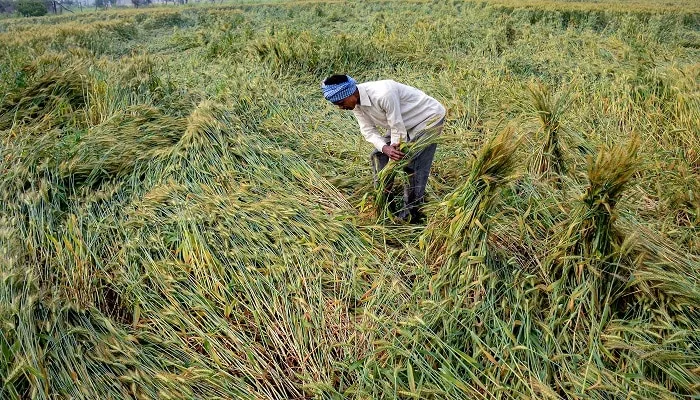
This is the section that decides whether the scheme actually helps you. Enrolment is paperwork; the claim is the payoff. And the payoff has one rule that overrides everything else: report the crop loss within 72 hours.
Missing the 72-hour reporting window is the single most common reason claims get rejected. Not the most common excuse — the most common actual reason. So let me make the process concrete.
How to Report Crop Loss (Pick Any Channel)
- Crop Insurance App — report the loss with geotagged photos of the damaged field. This is the fastest channel and creates a timestamped record.
- PMFBY helpline 14447 — the 24×7 Krishi Rakshak Portal & Helpline. Call, register your loss, and keep the ticket number.
- Your insurance company’s toll-free number — each state-season notification names the insurer and its number. It is listed on pmfby.gov.in for your district.
- Your bank branch — walk in and report the loss in writing, keeping a stamped copy.
- Your district agriculture officer — for localised calamities especially, an early report to the agriculture department helps.
My suggestion: use the app and call 14447. Two records of the same report, filed inside the 72-hour window, are worth more than any argument later.
What Happens After You Report
| Stage | What happens | Timeline |
|---|---|---|
| Loss intimation | You report the damage through any official channel | Within 72 hours of the loss |
| Surveyor appointment | The insurer appoints a surveyor to assess the damage | Within 72 hours of intimation (as reported) |
| Field survey | Damage assessment on the ground, often with photos and technology inputs | Completed within about 10 days (as reported) |
| Claim approval | Insurer verifies against the state notification, area yield data, and your application | After survey completion |
| Payment (DBT) | Approved amount credited to your Aadhaar-linked bank account | Usually within ~15 days of survey completion (as reported); delayed payments may attract a 12% yearly penalty to the insurer [VERIFY: current operational guidelines] |
For localised calamity claims (hailstorm or landslide hitting your farm specifically), the assessment is individual — your farm is surveyed on its own, not averaged with the village. These are often the fastest payouts because there is no waiting for area-level yield data.
For widespread calamities (drought, flood across the area), claims are settled based on the yield data for your insurance unit compared to the threshold yield. The scheme’s guideline aims for claim processing within two months of harvest [VERIFY: current operational guidelines] — technology-driven assessment through YES-TECH and CROPIC exists precisely to stop the old year-long waits.
If Your Claim Is Rejected
You are not out of options. The scheme has a formal grievance path: raise it on the 24×7 Krishi Rakshak Portal/helpline (14447) first. If that does not resolve it, escalate to the taluk/tehsil or district agriculture officer, then to the District Grievance Redressal Committee (DGRC), and above that the State Grievance Redressal Committee (SGRC). Keep every ticket number and every written response — paper trails win grievances.
PM Fasal Bima Yojana Status: How to Check Your Application
Once you have applied — or if your premium was deducted by your bank — do not assume everything is fine. Check. The status check is free and takes a minute:
- Go to pmfby.gov.in and click “Application Status” (in the Farmer Corner section).
- Enter your application/receipt number or policy ID. Some states also let you search by Aadhaar number.
- The portal shows your enrolment details: crop, area, premium paid, policy status, and claim status if you have filed one.
Premium deducted but your name is not in the list? This happens more often than it should. First, ask your bank or CSC for the application number and a written policy receipt. Check the portal with that number. If it still does not show, call 14447, register a complaint, and keep the ticket number. Do not let this slide until the next season — an undocumented deduction is money gone with no cover attached.
You can also track everything through the Crop Insurance App on your phone, which handles enrolment, loss reporting, and status in one place.
Why PMFBY Claims Get Rejected (And How to Avoid It)
I put this section here deliberately, right after the claim process, because prevention is cheaper than a grievance. The common rejection reasons:
- Reporting after 72 hours. The number one killer. Set a rule for your family: any visible crop damage gets reported the same day, no “let us see tomorrow”.
- Wrong crop information. The insured crop must be the crop you actually sowed. If the notification says wheat and the surveyor finds something else, the application fails the quality check.
- Non-notified crop or area. Insurance only exists where the state notification says it exists. Check the notification before the season, not after the loss.
- Incomplete or unreadable documents. Blurry land records, a missing sowing certificate — these get returned, and corrections after the cut-off do not count.
- Wrong bank details / Aadhaar not linked. DBT can only pay an Aadhaar-linked account. If the money has nowhere to go, the payment fails and the file stalls.
- Duplicate applications for the same crop and land.
Notice the pattern: every one of these is decided at application time, not at claim time. A careful application is the real insurance policy.
PMFBY, KCC and PM-Kisan: How They Connect
Farmers often mix these three up, so let me draw the lines clearly.
Kisan Credit Card (KCC) is your crop loan. If you take a crop loan from a bank, the bank used to auto-deduct the PMFBY premium — cover was compulsory for loanee farmers. Since Kharif 2020 it is voluntary: the bank will still deduct the premium by default unless you submit a written opt-out before the cut-off. So check your loan statement every season. If a premium was deducted and you did not want the cover, the opt-out declaration is your tool; if it was deducted and you do want the cover, verify the application exists on the portal (see the status section above).
PM-Kisan is income support — the ₹6,000-a-year installment scheme. It is not insurance and does not cover crop loss, but the two schemes share the same plumbing: Aadhaar-linked bank accounts and DBT. Getting your Aadhaar-bank linking right helps both schemes pay you on time. If you are reading this as a PM-Kisan beneficiary, PMFBY is the natural second layer of protection for the same farm — one pays you every season, the other pays you when the season goes wrong.
And if you are thinking long-term about the family’s financial safety net beyond a single season, a guaranteed savings instrument like the Sukanya Samriddhi Yojana is worth a look for a daughter’s future — insurance protects the crop, savings protect the plan.
7 Practical Tips Before You Enrol
Frequently Asked Questions
How do I apply for PM Fasal Bima Yojana online?
Visit pmfby.gov.in, open the Farmer Corner, and register as a new farmer with your mobile and Aadhaar number. Fill in your personal, land, crop, and bank details, upload documents (Aadhaar, land records, bank passbook, sowing certificate), pay the premium online, and save the application number generated after submission. You can also apply at your bank branch, a CSC centre, or through an authorised insurance company agent.
What is the last date for PM Fasal Bima Yojana in 2026?
Kharif 2026 enrolment closed on 31 July 2026 in most states (Odisha extended to 15 August, Rajasthan to 16 August). Rabi 2026–27 enrolment opens from around 15 October 2026 and normally closes on 31 December 2026. Exact dates vary by state and crop, so confirm your district’s notification on pmfby.gov.in. [VERIFY: state notification for Rabi 2026–27]
A maximum of 2% of the sum insured for Kharif crops, 1.5% for Rabi crops, and 5% for commercial and horticultural crops. The central and state governments pay the remaining 85–98.5% of the actual premium. In North-Eastern states, Himachal Pradesh, and Jammu & Kashmir, farmers pay zero premium.
How do I file a claim under PM Fasal Bima Yojana?
Report the crop loss within 72 hours through the Crop Insurance App (with geotagged photos), the 14447 helpline, your insurer’s toll-free number, your bank, or your agriculture officer. The insurer appoints a surveyor, the field survey is completed, and the approved amount is credited to your Aadhaar-linked bank account via DBT. Late reporting is the most common reason claims are rejected.
Yes. Tenant farmers and sharecroppers cultivating notified crops in notified areas are eligible, subject to the cultivation proof accepted by their state (such as a tenancy agreement). The insured crop must match the sown crop and your name must match your Aadhaar.
How do I check my PMFBY application or claim status?
Go to pmfby.gov.in, click “Application Status” in the Farmer Corner, and enter your application/receipt number or policy ID. You can also track status on the Crop Insurance App. If your premium was deducted but no application shows, get a written receipt from your bank or CSC and raise a complaint on 14447.
Final Word
PM Fasal Bima Yojana is one of those rare schemes where the math genuinely favours the farmer: ₹750 to ₹1,000 protects a ₹50,000 crop for a season, and the government absorbs the rest of the cost. But the scheme only works for farmers who respect its two hard rules — enrol before the cut-off, and report damage within 72 hours. Everything else in this guide is detail around those two rules.
If you are sowing Rabi this year, the window is opening now. Check your state notification on pmfby.gov.in, keep your documents ready, and enrol before December. Your crop deserves the cover — and at 1.5% of the sum insured, there is no cheaper peace of mind in Indian agriculture.