
Most government schemes for women promise money. This one promises something harder and far more useful: the ability to earn it yourself. When I first started tracking the Lakhpati Didi Yojana for this site, I expected another subsidy announcement. What I found instead was a quiet transformation happening through millions of self-help groups — one that has now crossed 3.46 crore women and earned a new national target of 6 crore by 2029.
✅ This guide is based on official government sources and notifications. Last verified: October 12, 2026. Scheme details, eligibility criteria, and benefit amounts are revised by the government from time to time — always cross-check the latest information on the official portal before applying.
The confusion is understandable. Search “Lakhpati Didi Yojana apply online” and you will find websites promising a one-click form and a free ₹1 lakh cheque from the government. Both claims are misleading. In this guide, I will walk you through what the scheme really is, who can join, how the process actually works (there is no individual online application form, and I will show you what to do instead), and what has changed in 2026 — including the new SHE-Mart push and state-wise progress for UP, MP and Rajasthan.
Lakhpati Didi Yojana Kya Hai? What the Scheme Actually Is
The Lakhpati Didi initiative is an outcome of the Deendayal Antyodaya Yojana – National Rural Livelihoods Mission (DAY-NRLM), a centrally sponsored scheme run by the Ministry of Rural Development in partnership with states and UTs. Prime Minister Narendra Modi announced it on 15 August 2023 with a simple idea: instead of giving women money, help them build an income that stays.
A Lakhpati Didi is an SHG (Self-Help Group) member whose annual household income is at least ₹1 lakh, with an average monthly income of at least ₹10,000, sustained for at least four agricultural seasons and/or business cycles. That definition comes straight from the Ministry of Rural Development’s own replies in Parliament — and it matters, because it rules out one-time spikes. The goal is a livelihood that keeps producing income year after year.
This is the single most misunderstood point about the scheme, so let me state it plainly: Lakhpati Didi Yojana does not transfer ₹1 lakh in cash to any woman’s account. There is no one-time payout. The scheme works through the rural livelihood system — SHGs, skill training, entrepreneurship handholding, bank credit, and market linkages — to help women earn the lakh, not receive it.
DAY-NRLM is the engine underneath. The mission has organised more than 10 crore rural households into around 92 lakh SHGs across the country (Ministry figures, 2026), and cumulative credit to SHGs has crossed ₹13.67 lakh crore. Lakhpati Didi is what happens when that vast SHG machinery is aimed at a single measurable outcome: sustainable ₹1 lakh-a-year incomes.
Where the Scheme Stands in 2026: The Numbers That Matter
The numbers tell the story of a scheme that outgrew its own targets. The original goal was 2 crore women, raised to 3 crore in the Union Budget of 2024. On 28 July 2026, the Ministry of Rural Development reported that 3.46 crore SHG members had been enabled as Lakhpati Didis. Speaking from the Red Fort on Independence Day 2026, PM Modi confirmed the 3-crore target had been surpassed and set a new target of 6 crore Lakhpati Didis by March 2029. A structured, time-bound approach through SHGs, Village Organisations and Cluster Level Federations will drive this next phase, according to the Ministry’s Lok Sabha replies.
How does a woman actually cross the ₹1 lakh line? A national impact evaluation of DAY-NRLM across nine states found that women in participating SHGs saw a 19% increase in income, a 28% increase in household savings, and a 20% decline in reliance on informal loans — which shows the mechanism working through diversified livelihoods rather than cash handouts. Typical Lakhpati Didis combine two or three income streams: dairy plus vegetable cultivation, tailoring plus a small kirana shop, or SHG-linked food processing plus wage work.
The latest state-wise breakdown comes from the Ministry’s Lok Sabha reply as of 31 March 2026:
| Rank | State / UT | Lakhpati Didis (as of 31.03.2026) |
|---|---|---|
| 1 | Maharashtra | 49,66,617 |
| 2 | Bihar | 43,40,227 |
| 3 | West Bengal | 34,20,962 |
| 4 | Uttar Pradesh | 33,52,157 |
| 5 | Odisha | 26,74,261 |
| 6 | Madhya Pradesh | 23,67,520 |
| 7 | Andhra Pradesh | 22,73,869 |
| 8 | Telangana | 17,31,262 |
| 9 | Rajasthan | 15,21,620 |
| 10 | Gujarat | 11,31,865 |
Source: Ministry of Rural Development, reply in Lok Sabha. Total: 3,46,49,448 as of 31.03.2026. The table shows the top 10 states; the full list covers 34 states/UTs.
What a Lakhpati Didi Actually Does for a Living
When I was researching this, one real case stayed with me because it shows the pattern so well. Ketki Bai Patel from Chhattisgarh (profiled in the Ministry’s own ecosystem reporting) built her income through vegetable cultivation and marketing with her SHG’s backing — her annual income crossed ₹3.5 lakh, letting her build a proper brick-and-concrete house, buy a power tiller and add farmland. That is the template: not one magic job, but layered, locally sensible income.
Across states, the livelihoods that push women past the ₹1 lakh line tend to fall into a few buckets:
- Agriculture and allied work: vegetable cultivation, dairy, poultry, goat farming, fishery, mushroom farming.
- Food processing: pickles, papad, spices, syrups and other packaged foods sold beyond the village.
- Services and manufacturing: tailoring, beauty services, LED bulb assembly, plumbing, solar panel work.
- New-age skills: drone operation for crop spraying under the Namo Drone Didi initiative, digital services, and e-commerce selling.
- Trade: kirana shops, SHG haats, and now community-owned retail through SHE-Marts.
The income can come from one activity or a combination of them. What matters for the official “Lakhpati Didi” tag is the household total crossing ₹1 lakh a year, with the woman’s contribution being significant, and that level being held for at least four seasons or business cycles.
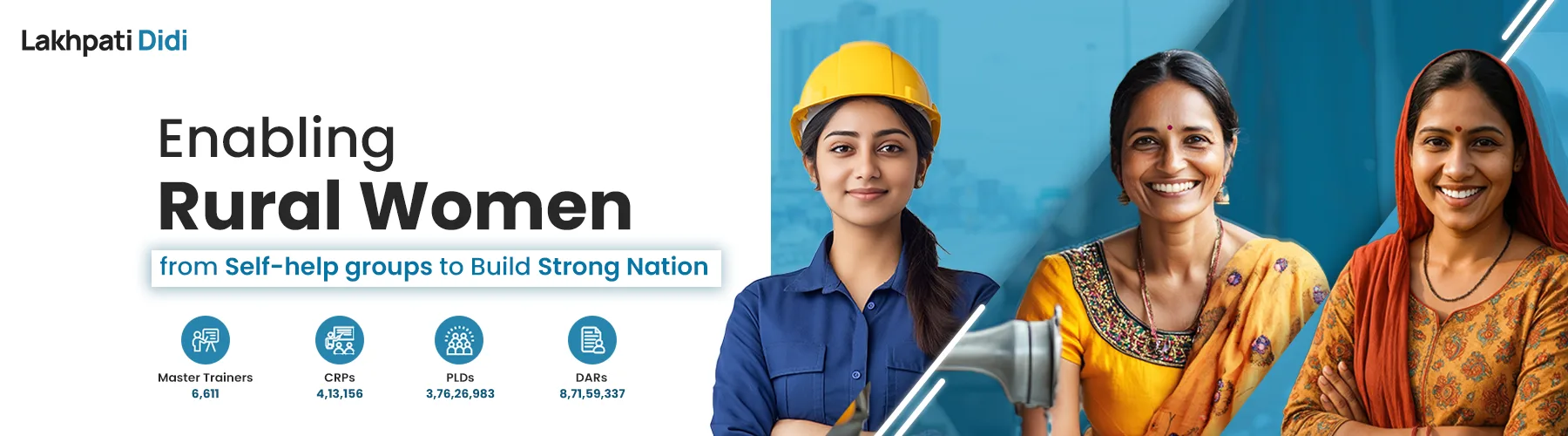
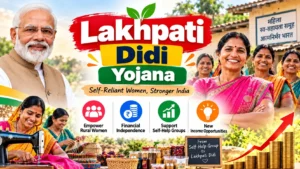
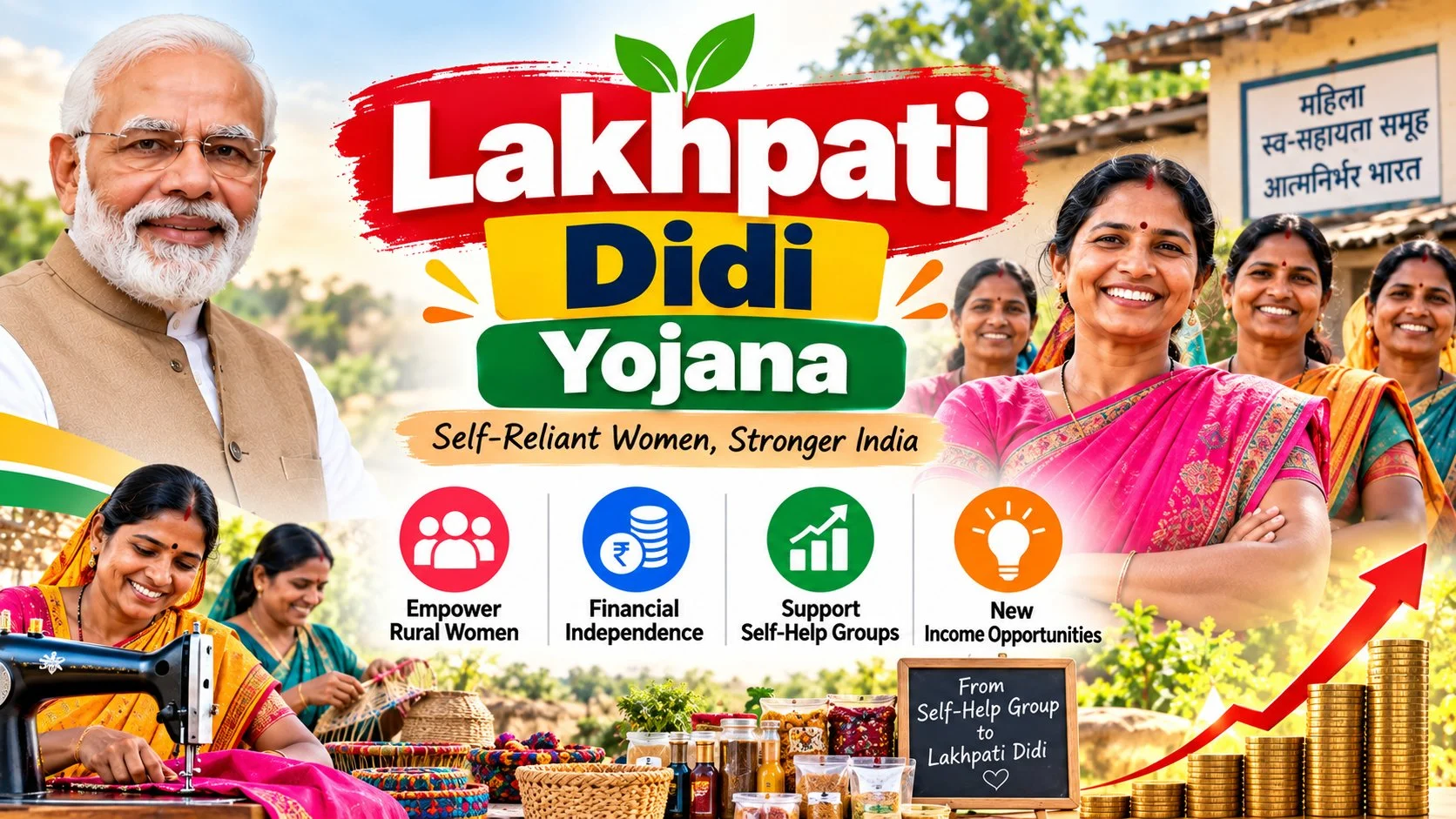
Official Lakhpati Didi campaign creative from Digital India Corporation (dic.gov.in), highlighting rural women from self-help groups building a strong nation.
How It Works: From SHG Member to Lakhpati Didi
Here is the honest, step-by-step path — no shortcuts, but also no mystery:
- Join or become active in an SHG. This is the entry gate. SHGs are groups of 10–20 women who meet regularly, save small amounts (often ₹20–₹100 a month), and support each other. If your village has none, your Gram Panchayat or block DAY-NRLM office can help you find or form one.
- Get identified as a potential Lakhpati Didi. Your SHG, Village Organisation, or the State Rural Livelihood Mission (SRLM) identifies women with viable livelihood activities and growth potential. A Community Resource Person (CRP) or SHG bookkeeper records your details in the DAY-NRLM MIS system — this is the “enrolment”, not a website form.
- Make your Lakhpati Plan. You prepare a simple livelihood plan: what you will do, what it costs, what you expect to earn, and what support you need. CRPs help you draft it.
- Complete skill training. Free training in your chosen trade — tailoring, dairy management, food processing, drone operation, LED assembly, plumbing, digital services — plus entrepreneurship and financial literacy sessions.
- Access credit through your SHG. Based on your plan, you access loans through the SHG–bank linkage: the SHG’s own Revolving Fund and Community Investment Fund, and bank loans (all public-sector banks and IDBI Bank have MoUs with DAY-NRLM for financing women SHG members). Convergence with MUDRA loans is also common — if you are planning a micro-enterprise, read my detailed guide on PM Mudra Loan Yojana alongside this one.
- Sell and scale with market support. This is where 2026’s biggest upgrade comes in (see the SHE-Mart section below). SHG products now reach government e-marketplaces, ONDC networks, Amazon Karigar-style tie-ups and SHG haats.
- Get certified and followed up. Once your income is verified as sustained, you are counted as a Lakhpati Didi. Follow-up continues afterwards to keep the income from slipping back.
Lakhpati Didi Yojana Eligibility: Who Can Join
The core eligibility is simple and comes from official scheme documents:
- Gender: Women only.
- Residency: Permanent resident of a rural area (the scheme runs under DAY-NRLM, which covers rural India; urban women fall under DAY-NULM).
- SHG membership: Active member of a Self-Help Group under DAY-NRLM or the state rural livelihood mission. This is mandatory — you cannot enter as an individual.
- Age: 18 to 50 years is the widely reported band used by state implementations. Note this varies by state — it is not a single central statute.
- Income activity: Currently engaged in, or willing to start, a viable income-generating activity. Priority goes to women from BPL, SC/ST, minority and economically weaker households.
- State-level additions: Some states add conditions such as the family not having a government employee, or a household income ceiling. Check with your block office rather than trusting a random website’s list.
If you are not in an SHG yet, that is step one — not the application form. Visit your Gram Panchayat, block development office, or ask the local CRP where the nearest SHG meets. Most villages already have several.
Lakhpati Didi Yojana Apply Online: The Honest Process
Let me save you an afternoon of frustration: there is no individual “Lakhpati Didi Yojana apply online” portal where a woman fills a personal application form and gets approved. Any website showing you a “click here to apply and get ₹1 lakh” button for this scheme is either confused or trying to harvest your details.
The official portal lakhpatididi.gov.in exists and is genuinely useful — it hosts the scheme’s reports and the dashboard showing progress numbers. The scheme details, training calendars and programme guidance live on aajeevika.gov.in (the DAY-NRLM portal). But enrolment into the initiative happens through your SHG and the block-level mission staff, who enter you into the DAY-NRLM MIS. That is the real “application”.
So here is what “applying” actually looks like in practice:
- Talk to your SHG first. Tell the group (or the CRP/field worker) that you want to work towards Lakhpati Didi status. They will tell you what livelihood plans the mission is supporting in your block this year.
- Visit the block DAY-NRLM / SRLM office. This is the single most useful physical step. Ask for the block mission manager or the livelihoods coordinator. They maintain the training calendar and the list of active trades in your area.
- Register for the skill training you need. Training is free, and the calendar is published locally — courses run in cycles, so you may need to wait for the next batch in your trade.
- Prepare your Lakhpati Plan with the CRP’s help. This document is what opens the door to credit and market support. Keep it realistic: one page of honest numbers beats five pages of fantasy.
- Apply for credit through the SHG–bank linkage. Your SHG forwards the loan application with the required micro-investment plan (MCP/MIP) documents to the Village Organisation / federation, which appraises and disburses. There is no application fee.
A word of caution that comes from real complaints: never pay anyone who promises to “get you approved” for Lakhpati Didi. The scheme costs nothing to join. Anyone demanding money is running a scam.
Lakhpati Didi Yojana Form PDF: What Exists and What Doesn’t
This is the most-searched query about the scheme, so let me be precise. There is no official, nationally published “Lakhpati Didi Yojana application form PDF” for individual women to download and submit. Because enrolment happens through the SHG into the DAY-NRLM MIS, the paperwork lives at the community-institution level: the SHG, the Village Organisation (VO) and the Cluster Level Federation (CLF).
What does exist at the field level:
- Loan application formats at the VO/PLF level for members seeking funds from the Community Investment Fund. Per the scheme’s own process documents, each application carries a serial number, is filled by the SHG, signed by the president, and submitted with the meeting minutes and signatures of all members. Photocopies are not accepted.
- Micro Credit Plans (MCP) / Micro Investment Plans (MIP) that accompany the loan request — essentially your Lakhpati Plan in document form.
- MoUs and grading records used by federations to appraise SHGs (Grade A SHGs following the Panchsutra principles get priority).
If a website offers you a “Lakhpati Didi form PDF download”, treat it with suspicion. The forms you actually need are handed to you by your SHG’s bookkeeper or CRP — free, at the village level. If you want to read the official scheme material yourself, go straight to lakhpatididi.gov.in (reports and dashboard) and aajeevika.gov.in (DAY-NRLM programme documents).
Documents You Will Need
Requirements vary slightly by state and by the credit product you take, but keep this folder ready — it covers nearly every interaction in the process:
Tip from experience with these schemes: get your Aadhaar–mobile and Aadhaar–bank seeding done before you visit the block office. Half the “rejections” people complain about online are just e-KYC mismatches that a bank visit could have fixed.
Benefits: Training, Credit and Market Support
The package has three pillars, and the third one is where the real 2026 story is.
1. Free skill training
Training is the backbone. Women get trained in trades with real local demand — tailoring, dairy and poultry management, food processing, handicrafts, plumbing, LED bulb assembly, solar panel work, digital services, and drone operation. The standout modern track is Namo Drone Didi: women SHG members trained as drone pilots for agricultural spraying, crop monitoring and precision farming — turning a piece of high-end technology into a rural service business.
On 8 March 2025, PM Modi personally interacted with Lakhpati Didis at Navsari, Gujarat, where several of these women — including drone pilots and food-processing entrepreneurs — described how the training changed their income trajectory. That interaction is worth remembering because it shows what the mission considers its showcase outcomes.
2. Credit without the usual barriers
All public-sector banks and IDBI Bank have signed MoUs with DAY-NRLM to finance women SHG members, and the mission actively pushes for easy bank credit to SHGs. Through the SHG you can access the Revolving Fund and Community Investment Fund, plus bank loans appraised on the group’s guarantee rather than traditional collateral.
Two honest caveats here. First, news reports from several states mention interest-free or concessional loans of ₹1–5 lakh routed through SHGs — but this is state-level implementation, not a uniform national cash rule, so confirm what applies in your state at the block office. Second, many women converge their SHG credit with MUDRA loans when they formalise a micro-enterprise — if that path interests you, my PM Mudra Loan Yojana guide walks through the categories and process.
If your enterprise is agri-linked (dairy, poultry, farm machinery), also look at the Kisan Credit Card — it can sit alongside your SHG credit at very low effective interest with timely repayment.
3. Market support — the 2026 upgrade
This is the part I find most exciting, because it solves the oldest problem SHG products face: we can make it, but who will buy it? In the Union Budget 2026, Finance Minister Nirmala Sitharaman announced SHE-Marts — community-owned retail outlets set up within cluster-level federations of women entrepreneurs. Her own framing was deliberate: helping women move “from credit-linked livelihoods to being owners of enterprises”.
Around this, the Ministry is building a marketing ecosystem: SHG haats, government e-marketplace tie-ups, ONDC (Open Network for Digital Commerce) partnerships, a unified national marketing identity for SHG products, and quality/packaging support through Common Facility Centres. For a woman making pickles or incense sticks in a village, the distance to a paying customer in a metro just shrank dramatically.
Lakhpati Didi Yojana in UP, Madhya Pradesh and Rajasthan
National numbers are useful, but implementation lives at the state level. Here is where the three most-asked states stand.
Lakhpati Didi Yojana UP
Uttar Pradesh has 33,52,157 Lakhpati Didis as of 31 March 2026 (Ministry data) — the fourth-highest in the country. The state runs the initiative through the UP State Rural Livelihoods Mission (UPSRLM), which has one of India’s largest SHG networks. Women in UP have scaled up dairy, tailoring clusters, food processing units and e-rickshaw enterprises, and the state has leaned heavily on convergence with other women-focused schemes. If you are in UP, your point of contact is the block mission manager under UPSRLM — and if your enterprise needs formal credit, the Mudra route is widely used in the state.
Lakhpati Didi Yojana MP
Madhya Pradesh has 23,67,520 Lakhpati Didis as of 31 March 2026 — sixth nationally. MP’s women-empowerment ecosystem is one of the country’s oldest (the state pioneered large-scale SHG and women-welfare programmes), and Lakhpati Didi slots into that machinery with strong training infrastructure. When the Union Rural Development Minister met Lakhpati Didis from MP in Delhi on Independence Day 2025, he urged them to aim next for “Crorepati Didi” status — a sign of how seriously the state pipeline is taken. Your entry point in MP is the district/state rural livelihood mission office or your block CRP.
Lakhpati Didi Yojana Rajasthan
Rajasthan is the fastest-moving story right now. As of 31 March 2026 the Ministry counted 15,21,620 Lakhpati Didis in the state — but on 3 October 2026, Chief Minister Bhajanlal Sharma announced at the Nari Shakti Sammelan in Jaipur that over 26 lakh women had been trained under the initiative and around 20 lakh had achieved Lakhpati Didi status. The state has layered the initiative with its own women-centric programmes (pension disbursements, free sanitary napkins for 1.22 crore women and girls, scooters for meritorious students), and the CM has framed women’s economic participation as central to a self-reliant Rajasthan. Rajasthan women: check with your block office for the current training calendar, since the state is running high-volume batches.
A note on numbers: state CMs sometimes cite newer, larger figures than the last published Lok Sabha data. I have given you both with dates so you can see the trend rather than a single disputed number.
Lakhpati Didi vs Other Ways Women Build Income
To place the scheme in context, here is how it compares with the other big options women ask me about:
| Option | What you get | Who it suits |
|---|---|---|
| Lakhpati Didi Yojana | Skill training + SHG credit + market support to earn ₹1L+/yr | Rural SHG women wanting a sustained livelihood |
| PM Mudra Yojana | Collateral-free business loans up to ₹10 lakh | Women formalising a micro/small enterprise |
| Sukanya Samriddhi Yojana | High-interest savings for a daughter’s future | Mothers parking part of new income safely |
| Kisan Credit Card | Cheap working capital for farming/allied activities | Women in dairy, poultry, crop enterprises |
These are complements, not competitors. A sensible pattern I see often: a woman builds income through Lakhpati Didi, takes a Mudra loan to formalise the enterprise, uses a KCC for the agri working capital, and parks part of the surplus in her daughter’s Sukanya Samriddhi account. And if the daughters are of studying age, the National Scholarship Portal can cut education costs dramatically — income and savings work best together.
Mistakes to Avoid and Scams to Watch For
- Paying a “registration fee”. Joining costs nothing. Anyone asking for money to enrol you, approve your plan, or release your loan is a fraud — report them to the block office or police.
- Trusting fake “apply online” websites. Many sites rank for “lakhpati didi yojana apply online” with forms that only collect your mobile number and Aadhaar details for marketing or worse. The official web presence is lakhpatididi.gov.in and aajeevika.gov.in — neither asks for your personal details through a random web form.
- Assuming the ₹1 lakh arrives automatically. It does not. Women who treat the scheme as a payout get disappointed; women who treat it as a free business school plus credit access do well.
- Skipping the Lakhpati Plan. The plan is your key to credit. A vague plan gets a vague response from the federation.
- Ignoring follow-up after certification. Incomes can slip — businesses fail, health emergencies hit. The mission does follow up, but your SHG’s emergency fund and insurance coverage (converged through the mission) are your real safety net. Keep contributing to the group even after you cross the lakh.
Frequently Asked Questions
1. Lakhpati Didi Yojana kya hai in simple words?
It is a central government initiative under DAY-NRLM that helps women in rural Self-Help Groups build a sustained annual household income of at least ₹1 lakh through skill training, credit access and market support. It is not a cash-transfer scheme — it helps you earn the money through a livelihood or enterprise.
2. Can I apply for Lakhpati Didi Yojana online?
There is no individual online application form. You join (or become active in) an SHG, express interest to your SHG/CRP, and the block-level mission staff enrols you in the DAY-NRLM MIS. The official portals — lakhpatididi.gov.in and aajeevika.gov.in — provide scheme information, reports and dashboards, not a personal apply button.
3. Is there a Lakhpati Didi Yojana form PDF to download?
No official national-level individual application form PDF exists. The documentation happens at the SHG/federation level (loan application formats with serial numbers, micro-investment plans, meeting minutes). Your SHG bookkeeper or CRP will give you whatever needs filling — free of charge.
4. Who is eligible for Lakhpati Didi Yojana?
Women who are permanent residents of rural areas and active members of an SHG under DAY-NRLM, willing to build an income-generating activity. The widely used age band is 18–50, with priority for BPL, SC/ST, minority and economically weaker households. Individual states may add conditions (e.g., no government employee in the family), so confirm locally.
5. How many women have become Lakhpati Didis so far?
As of 31 March 2026, the Ministry counted 3,46,49,448 Lakhpati Didis (Lok Sabha data). By July 2026 the figure had crossed 3.46 crore, and the government has now set a target of 6 crore by March 2029. State CMs sometimes cite higher, newer figures in speeches — I have marked the source and date for every number in this article.
6. Does the scheme give a loan? Is it interest-free?
The scheme connects SHG women to credit — SHG revolving/community funds and bank loans (PSU banks and IDBI Bank have DAY-NRLM MoUs), often converged with MUDRA. Some states report interest-free or concessional loans of ₹1–5 lakh through SHGs, but this is state-level implementation, not a uniform national rule. Ask your block office what applies in your state.
The Bottom Line
After covering dozens of government schemes for this site, the Lakhpati Didi Yojana stands out for one reason: it respects the intelligence of its beneficiaries. It does not hand out a lakh; it builds the capacity to earn many lakhs, year after year, and measures success only when the income survives four full seasons. With 3.46 crore women already past the line, a 6-crore target for 2029, SHE-Marts opening community-owned retail, and ONDC-era market access arriving for SHG products, the next three years are the best time this scheme has ever offered to join.
If this guide helped you, start where it matters: walk into your next SHG meeting (or your Gram Panchayat, if you are not in one yet) and ask about the Lakhpati Didi training calendar in your block. That single conversation is worth more than a hundred “apply online” searches.
Found this useful? Share it with a woman who could use it — and if you want me to cover your state’s specific implementation in detail, tell me in the comments which state you are from.