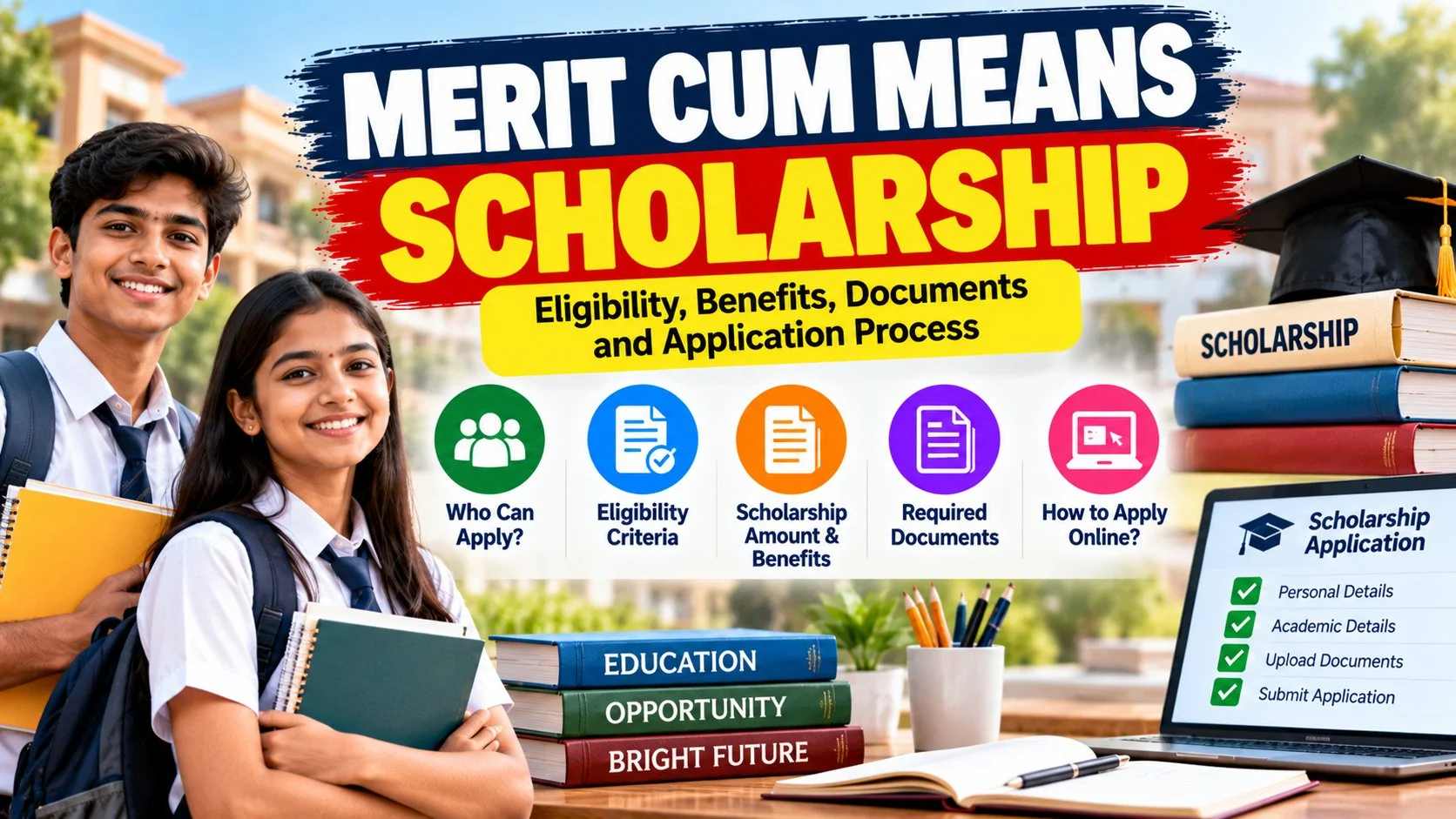

Scored well in Class 12 but worried about paying for a professional degree? If you’re from a minority community, the Merit Cum Means Scholarship could be the most valuable scholarship you’ll ever apply for — it covers both tuition fees and maintenance for professional and technical courses.
✅ This guide is based on official government sources and notifications. Last verified: October 17, 2026. Scheme details, eligibility criteria, and benefit amounts are revised by the government from time to time — always cross-check the latest information on the official portal before applying.
Most students have heard of it but don’t understand the “merit cum means” part — you need both good marks and limited family income. This guide breaks down exactly how the two criteria work together, what courses qualify, how much you get, and the step-by-step application process on the National Scholarship Portal.
What Is the Merit Cum Means Scholarship?
The Merit-cum-Means Scholarship (often abbreviated MCM) is a central government scheme run by the Ministry of Minority Affairs. It’s designed for one specific purpose: helping meritorious minority-community students afford professional and technical courses — the expensive degrees (engineering, medicine, management, law) that deliver the highest career returns but cost the most.
The name tells you the two gates you must pass:
- Merit: You must have scored well — at least 50% marks in the previous final examination.
- Means: Your family’s annual income must be within the prescribed limit — currently ₹2.5 lakh per year.
Miss either gate and you’re out. That’s what makes MCM different from pure merit scholarships (marks only) or pure means scholarships (income only). Many students discover MCM only in their second or third year of a professional course — the good news is you can apply fresh in any year, so it’s never too late to claim what you’re entitled to. If you’re looking for general scholarship options, our NSP scholarship guide covers the full portal.
Who Is Eligible? (Minority Communities Covered)
This scheme is only for students belonging to notified minority communities. As per the National Commission for Minorities Act, these are:
- Muslim
- Christian
- Sikh
- Buddhist
- Jain
- Parsi (Zoroastrian)
You don’t need a “minority certificate” from the government — a self-declaration on affidavit (or the declaration format on NSP) stating your community is sufficient. But be truthful; false declarations are a punishable offence and lead to recovery of the scholarship amount.
| Eligibility Point | Requirement |
|---|---|
| Community | Notified minority (Muslim, Christian, Sikh, Buddhist, Jain, Parsi) |
| Course level | Professional & technical courses at UG/PG level (listed courses) |
| Minimum marks | 50% in previous final exam |
| Family income | Not more than ₹2.5 lakh/year |
| Institution | Recognized institution, course must be in the approved list |
| Other scholarships | Must not be availing any other scholarship for the same course |

Which Courses Are Covered?
Not every course qualifies — the scheme targets professional and technical education. The approved list on NSP includes:
- Engineering & Technology: B.Tech, M.Tech (all branches)
- Medical: MBBS, BDS, BAMS, BHMS, Nursing, Pharmacy
- Management: MBA, PGDM (from recognized institutions)
- Law: LLB, integrated law programs
- Other professional courses: Architecture, Design, Hotel Management, CA/CS/CMA
What’s typically NOT covered: General BA/BSc/BCom degrees (these fall under other schemes), distance/correspondence courses, and unrecognized private courses. If your course isn’t on the NSP approved list for MCM, you can’t apply — check the list before spending time on the application. One practical tip: course names on NSP use specific nomenclature (e.g., “B.E.” vs “B.Tech” may be listed separately). If your exact degree name doesn’t appear, check with your institution’s scholarship cell — they deal with this mapping every year and know which NSP entry corresponds to your program.
Students in general degree courses should look at the MYSY scholarship (Gujarat) or post-matric options instead.
Scholarship Amount: The Numbers
MCM is generous because professional courses are expensive. The scholarship has two components:
| Component | Amount |
|---|---|
| Course fee reimbursement | Up to ₹20,000/year (actual fees or cap, whichever is lower) |
| Maintenance allowance (hosteller) | ₹10,000/year |
| Maintenance allowance (day scholar) | ₹5,000/year |
So a hosteller in an engineering college can receive up to ₹30,000 per year — ₹20,000 toward fees plus ₹10,000 maintenance. For a 4-year B.Tech, that’s up to ₹1.2 lakh in total support. Not pocket change.
Payment is through DBT to the student’s Aadhaar-linked bank account, usually in one or two installments per academic year. Keep your registered mobile number active — all DBT credit alerts and NSP verification OTPs go there, and a changed number without updating the portal is a surprisingly common reason students miss critical notifications.
Documents Required
- Aadhaar card of the student
- Minority community declaration (self-declared affidavit as per NSP format)
- Income certificate — not more than ₹2.5 lakh/year, issued by competent authority, current financial year
- Previous year’s marksheet showing 50%+ marks
- Bonafide certificate from the institution
- Fee structure / fee receipt from the institution
- Bank account details — Aadhaar-linked, in student’s name
- Domicile certificate
- Passport-size photograph
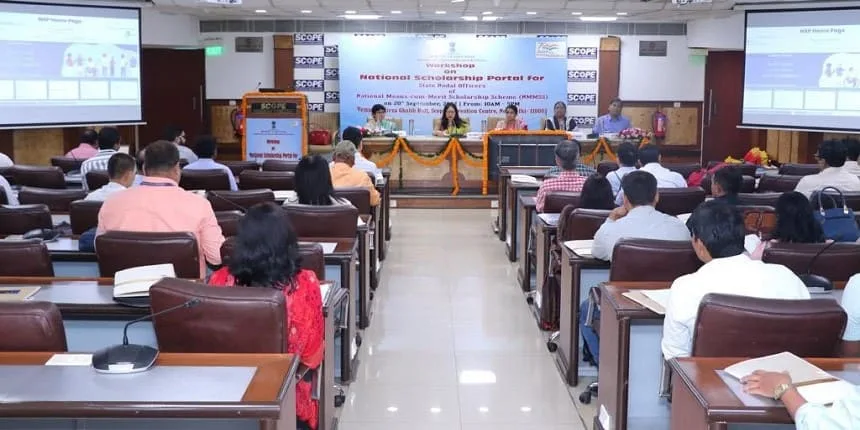
How to Apply on NSP: Step by Step
Step 1: Go to scholarships.gov.in and complete “New Registration” if you’re a first-time applicant.
Step 2: Log in with your Application ID and select the Merit Cum Means Scholarship under Ministry of Minority Affairs schemes.
Step 3: Fill in course details carefully — select your exact course from the dropdown. If your course doesn’t appear, it may not be in the approved list.
Step 4: Enter fee details matching your institution’s fee receipt exactly.
Step 5: Upload the minority declaration, income certificate, marksheets, and other documents.
Step 6: Submit, save the acknowledgement, and get your institution to verify through their NSP login.
Step 7: Track status regularly — institute → district → state → payment.
Renewal: Keep It Going Every Year
MCM must be renewed each academic year. Renewal requires:
- Passing the previous year with 50%+ marks (the merit bar continues)
- Fresh income certificate
- Continued enrollment in the same approved course
- Institution re-verification
Critical: If your marks drop below 50% in any year, renewal is typically denied. The “merit” in Merit-cum-Means isn’t a one-time entry ticket — it’s an ongoing requirement. Take this seriously from day one.
MCM vs Other Minority Scholarships
| Scheme | Level | Key Criterion |
|---|---|---|
| Pre-Matric (Minority) | Class 1–10 | Income ≤ ₹1L, 50% marks |
| Post-Matric (Minority) | Class 11–PhD | Income ≤ ₹2L, 50% marks |
| Merit-cum-Means | Professional/technical UG/PG | Income ≤ ₹2.5L, 50% marks |
Think of it as a ladder: pre-matric gets you through school, post-matric through college, and MCM specifically powers professional degrees. Apply for the right rung.
Common Mistakes That Kill Applications
- Applying for a non-listed course: Always verify your exact course name appears in the MCM approved list on NSP.
- Income certificate issues: Expired, wrong format, or income slightly over the limit — all fatal.
- Marks below 50%: Even 49.8% doesn’t round up. The cutoff is strict.
- Fee receipt mismatch: The fee amount you enter must match the receipt to the rupee.
- Missing the institution verification: Your college must verify on NSP. Many students submit and assume it’s done — follow up with your college’s nodal officer.
Important Dates
- Applications open: July–August
- Last date: October–31
- Verification: November–December
- Disbursement: January–March via DBT
Begum Hazrat Mahal Scholarship vs MCM: Don’t Confuse Them
Many minority girl students hear about two scholarships and mix them up. Let’s clarify:
| Point | Merit-cum-Means (MCM) | Begum Hazrat Mahal |
|---|---|---|
| For whom | Minority students (all genders) in professional courses | Minority girl students, Class 9–12 |
| Level | UG/PG professional & technical | School level (9th–12th) |
| Amount | Up to ₹30,000/year | ₹6,000/year |
They’re complementary, not competing — a girl student could get Begum Hazrat Mahal in school and MCM later in a professional degree. Plan your scholarship journey across education levels.
Income Certificate: Getting It Right for MCM
The ₹2.5 lakh income ceiling is the most common rejection point, so let’s get this document perfect:
Who issues it: Tehsildar, SDM, or equivalent revenue authority. Some states allow online application through e-district portals — check yours.
What’s counted: Combined annual income of parents (and yours, if you earn). Include salary, business income, agricultural income, and rental income. The certificate must show a specific yearly figure.
Freshness rule: Issued within the current financial year. Last year’s certificate — even if income is unchanged — will be rejected.
Self-employed/farming families: You’ll typically submit a self-declaration of income along with supporting documents (land records, etc.). The issuing authority may do a local enquiry — cooperate fully.
Red flag: Never understate income to sneak under the ceiling. Cross-verification with tax records is increasingly common, and fraud findings lead to multi-year bans from all government schemes.
Maintaining 50%: The Ongoing Merit Requirement
Unlike one-time merit checks, MCM demands 50%+ every year for renewal. Here’s how to protect your scholarship:
- Know your university’s grading: 50% means 5.0 CGPA on a 10-point scale in most Indian universities — but verify your institution’s conversion. Some use different scales.
- Backlogs are dangerous: Even one uncleared backlog can block renewal. Prioritize clearing backlogs in supplementary exams.
- Keep semester marksheets safe: You’ll upload them every renewal. Lost marksheets mean delays — get duplicates early from your university if needed.
- Attendance matters indirectly: Low attendance leads to poor performance, which leads to sub-50% marks. The chain is predictable.
Tracking Your Application Status
After submission, monitor these stages on scholarships.gov.in:
- Submitted: Your application is in the system.
- Institute verified: Your college confirmed your enrollment and details.
- District/State verified: Government officers validated eligibility.
- Final verified: Approved for payment.
- Payment initiated/done: DBT transfer to your account.
If stuck at “Institute verified” for over a month, contact your college’s NSP nodal officer — this is the most common bottleneck. For payment-stage queries, check PFMS with your account number.
State Minority Welfare Departments: Your Local Help Desk
While MCM is a central scheme on NSP, each state has a Minority Welfare Department that handles verification. Knowing yours helps when applications get stuck:
- Uttar Pradesh: One of the largest applicant pools — the state minority welfare portal supplements NSP. District Minority Welfare Officers (DMWOs) handle ground verification.
- West Bengal: High MCM uptake given the professional course ecosystem in Kolkata. The state portal integrates with NSP timelines.
- Kerala: Strong institutional support — most professional colleges have dedicated scholarship cells that proactively help with MCM applications.
- Karnataka & Maharashtra: State DBT portals work alongside NSP. Keep documents ready in both formats if required.
- Bihar: Check whether your course’s MCM application routes through NSP or the state portal in a given year — this has varied.
When escalating a stuck application, always start with your institution’s nodal officer, then the District Minority Welfare Officer, then the state nodal officer (listed on NSP). Written complaints (email) work better than phone calls — they create accountability.
Document Checklist: The Perfect Application File
Before hitting submit, run through this checklist. Every unchecked box is a potential rejection:
File hygiene: Keep each file under the portal’s size limit (usually 200KB–200KB per document — check current limits). Blurry phone photos of documents are the #1 avoidable rejection cause. Use a proper scanner app with auto-crop.
After You Get the Scholarship: Your Responsibilities
Receiving MCM money comes with ongoing obligations most students don’t think about:
- Maintain 50%+ every year — this is non-negotiable for renewal, as covered above.
- Stay enrolled continuously. Dropping out mid-year or taking an unauthorized break can trigger recovery proceedings for that year’s amount.
- Report course/institution changes during the renewal window. Silent transfers create verification mismatches.
- Keep your bank account active. If your account goes dormant, the next installment fails — and re-initiating a failed DBT takes months.
- Use the money for education. The maintenance component is meant for books, hostel, and study expenses. While nobody audits your spending line-by-line, the spirit of the scheme matters — and misrepresentation in future applications is fraud.
Think of the scholarship as a contract: the government invests in your professional education, and you deliver academic performance in return. Honor it.
Frequently Asked Questions
Q1. I’m from a minority community but studying BA. Can I apply for MCM?
No. MCM is specifically for professional and technical courses. For general degrees, apply for the Post-Matric Minority Scholarship instead, which covers BA/BSc/BCom and beyond.
Q2. My family income is ₹2.6 lakh — just over the limit. Any relaxation?
No. The income ceiling is a hard cutoff. There are no relaxations or rounding. If you’re over, look at merit-only scholarships or education loans instead.
Q3. Do I need a minority certificate from the government?
No. A self-declaration affidavit of your minority community status, in the format prescribed on NSP, is sufficient. No government-issued minority certificate exists or is required.
Q4. Can I apply in the 2nd year of my course if I missed 1st year?
Yes — you can apply as a “fresh” applicant in any year of your course, as long as you meet the 50% marks criterion in the previous year and the course is still ongoing. You can’t claim retroactively for the missed year, though.
Q5. Is the scholarship taxable?
Educational scholarships are generally exempt under Section 10(16) of the Income Tax Act when used for education.
Q6. What happens if I change my course mid-way?
If you switch to another approved professional course, update your application during the renewal window and get fresh institution verification. Switching to a non-approved course will discontinue the scholarship.
Q7. Which minority communities are covered under the MCM scholarship?
Six communities notified by the Government of India: Muslims, Christians, Sikhs, Buddhists, Jains, and Parsis (Zoroastrians). You must belong to one of these six — there is no state-wise variation in this list.
Q8. I’m in a general degree (BA/BCom). Is there a minority scholarship for me?
MCM is only for professional and technical courses. For general degrees, apply for the Post-Matric Scholarship for Minorities (also on NSP), which covers Class 11–12 right through PhD for minority students. Don’t waste an MCM application on a BA — it will be rejected at verification.
Q9. Exactly how much money does the MCM scholarship pay?
Two parts: course fee reimbursement up to ₹20,000 per year (or actual fees, whichever is less), plus a maintenance allowance of ₹1,000/month for hostellers (₹10,000/year) or ₹500/month for day scholars (₹5,000/year), paid for 10 months. Students in premier institutes listed by the Ministry of Minority Affairs can get full tuition fee reimbursement.
Q10. Do I need 50% marks every year, or only at admission?
Every year. The 50% requirement applies at entry AND for renewal — you must secure at least 50% in the previous year’s exam to renew. One bad year can cost you the scholarship, so treat the 50% line as non-negotiable.
Q11. What is the 30% reservation for girl students in MCM?
30% of the total MCM scholarships are earmarked for girl students from minority communities. If enough eligible girls don’t apply, unfilled slots can go to boy students — but apply early anyway, because earmarked seats are filled on merit.
Q12. What is West Bengal’s Aikyashree scholarship? Is it the same as MCM?
Aikyashree is West Bengal’s state portal (run by WBMDFC) that hosts the central MCM scheme for the state’s students alongside state minority scholarships. The eligibility — 50% marks, ₹2.5 lakh income, six minority communities — mirrors the central scheme. Apply through the portal your state directs you to; the money follows the same DBT route.
Q13. Can I hold MCM along with another scholarship?
No. A student receiving MCM cannot receive any other major central or state scholarship or fee reimbursement for the same course. From AY 2026-27, NSP permits one merit-based plus welfare-based combinations in some cases — but MCM plus another major scholarship for the same course is not permitted.
Final Words
The Merit Cum Means Scholarship is one of the highest-value central scholarships available to minority students — up to ₹30,000 a year for professional courses is genuinely life-changing money for most families. But the dual merit-plus-means bar means you need to be both a good student and organized with paperwork.
If you’re eligible, don’t leave this on the table. The application window is short, the documents take time to gather, and every year you delay is ₹30,000 of support gone forever — money that doesn’t carry forward. Start your document collection today, register on NSP the moment the portal opens, and follow up relentlessly on verification.
And if you know someone in a professional course from a minority community who’s struggling with fees — a classmate, a junior, a neighbor — share this guide or point them to our complete NSP walkthrough. The money exists. The system works for those who work it correctly. You just have to claim it.