
Living in a kutcha house during Gujarat’s monsoon is something no family should have to endure — yet thousands of Scheduled Caste families still do. If you are one of them, the Dr Ambedkar Awas Yojana Gujarat could be the most important government scheme you apply for this year. It offers ₹1,20,000 in direct financial assistance to help SC families build a permanent pucca house of their own.
✅ This guide is based on official government sources and notifications. Last verified: October 12, 2026. Scheme details, eligibility criteria, and benefit amounts are revised by the government from time to time — always cross-check the latest information on the official portal before applying.
In this complete guide, you will find the verified benefit amount, who is eligible, every document you need, the exact online application steps on the e-Samaj Kalyan portal, how to check your application status, and how this scheme compares with PMAY. Everything is explained in simple language so you can apply with confidence.
Dr Ambedkar Awas Yojana Gujarat 2026 – Quick Highlights
| Point | Details |
|---|---|
| Scheme name | Dr Ambedkar Awas Yojana |
| State | Gujarat |
| Run by | Director, Scheduled Caste Welfare – Social Justice & Empowerment Department, Government of Gujarat |
| Financial assistance | ₹1,20,000 (paid in 3 installments linked to construction stages) |
| Who can apply | Scheduled Caste families of Gujarat without a pucca house |
| Income limit | Annual family income up to ₹6,00,000 (rural and urban) |
| Apply | Online via e-Samaj Kalyan portal, or offline at the district office |
| Official portal | esamajkalyan.gujarat.gov.in |
What Is Dr Ambedkar Awas Yojana?
Dr Ambedkar Awas Yojana is a Gujarat state government housing assistance scheme run by the Director of Scheduled Caste Welfare under the Social Justice and Empowerment Department. Its purpose is simple: help Scheduled Caste families who are homeless, who own an open plot, or who live in kutcha, dilapidated or uninhabitable houses to build a safe, permanent home.
Unlike a loan, this is a grant — the money does not have to be repaid. The assistance is transferred directly to the beneficiary’s bank account through Direct Benefit Transfer (DBT), which removes middlemen from the process. The scheme applies in both rural and urban areas of Gujarat.
One useful feature many applicants miss: the scheme also covers construction of a house on the first floor of an existing property, provided the ground floor is registered in someone else’s name and the owner gives written consent. So even if you do not own a separate plot, you may still qualify if your family arrangement fits this condition.
Benefit Amount: ₹1,20,000 (Verified) – Installment Breakdown
Let us address the confusion around the benefit amount directly, because several websites state different figures. The freshest reporting — The Times of India, September 2026 — confirms the assistance is ₹1,20,000, released in three installments tied to construction progress:
| Installment | Amount | When It Is Paid |
|---|---|---|
| 1st installment | ₹40,000 | After administrative sanction of your application |
| 2nd installment | ₹60,000 | When construction reaches the lintel level |
| 3rd installment | ₹20,000 | On full completion of construction, including the toilet |
About the ₹1,70,000 figure you may have seen: one blog (sscupdates.com) claims the scheme now pays ₹1,70,000 in four installments. We could not find this figure corroborated by any recent news report or the official portal listing — the September 2026 TOI report, which is the freshest source available, states ₹1,20,000 in three installments. Treat the ₹1,70,000 claim as unverified until the e-Samaj Kalyan portal itself reflects it. If the amount has been revised upward, that is good news — but apply based on the officially published figure.
Toilet assistance: constructing a toilet is compulsory to receive the full assistance. If you are eligible for the separate Swachh Bharat toilet subsidy of ₹12,000, you can claim it from the Taluka Panchayat (rural) or Nagarpalika/Mahanagarpalika (urban) in addition to the housing grant.
MGNREGA support: in rural areas, you can additionally get up to 90 days of unskilled employment under the Mahatma Gandhi NREGA scheme for the housing construction work, through the NREGA branch of your Taluka Panchayat.
Eligibility Criteria for Dr Ambedkar Awas Yojana Gujarat
Check every condition below before applying — most rejections happen because one of these is overlooked:
- Caste: the applicant must belong to the Scheduled Caste (SC) category and hold a valid caste certificate.
- Domicile: the applicant must be a native/permanent resident of Gujarat.
- Income limit: annual family income must not exceed ₹6,00,000 in both rural and urban areas (as per the September 2026 reporting). Note: older portal listings mentioned ₹1,20,000 (rural) and ₹1,50,000 (urban); the current published figure is ₹6,00,000. If in doubt, confirm with your district SC welfare office before applying.
- Age: the applicant must be at least 21 years old.
- Housing status: the applicant must not own a pucca residential house or a residential plot already. Homeless families, open-plot owners, and families in kutcha/dilapidated houses qualify.
- No double benefit: neither the applicant nor any family member should have already availed benefits under any other government housing scheme (PMAY, etc.).
- Construction timeline: the house must be completed within 2 years of receiving the first installment.
- Construction cost ceiling: the total construction cost should not exceed ₹10,00,000 in urban areas and ₹7,00,000 in rural areas (this ceiling does not apply to Affordable Housing Scheme houses in urban areas).
- Nameplate: a nameplate stating “Dr. Ambedkar Awas Yojana – State Government” must be installed on the completed house.
Documents Required
Keep scanned copies of these ready before you start the online form — the portal will ask you to upload them:
| # | Document | Notes |
|---|---|---|
| 1 | Aadhaar card of the applicant | Name must match the application |
| 2 | Ration card | Family details proof |
| 3 | Caste certificate (SC / sub-caste) | Issued by competent authority |
| 4 | Income certificate | Annual family income proof |
| 5 | Residence proof | Electricity bill, voter ID, lease agreement, or ration card |
| 6 | Land ownership documents | 7/12 form, rights form, size form, or title deed |
| 7 | Bank passbook first page / cancelled cheque | In the applicant’s name (for DBT) |
| 8 | Plot map signed by Talati-cum-Mantri | Shows the land area for construction |
| 9 | Election identity card (voter ID) | Identity proof |
| 10 | Photograph of open plot / dilapidated house | Where construction will happen |
| 11 | Self-declaration / affidavit | That the scheme benefit was not availed before |
| 12 | Husband’s death certificate (if widow applicant) | Only for widow applicants |
| 13 | Passport-size photograph | Recent photograph of applicant |
How to Apply Online for Dr Ambedkar Awas Yojana Gujarat
Applications are accepted through the official e-Samaj Kalyan portal of the Social Justice & Empowerment Department. Follow these steps exactly:
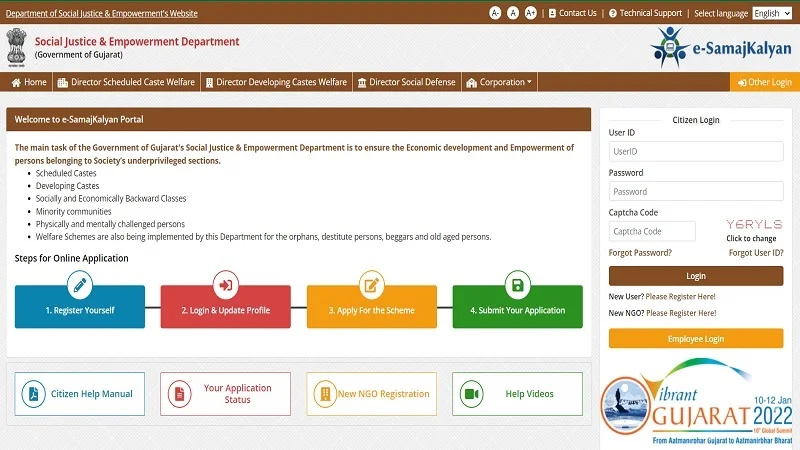
The e-Samaj Kalyan portal homepage, where all applications for Dr Ambedkar Awas Yojana Gujarat begin.
- Open the portal: go to esamajkalyan.gujarat.gov.in in your browser.
- Register as a new user: on the home page, under the “Citizen Login” tab, click “Please Register Here”. Enter your full name exactly as on your Aadhaar card, gender, date of birth, Aadhaar number, email ID and caste, then click Register.
- Log in: use the User ID and password you just created to log in through Citizen Login.
- Update your profile: click on “User Profile” and fill in all mandatory information — personal details, address, income and caste details — then click Update.
- Select the scheme: from the home page scheme list, choose Dr. Ambedkar Awas Yojana (listed under the Director, Scheduled Caste Welfare section). The application form will open.
- Fill the form: enter all mandatory details — housing status (homeless / open plot / kutcha house), land details, bank account details for DBT — and upload the scanned documents listed above.
- Agree and save: read the terms and conditions, tick the agreement box, and click “Save Application”.
- Submit and print: submit the final application, note down your application number, and take a printout for your records. You will need this number to track your status.
Tip: after submitting online, keep the printed application with photocopies of all documents ready — the district office may ask you to submit a physical set during verification.
How to Apply Offline
If online application is difficult for you, the offline route works too:
- Download the Dr Ambedkar Awas Yojana application form (available in Gujarati and English) from the e-Samaj Kalyan portal, or collect it from your District Scheduled Caste Welfare Office.
- Fill the form carefully and attach photocopies of all documents listed above.
- Submit the complete set to the District Scheduled Caste Welfare Officer of your district.
- Collect the acknowledgement receipt and keep it safe — it is your proof of application.
How to Check Dr Ambedkar Awas Yojana Application Status
Once you have applied, tracking your application is easy:
- Go to esamajkalyan.gujarat.gov.in.
- Log in with your User ID and password (Citizen Login).
- Click on “Your Application Status” or “Application Status”.
- You will see whether your application is pending, under verification, approved, or rejected — along with the installment payment status.
If the status shows a document objection, re-upload the corrected document quickly — delayed responses are a common reason applications get stuck.
Construction Rules You Must Follow
Receiving the installments is linked to actual construction progress, so understand these rules upfront:
- The complete house must be built within 2 years of the first installment being paid.
- A toilet is compulsory — the third installment is released only when construction is complete including the toilet.
- The assistance will not cover the full construction cost, so you must arrange the remaining amount yourself.
- Keep photographic proof of each construction stage (foundation, lintel level, completion) — officials verify progress before releasing each installment.
- Install the scheme nameplate (“Dr. Ambedkar Awas Yojana – State Government”) on the completed house.
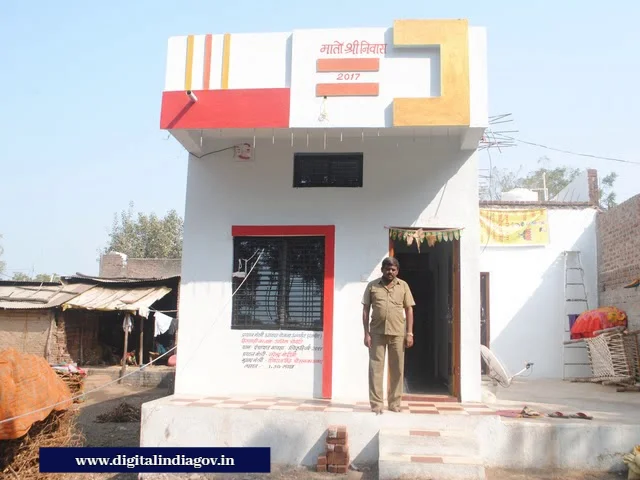
A completed pucca house of the kind beneficiaries build with assistance under the scheme.
Dr Ambedkar Awas Yojana vs PMAY – Which Should You Choose?
Many SC families in Gujarat wonder whether to apply for Dr Ambedkar Awas Yojana or the Pradhan Mantri Awas Yojana (PMAY). Here is an honest comparison:
| Point | Dr Ambedkar Awas Yojana | PMAY (Urban/Rural) |
|---|---|---|
| Run by | Gujarat state government (SC Welfare) | Central government |
| Who qualifies | SC families of Gujarat only | EWS/LIG/MIG families (all categories) |
| Assistance | ₹1,20,000 grant (DBT) | Up to ₹2.5 lakh (varies by component) |
| Repayment | None — it is a grant | None for subsidy components |
| Apply via | e-Samaj Kalyan portal | pmay-urban.gov.in / pmayg.nic.in |
| Key rule | Cannot combine with any other housing scheme | Cannot combine with other housing schemes |
The honest answer: you cannot take both — the rules of each scheme bar anyone who has availed another government housing benefit. If you are an SC family in Gujarat, compare the two and apply for the one whose eligibility you meet more comfortably. Read our detailed guides: PMAY Online Form 2026 guide and Shramik Basera Yojana (₹5/day worker housing) to see the full housing-scheme landscape before you decide.
Common Reasons Applications Get Rejected
- Income certificate mismatch: the income on your certificate exceeds the limit, or the certificate is expired.
- Already owns a pucca house: field verification finds an existing permanent house in the applicant’s or family member’s name.
- Double benefit: a family member already took PMAY or another housing scheme grant.
- Land documents missing: no 7/12, rights form, or title deed proving ownership of the plot.
- Name mismatch: the name on the Aadhaar card does not match the name on the bank account or application.
- Incomplete uploads: blurry scans or missing documents — the portal marks these as objections and applicants never respond.
Go through this list before you hit submit. Fixing these six things covers the vast majority of rejections.
Important Reminders Before You Apply
- Apply only through the official portal — never pay any agent or middleman. The application is free.
- The ₹1,20,000 will not cover the entire construction cost. Plan how you will fund the remaining construction before you start.
- Construction must finish within 2 years of the first installment — plan your building schedule accordingly.
- Keep copies of everything: application printout, application number, document uploads, and stage-wise construction photos.
- Benefit figures and income limits are revised by government resolutions from time to time. If anything in this guide differs from what the portal shows today, the portal’s current figures are the final word.
Frequently Asked Questions
What is the benefit amount of Dr Ambedkar Awas Yojana Gujarat in 2026?
The verified assistance is ₹1,20,000, paid in three installments — ₹40,000 on sanction, ₹60,000 at lintel level, and ₹20,000 on completion including the toilet. This is confirmed by September 2026 reporting; some blogs claim ₹1,70,000, but that figure is not corroborated by recent official reporting.
What is the income limit for Dr Ambedkar Awas Yojana?
Annual family income must not exceed ₹6,00,000 in both rural and urban areas, as per the latest published terms. Older listings mentioned lower limits (₹1,20,000 rural / ₹1,50,000 urban), so confirm the current figure on the portal or with your district office if your income is near the boundary.
Who is eligible for Dr Ambedkar Awas Yojana in Gujarat?
Scheduled Caste families who are permanent residents of Gujarat, aged 21 or above, without a pucca house, and who have not taken any other government housing scheme benefit. You must own (or have rights to) the plot where the house will be built.
How can I apply online for Dr Ambedkar Awas Yojana?
Register on esamajkalyan.gujarat.gov.in, log in, update your user profile, select Dr Ambedkar Awas Yojana from the scheme list, fill the form, upload documents, agree to the terms, save, submit, and take a printout with your application number.
Is Dr Ambedkar Awas Yojana a loan or a grant?
It is a grant, not a loan. The ₹1,20,000 does not have to be repaid. It is transferred directly to your bank account in installments as construction progresses.
Can I apply for both Dr Ambedkar Awas Yojana and PMAY?
No. Both schemes prohibit applicants who have already availed any other government housing scheme benefit. Choose the one that fits your eligibility better and apply for that one only.
How do I check my Dr Ambedkar Awas Yojana application status?
Log in to the e-Samaj Kalyan portal with your User ID and password, then click “Your Application Status” to see whether your application is pending, under verification, approved, or rejected.
Is a toilet compulsory under the scheme?
Yes. The final installment of ₹20,000 is released only when the house is complete including the toilet. Separately, eligible beneficiaries can claim ₹12,000 toilet assistance under the Swachh Bharat Mission.
Final Words
A permanent roof over your family’s head changes everything — safety during monsoon, dignity, and an asset for the next generation. The Dr Ambedkar Awas Yojana Gujarat exists precisely for SC families who have been waiting for that chance. The assistance of ₹1,20,000 will not build the whole house, but it is a genuine, no-repayment grant that gets construction started and keeps it moving through three verified stages.
If you meet the eligibility criteria, do not wait for someone else to apply on your behalf. Gather your documents, register on the e-Samaj Kalyan portal today, and track your application number until the final installment lands. And if this guide helped you, share it with another family in your village or neighbourhood who might qualify — the best schemes only work when the right people hear about them.