
If you are a central government employee, your Diwali bonus for 2026 is confirmed: ₹6,908. If you work for the railways, your bonus is bigger: a 78-day productivity-linked bonus worth up to ₹17,951 per person. Both announcements came within 24 hours of each other, just weeks before Diwali on November 8, 2026. I have gone through the actual government orders — the Department of Expenditure’s O.M. dated October 15, 2026 and the PIB release on the railway bonus dated October 14, 2026 — so this guide tells you exactly who gets what, how the amount is calculated, and when the money reaches your account.
✅ This guide is based on official government sources and notifications. Last verified: October 12, 2026. Scheme details, eligibility criteria, and benefit amounts are revised by the government from time to time — always cross-check the latest information on the official portal before applying.
Diwali Bonus Kitna Milega? The 2026 Figures at a Glance
Let me put the headline numbers on the table first, because that is what most of you searched for. Two separate announcements, two different bonuses, two different sets of rules:
| Bonus | Who gets it | Amount | Announced on |
|---|---|---|---|
| Ad-hoc (non-productivity-linked) bonus, 30 days | Group C and non-gazetted Group B central govt staff | ₹6,908 maximum | 15 October 2026 (DoE Office Memorandum) |
| Productivity-linked bonus (PLB), 78 days | Non-gazetted railway employees (~11.4 lakh) | Up to ₹17,951 per employee; total ₹2,009.61 crore | 14 October 2026 (Union Cabinet decision) |
Notice the distinction. The ₹6,908 bonus is not linked to productivity — it is a flat ad-hoc bonus for 30 days of emoluments, sanctioned by the President and conveyed through the Department of Expenditure. The railway bonus is performance-linked: the government explicitly tied it to the railways’ record year in 2025-26. Railway employees get one bonus or the other, never both.
Central Government Employees Diwali Bonus: ₹6,908 Ad-Hoc Bonus
On October 15, 2026, the Department of Expenditure under the Ministry of Finance issued Office Memorandum F. No. 7/24/2007/E III (A), conveying the President’s sanction for a non-productivity-linked (ad-hoc) bonus equivalent to 30 days’ emoluments for the accounting year 2025-26. This is the bonus that is being reported everywhere as the “Diwali bonus” for central government staff.
It covers all central government employees in Group C and all non-gazetted employees in Group B who are not covered by any productivity-linked bonus scheme. The payment is also admissible to eligible employees of the Central Armed Police Forces and the Armed Forces, and the orders extend to employees of Union Territory administrations that follow the central government’s emolument pattern and are not covered by any other bonus or ex-gratia scheme.
One important clarification I want to make because I have seen the confusion on social media: this is not a new type of bonus. The government sanctions this ad-hoc bonus every year for staff who fall outside the PLB schemes. The formula and the ₹7,000 ceiling are the same as last year. What changed is only the year the order covers.
How the ₹6,908 Figure Is Actually Calculated
The order fixes a calculation ceiling of ₹7,000 per month of average emoluments. Here is the exact formula from the Office Memorandum:
- Take the employee’s average monthly emoluments, or ₹7,000 — whichever is lower.
- Divide that by 30.4 (the average number of days in a month).
- Multiply by the number of bonus days granted (30).
So for anyone whose average monthly emoluments are at least ₹7,000:
₹7,000 × 30 ÷ 30.4 = ₹6,907.89 → rounded to ₹6,908
All payments under the order are rounded off to the nearest rupee. If your average emoluments are below ₹7,000, the bonus is worked out on your actual emoluments — so it will be proportionately lower. This is why “kitna milega” has two answers: ₹6,908 is the maximum, and your actual figure depends on your average monthly pay.
Pro-Rata Bonus If You Did Not Serve the Full Year
Did not complete twelve months of service in 2025-26? You still get something, as long as you were in service on 31 March 2026 and completed at least six months of continuous service during the year. The order allows pro-rata payment, counting the eligible service in whole months, rounded to the nearest month.
Here is what the pro-rata works out to at the ₹7,000 ceiling (your office will calculate it on your actual average emoluments, so treat these as the maximum for each service length):
| Months of eligible service (2025-26) | Maximum bonus at ceiling |
|---|---|
| 12 months (full year) | ₹6,908 |
| 11 months | ₹6,332 |
| 10 months | ₹5,757 |
| 9 months | ₹5,181 |
| 8 months | ₹4,605 |
| 7 months | ₹4,030 |
| 6 months (minimum to qualify) | ₹3,454 |
A special provision covers employees who superannuated, retired on medical invalidation, or passed away before 31 March 2026 — if they had rendered at least six months of regular service during 2025-26, they (or their families) receive the bonus on a pro-rata basis too. That is a humane detail in the order that rarely gets reported.
Casual Labourers: ₹1,184
The order has a separate track for casual labour. To qualify, casual workers must have worked at least 240 days per year for three years or more in offices observing a six-day week (206 days per year in offices on a five-day week). Their calculation ceiling is ₹1,200 per month:
₹1,200 × 30 ÷ 30.4 = ₹1,184.21 → rounded to ₹1,184
Where actual monthly emoluments fall below ₹1,200, the bonus is calculated on the actual emoluments. Note that the “in service on 31 March 2026” condition applies to regular employees, not to casual labour.
Railway Diwali Bonus: 78-Day PLB Worth ₹2,009.61 Crore
A day before the ad-hoc bonus order, the Union Cabinet — chaired by Prime Minister Narendra Modi — approved payment of productivity-linked bonus (PLB) equivalent to 78 days’ wages to 11,40,770 railway employees, at a total cost of ₹2,009.61 crore. The announcement was made by Information and Broadcasting Minister Ashwini Vaishnaw after the Cabinet meeting on October 14, 2026.
Unlike the 30-day ad-hoc bonus, the railway PLB is directly linked to performance. The government cited the railways’ record year in 2025-26: a record 1,670 million tonnes of cargo loaded and nearly 7.41 billion passengers carried. The Cabinet release said the bonus recognises the excellent performance of railway staff and acts as an incentive to keep improving.
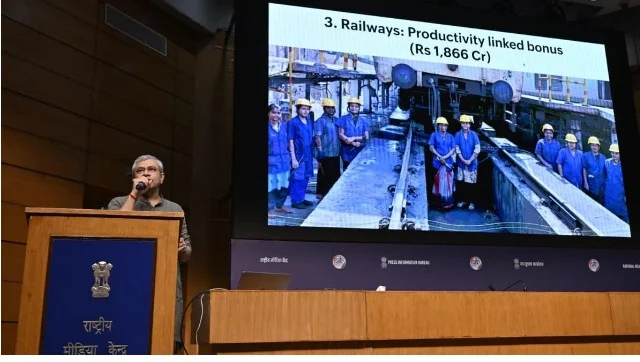
Railways Minister Ashwini Vaishnaw at the official press briefing announcing the productivity-linked bonus for railway employees. (Representative briefing photo)
Who Gets the Railway Bonus
The 78-day PLB goes to eligible non-gazetted railway employees — about 11.40 lakh of them. The categories named in the Cabinet release include:
- Track maintainers
- Loco pilots
- Train managers (guards)
- Station masters
- Supervisors
- Technicians and technician helpers
- Pointsmen
- Ministerial staff and other Group C staff
The Railway Board’s order (RBE No. 84/2026) excludes RPF and RPSF personnel. Also note: railway employees covered by the PLB scheme do not get the ₹6,908 ad-hoc bonus — the two schemes are mutually exclusive by design.
₹17,951 Maximum — How the Railway PLB Is Worked Out
The maximum payable to an eligible railway employee is ₹17,951 for 78 days. Like the ad-hoc bonus, it is calculated with a wage ceiling: where wages exceed ₹7,000 per month, the PLB is calculated as if wages were ₹7,000 per month. The payment is made in the same mode as salary payment, on a priority basis. The release also notes that SRPF subscribers may deposit the whole or part of their PLB into their State Railway Provident Fund account if they wish.
For context, last year the Cabinet cleared the same 78-day bonus at a total cost of ₹1,865.68 crore for 10,91,146 employees — the maximum per employee was also ₹17,951. This year’s outlay is ₹143.93 crore higher, reflecting the larger workforce covered.
Beware the Fake ₹41,149 Bonus Letter on WhatsApp
Days before the real announcement, a letter numbered RBE No. 101/2026 went viral on WhatsApp, promising a 78-day bonus of ₹41,149. The Railway Board flagged it as fake on October 7, 2026, noting it carried a forged signature. If anyone forwards you a bonus letter with a figure that looks too good to be true, check the Railway Board or PIB website before believing it. The genuine maximum is ₹17,951, not ₹41,149.
Bonus Kab Milega? Payment Dates Explained
This is the second most-asked question, and the answer differs for the two bonuses.
Railway employees: the Cabinet release says PLB is paid every year before the Durga Puja/Dussehra holidays, and this year is no different. With Dussehra already behind us and the approval dated October 14, disbursement happens on a priority basis — the money is paid in the same mode as your salary, so it should land with or shortly after your regular pay cycle.
Central government employees (₹6,908 ad-hoc bonus): the October 15 order does not fix a date by which the amount must be credited. In practice, offices process it alongside salary and pay it before Diwali — which falls on November 8, 2026 this year. The expenditure is met from within each ministry’s existing 2026-27 budget provision, so no fresh budget approval is needed to release it. If your office is slow, check with your DDO (Drawing and Disbursing Officer) or accounts section rather than waiting for a separate notification.
The short version: railway staff get it before the festive holidays as usual; other central staff should expect it in their account before Diwali, since there is nothing left to approve.
Diwali Bonus Eligibility: The Complete Rules
Let me lay out the eligibility conditions from the Department of Expenditure’s order in plain language, because “diwali bonus eligibility” is one of the top searches and the fine print matters:
- Service date: you must have been in service as on 31 March 2026.
- Minimum service: at least six months of continuous service during 2025-26. Service between six months and a full year gets a pro-rata bonus, counted in whole months.
- Covered categories: Group C employees and non-gazetted Group B employees of the central government who are not covered by any productivity-linked bonus scheme.
- Forces: eligible personnel of the Central Armed Police Forces and the Armed Forces are included.
- Union Territories: employees of UT administrations that follow the central government’s pattern of emoluments, where no other bonus or ex-gratia scheme applies.
- Casual labour: the separate 240-day/206-day rule over three years, as explained above.
- Special cases: staff who retired, were medically invalidated, or died before 31 March 2026 — but had at least six months of regular service in the year — still qualify on a pro-rata basis.
Nobody has to apply. Once the order is issued, your office calculates and pays it. If you meet the conditions and nothing arrives, your accounts section is the place to ask — not some website or agent.
Who Does NOT Get the Bonus
Equally important — here is who is left out of the ₹6,908 ad-hoc bonus:
- Gazetted Group B officers and all Group A officers are not covered.
- Anyone already covered by a productivity-linked bonus scheme (this is why railway PLB recipients do not get it).
- Part-time staff on nominal fixed payment.
- Employees on deputation to a state government, Union Territory or PSU as on 31 March 2026 — the borrowing organisation pays the bonus if it has its own scheme; the lending department does not.
- Employees whose UT administration or department runs its own bonus or ex-gratia scheme.
Central Govt vs Railway Bonus: Side-by-Side Comparison
| Feature | Central govt ad-hoc bonus | Railway PLB bonus |
|---|---|---|
| Type | Non-productivity-linked (ad-hoc) | Productivity-linked |
| Bonus days | 30 days | 78 days |
| Maximum per employee | ₹6,908 | ₹17,951 |
| Calculation ceiling | ₹7,000/month average emoluments | ₹7,000/month wages |
| Who is covered | Group C + non-gazetted Group B (not under PLB), CAPF, Armed Forces, eligible UT staff | ~11.4 lakh non-gazetted railway employees (RPF/RPSF excluded) |
| Total cost to government | Met from ministries’ existing budgets | ₹2,009.61 crore |
| Approved on | 15 October 2026 (DoE O.M.) | 14 October 2026 (Union Cabinet) |
| Paid by | Before Diwali (offices process with salary) | Before Durga Puja/Dussehra holidays, on priority |
DA Hike Before Diwali: What Is Actually Confirmed
You have probably seen headlines about a dearness allowance hike of around 3% taking DA to 63-64%, with arrears for three months. Let me be straight with you: the DA hike has NOT been announced as of now. Media reports (including the Financial Express) say central government employees are awaiting the July 2026 DA revision, but no government order has been issued.
Here is what is confirmed versus what is speculation:
- Confirmed: the ₹6,908 ad-hoc bonus (order dated October 15, 2026) and the railway 78-day PLB (Cabinet approval October 14, 2026).
- Not confirmed: any DA/DR revision figure. Reports of 63-64% DA and three months of arrears are media expectations, not government announcements.
- Context: the July 2026 DA revision would be the second instalment after the end of the 7th Pay Commission’s pay cycle. The government can continue revising DA under the existing framework until the 8th Pay Commission’s new pay structure is implemented.
The bonus and DA are two separate things — the bonus order was issued precisely while the DA announcement remains pending. Do not mix the two up, and do not treat a 3% hike as official until you see the Department of Expenditure’s order.
What About State Government Employees?
If you work for a state government, your Diwali bonus comes from your state’s own order, not from the Centre’s. As of the time of writing, no 2026 Diwali bonus orders from major states have been verified [VERIFY: check respective state finance department notifications for 2026]. Media reports in early October 2026 suggest states like Uttar Pradesh are considering announcements of around ₹3,400-₹7,000 along with a possible DA increase, but these are expectations, not orders.
For reference, last year (2025) Uttar Pradesh cleared a ₹1,022 crore Diwali bonus for 14.82 lakh state employees (up to ₹6,908 each, the same 30-day formula), Rajasthan approved an ad-hoc bonus for about 6 lakh employees, and Gujarat granted up to ₹7,000 to around 16,921 Class-4 employees. State bonuses usually follow the same 30-day, ₹7,000-ceiling pattern as the Centre’s, and they are typically announced in the two weeks before Diwali — so if your state has not announced yet, watch your state finance department’s notifications this week.
Diwali Bonus 2026 in Hindi
दिवाली बोनस 2026: केंद्र सरकार ने 15 अक्टूबर 2026 को Group C और गैर-राजपत्रित Group B कर्मचारियों के लिए ₹6,908 का एड-हॉक बोनस (30 दिन) मंजूर किया। रेलवे कर्मचारियों को 14 अक्टूबर 2026 को कैबिनेट के फैसले से 78 दिन का प्रोडक्टिविटी-लिंक्ड बोनस मिलेगा — अधिकतम ₹17,951 प्रति कर्मचारी, कुल ₹2,009.61 करोड़, लगभग 11.4 लाख कर्मचारियों को। बोनस पाने के लिए 31 मार्च 2026 को सेवा में होना और 2025-26 में कम से कम 6 महीने की निरंतर सेवा जरूरी है। DA बढ़ोतरी की अभी कोई आधिकारिक घोषणा नहीं हुई है — मीडिया रिपोर्टों को आधिकारिक आदेश न समझें।
What You Should Do Now
You do not need to apply anywhere — but a little homework makes sure you actually receive what you are owed:
FAQs: Diwali Bonus 2026
Q1. Diwali bonus kitna milega in 2026?
Eligible central government employees (Group C and non-gazetted Group B) get a maximum of ₹6,908 as the 30-day ad-hoc bonus. Eligible railway employees get up to ₹17,951 under the 78-day productivity-linked bonus. If your average monthly emoluments are below ₹7,000, or you served less than the full year, the amount will be proportionately lower.
Q2. Bonus kab milega?
Railway PLB is paid before the Durga Puja/Dussehra holidays every year, on a priority basis — so railway staff get it first. For other central government employees, the October 15 order sets no fixed date, but offices process it with salary and it is normally credited before Diwali (November 8, 2026).
Q3. Who is eligible for the ₹6,908 bonus?
Group C and non-gazetted Group B central government employees not covered by any PLB scheme, plus eligible CAPF and Armed Forces personnel and UT staff on the central pattern — provided you were in service on 31 March 2026 and completed at least six months of continuous service in 2025-26.
Q4. Railway diwali bonus me kaun eligible hai?
About 11.4 lakh non-gazetted railway employees — track maintainers, loco pilots, train managers, station masters, supervisors, technicians, pointsmen, ministerial staff and other Group C staff. RPF/RPSF personnel are excluded. The maximum is ₹17,951 for 78 days, at a total government cost of ₹2,009.61 crore.
Q5. Has the DA hike been announced before Diwali?
No. Media reports expect around a 3% increase (taking DA to roughly 63-64%) with arrears, but no government order has been issued. The bonus announcements are separate from DA — do not treat media expectations as confirmed.
Q6. Do I need to apply for the Diwali bonus?
No. There is no application form and no portal. Your office calculates the amount as per the order and credits it with your salary. If it does not arrive, follow up with your DDO or accounts section.
Sources
- PIB Delhi: “Cabinet approves Productivity Linked Bonus (PLB) for 78 days to Railway Employees” (14 Oct 2026, Release ID 2323256) — read the official release
- Department of Expenditure, Ministry of Finance: Office Memorandum F. No. 7/24/2007/E III (A) dated 15.10.2026 — “Grant of Non-Productivity Linked Bonus (ad-hoc bonus) to Central Government Employees for the year 2025-26”
How to Calculate YOUR Exact Diwali Bonus: 3 Worked Examples
The formula is simple, but “average monthly emoluments” trips people up. It means your average pay over the year 2025-26 — basically basic pay plus dearness allowance averaged across the twelve months — capped at ₹7,000. Let me work through three realistic cases so you can see where you land.
Example 1: Full-year clerk, average emoluments above the ceiling.
Ramesh is a Group C clerk who served all twelve months of 2025-26, and his average monthly emoluments are well above ₹7,000. His calculation uses the ceiling: ₹7,000 × 30 ÷ 30.4 = ₹6,907.89, rounded to ₹6,908. Full bonus.
Example 2: MTS with average emoluments of ₹6,200.
Sita is a multi-tasking staff member who served the full year, but her average monthly emoluments are ₹6,200 — below the ceiling. Her bonus is worked out on the actual figure: ₹6,200 × 30 ÷ 30.4 = ₹6,118.42, rounded to ₹6,118. This is the answer to “kitna milega” for everyone earning below the ceiling: the ₹6,908 is a cap, not a guarantee.
Example 3: Joined in September 2025 (7 months of service).
Amit joined as a Group C assistant in September 2025 and was in service on 31 March 2026. He qualifies — seven months is more than the six-month minimum — but gets a pro-rata share. At the ceiling: ₹6,908 × 7 ÷ 12 = ₹4,030 (the order counts eligibility in whole months, rounded to the nearest month). If his average emoluments are below the ceiling, the same fraction applies to his lower figure.
For railway employees the same ceiling logic applies, except the multiplier is 78 days instead of 30. At the ₹7,000 wage ceiling, 78 days works out to the ₹17,951 maximum the Cabinet announced.
Why the Railway Bonus Is Bigger Than the Central Bonus
If you are wondering why a railway track maintainer can get ₹17,951 while a central government clerk gets ₹6,908, the answer lies in the two different bonus systems the government runs.
The ad-hoc (non-PLB) bonus is a flat 30-day payment for employees who are not part of any productivity-linked scheme. It is essentially a festival-season payment the government sanctions every year through the Department of Expenditure. It does not depend on how your department performed.
The productivity-linked bonus (PLB), paid to railway employees, is tied to performance. The railways have their own PLB scheme under which the number of bonus days is decided each year based on the organisation’s results. This year the Cabinet fixed it at 78 days — the same as last year — explicitly citing the record 1,670 million tonnes of freight and 7.41 billion passengers carried in 2025-26. Because it is 78 days instead of 30, the payout is naturally much larger even though the ₹7,000 monthly ceiling is identical.
Other departments have their own PLB schemes too (for example, certain production units), and employees under those schemes get their department’s PLB instead of the ad-hoc bonus. Nobody gets both — that is the whole point of the “not covered by any PLB scheme” condition in the October 15 order.
The ₹7,000 Ceiling Has Not Changed Since 2006
Here is a fact that surprises most people: the ₹7,000-per-month calculation ceiling for the ad-hoc bonus has been in place since the 6th Pay Commission era — it has not moved even though pay scales have been revised twice since then. That is why the maximum ad-hoc bonus has been stuck at ₹6,908 for years.
Employee unions have noticed. The Confederation of Central Government Employees and Workers has been demanding that the ceiling be raised to ₹21,000 per month to reflect current minimum wages — at which the 30-day bonus would be over ₹20,000. As of now, no decision on raising the ceiling has been announced, and the October 15, 2026 order retains the ₹7,000 ceiling. Similarly, the railway unions (including the Indian Railways Technical Supervisors’ Association) have sought a higher ceiling for the PLB, but the Cabinet kept the existing formula this year too.
So if you see claims that “this year’s bonus is ₹20,000+”, treat them with the same scepticism as the fake ₹41,149 railway letter. Until the ceiling changes by a formal order, ₹6,908 and ₹17,951 remain the maxima.
Is the Diwali Bonus Taxable?
Yes. This is the question nobody asks until March, when the Form 16 arrives. Bonus — whether ad-hoc or productivity-linked — is taxable as salary income in the year you receive it. Your employer adds it to your salary and deducts TDS on it at your applicable slab rate, exactly like any other salary component.
Practically, this means the ₹6,908 that hits your account is the gross figure; the tax department treats it as part of your total income for FY 2026-27. If you are in the 20% slab, roughly a fifth of it goes to tax (your employer handles the TDS, so you do not need to do anything separately — but do check that it appears correctly in your Form 16 and AIS). One small silver lining: because it is salary income, standard deduction and your regime choice apply to it like the rest of your pay.
Transferred, On Deputation, or Changed Departments? Read This
The order’s annexure covers several situations that affect a lot of people in real life:
- On deputation as on 31 March 2026: if you were on deputation or foreign service with a state government, UT administration or PSU on that date, the lending (parent) department does not pay your bonus. The borrowing organisation pays it if it has its own bonus scheme; if it does not, you may miss out — check with both offices.
- Transferred between central government offices: your service across offices counts as continuous service for the six-month test, as long as there was no break. The office where you are posted on the payment date normally processes it.
- Regularised during the year: if you were regularised without completing six months of regular service, your earlier casual service can be combined with regular service to meet the qualifying requirement, as per the annexure’s regulation points.
- Part-year in two departments: the bonus is paid once. If two offices are involved, they coordinate so you are not paid twice — and you should not claim from both.
If any of these apply to you, do not assume the payment will happen automatically. A short written query to your current accounts section, citing the October 15, 2026 O.M., is the fastest way to get clarity.
Diwali Bonus 2026: Key Dates Timeline
To keep everything in one place, here is the sequence of events as they happened:
- 7 October 2026: Railway Board flags the viral “RBE No. 101/2026” letter promising a ₹41,149 bonus as fake.
- 14 October 2026: Union Cabinet approves the 78-day productivity-linked bonus for 11,40,770 railway employees (₹2,009.61 crore total, up to ₹17,951 each). The PIB release follows the same evening.
- 15 October 2026: Department of Expenditure issues O.M. F. No. 7/24/2007/E III (A) sanctioning the 30-day ad-hoc bonus (maximum ₹6,908) for eligible Group C and non-gazetted Group B central government employees.
- Late October 2026: Railway PLB disbursement begins on a priority basis, ahead of the festive holidays; central government offices start processing the ad-hoc bonus with salary.
- 8 November 2026: Diwali — by which time both bonuses should have reached eligible employees’ accounts.
If your state government announces its own Diwali bonus this week, add that date to this timeline — and send me a message, because I will update this guide with the verified figures.