The first time I tried to buy an Apple share from my apartment in India, I genuinely thought it would take ten minutes. A friend had casually said, “Just open a Vested account, bro.” What followed was a three-day spiral through LRS limits, W-8BEN forms, forex markups, and a TCS surprise that almost made me give up entirely. I’m glad I pushed through — but I wish someone had walked me through the actual sequence, with the gotchas, before I started.
This article is that walkthrough. The 2026 version — with the latest platform comparison, the post-2024 tax reality, and the step-by-step sequence that actually works for a beginner sitting in India.

By the end, you’ll know which platform to pick, how much it’ll really cost you (forex + commission + tax), and the three mistakes that quietly drain returns for most first-time Indian US-stock investors.
Why Indian Investors Are Looking at US Stocks in 2026
There’s a reason every other conversation in my investing circle ends up mentioning Nvidia, Alphabet, or Microsoft. India’s NSE gives you fantastic companies — Reliance, HDFC, Infosys, TCS — but the global AI, cloud, and SaaS revolution is overwhelmingly listed in New York.
Five things pull Indian investors to US markets in 2026:
But “buying US stocks from India” is a phrase that hides a lot of friction. The next sections unpack each layer.
The Legal Framework: LRS, $250,000 Limit, and the 20% TCS Gotcha
Before you download any app, understand the one rule that makes the whole thing legal: LRS — the Liberalised Remittance Scheme.
LRS is an RBI rule that allows resident Indians to remit up to $250,000 per financial year outside India for permitted purposes — and investing in foreign stocks is explicitly permitted.
Three things to know about LRS:
- Per PAN, per financial year — the limit is per individual. Couples with separate PANs can each remit $250K.
- Permitted current + capital account transactions — equity investments in US markets are allowed.
- Only through authorised channels — bank wire, authorised dealer, or licensed Indian fintechs that route via authorised dealer banks.
The gotcha that catches almost every beginner is TCS — Tax Collected at Source.
Under the post-2024 rules, foreign remittances for investments (other than education and medical) attract 20% TCS on amounts above ₹7 lakh per financial year.
Here’s what that means in real money:
- You remit ₹5 lakh for US stocks in a year → 0% TCS
- You remit ₹10 lakh → 20% TCS on ₹3 lakh = ₹60,000 collected upfront
- That ₹60,000 is refundable when you file ITR (if your total income is below the taxable slab), but until then it’s locked with the government and unavailable to invest.
Practical tip most retail investors use: remit monthly in tranches that stay under ₹7L so TCS doesn’t kick in. The platforms automate this for you — they call it “periodic remittance” or “LRS scheduling.”
3 Best Platforms to Buy US Stocks from India (2026 Compared)
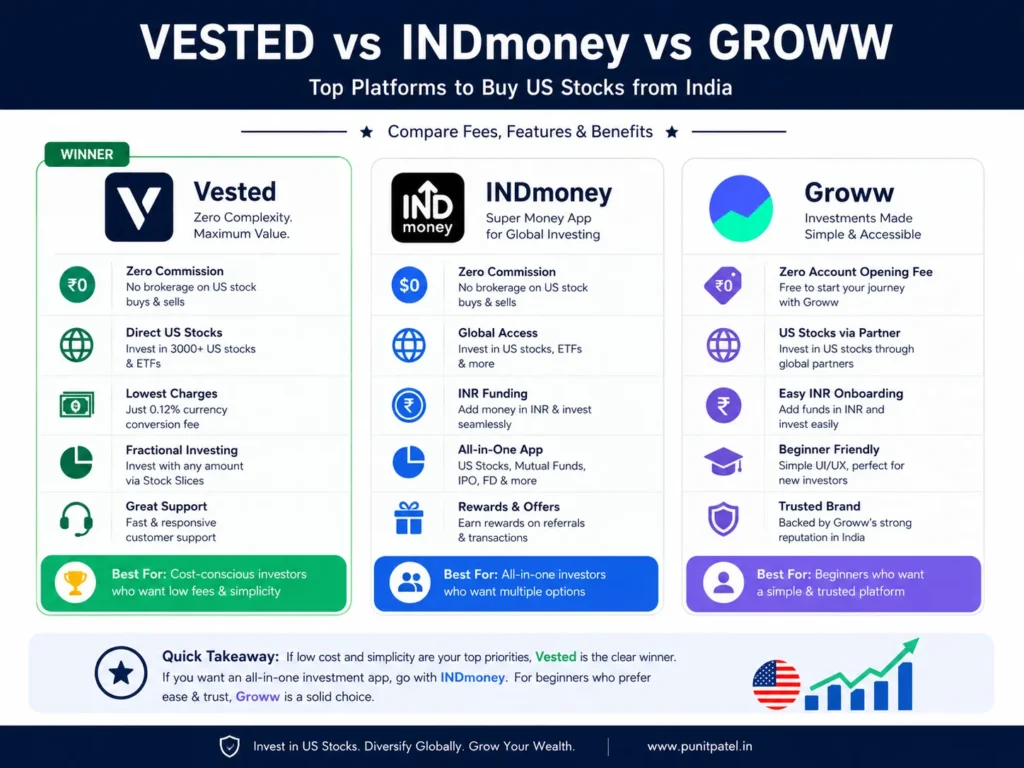
There are really only 3 platforms most Indian retail investors should choose between. Here’s an honest 2026 comparison.
| Feature | Vested | INDmoney | Groww (US Stocks) |
|---|---|---|---|
| Regulatory model | US broker (DriveWealth partnership) | US broker partnership | GIFT City IFSC route |
| Account opening fee | Free | Free | Free |
| Commission per trade | $0 (free tier) / $0.99 (premium) | $0 typical | ₹0 / small fee per order |
| Forex markup (approx) | ~0.5–1% | ~0.5–1% | ~0.5% |
| Fractional shares | Yes | Yes | Yes |
| W-8BEN handled for you | Yes | Yes | Yes |
| Indian tax P&L reports | Manual | Built-in | Built-in |
| Best for | Long-term US investors | All-asset tracker + investor | If you’re already a Groww user |
My honest take on each:
- Vested — the most “US-feel” experience. Clean app, dollar-cost-averaging SIP feature, great if you specifically want to build a US-only portfolio over time.
- INDmoney — the best all-in-one tracker. If you want to see Indian MFs + US stocks + crypto + FDs in one dashboard, this is it. Built-in ITR support is underrated.
- Groww (US Stocks) — lowest friction if you’re already using Groww for Indian mutual funds. Smaller product, but the mental overhead of adding “another app” disappears.
One footnote for high-volume traders moving more than $1L a year: Interactive Brokers, routed through an Indian advisor, gives lower per-trade commissions and access to more global markets. But the paperwork is heavier, and the UI is dated. Skip for now if you’re starting with under ₹5 lakh.
Step-by-Step: Your First US Stock Purchase in 2026
The exact click path for buying your first US share from India. I’m using Vested as the example, but the flow on INDmoney and Groww is nearly identical.
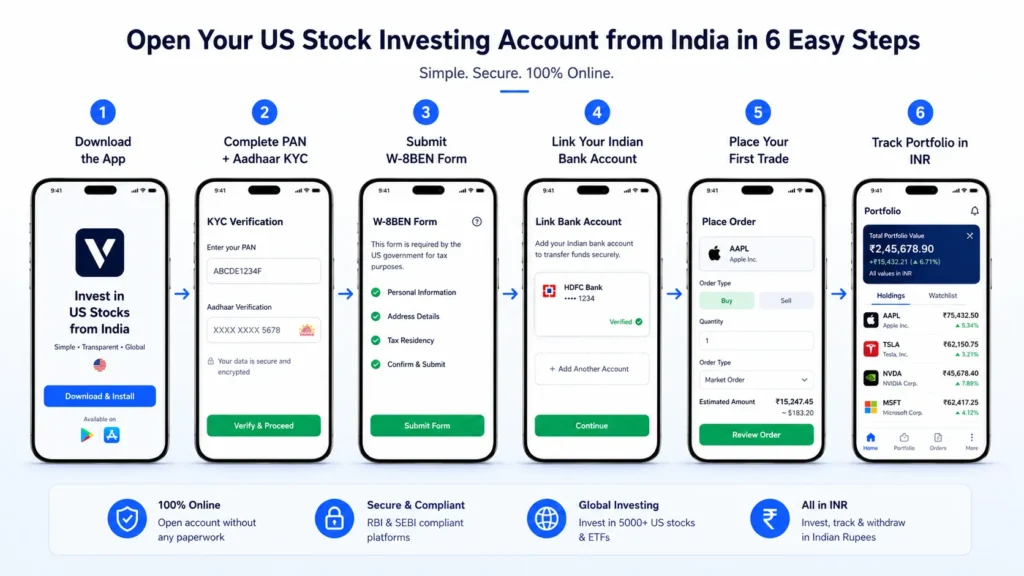
Step 1 — Pick your platform and download the app. For most beginners, Vested or INDmoney is the fastest onboarding. Both are SEBI-registered and RBI-compliant for the remittance piece.
Step 2 — Sign up and complete KYC. PAN, Aadhaar, Indian bank account, a selfie, and a short video KYC. Takes 5–10 minutes if your documents are clean. Have your PAN card photo ready.
Step 3 — Submit the W-8BEN form. This is the IRS form that tells the US government “I’m not a US taxpayer, please don’t withhold 30% on my dividends.” Every legitimate platform walks you through this digitally. Skip this step, and you’ll lose 30% of every dividend to the IRS — forever.
Step 4 — Add money via LRS. Link your Indian savings account. The platform initiates an LRS-compliant remittance through an authorised dealer bank. You’ll see the INR→USD conversion rate and the forex markup clearly before you confirm. Most platforms let you set up a monthly auto-remittance so you don’t have to think about it.
Step 5 — Place your first trade. Search for the ticker — AAPL for Apple, NVDA for Nvidia, MSFT for Microsoft, GOOGL for Alphabet. Enter the amount in USD or the number of shares (whole or fractional). Confirm. The order routes to NASDAQ or NYSE and fills within seconds during market hours.
Step 6 — Track in INR. The platform shows your portfolio in both USD and INR. Pin the INR value to the top. That number is your real return after currency moves.
The whole process end-to-end is honestly 30 minutes if your KYC documents are clean. After the first time, repeat trades take under 60 seconds.
The Real Cost: Forex Markup, Commission, and Hidden Fees
This is the section I wish I’d read before my first trade. The costs are small individually, but they compound.
1. Forex markup (0.5–1.5% per conversion): Every time you convert INR to USD, the platform (or its banking partner) takes a small cut above the interbank rate. ₹50,000 at 1% markup = ₹500 silently lost. Across 20 trades a year, that’s ₹10,000 gone before you invested it.
2. Commission per trade ($0 – $1): Most platforms are zero-commission on the free tier. Premium tiers might charge $0.99. For monthly SIPs, this adds up — pick a platform with $0 commissions if you’re doing ₹5K–₹10K monthly.
3. Currency conversion spread: Hidden inside the forex rate itself. Worse on weekends when markets are thin, slightly better mid-week.
4. TCS (20% above ₹7L per FY) Already covered above. Refundable on ITR filing.
5. Dividend withholding (typically 15% with W-8BEN): The US withholds a percentage on dividends as per the India-US tax treaty. You claim this as a foreign tax credit in your Indian ITR.
6. Indian capital gains tax: Covered in the next section.
Realistic all-in cost for a ₹50,000 investment, held 1 year, no dividend:
- Forex markup: ~₹500
- Commission: ₹0–80
- TCS: ₹0 (under ₹7L) or ₹8,600 (above)
- Indian tax on 12% gain: ~₹600 (LTCG) or slab rate (STCG)
The visible cost is small. The invisible cost — forex + tax friction + dividend withholding — is the part most beginners miss. Build it into your expected return calculations from day one.
Tax Rules for US Stocks for Indian Residents
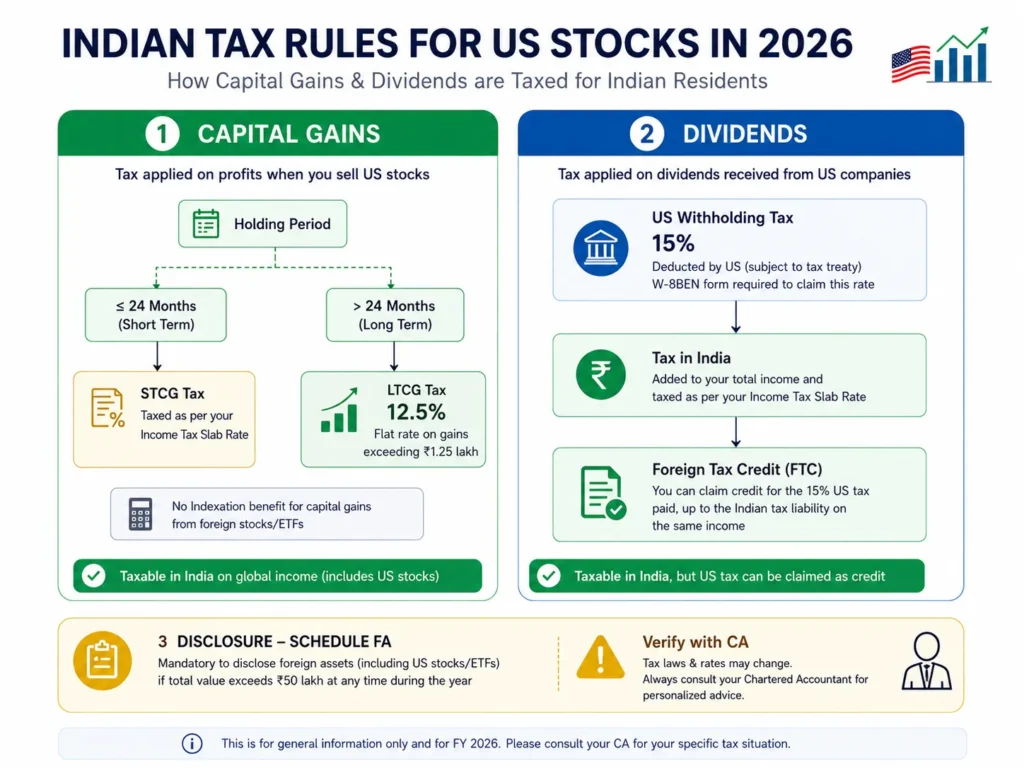
The Indian tax treatment of US stocks is where most first-timers get it wrong. Three rules to know:
1. Capital gains tax
If you bought US stocks through an LRS-compliant remittance:
- Short-term (held < 24 months for unlisted foreign equities): gains taxed at your income tax slab rate.
- Long-term (held > 24 months): taxed at 12.5% without indexation under the post-July 2024 rules.
2. Dividend taxation
US companies pay dividends in USD. Before the money hits your account, the US withholds a portion (typically 15% if you signed a W-8BEN under the India-US DTAA). The remaining amount is yours — but in India, you must add the gross dividend to your income and pay tax at your slab rate. You can claim the 15% US withholding as a foreign tax credit (FTC) in your ITR. The India-US DTAA prevents you from being taxed twice.
3. Reporting in ITR — Schedule FA
If you hold foreign assets at any time during the financial year, you must disclose them in Schedule FA (Foreign Assets) of your Indian ITR. Penalties for non-disclosure can be severe — the bare-minimum reporting fine is in the lakhs. Most platforms now export a CSV file you can attach to your return.
A qualified CA who handles NRI/foreign-asset cases is worth the ₹3–5K fee for your first year. Don’t try to DIY Schedule FA in year one if your situation is non-trivial.
5 Mistakes That Quietly Drain Returns
I’ve personally made at least three of these. Learn from my laziness.
1. Skipping W-8BEN. The default US withholding is 30% on dividends. Without W-8BEN, you lose 30% of every dividend. Forever. Submit it on day one of account opening — most platforms will literally not let you trade without it.
2. Ignoring TCS. Remit ₹10 lakh in one go and 20% of the over-₹7L portion disappears into the government coffers until you file your ITR. Plan your remittances to stay under ₹7L per tranche, or accept the lockup. Monthly auto-remittance is your friend.
3. Chasing the cheapest commission platform and getting hit by forex markup. A platform with $0 commission but 1.5% forex markup costs you more than one with $0.99 commission and 0.5% markup. Read the fine print on the conversion fee, not just the headline commission.
4. Treating US stocks like Indian stocks for tax. US dividends are pre-taxed. Indian tax is on the gross amount. The 15% US withholding is a credit against your Indian tax — not a refund. Don’t expect to receive the 15% back as cash.
5. Not disclosing in ITR / Schedule FA. The penalty for non-disclosure is up to ₹10 lakh in some cases. Just do it. Most platforms give you a one-click export of your transactions.
FAQ — Questions Indian Investors Ask Most
Q1. Is it legal for an Indian resident to buy US stocks?
Answer: Yes. Under RBI’s Liberalised Remittance Scheme (LRS), a resident individual can remit up to $250,000 per financial year for permitted capital account transactions, which includes foreign equity investment. You just need to do it through an authorised dealer bank or a regulated Indian platform.
Q2. What’s the minimum amount I need to start?
Answer: Most platforms allow you to start with as little as $1 via fractional shares. For practical purposes, ₹5,000–₹10,000 is a sensible first investment. Just budget for the forex markup and the platform’s minimum ticket size.
Q3. Do I really need to file W-8BEN?
Answer: Yes. Without it, the US IRS withholds 30% on every dividend, and 24% backup withholding on certain sale proceeds. W-8BEN reduces the dividend withholding to typically 15% under the India-US DTAA. Every legitimate platform makes it a one-time digital form during onboarding.
Q4. Can I buy fractional shares of US stocks from India?
Answer: Yes. All three major Indian platforms (Vested, INDmoney, Groww) support fractional shares. You can own 0.05 of a Nvidia share for a few thousand rupees. This is the easiest way to diversify small monthly SIPs across multiple US stocks.
Q5. What happens to my US stocks if I move abroad or become an NRI?
Answer: Your existing US holdings typically don’t need to be sold. But your tax treatment changes — you may need to file US taxes if you hold certain work visas, and Indian reporting changes too. If this applies, get a CA’s help before you move. Do not assume the LRS route continues seamlessly.
Q6. Is it better to invest in US stocks or Indian mutual funds?
Answer: Different roles. Indian mutual funds give you India exposure at the lowest cost. US stocks give you global exposure and a dollar hedge. Most serious investors do both — a Nifty 50 index fund SIP for the India core, plus a small US allocation (say 10–20% of equity) for diversification.
My One-Line Takeaway
If you can wire a fixed amount in USD every month without checking the rupee-dollar rate, you’ll outperform 90% of Indian retail investors in five years.
The boring SIP works in every market. The forex is just a different price tag.
If this helped, bookmark it — platform fees and tax rules change every year, so this article will be updated annually. Got a specific US stock or ETF you want me to break down next? Drop it in the comments, and I’ll cover the most-upvoted one in the next piece. Take a few minutes to read our in-depth How to Delete Instagram & coverage. We answer the most common questions about Gmail Account Login in this guide.