Thinking of registering your small business but confused by all the conflicting advice online? You are not alone. Every week, thousands of shop owners, freelancers, manufacturers, and service providers search for udyam aadhar registration — and land on outdated blogs quoting old investment limits or, worse, agent websites charging ₹1,500 for something the government does free.
This guide fixes that. You will get the complete, updated-for-2026 process: the new MSME limits that changed in April 2025, the exact documents you need (spoiler: almost none), the step-by-step form walkthrough, the NIC code mystery explained, and the real benefits — including how that certificate actually helps you get a business loan. Let’s get into it.
What Is Udyam Aadhar Registration?
Udyam Registration is the government’s official system for recognising Micro, Small and Medium Enterprises (MSMEs) in India. It replaced the older Udyog Aadhaar Memorandum (UAM) system in July 2020. When you complete udyam aadhar registration, you receive a permanent Udyam Registration Number (URN) and a digital certificate with a QR code — valid for the lifetime of your enterprise, with no renewal needed.
Think of it as your business’s official identity card in the eyes of the government. Banks ask for it when you apply for MSME loans. Tender portals ask for it when you bid on government contracts. Subsidy schemes ask for it before releasing a single rupee. Without it, you are invisible to the entire MSME support ecosystem.
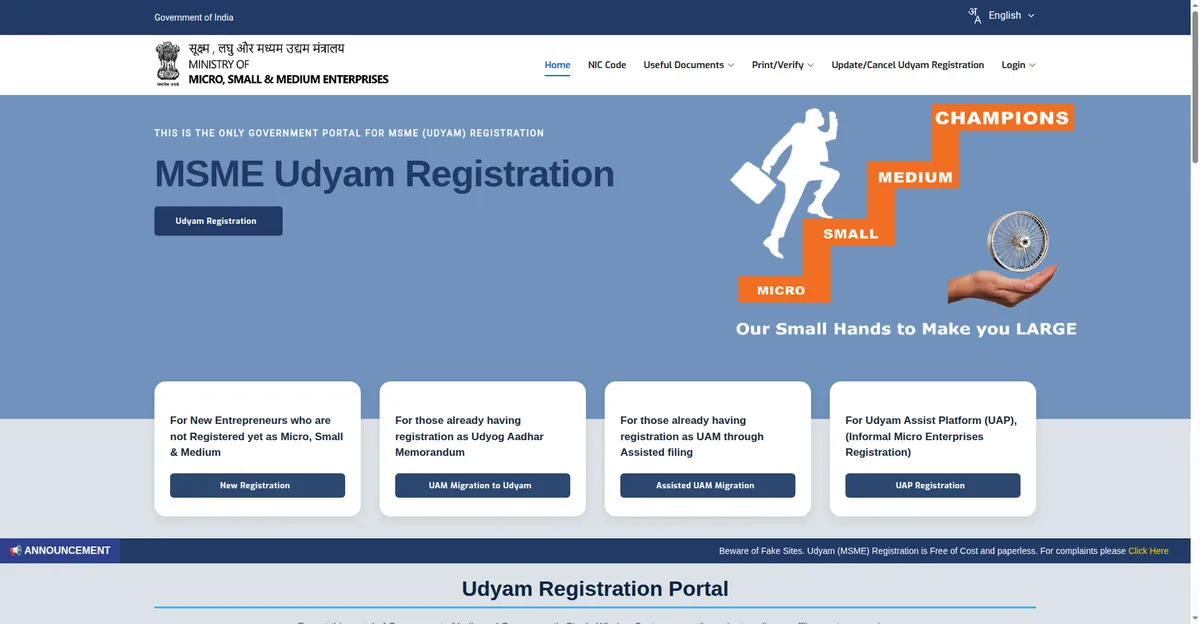
The registration happens only on one official portal: udyamregistration.gov.in, run by the Ministry of Micro, Small and Medium Enterprises. There is no other authorised website. If any site with a similar name asks for payment, close the tab — you are on the wrong site.
New MSME Limits From April 2025 (Important Update)
Here is the part most blogs get wrong. In Union Budget 2025, Finance Minister Nirmala Sitharaman announced revised MSME classification limits, notified through Notification S.O. 1364(E) dated 21 March 2025 and effective from 1 April 2025. Investment limits went up 2.5 times; turnover limits doubled.
| Category | Investment in Plant & Machinery / Equipment | Annual Turnover |
|---|---|---|
| Micro | Up to ₹2.5 crore | Up to ₹10 crore |
| Small | Up to ₹25 crore | Up to ₹100 crore |
| Medium | Up to ₹125 crore | Up to ₹500 crore |
Three rules decide your category:
- Composite criteria: You must satisfy both the investment and turnover limits for a category. Breach either one, and you move up a category.
- Exports don’t count: Export turnover is excluded from the annual turnover calculation — so exporting more never pushes you out of MSME status.
- Investment means WDV: Investment is measured as the Written Down Value of plant, machinery and equipment at the end of the financial year (per Income Tax rules). Land and buildings are not included.
Why does this matter for your udyam aadhar registration? Because businesses that were about to outgrow the old limits now keep their MSME status — and their access to cheaper loans, subsidies and tender preferences. If you checked your eligibility before April 2025 and thought you didn’t qualify, check again.
Udyog Aadhar vs Udyam: What Changed?
If you registered under the old Udyog Aadhaar Memorandum (UAM) system, that registration is no longer valid for claiming MSME benefits. You must migrate to Udyam. The differences are significant:
| Feature | Udyog Aadhaar (Old) | Udyam (Current) |
|---|---|---|
| Verification | Self-declaration only | Auto-verified against PAN, GST & ITR databases |
| PAN / GSTIN | Optional | PAN mandatory; GSTIN required if GST-registered |
| Classification basis | Investment only | Investment + turnover (composite) |
| Certificate | Simple acknowledgement | QR-coded e-certificate, lifetime validity |
Migration is straightforward: on the portal, choose the option for existing UAM holders, enter your old UAM number, verify with Aadhaar OTP, fill in the missing PAN/GST details, and submit. Your new Udyam certificate replaces the old registration.
Who Can Apply for Udyam Registration?
Any enterprise engaged in manufacturing or service activities that fits within the MSME investment and turnover limits can register. This covers:
- Sole proprietorships, partnerships, LLPs, private limited companies and cooperatives
- Manufacturers, traders of manufactured goods, and service providers — from a home-based tailoring unit to a 50-person software firm
- New businesses and existing businesses alike
One enterprise gets exactly one Udyam Registration — but you can list multiple business activities (manufacturing and services) under that single registration. If you are unsure whether your specific activity qualifies (for example, certain trading activities), the portal itself will confirm your category during the form flow — always verify there rather than trusting a third-party blog.
Documents Required for Udyam Aadhar Registration
Here is the pleasant surprise: no physical documents need to be uploaded. The entire process is paperless and based on self-declaration, with the portal auto-fetching data from government databases. Keep these details ready before you start:
- Aadhaar number of the proprietor, partner, or authorised director — with the mobile number linked to it (OTP comes here)
- PAN of the business or individual — mandatory; the portal validates it and pulls financial data
- GSTIN — required if your business is registered under GST
- Bank details — account number and IFSC code
- Business details — name, type of organisation, official address, date of commencement
- NIC code — the classification code for your main business activity (explained below)
- Investment and turnover figures — self-declared; cross-checked against ITR/GST data for existing businesses
NIC Codes Explained (Don’t Skip This)
The NIC (National Industrial Classification) code tells the government what your business actually does. It is a numeric code — 2, 4 or 5 digits — and picking the wrong one is the most common reason applications get flagged.
- The portal has a built-in NIC code search. Type a keyword describing your activity (e.g., “restaurant”, “software”, “textile”) and pick the closest match.
- Choose the code for your primary activity — the one generating most of your revenue. You can add secondary activities too.
- Example: a bakery would look under food manufacturing codes; a digital marketing freelancer under advertising/professional service codes.
- When in doubt, pick the broader 2-digit division rather than an over-specific 5-digit class that doesn’t quite fit.
Step-by-Step: How to Complete Udyam Aadhar Registration Online
The whole process takes 10–15 minutes if your details are ready. Every step happens on udyamregistration.gov.in.
Step 1: Open the Portal and Choose New Registration
On the homepage, click “For New Entrepreneurs who are not Registered yet as MSME” (or the equivalent new-registration option). If you hold an old UAM, use the migration option instead.
Step 2: Aadhaar Verification via OTP
Enter the Aadhaar number of the proprietor/partner/director and the name exactly as printed on the Aadhaar card. Click validate — an OTP arrives on the Aadhaar-linked mobile number. Enter it to proceed. No OTP, no registration: if your mobile isn’t linked to Aadhaar, update it at an Aadhaar centre first.
Step 3: Enter PAN Details
Enter the PAN of the enterprise. The portal validates the PAN live and, for existing businesses, auto-fetches investment and turnover information from Income Tax and GST databases. This is why the system trusts self-declaration — it cross-checks you silently>.
Step 4: Fill in Business Information
Complete the Udyam form: type of organisation, business name and trade name, official address, bank account details, date of commencement, number of employees, and your NIC code(s) for business activity. Double-check spellings — this data prints directly on your certificate.
Step 5: Declare Investment and Turnover
Enter your investment in plant & machinery/equipment and annual turnover. The portal classifies you as micro, small or medium automatically based on the April 2025 limits. For new businesses with no turnover yet, declare current figures honestly.
Step 6: Final Verification and Submit
Review the declaration carefully, complete the final OTP verification (sent to the PAN-linked mobile), and submit. Your Udyam Registration Number (URN) is generated immediately, and the e-certificate with QR code is emailed to you and available for instant download.
Udyam Aadhar Registration Fees: It’s Free (Beware of Agents)
Let me be blunt: the government charges zero fees for Udyam registration. Not for micro, not for medium — for nobody. The entire process on the official portal is free.
So why do so many sites charge ₹999–₹1,999 for “Udyam registration services”? Because confused business owners Google the term, click the top ad (often a lookalike domain like udyamregistration.org), and pay a middleman to fill the same free form. These consultants add no government validity — the certificate is identical either way.
Red flags: any site demanding payment for the registration itself, countdown timers pressuring you to “register before the deadline” (there is no deadline), or claims that you need a consultant for approval. The only cost you should ever pay is if you voluntarily hire a CA to organise your paperwork — and that is your choice, not a government requirement.
Benefits of the Udyam Certificate for Small Businesses
A certificate sitting in your email is useless until you use it. Here is what it actually gives you access to:
1. Easier Business Loans
Banks and NBFCs have dedicated MSME loan products with lower interest rates and relaxed eligibility for Udyam-registered enterprises. More importantly, you become eligible for collateral-free loans backed by the Credit Guarantee Fund Trust for Micro and Small Enterprises (CGTMSE) — meaning you don’t have to pledge property to borrow. (Full loan section below.)
2. Government Subsidies and Schemes
Dozens of central and state schemes — technology upgradation subsidies, marketing assistance, skill development reimbursements — require Udyam registration as the entry ticket. No certificate, no application.
3. Protection Against Delayed Payments
Under the MSMED Act, buyers must pay MSME suppliers within 45 days. If they don’t, you can approach the Micro and Small Enterprises Facilitation Council, and the buyer owes compound interest at three times the RBI rate. Separately, Section 43B(h) of the Income Tax Act disallows buyers from claiming unpaid MSME dues as expenses — a powerful incentive for them to pay you on time.
4. Priority in Government Tenders
On the Government e-Marketplace (GeM) portal, registered MSMEs get tender preferences, exemption from earnest money deposits in many cases, and price preferences. For a small manufacturer, this is a direct pipeline to government buyers.
5. Tax and Compliance Benefits
Various state governments offer stamp duty exemptions, electricity tariff concessions and octroi benefits to registered MSMEs. Your CA can map the ones applicable in your state.
6. ISO Certification Reimbursement
The government reimburses a significant portion of ISO certification expenses for Udyam-registered enterprises — useful when enterprise clients demand certified vendors.
Get Business Loans Faster With Your Udyam Certificate
Let’s talk about the benefit most business owners actually care about: money. Over 1 crore MSMEs are registered on the Udyam portal, employing 7.5 crore people and contributing roughly 36% of India’s manufacturing output and 45% of exports (Budget 2025 figures). Lenders know these numbers — which is why fintech companies and banks actively chase Udyam-registered borrowers.
Here’s what changes once you hold the certificate:
- Faster approvals: Your enterprise identity is pre-verified against government databases, so lenders skip half their due diligence.
- Collateral-free options: CGTMSE-backed loans mean machinery or property pledges aren’t mandatory for qualifying borrowers.
- Better rates: MSME-tagged loans typically carry interest rates 1–3% lower than generic business loans.
- Higher limits: With the April 2025 limits, a business with turnover up to ₹10 crore still counts as “micro” — keeping you inside the most favoured lending bracket longer.
Your Udyam certificate is step one. Step two is comparing business loan offers — interest rates, processing fees and approval times vary wildly between lenders. Check current MSME loan options from leading banks and NBFCs, and pick the one that fits your cash flow. A 1% rate difference on a ₹10 lakh loan saves you thousands every year.
Tip: never pay an “advance fee” to any loan agent promising guaranteed approval. Legitimate lenders deduct processing fees from the disbursed amount or charge them transparently — anyone demanding cash upfront is running a scam.
Common Mistakes to Avoid in Udyam Aadhar Registration
- Using a lookalike website: Only udyamregistration.gov.in is official. Bookmark it. Everything else is a private service.
- Wrong NIC code: A garment trader selecting a manufacturing code creates mismatches with GST data. Use the portal’s search and pick carefully.
- Name mismatch with Aadhaar: The proprietor name must match the Aadhaar card exactly — including spelling and initials. Mismatches fail OTP validation.
- Skipping PAN: PAN is mandatory since 2021. “I’ll add it later” doesn’t work — the form won’t submit without valid PAN verification.
- Creating multiple registrations: One enterprise = one Udyam registration. Multiple URNs for the same PAN get flagged and can invalidate your benefits.
- Never updating details: If your turnover crosses into the next category, update your Udyam profile. Operating on stale classification data causes problems during loan verification.
- Paying “registration fees”: As covered above — the government charges nothing. Any fee is going to a middleman.
Udyam Certificate Download and Management
After registration, your e-certificate (with QR code and URN) is emailed to your registered address and can be re-downloaded anytime from the portal using your Udyam number and registered mobile OTP. Print a copy for your office file, and keep a PDF handy — banks, GeM and scheme portals all accept the digital version.
The certificate never expires, but update your profile when investment or turnover changes materially. Reclassification between micro/small/medium happens automatically based on your latest declared figures.
Frequently Asked Questions
Is Udyam registration mandatory for small businesses?
Not legally compulsory — nobody will fine you for not registering. But it is practically essential: without it you cannot access MSME loans, subsidies, GeM tenders or delayed-payment protection. For most small businesses, the 15 minutes it takes pay for themselves many times over.
Is there any fee for Udyam aadhar registration?
No. Registration on the official portal (udyamregistration.gov.in) is completely free and paperless. Any website charging a “registration fee” is a private middleman, not the government.
What is the difference between Udyog Aadhaar and Udyam registration?
Udyog Aadhaar (UAM) was the old self-declaration system discontinued in 2020. Udyam is the current system with PAN/GST-based auto-verification, composite investment-plus-turnover classification, and a QR-coded lifetime certificate. Old UAM holders must migrate to Udyam to keep claiming MSME benefits.
Can I get more than one Udyam registration for multiple businesses?
No. One enterprise (one PAN) gets one Udyam Registration Number. However, you can include multiple business activities — manufacturing and services — under that single registration.
Do I need to renew my Udyam certificate?
No renewal is needed. The certificate is valid for the lifetime of the enterprise. You only need to update your details if your investment or turnover changes enough to shift your micro/small/medium classification.
How does Udyam registration help in getting a business loan?
Banks and NBFCs offer dedicated MSME loan products to Udyam-registered enterprises — typically with lower interest rates, faster approvals and collateral-free options under the CGTMSE guarantee scheme. Your verified enterprise identity reduces the lender’s risk, which translates directly into better loan terms for you.
Final Thoughts
Udyam aadhar registration is one of those rare government processes that is genuinely free, fast and useful. Fifteen minutes on the official portal gives you a lifetime certificate that opens doors to cheaper credit, government tenders, subsidies and legal protection against late payments. With the April 2025 limits now covering businesses up to ₹125 crore investment and ₹500 crore turnover, more enterprises qualify than ever before.
Do it yourself on udyamregistration.gov.in — don’t pay a middleman for a free form. And once the certificate is in your inbox, put it to work: talk to your bank about MSME loan products, register on GeM, and explore the subsidies your state offers. That certificate only earns its keep when you use it.
Once you finish your udyam aadhar registration, take two more smart steps. If you are a student or recent graduate, apply for the PM Internship Scheme to gain work experience while your udyam aadhar registration is active. Also secure your retirement with the Atal Pension Yojana. Keep your udyam aadhar registration details updated as your business grows — a current udyam aadhar registration keeps unlocking loans, subsidies, and tender benefits every year, so treat your udyam aadhar registration as a living business asset.