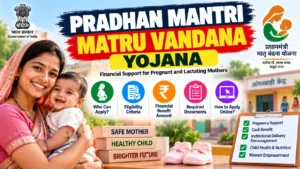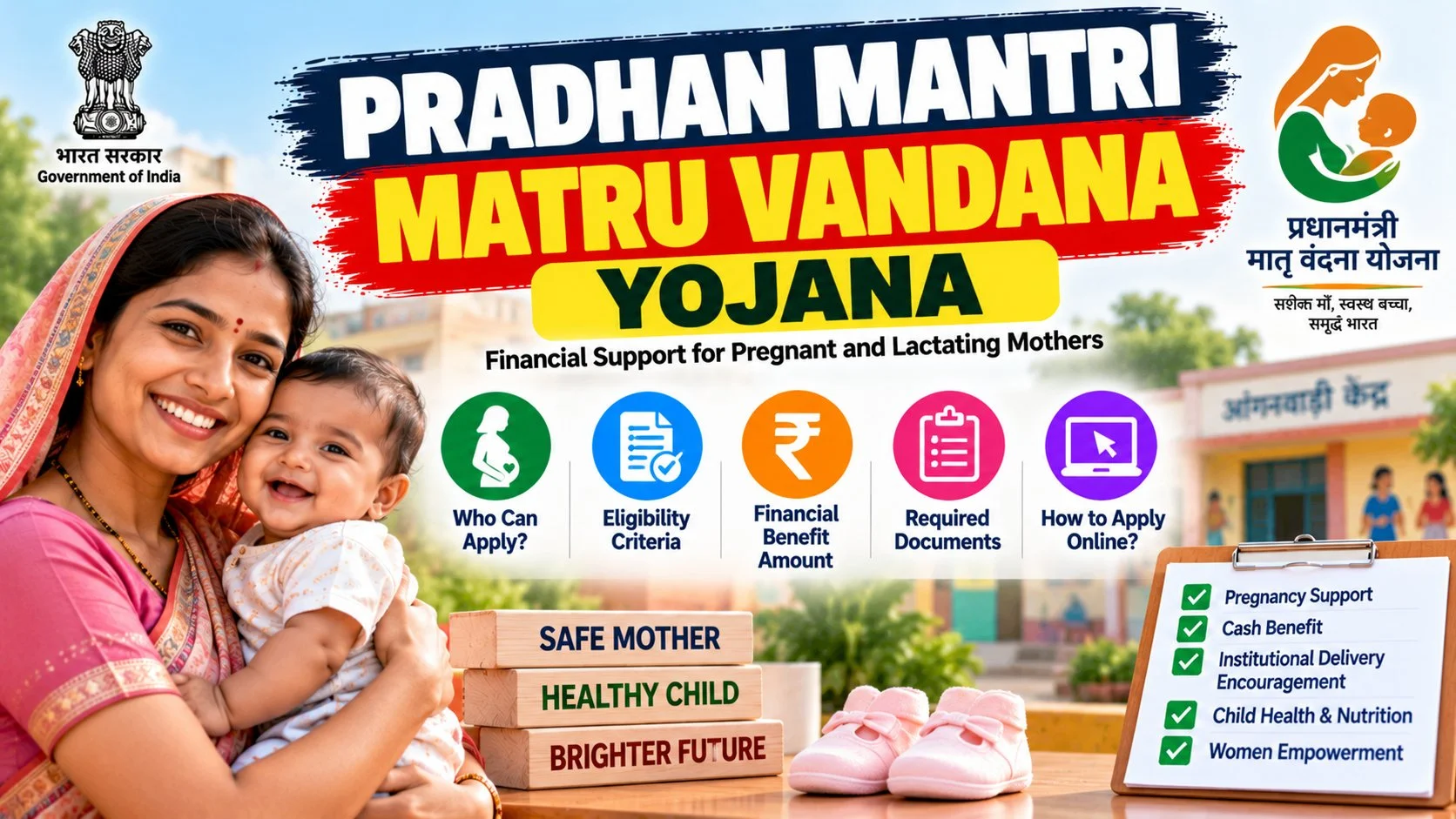

Did you know the government gives ₹5,000 directly to pregnant women — and ₹6,000 more if the second child is a girl? It’s called the Pradhan Mantri Matru Vandana Yojana (PMMVY), and it’s designed to make sure no woman has to choose between earning wages and taking care of her health during pregnancy.
✅ This guide is based on official government sources and notifications. Last verified: October 12, 2026. Scheme details, eligibility criteria, and benefit amounts are revised by the government from time to time — always cross-check the latest information on the official portal before applying.
The pradhan mantri matru vandana yojana gives Rs.5,000 to pregnant and lactating mothers. This pradhan mantri matru vandana yojana guide covers eligibility, how to apply, documents needed, and payment status check — all explained simply.
Whether you’re expecting your first child or planning for a second, this article covers everything — how much you get, when each installment arrives, who qualifies, what documents you need, and exactly how to apply both online and at your nearest Anganwadi centre.
What Is Pradhan Mantri Matru Vandana Yojana?
The Pradhan Mantri Matru Vandana Yojana (PMMVY) is a centrally sponsored maternity benefit scheme launched on 1 January 2017 under the Ministry of Women and Child Development. It provides cash incentives to pregnant and lactating women to compensate for wage loss during pregnancy and after delivery.
The logic is straightforward: many women in informal employment lose income when they take rest during pregnancy. Without financial support, they’re forced to work through pregnancies or skip antenatal check-ups — both dangerous for mother and child. PMMVY puts money directly in their hands so they can afford to rest, eat well, and seek proper medical care.
The scheme operates under the provisions of the National Food Security Act, 2013, which mandates maternity entitlements. When I first studied this scheme, what struck me was its conditional design — the money isn’t just handed over; it’s linked to health milestones like pregnancy registration, antenatal check-ups, and child immunization. This nudges families toward better health practices while providing financial support.
PMMVY Benefits: How Much Money Do You Get?
For the First Child: ₹5,000
For your first living child, you receive ₹5,000 in two installments:
| Installment | Amount | Condition |
|---|---|---|
| 1st installment | ₹3,000 | Early pregnancy registration + at least one antenatal check-up |
| 2nd installment | ₹2,000 | Birth registration + child completes first immunization cycle |
For the Second Child (PMMVY 2.0): ₹6,000
PMMVY 2.0, launched in April 2022, extended the scheme to the second living child — but only if it’s a girl. The benefit is ₹6,000 in a single installment after birth registration and immunization milestones are met.
This is a deliberate policy choice to improve the sex ratio at birth and promote positive attitudes toward girl children. A family with two children (first child + second girl child) can receive a total of ₹11,000.
Note on installment structure: Some older official documents describe three installments (₹1,000 + ₹2,000 + ₹2,000). The current operational structure under PMMVY 2.0 uses two installments for the first child (₹3,000 + ₹2,000).
Additional Benefit: Janani Suraksha Yojana
Here’s something many women miss: after institutional delivery, you may also qualify for Janani Suraksha Yojana (JSY) benefits, which provides additional cash assistance for hospital deliveries. The two schemes are complementary — PMMVY for pregnancy support, JSY for delivery incentive. Ask your ASHA worker about both.
Who Is Eligible for PMMVY?
Eligibility Criteria
- Pregnant or lactating women aged 19 years and above
- For the first living child (all eligible women)
- For the second living child — only if the child is a girl
- Must belong to specified categories, which typically include:
- Women from SC/ST households
- Women with 40%+ disability
- BPL / NFSA ration card holders
- PM-JAY (Ayushman Bharat) beneficiaries — see our Ayushman Bharat guide
- e-Shram card holders — see e-Shram registration
- MGNREGA job card holders
- PM-KISAN beneficiary farmers — see PM-KISAN
- Households with annual income up to ₹8 lakh
Who Is NOT Eligible?
- Women in regular Central/State Government or PSU employment
- Women already receiving paid maternity benefits under any other law
- Women receiving similar benefits under another government scheme for the same pregnancy
The government employee exclusion makes sense — they already get paid maternity leave. PMMVY targets women in the informal sector who have no such safety net.
PMMVY vs Janani Suraksha Yojana
| Feature | PMMVY | Janani Suraksha Yojana |
|---|---|---|
| Purpose | Wage compensation during pregnancy | Incentive for institutional delivery |
| Amount | ₹5,000 (1st child) / ₹6,000 (2nd girl) | ₹600–₹1,400 (varies by state/rural-urban) |
| When paid | During pregnancy + after birth | After hospital delivery |
| Can you get both? | Yes — they are complementary | |
Documents Required for PMMVY
Tip: Get your MCP card at the earliest — it’s issued free at any Anganwadi centre or government health facility when you register your pregnancy, and it’s the backbone document for the entire PMMVY process.
How to Apply for PMMVY: Step by Step
Method 1: Apply at Anganwadi Centre (Recommended)
This is the simplest method, especially if you’re not comfortable with online processes:
- Visit your nearest Anganwadi Centre as soon as you confirm pregnancy
- Register your pregnancy — the Anganwadi worker issues your MCP card
- Fill Form 1-A (PMMVY application) with help from the worker
- Submit documents: Aadhaar, bank details, MCP card copy
- Collect acknowledgement with your registration number
- Complete antenatal check-ups as scheduled — the worker tracks these
- After delivery, submit birth certificate and immunization records for the 2nd installment
Method 2: Apply Online
- Visit pmmvy.wcd.gov.in — the official PMMVY portal
- Register with your mobile number (OTP verification)
- Fill the online application form with personal, pregnancy, and bank details
- Upload scanned documents (Aadhaar, MCP card, bank passbook)
- Submit and note your registration/application number
- Track status on the same portal
My recommendation: Even if you apply online, visit your Anganwadi centre too. The Anganwadi worker is your best ally — she tracks your check-ups, reminds you of milestones, and helps resolve issues. The human connection matters more than the portal.
Application Deadline
Apply within 270 days of childbirth to be considered. Don’t wait — register during pregnancy itself to avoid missing the first installment.
How to Check PMMVY Payment Status
- Online: Visit pmmvy.wcd.gov.in → enter your registration number → view status
- SMS alerts: You’ll receive SMS notifications when each installment is processed and credited
- Bank statement: Check your Aadhaar-linked account — PMMVY credits appear as DBT transfers
- Anganwadi worker: She can check the backend status and tell you if any document is pending
If your payment is delayed beyond 60 days after submitting complete documents, escalate: first to the Child Development Project Officer (CDPO), then to the District Programme Officer.
Common Issues and Solutions
- Aadhaar-bank linking failed: Visit your bank branch and complete Aadhaar seeding. DBT won’t work without it.
- Name mismatch: The name on your Aadhaar, bank account, and MCP card must match exactly. Get discrepancies corrected before applying.
- Missed antenatal check-up: Talk to your Anganwadi worker immediately — catch-up check-ups can often be arranged.
- Application rejected as “government employee”: This sometimes happens erroneously for contract/outsourced workers. Provide an employment certificate clarifying your non-regular status and appeal.
- Second child is a boy: PMMVY 2.0 covers only a second girl child. A second boy child doesn’t qualify — but check state-specific schemes that might help.
Frequently Asked Questions
What is the PMMVY benefit amount?
₹5,000 for the first living child (₹3,000 after pregnancy registration + antenatal check-ups, ₹2,000 after birth registration + immunization). Under PMMVY 2.0, ₹6,000 for the second living child if it’s a girl. Maximum total: ₹11,000.
Who is eligible for Pradhan Mantri Matru Vandana Yojana?
Pregnant/lactating women aged 19+, for the first child (and second child if girl), belonging to specified categories (SC/ST, BPL, PM-JAY, e-Shram, MGNREGA, PM-KISAN beneficiaries, etc.). Regular government/PSU employees and those getting other paid maternity benefits are excluded.
How to apply for PMMVY online?
Visit pmmvy.wcd.gov.in, register with your mobile number, fill the application, and upload documents. Alternatively (and recommended), apply at your nearest Anganwadi Centre with help from the worker.
What documents are required for PMMVY?
Aadhaar card, MCP (Mother and Child Protection) card, Aadhaar-linked bank account details, pregnancy registration proof, child birth certificate, and immunization records.
Can I get both PMMVY and Janani Suraksha Yojana?
Yes. PMMVY compensates wage loss during pregnancy, while JSY incentivizes institutional delivery. They are complementary — ask your ASHA worker about claiming both.
What is PMMVY 2.0?
Launched in April 2022, PMMVY 2.0 extended maternity benefits to the second living child (₹6,000) if it’s a girl child, promoting better sex ratio and positive attitudes toward daughters.
Final Thoughts
The Pradhan Mantri Matru Vandana Yojana puts real money — up to ₹11,000 — in the hands of women who need it most, at the time they need it most. But like many government schemes, its biggest barrier isn’t eligibility or paperwork. It’s awareness.
If you’re pregnant or know someone who is, don’t wait. Visit your Anganwadi centre this week, get your MCP card, and register. The ₹3,000 first installment alone can cover months of nutritional supplements and transport to check-ups.
And remember to explore complementary support: Ayushman Bharat for hospitalization coverage, e-Shram for unorganized worker benefits, and Sukanya Samriddhi Yojana if your newborn is a daughter. A healthy mother and a secure child — that’s what these schemes are building toward, one family at a time.
PMMVY Timeline: From Pregnancy to Payment
Here’s the complete journey with realistic timelines:
| Stage | When | Action Required | Payment |
|---|---|---|---|
| Pregnancy confirmed | Month 1-2 | Visit Anganwadi, register pregnancy, get MCP card, submit Form 1-A | — |
| Antenatal check-up | Month 4-6 | Complete at least one ANC, update MCP card | ₹3,000 (1st installment) |
| Delivery | Month 9-10 | Institutional delivery recommended; register birth within 21 days | — |
| Immunization | After birth | Complete first immunization cycle (BCG, OPV, DPT), update MCP card | ₹2,000 (2nd installment) |
| Second girl child | After 2nd birth | Same process; birth + immunization milestones | ₹6,000 (one installment) |
PMMVY and Nutrition: Beyond Cash
The cash is important, but PMMVY’s conditional design delivers health benefits that money alone can’t buy:
- Antenatal check-ups detect high-risk pregnancies early (anemia, hypertension, gestational diabetes)
- MCP card tracking ensures no vaccination is missed
- Anganwadi linkage connects mothers to supplementary nutrition (Take Home Rations)
- Institutional delivery incentive (via JSY convergence) reduces maternal and infant mortality
- Growth monitoring through Poshan Tracker catches malnutrition early
When you register for PMMVY at your Anganwadi centre, you automatically get plugged into this entire ecosystem — free growth monitoring, supplementary nutrition, immunization tracking, and health counselling. The ₹5,000 is just the most visible part.
State-Level Top-Ups and Variations
Several states offer additional maternity benefits on top of PMMVY:
- Check your state’s Women and Child Development department website for state-specific enhancements
- Some states provide additional cash for institutional delivery through state JSY variants
- Nutrition kits are distributed in several states alongside PMMVY payments
- Ask your Anganwadi worker specifically: “PMMVY ke alawa state se koi additional benefit milta hai?”
PMMVY for Special Cases
What If You Had a Miscarriage or Stillbirth?
You can claim the installments for which you had already fulfilled the conditions before the unfortunate event. For example, if you’d completed pregnancy registration and ANC, the first installment remains claimable. Contact your Anganwadi worker — she’ll guide you through the sensitive process with dignity.
What About Adoptive Mothers?
PMMVY is designed for biological mothers (pregnancy-linked milestones). Adoptive mothers should explore state-specific adoption support schemes through the District Child Protection Unit.
Twins in First Delivery?
Twins from the first delivery count as the first child for PMMVY purposes. The benefit structure doesn’t double — it’s per eligible pregnancy event, not per child, for the first child category.
Migrated to Another State After Registration?
Your PMMVY registration is portable. Inform both the original and new Anganwadi centres. Carry your MCP card, acknowledgement, and all documents. The new centre can continue your case.
How ASHA and Anganwadi Workers Help You
Your ASHA worker and Anganwadi worker are the human backbone of PMMVY. Here’s what each does:
| Role | How They Help with PMMVY |
|---|---|
| ASHA Worker | Home visits, pregnancy detection, motivates institutional delivery, accompanies to health facility, JSY linkage |
| Anganwadi Worker | PMMVY form filling, MCP card issuance, ANC tracking, nutrition distribution, immunization reminders, payment follow-up |
Build a good relationship with both. Save their phone numbers. They’re your fastest channel for resolving any PMMVY issue — much faster than helplines or portals.
Additional FAQs
Is Aadhaar mandatory for PMMVY?
Yes, Aadhaar is mandatory for beneficiaries in most states (except J&K, Assam, and Meghalaya where alternatives are accepted). Your bank account must also be Aadhaar-linked for DBT.
What if I deliver at home instead of hospital?
You can still claim PMMVY (it’s not conditional on institutional delivery), but you’ll miss out on the additional JSY incentive which requires hospital delivery. Home deliveries should still be registered and the child immunized to claim the second installment.
Can I apply for PMMVY for my second child if the first was a boy?
Under PMMVY 2.0, the second-child benefit (₹6,000) applies only if the second child is a girl. If your second child is a boy, no PMMVY benefit applies for that birth.
How long does PMMVY payment take?
Typically 30-60 days after submitting complete documents for each installment. Delays are usually due to Aadhaar-bank linking issues or pending verification. Follow up with your Anganwadi worker if it exceeds 60 days.
PMMVY Benefit Calculator: How Much Will YOU Get?
Let’s make this personal. Here’s exactly what different family situations receive:
| Your Situation | Total PMMVY Benefit |
|---|---|
| First child (any gender) | ₹5,000 (₹3,000 + ₹2,000) |
| First child + second girl child | ₹11,000 (₹5,000 + ₹6,000) |
| First child + second boy child | ₹5,000 (second boy not covered) |
| First child + JSY (hospital delivery) | ₹5,000 + ₹600-1,400 (JSY varies by state) |
Nutrition on a Budget: Making ₹5,000 Count
The PMMVY money is meant to support maternal nutrition. Here’s how to stretch it:
- Iron and calcium supplements: Free at government health centres — don’t spend PMMVY money on these
- Protein: Eggs, dal, peanuts, and milk — the cheapest high-protein foods
- Take Home Rations: Collect your free THR from the Anganwadi every month — it’s your entitlement
- Seasonal fruits and vegetables: Buy what’s in season from local markets — cheapest and freshest
- Avoid: Expensive “pregnancy powders” and branded supplements — government-provided IFA tablets work just as well
PMMVY Grievance Redressal: When Things Go Wrong
If your application is stuck, follow this escalation ladder:
- Anganwadi Worker — first point of contact, resolves 80% of issues
- Child Development Project Officer (CDPO) — block-level officer, handles verification delays
- District Programme Officer (DPO) — district-level, for systemic issues
- State WCD Helpline — check your state’s Women and Child Development website
- CPGRAMS Portal (pgportal.gov.in) — central government grievance system, tracked at the highest level
Document everything: Keep copies of your application, acknowledgement, MCP card entries, and any written communication. When escalating, reference your registration number in every interaction.