
If you’ve ever looked at your salary slip or a freelancer’s invoice and wondered why a chunk of money was cut before it reached you, you’re looking at TDS in action. A tds rate chart is the single most useful reference for this — it tells you exactly what percentage gets deducted on every type of income, from salary and rent to professional fees and lottery winnings. In this guide, I’ve put together a complete, section-wise tds rate chart for FY 2026-27, explained what each section actually means in plain language, covered the thresholds nobody tells you about, and added the new rules (like Section 194T) that most old articles miss — plus one important removal: the higher TDS under 206AB that many old articles still wrongly show as a live rule.
✅ This guide is based on the Income Tax Act, 1961 and Finance Act amendments. Last verified: October 17, 2026. TDS rates and thresholds are revised by the government in each Budget — always cross-check the latest rates on incometax.gov.in before relying on them for actual deductions.
What is TDS, Really?
TDS stands for Tax Deducted at Source. The idea is beautifully simple: instead of waiting for you to pay tax at the end of the year, the government collects it at the very moment income is paid to you. When your employer pays your salary, they deduct TDS. When a bank pays you interest, it deducts TDS. When a client pays a freelancer, they deduct TDS.
Think of it as a pay-as-you-earn system — and the tds rate chart tells you exactly how much gets cut at each stage. The person paying you (called the deductor) deposits that tax with the government on your behalf, and you (the deductee) get credit for it when you file your income tax return. If too much was deducted, you get a refund. If too little, you pay the balance.
Every type of payment has its own section in the Income Tax Act, its own rate, and its own threshold — the minimum amount below which no TDS applies. That’s exactly what the tds rate chart below lays out.
TDS Rate Chart for FY 2026-27 (AY 2027-28)
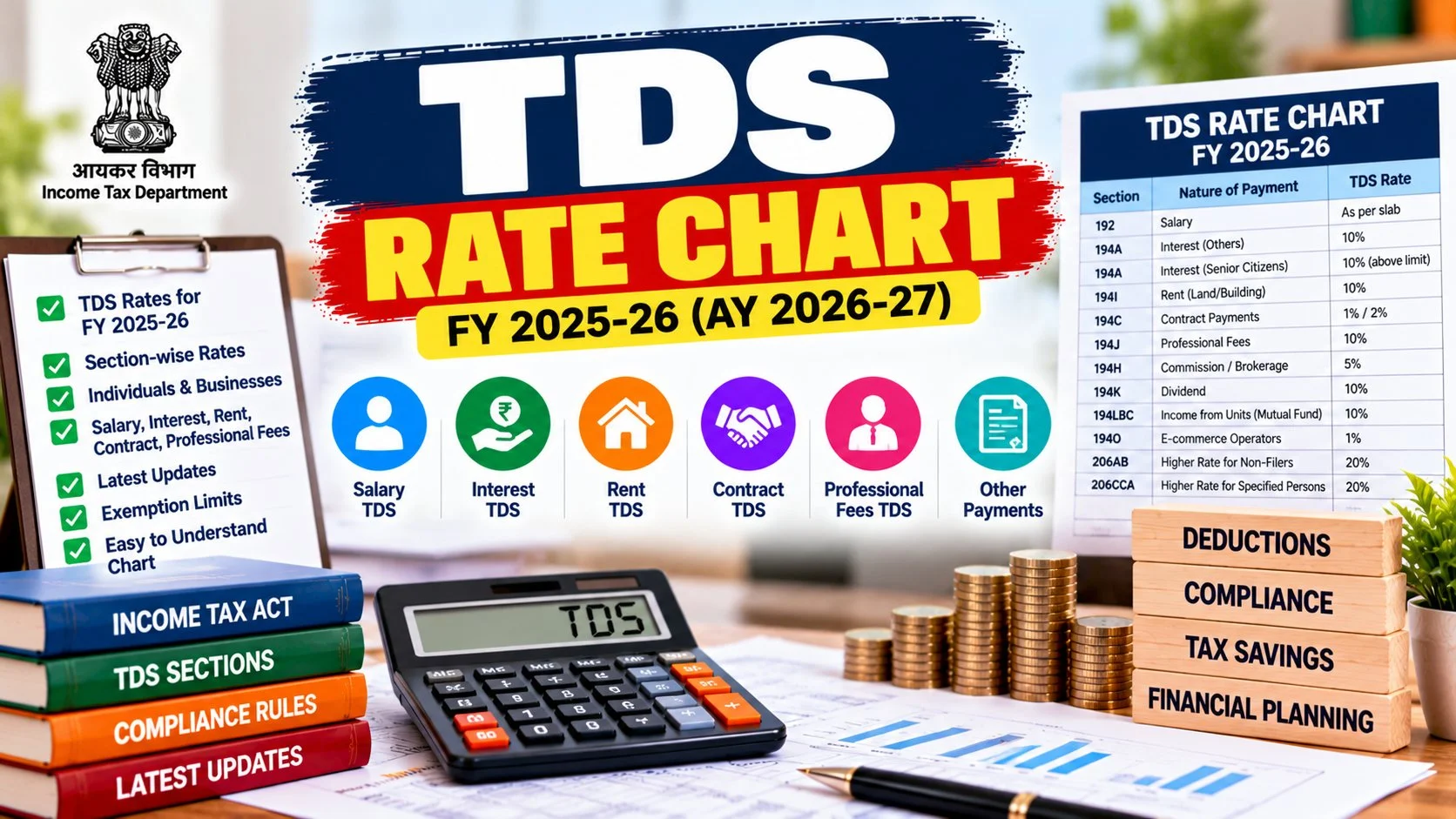
Here’s the complete section-wise tds rate chart. I’ve organised it by payment type so you can find your situation in seconds. Rates are for payments to residents — NRI payments under Section 195 follow different rules (covered later).
| Section | Nature of Payment | TDS Rate | Threshold (No TDS Below) |
|---|---|---|---|
| 192 | Salary | As per slab rates | Basic exemption limit |
| 193 | Interest on securities | 10% | ₹10,000 |
| 194 | Dividends (companies/mutual funds) | 10% | ₹10,000 |
| 194A | Interest other than securities (bank FD, savings) | 10% | ₹50,000 (₹1,00,000 for senior citizens) |
| 194B | Lottery, crossword, card games winnings | 30% | ₹10,000 |
| 194BB | Horse race winnings | 30% | ₹10,000 |
| 194C | Payment to contractors/sub-contractors | 1% (individual/HUF), 2% (others) | ₹30,000 (single) / ₹1,00,000 (aggregate) |
| 194D | Insurance commission | 2% (individual/HUF), 10% (others) | ₹20,000 |
| 194E | Payments to non-resident sportsmen/entertainers | 20% | No threshold |
| 194EE | NSS (National Savings Scheme) deposits | 10% | ₹2,500 |
| 194G | Commission on lottery tickets | 2% | ₹20,000 |
| 194H | Commission or brokerage | 2% | ₹20,000 |
| 194I | Rent — land & building / plant & machinery | 10% (land/building), 2% (plant & machinery) | ₹50,000/month |
| 194J | Professional fees, technical services, royalty | 2% (technical/call centre), 10% (others) | ₹50,000 |
| 194K | Income from mutual fund units | 10% | ₹10,000 |
| 194LA | Compensation on land acquisition | 10% | ₹5,00,000 |
| 194M | Payments by individuals/HUF (contract, commission, professional) | 2% | ₹50,00,000 |
| 194N | Cash withdrawals above limit | 2% (above ₹1 cr); 2%/5% for non-filers | ₹1,00,00,000 |
| 194O | E-commerce participants (Amazon, Flipkart sellers) | 0.1% | ₹5,00,000 |
| 194P | Senior citizens 75+ (bank to deduct, no ITR needed) | As per slab | Specified conditions |
| 194Q | Purchase of goods above ₹50 lakh | 0.1% | ₹50,00,000 |
| 194R | Benefits/perquisites from business | 10% | ₹20,000 |
| 194S | Transfer of virtual digital assets (crypto) | 1% | ₹50,000 (₹10,000 for specified persons) |
| 194T | Payments to partners (salary, remuneration, commission, interest) | 10% | ₹20,000 |
Note: Several rates and thresholds in this chart changed in recent Budgets, so it is always worth double-checking the figure that applies to you on incometax.gov.in. The chart above reflects the rates in force for FY 2026-27 planning.
Salary TDS (Section 192) — How Your Employer Calculates It
Section 192 is the one that affects most readers directly. Your employer estimates your total annual income, subtracts eligible deductions (like 80C investments, HRA exemption, standard deduction of ₹75,000 under the new regime), applies the slab rates, and divides by 12 for monthly deduction.
Under the new tax regime (default since FY 2023-24), the slabs are: nil up to ₹4 lakh, 5% for ₹4–8 lakh, 10% for ₹8–12 lakh, 15% for ₹12–16 lakh, 20% for ₹16–20 lakh, 25% for ₹20–24 lakh, and 30% above ₹24 lakh. There’s also a rebate under 87A making income up to ₹12 lakh effectively tax-free for salaried individuals under the new regime.
If you’re confused about which regime saves you more, our new vs old tax regime comparison walks through it with real numbers.
Interest TDS — Bank FDs, Savings Accounts (194A)
This is where most people first encounter TDS outside salary, and the tds rate chart makes the 10% rule easy to verify. Banks deduct 10% TDS on interest if it crosses the threshold in a financial year. The key detail: the threshold applies per bank, per financial year — not per FD. So if you have three FDs in the same bank earning ₹20,000 each, the total ₹60,000 crosses the threshold and TDS applies.
Senior citizens get a higher threshold. And here’s a pro tip most articles skip: if your total income is below the taxable limit, submit Form 15G (under 60) or Form 15H (senior citizens) to your bank at the start of the financial year — the bank won’t deduct TDS at all.
Freelancers & Professionals — 194C vs 194J (Don’t Mix These Up)
This is the most confused pair in the entire tds rate chart, so let’s settle it:
| Point | 194C (Contractor) | 194J (Professional) |
|---|---|---|
| Applies to | Work contracts, labour, supply of goods with work | Professional services (CA, lawyer, doctor, designer), technical services, royalty |
| Rate | 1% (individual/HUF), 2% (others) | 2% (technical services), 10% (others) |
| Threshold | ₹30,000 single payment / ₹1,00,000 total | ₹50,000 |
| Example | Construction work, catering contract | Freelance writing, consulting, audit fees |
If you’re a freelancer receiving payments, your client will almost always deduct under 194J at 10%. Keep every TDS certificate — you’ll need them at ITR filing time.
Rent TDS (194I) — What Tenants and Landlords Must Know
If you pay rent above the monthly threshold, you must deduct TDS before paying your landlord — as per the tds rate chart, — yes, even as an individual tenant. The rate is 10% for land and building, 2% for plant and machinery.
Important: individuals and HUFs not subject to tax audit deduct under a different provision — Section 194-IB at 2% on monthly rent above ₹50,000, using Form 26QC. This is the section that applies to most salaried tenants in metro cities.
New & Notable Sections Most Charts Miss
Section 194T — TDS on Payments to Partners
Introduced by the Finance (No. 2) Act 2024 (effective 1 April 2025), Section 194T requires partnership firms and LLPs to deduct 10% TDS on salary, remuneration, commission, bonus, or interest paid to partners when the aggregate exceeds ₹20,000 in a financial year. If you’re a partner in a firm, this affects you from FY 2025-26 onwards.
Section 194R — Business Perquisites
Freebies aren’t free from tax. If a business gives you benefits worth more than ₹20,000 in a year (free trips, gadgets, gift vouchers), 10% TDS applies. The company giving the perk must ensure you’ve paid tax on it before releasing the benefit.
Section 194S — Crypto/VDA Transfers
Every crypto transfer above the threshold attracts 1% TDS — and this applies even at a loss. The 1% is deducted by the exchange (or the buyer in P2P deals) regardless of whether you made a profit.
Higher TDS Penalty — 206AA (and the Removed 206AB)
One section can still silently multiply your TDS — 206AA, if you don’t quote your PAN. A second one, 206AB (higher TDS for ITR non-filers), used to sit alongside it, but the Finance Act 2025 omitted it with effect from 1 April 2025, so it no longer applies. It stays in the table below only as a historical note:
| Section | Trigger | Higher Rate |
|---|---|---|
| 206AA | PAN not furnished to deductor | 20% (or the normal rate, whichever is higher) |
| 206AB | Specified person who hadn’t filed ITR for the previous year (with TDS/TCS above ₹50,000) — section omitted by the Finance Act 2025 w.e.f. 1 April 2025 | Twice the normal rate or 5%, whichever is higher — no longer applicable |
The lesson from the tds rate chart: always give your PAN to every deductor, and file your ITR every year even if your income is low. Until 31 March 2025, skipping ITR filing could also double your TDS under 206AB — that rule has since been removed, but filing on time still keeps your TDS credits and refunds smooth. If you haven’t linked your PAN with Aadhaar yet, do it via our PAN-Aadhaar linking guide — an inoperative PAN triggers 206AA too.
How to Check TDS Deducted on Your Income
Every rupee of TDS deducted in your name appears in two official statements:
1. Form 26AS — the classic tax credit statement on incometax.gov.in. Shows all TDS/TCS, advance tax, and refunds linked to your PAN.
2. AIS (Annual Information Statement) — the newer, more comprehensive statement. Includes securities transactions, mutual funds, foreign remittances — everything reported about your PAN.
Check both against the tds rate chart before filing your ITR. If TDS deducted doesn’t appear in 26AS, contact the deductor — they may have deposited it late or against the wrong PAN. Never claim TDS credit that doesn’t show in 26AS; mismatches are a top reason for defective returns.
TDS Certificates — Form 16 and 16A
After deducting TDS, the deductor must give you a certificate:
- Form 16 — for salary TDS (Section 192), issued annually by your employer by June 15. Our Form 16 download guide explains how to get it and read it.
- Form 16A — for non-salary TDS (interest, professional fees, rent), issued quarterly.
- Form 16B/16C/16D — for TDS on property purchase (194-IA), rent by individuals (194-IB), and 194M payments.
Keep these safe — they’re your proof of tax paid and essential for filing.
How to Claim Excess TDS as Refund
If total TDS deducted exceeds your actual tax liability, the excess comes back as a refund when you file your ITR. The process:
Refunds typically arrive in 2–4 weeks after processing, with 6% annual interest under Section 244A if delayed beyond the due date.
TDS Returns Every Deductor Must File
If you’re on the deducting side — an employer, a business owner, or even a landlord paying a contractor — TDS doesn’t end at deduction. You must file quarterly TDS returns, and missing the deadlines attracts a late fee of ₹200 per day under Section 234E (until the fee equals the TDS amount).
| Form | Used For | Due Dates (Q1–Q4) |
|---|---|---|
| 24Q | Salary TDS (Section 192) | Jul 31, Oct 31, Jan 31, May 31 |
| 26Q | Non-salary TDS for residents | Jul 31, Oct 31, Jan 31, May 31 |
| 27Q | TDS on payments to NRIs (Section 195) | Jul 31, Oct 31, Jan 31, May 31 |
| 27EQ | TCS (Tax Collected at Source) returns | Jul 15, Oct 15, Jan 15, May 15 |
| 26QB | TDS on property purchase (194-IA) | Within 30 days of month-end |
| 26QC | TDS on rent by individuals (194-IB) | Within 30 days of month-end |
Beyond the late fee, wrong or short deduction also attracts interest: 1% per month for late deduction and 1.5% per month for late deposit after deduction. For a small business, these add up fast — which is why getting the tds rate chart right the first time matters.
5 Costly TDS Mistakes to Avoid
After seeing thousands of queries on this topic, here are the mistakes that cost people real money:
1. Using the wrong section of the tds rate chart. Deducting a freelancer’s payment under 194C (1%) instead of 194J (10%) means short deduction — and the assessing officer will demand the difference plus interest from you, the deductor.
2. Ignoring the aggregate threshold. Under 194C, even if each payment is below ₹30,000, TDS applies once the yearly total crosses ₹1,00,000. Many small businesses miss this.
3. Not collecting PAN. This triggers 20% TDS under 206AA — and an unhappy payee. Always collect PAN before the first payment.
4. Forgetting Form 15G/15H. If you’re the deductee with income below the taxable limit, one form at the start of the year saves you from the whole deduct-then-claim-refund cycle.
5. Mismatched PAN in returns. If the deductor enters your PAN wrong, the TDS won’t show in your 26AS and you can’t claim credit. Always verify your 26AS after every quarter.
Frequently Asked Questions
What is the tds rate chart for FY 2026-27?
The complete section-wise tds rate chart is given above. Key rates: salary (192) as per slab, bank interest (194A) 10%, professional fees (194J) 10%, contractor payments (194C) 1%/2%, rent (194I) 10%/2%, dividends (194) 10%, lottery winnings (194B) 30%, crypto transfers (194S) 1%, and partner payments (194T) 10%.
What is Section 194T in the tds rate chart?
Section 194T (effective FY 2025-26) requires partnership firms and LLPs to deduct 10% TDS on salary, remuneration, commission, bonus, or interest paid to partners when the total exceeds ₹20,000 in a financial year.
What was 206AB higher TDS — and does it still apply?
Section 206AB earlier required deductors to deduct TDS at twice the normal rate or 5% — whichever was higher — if you hadn’t filed your income tax return for the previous year (and had TDS/TCS above ₹50,000). The Finance Act 2025 omitted this section with effect from 1 April 2025, so this higher TDS no longer applies. Filing your ITR every year is still important — it is how you claim your TDS credits and refunds.
Is TDS applicable if my income is below the taxable limit?
Yes, TDS can still be deducted (e.g., 10% on bank interest above the threshold) even if your total income is below the taxable limit. In that case, file your ITR to claim the full amount as a refund. To prevent deduction upfront, submit Form 15G/15H to the deductor.
What is the difference between TDS and TCS?
TDS (Tax Deducted at Source) is deducted by the payer on income like salary, interest, and professional fees. TCS (Tax Collected at Source) is collected by the seller on specified goods/services like motor vehicles, foreign remittances under LRS, and scrap. Both give you tax credit when filing ITR.
How do I check my TDS online?
Log in to incometax.gov.in → go to Form 26AS and AIS under the “e-File” menu. Both statements show every TDS entry linked to your PAN. Cross-check them against your Form 16/16A certificates before filing.
What happens if TDS is deducted but not deposited by the deductor?
You still get credit if it appears in Form 26AS. If it doesn’t appear, the deductor hasn’t deposited it — contact them immediately. If they don’t resolve it, you can raise a grievance on the e-filing portal. Never pay tax twice for the same income without following up.
Can I get a TDS refund without filing ITR?
No. The only way to claim excess TDS as a refund is by filing your income tax return. There’s no separate refund application process — the ITR itself is the claim.
What is Form 15G and 15H?
These are self-declaration forms you submit to your bank or deductor to prevent TDS deduction when your total income is below the taxable limit. Form 15G is for individuals below 60 years; Form 15H is for senior citizens (60+). Submit them at the start of every financial year.
Does the tds rate chart apply to NRIs?
No — payments to non-residents fall under Section 195 with different (usually higher) rates, plus DTAA treaty benefits may apply. The chart above covers resident payments only.
Final Word
A tds rate chart isn’t just a reference table — it’s the difference between being surprised at tax time and being in control all year. Bookmark this page, check the sections that apply to your income, and make sure your PAN is shared with every deductor and your ITR is filed on time. That alone protects you from the 20% penalty under 206AA. (The doubled TDS rates under 206AB for non-filers were removed by the Finance Act 2025 with effect from 1 April 2025, so they no longer apply.) And if you’ve had excess TDS deducted, don’t leave that money with the government — file your return and claim every rupee back.