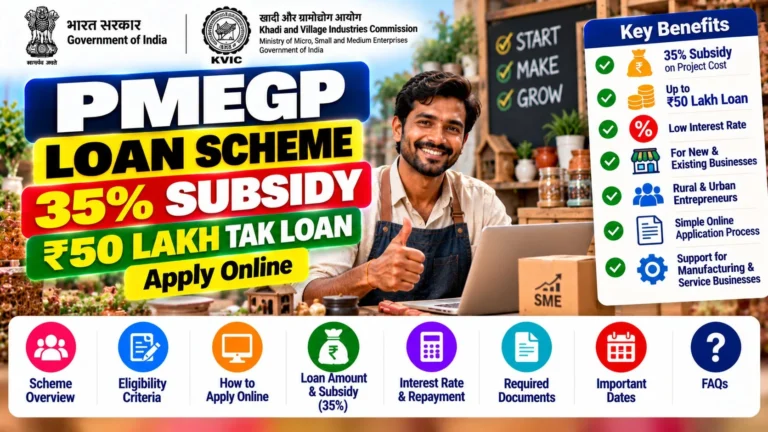

Every October, the same thing happens. Students who meant to apply for a scholarship all year suddenly rush to the National Scholarship Portal, the site slows to a crawl, and thousands miss out simply because they started too late. If you’re reading this, you still have time — but not much. The NSP Scholarship 2026-27 application window closes on October 31, 2026, and there’s a mandatory registration step most students don’t even know about until it’s too late.
✅ This guide is based on official government sources and notifications. Last verified: October 15, 2026. Scheme details, eligibility criteria, and benefit amounts are revised by the government from time to time — always cross-check the latest information on the official portal before applying.
Here’s the part nobody tells you upfront: you cannot just open the portal and fill a form. Since the 2024-25 academic year, every student needs a 14-digit One-Time Registration (OTR) number generated through Aadhaar-based face authentication. No OTR, no application. And generating it takes a few days if you hit snags — which many students do. If you want to do nsp scholarship apply online correctly without rejection, this guide walks you through every step.
This guide walks you through everything: what NSP actually is, which schemes are live right now, the exact OTR process (including how to fix the face-auth errors that block most applicants), documents you’ll need, how institute verification works, how to track your payment, and the rejection reasons that kill the most applications. Let’s get into it.
Why October 31, 2026 Is Your Real Deadline
The portal opened on June 1, 2026. That feels like ages ago, and that’s exactly the trap. Here’s the timeline that actually matters:
| Event | Deadline | Who Acts |
|---|---|---|
| Student applications close | October 31, 2026 | You |
| Institute verification (Level 1) | November 15, 2026 | Your college/school nodal officer |
| District/State/Ministry verification (Level 2) | November 30, 2026 | Government nodal officers |
| Defective application correction window | Up to November 15, 2026 | You (if your application is sent back) |
Notice something? Your deadline isn’t really October 31. If your application has any defect — a blurry document, a name mismatch, a wrong bank detail — your institute sends it back for correction, and that correction also has to finish by November 15. Students who apply on October 30 leave themselves zero room for fixes. Apply at least 2-3 weeks before the deadline. That means now.
What Is the National Scholarship Portal (NSP)?
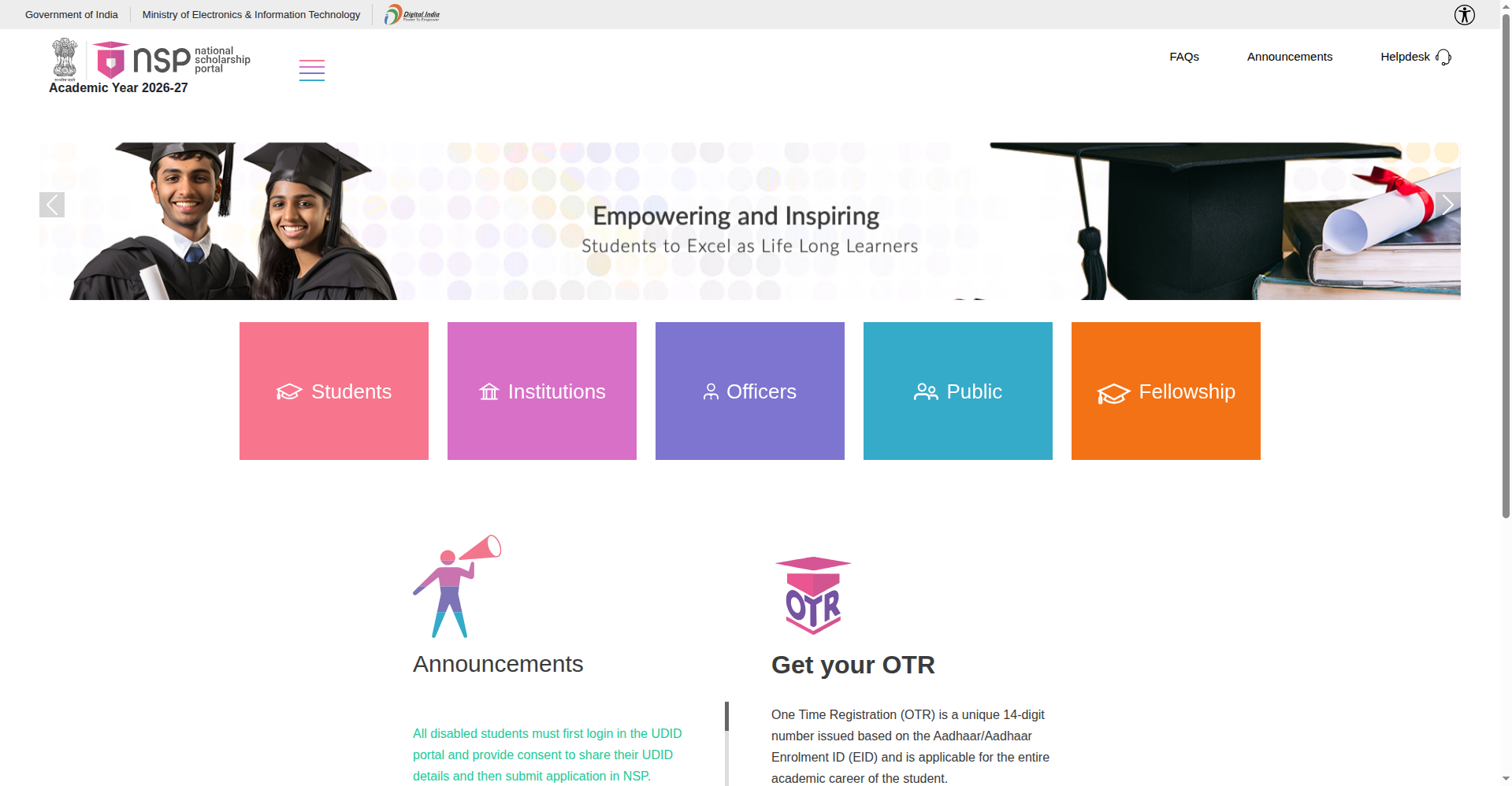
The National Scholarship Portal at scholarships.gov.in is the Government of India’s single-window platform for scholarships. Instead of applying separately to different ministries, you register once and apply to schemes run by central ministries, state governments, AICTE, UGC, and other departments — all from one dashboard.
Think of it this way: before NSP, a student eligible for three different scholarships had to visit three different websites, create three accounts, and track three applications. NSP merged all of that into one login, one application flow, and one status tracker.
One important change starting this academic year (2026-27): you can now apply for one merit-based scholarship scheme along with one or more welfare-based scholarship schemes, as long as you meet each scheme’s eligibility. Earlier, holding more than one scholarship was broadly restricted. So if you qualify for a merit scholarship and also a category-based welfare scholarship, you don’t have to choose — check both schemes’ guidelines and apply for each.
One-Time Registration (OTR): The Step You Can’t Skip
This is where most students get stuck, so let’s be thorough.
OTR vs the Old Registration: What Changed
Before 2024-25, you created a fresh application ID on NSP every year. That system is gone. Now, One-Time Registration gives you a single 14-digit number that stays with you for your entire academic career on NSP. You generate it once, and you use it to log in for every future application — fresh or renewal.
The OTR is generated using your Aadhaar number or Aadhaar Enrollment ID (EID), verified through face authentication. Your basic details (name, date of birth, gender) get pulled directly from your Aadhaar record, which means fewer typos and fewer mismatches — the two biggest causes of rejection under the old system.
If you don’t have Aadhaar yet, a parent’s or legal guardian’s Aadhaar can be used for minors. A guardian can generate OTRs for up to two minor children.
How to Generate Your OTR Number: Step by Step
You’ll need an Android smartphone with a working front camera. The face authentication step only works on Android (the NSP OTR app is Android-only).
Phase 1: Get your reference number
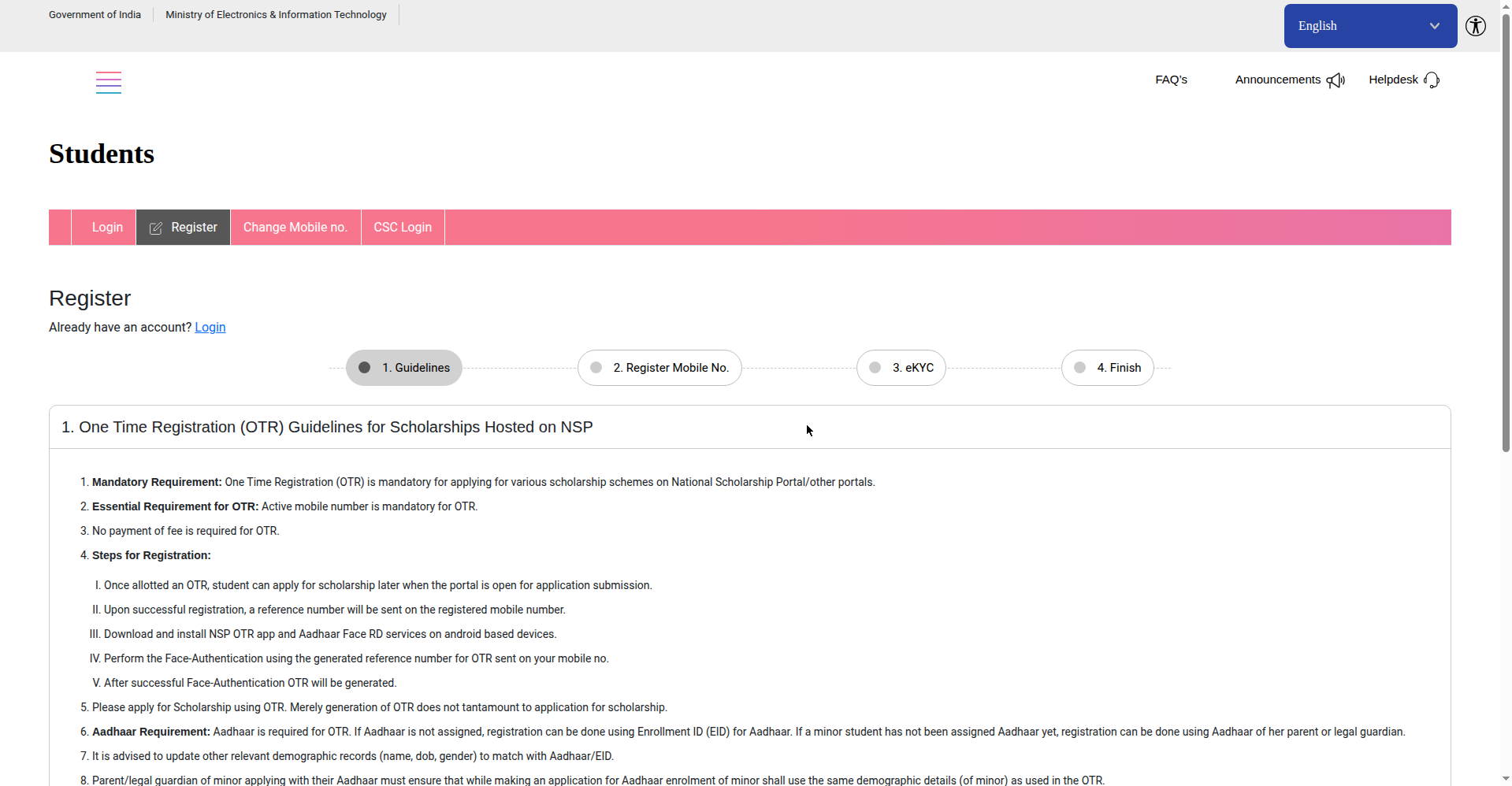
- Go to scholarships.gov.in and click “Apply for OTR” (under the Students section). You can also start directly in the NSP OTR app.
- Read the guidelines, give consent for Aadhaar-based e-KYC and for your OTR to be used for de-duplication across NSP and state portals.
- Enter your mobile number, receive the OTP, enter it along with the on-screen captcha, and verify.
- Enter your 12-digit Aadhaar number (or Enrollment ID). You’ll get an OTP on your Aadhaar-linked mobile number. Enter it to complete e-KYC.
- Enter your mother’s name, father’s name, and optionally your email address. The screen will also show whether your bank account is seeded with Aadhaar (important for DBT payments — more on that later).
- Click Finish. A reference number is generated and sent to your mobile via SMS. Save it.
Phase 2: Face authentication (this generates your actual OTR)
- Install two apps from the Google Play Store: NSP OTR and AadhaarFaceRD (by UIDAI). Both are free.
- Open the NSP OTR app and choose “eKYC with FaceAuth”.
- Enter your reference number, get the OTP, enter it with the captcha, and tap Next.
- Review your profile details and tap “Proceed for Face Authentication”.
- The camera opens. Align your face in the circle, stay still, and blink once when prompted. Do this in a well-lit room with a plain background.
- On success, your 14-digit OTR number appears on screen and is sent to your mobile. Your login password arrives separately via SMS.
- Log in with your OTR number — you’ll be asked to change your password on first login. Do it immediately and save the new password somewhere safe.
Face Authentication Fails? Fix These First
Face-auth failure is the single most common OTR blocker. Before you retry for the fifth time, check these:
- Biometric lock: If you (or your parent/guardian) ever locked biometrics in Aadhaar, face authentication will fail every time. Check your lock status in the mAadhaar app or on the My Aadhaar portal, and make sure it’s set to “Unlocked” before attempting face auth. This one fix resolves a huge share of failures.
- Error 904: If you see error 904 during face authentication, update the UIDAI AadhaarFACERD app from the Play Store to the latest version, then retry.
- Lighting and background: Face capture needs decent light on your face and a plain background. Don’t try it in a dark room or with bright light directly behind you.
- Camera permissions: Make sure the AadhaarFaceRD app has camera permission enabled in your phone settings.
- Still stuck? NSP services are available at Common Service Centres (CSCs) near you. The total charge for the complete process — reference number, biometric authentication, OTR generation, and filing the full application — is fixed at Rs 30 (all taxes included). Find your nearest CSC at locator.csccloud.in.
Scholarship Schemes Live on NSP 2026-27
Dozens of schemes are onboarded on NSP, run by different ministries and departments. Here are the major ones students search for most, with verified details:
| Scheme | Who It’s For | Amount | Income Limit |
|---|---|---|---|
| PM-USP CSSS (Central Sector Scheme for College & University Students) | Class 12 toppers (above 80th percentile) in regular UG/PG courses | ₹12,000/yr (UG, first 3 yrs); ₹20,000/yr (PG; 4th–5th yr professional courses) | ₹4.5 lakh/yr |
| AICTE Pragati Scholarship | Girl students in AICTE-approved technical courses (max 2 girls per family) | ₹50,000/yr | ₹8 lakh/yr |
| AICTE Saksham Scholarship | Students with 40%+ disability in AICTE-approved courses | ₹50,000/yr | ₹8 lakh/yr |
| AICTE Swanath Scholarship | Orphans, wards of Covid-deceased parents, children of martyrs (Armed Forces/Paramilitary/Police) | ₹50,000/yr | ₹8 lakh/yr |
| PM USP Special Scholarship (J&K and Ladakh) | Students domiciled in J&K and Ladakh studying outside the UTs | As per scheme norms | ₹8 lakh/yr |
| Post-Matric Scholarships (SC/ST/OBC/Minority) | Category students in Class 11 to PhD | Varies by course group + maintenance allowance | ₹2.5 lakh/yr (scheme-wise) |
| National Means-cum-Merit (NMMS) | Class 9–12 students from economically weaker sections (via state selection test) | ₹12,000/yr | ₹3.5 lakh/yr |
| Top Class Education (SC/ST/Disabilities) | Category students in premier institutes | Full tuition + living expenses (as per norms) | ₹8 lakh/yr |
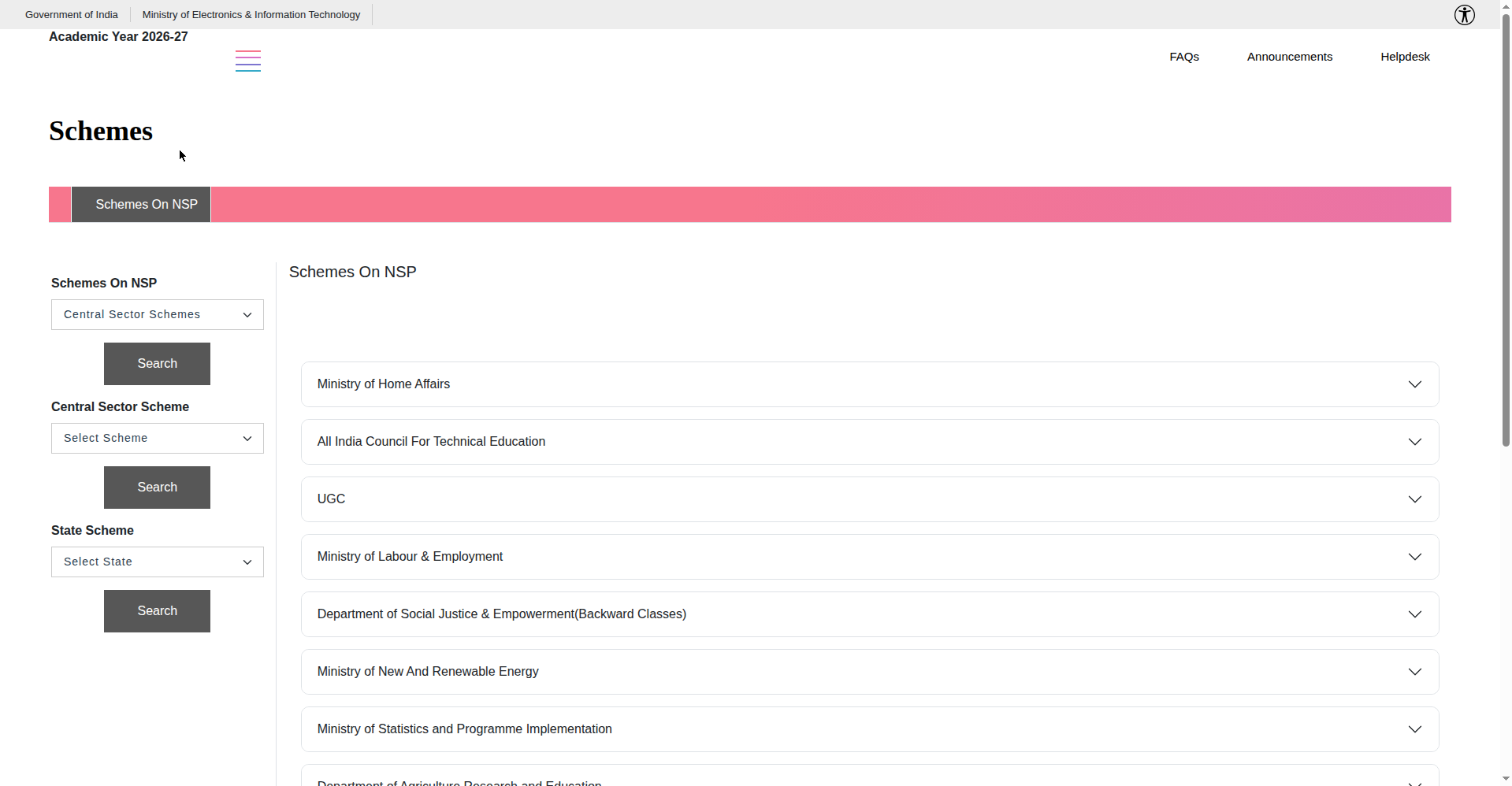
This is not the full list — NSP also hosts UGC scholarships, PM YASASVI schemes, NEC scholarships for the North East, ICAR awards, and state-specific schemes. After logging in with your OTR, the portal shows you the schemes you’re eligible for based on your profile. Always read the individual scheme guidelines on the portal before applying, because eligibility criteria vary.
Gujarat students, note: several Gujarat state scholarships run on the state’s own portals instead of NSP. If you’re from Gujarat, also check the Digital Gujarat Scholarship guide and the MYSY Scholarship — you may be eligible on both NSP and the state portal, and the deadlines are different.
Eligibility: The Rules That Apply to Almost Every Scheme
Every scheme has its own fine print, but these conditions repeat across most NSP scholarships:
- Domicile and institute: You must be studying in a recognized institution. For most schemes, your institute must be registered and active on NSP — if your college isn’t onboarded, your application can’t move forward. Check with your institute’s nodal officer first.
- Academic record: You must have passed the previous qualifying exam. Merit schemes add cut-offs (CSSS needs above 80th percentile in Class 12).
- Income ceiling: Varies by scheme (₹2.5 lakh to ₹8 lakh per year). You’ll need a valid income certificate for most schemes.
- Aadhaar + seeded bank account: Your bank account must be seeded with Aadhaar for Direct Benefit Transfer. An account that’s merely “linked” isn’t always enough — check the seeding status shown during OTR, or use NPCI’s BASE platform to seed/de-seed in self-service mode.
- One merit scholarship rule: From 2026-27, you can hold one merit-based scheme plus one or more welfare-based schemes. You still can’t stack two merit scholarships for the same academic year.
- Attendance and conduct (renewals): CSSS renewals need 50% marks and 75% attendance each year. Indiscipline or ragging complaints can forfeit the scholarship.
Documents Required for NSP Scholarship 2026-27
Get these ready before you start the application. Blurry or mismatched documents are the top reason applications get marked defective:
- Aadhaar card (student; parent’s/guardian’s for minors without Aadhaar)
- Previous year’s marksheet / qualifying exam certificate
- Income certificate (issued by competent authority, within validity period)
- Caste/category certificate (SC/ST/OBC — where applicable)
- Disability certificate (for disability schemes; UDID consent must be given on the portal first)
- Bonafide certificate from your current institute
- Fee receipt of the current academic year
- Bank passbook first page — account must be Aadhaar-seeded for DBT
- Domicile certificate (for state-linked schemes)
- Passport-size photograph (recent, clear background)
Name-match warning: the name on your Aadhaar, marksheet, bank account, and income certificate should match exactly. Even a spelling difference (“Kumari” present in one document, missing in another) can get your application defected. Fix mismatches at the source before applying.
How to Apply for NSP Scholarship 2026-27: Step by Step
Fresh Application
- Complete your OTR first (see the steps above). Without it, you can’t log in to apply.
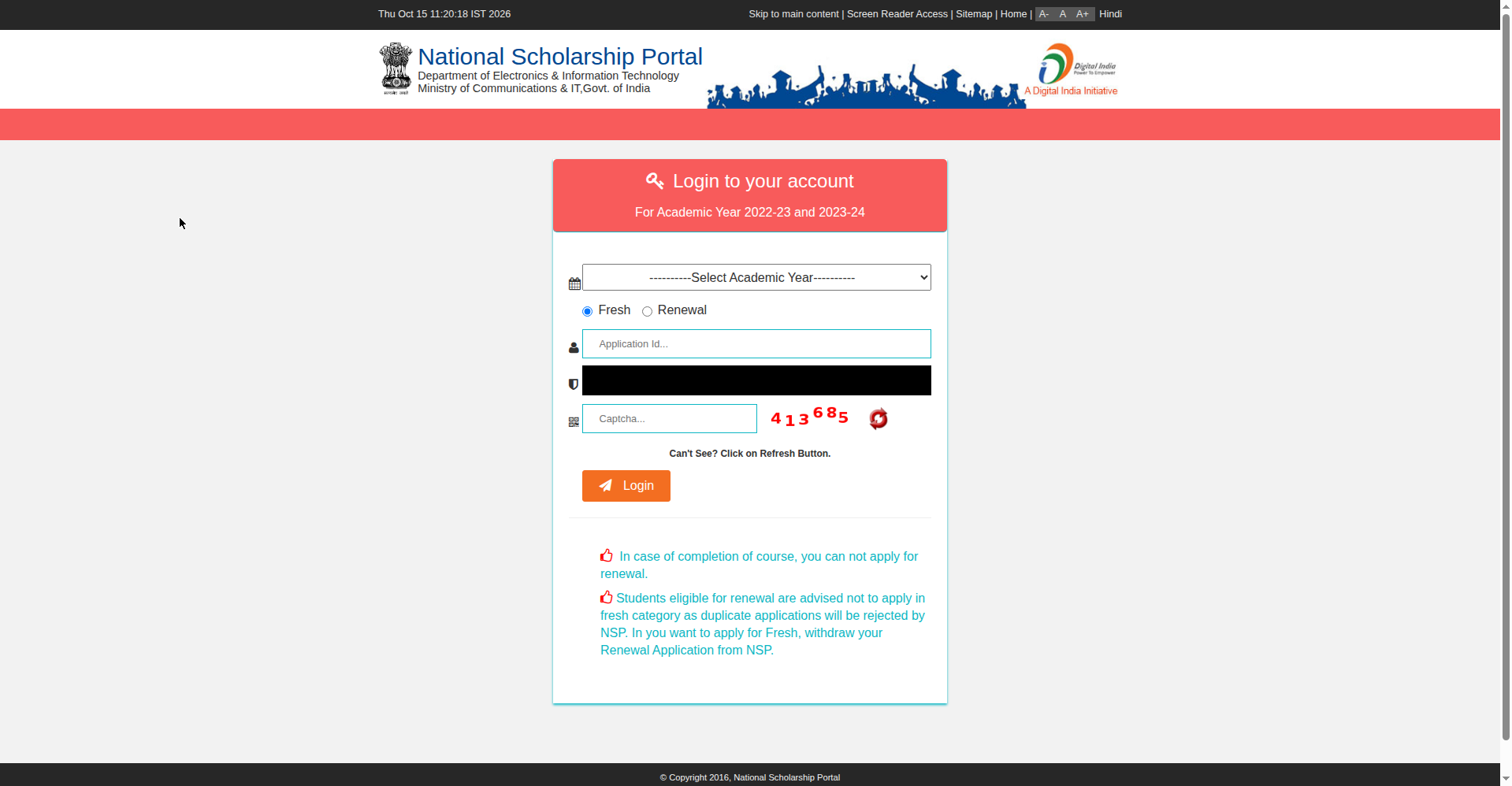
- Log in at scholarships.gov.in with your OTR number and password.
- Go to the Application Form section and select “Fresh”.
- Your basic details auto-fill from Aadhaar. Fill in academic details (current institute, class/course, previous year marks) and family income carefully.
- Select the scholarship scheme you’re eligible for. The portal filters schemes by your profile — but double-check the scheme guidelines yourself.
- Upload documents in the specified format and size. Use clear scans, not tilted phone photos.
- Review everything, then click “Final Submit”. Note: once finally submitted, you can’t edit — so review twice.
- Save/print the application reference number. You’ll need it for status tracking.
Renewal Application: What’s Different
| Point | Fresh Application | Renewal Application |
|---|---|---|
| OTR | Must generate first | Use existing OTR (one-time, never expires) |
| Academic proof | Previous qualifying exam marksheet | Last year’s marksheet showing promotion (50%+ for CSSS) |
| Income certificate | Required | Usually not required again (check scheme) |
| Key risk | Document mismatch, wrong scheme selection | Year gap or backlog — renewals need continuous promotion |
| Deadline 2026-27 | October 31, 2026 | October 31, 2026 (CSSS & J&K Special renewals open now) |
Currently, renewal applications are open for PM-USP CSSS and the PM USP Special Scholarship Scheme for Jammu Kashmir and Ladakh. If you’re renewing one of these, don’t wait — the same October 31 deadline applies.
Institute Nodal Officer Verification: What Actually Happens After You Apply
This is the step students understand least — and it causes the most heartbreak. After you submit, your application doesn’t go to the government directly. It goes to your Institute Nodal Officer (INO) — a designated staff member at your school or college.
The INO’s job at Level 1 verification:
- Confirm you’re genuinely enrolled in the institute for the claimed course and year
- Verify your documents against originals
- Check your attendance and academic standing
- Either verify (forward to Level 2) or mark defective (send back to you for correction) or reject
Why this matters to you: the INO has until November 15. If your college is slow, disorganized, or the nodal officer is on leave, your verified-on-time application can still miss the bus. Practical advice:
- After submitting, visit your institute’s scholarship cell in person and confirm they’ve received your application in their NSP login.
- Ask for the nodal officer’s name and contact. Be polite, be persistent.
- If your application is marked defective, fix and resubmit immediately — the correction window also closes November 15.
- After Level 1, your file goes to Level 2 (district/state/ministry nodal officers), who verify until November 30. You can’t influence this stage directly, but you can track it (see status check below).
How to Check Your NSP Scholarship Application Status
- Log in at scholarships.gov.in with your OTR number and password.
- Open the “Check Your Status” / application status section on your dashboard.
- Enter your application reference number if asked.
- Your status will show one of these stages: Submitted → Verified by Institute (L1) → Verified by District/State (L2) → Approved → Payment initiated → Payment disbursed.
If your status is stuck at “Submitted” for weeks, your institute hasn’t verified yet — go talk to your nodal officer. If it says “Defective,” open the application, read the defect remark carefully, fix exactly what’s asked, and resubmit.
For Gujarat-specific scholarships tracked on state portals, our Gujarat scholarship status check guide covers the Digital Gujarat portal process separately.
PFMS Payment Tracking: Where Your Money Actually Is
Approved doesn’t mean paid. Scholarship money moves through the Public Financial Management System (PFMS), and this is where most “where is my scholarship?” anxiety lives. Here’s how to track it:
- Once your application shows “Payment initiated”, the amount is being processed through PFMS to your Aadhaar-seeded bank account.
- Track it on the PFMS portal (pfms.nic.in) using your bank account number or DBT details — look for the “Know Your Payments” option.
- Common payment failures: account not Aadhaar-seeded (the #1 reason), dormant/frozen account, name mismatch between NSP and bank records, or wrong IFSC.
- If payment fails, the amount usually bounces back and is re-initiated — but only if your bank details on NSP are correct. Update them promptly if your account changed.
This is why the OTR screen showing your Aadhaar seeding status matters so much. If it showed “not seeded” during registration, fix it via your bank or NPCI’s BASE platform before you apply — don’t discover it after approval.
7 Reasons NSP Applications Get Rejected (And How to Avoid Each)
- No OTR / wrong login: Trying to apply with an old application ID instead of the OTR number. Fix: generate your OTR first, always log in with it.
- Name or DOB mismatch: Aadhaar says one thing, marksheet says another. Fix: get documents corrected at the source before applying — affadavits don’t always work.
- Income certificate issues: Expired certificate, or income above the scheme ceiling. Fix: get a fresh certificate from the competent authority; double-check the scheme’s limit.
- Bank account not Aadhaar-seeded: Application approved, payment fails. Fix: seed your account before applying; verify seeding status during OTR.
- Wrong scheme selection: Applying to a scheme you don’t qualify for (wrong category, wrong course level). Fix: read the scheme guidelines on the portal; use the eligibility filter honestly.
- Institute not verified / not onboarded: Your college isn’t registered on NSP or the nodal officer never verified. Fix: confirm onboarding before applying; follow up in person.
- Duplicate applications: Applying twice, or holding two merit scholarships for the same year. Fix: one application per scheme; respect the one-merit-scholarship rule (welfare combinations allowed from 2026-27).
NSP vs State Portals: Which One Should You Use?
A common confusion: “Should I apply on NSP or my state’s portal?” The answer is both, if you’re eligible on both — they’re different schemes with different deadlines.
- NSP (scholarships.gov.in): Central schemes (CSSS, AICTE, UGC, Post-Matric central, Top Class, NMMS).
- State portals: State-specific schemes. Gujarat students, for example, use the Digital Gujarat portal for MYSY, post-matric state schemes, and others.
📚 Related Scholarship Guides
Frequently Asked Questions
What is the last date for NSP Scholarship 2026-27?
Student applications close on October 31, 2026. Institute verification ends November 15, 2026, and Level-2 verification ends November 30, 2026. Apply well before October 31 to leave room for corrections.
Is OTR mandatory for NSP 2026-27?
Yes. One-Time Registration has been mandatory since AY 2024-25. You need a 14-digit OTR number generated through Aadhaar-based face authentication before you can log in and apply for any scheme on the portal.
Can I apply for two scholarships on NSP at the same time?
From AY 2026-27, you can apply for one merit-based scheme plus one or more welfare-based schemes, if you meet each scheme’s eligibility. Two merit-based scholarships for the same academic year are still not allowed.
How do I check my NSP scholarship payment status?
Log in to scholarships.gov.in with your OTR number and check the application status on your dashboard. Once it shows “payment initiated,” track the actual fund transfer on the PFMS portal (pfms.nic.in) using your bank account details.
What should I do if my face authentication keeps failing during OTR?
First, check that your Aadhaar biometrics are unlocked (via mAadhaar app or My Aadhaar portal). If you get error 904, update the UIDAI AadhaarFACERD app. Use good lighting and a plain background. If it still fails, visit a CSC — the full assisted process costs Rs 30.
My institute hasn’t verified my application. What can I do?
Visit your institute’s scholarship cell in person and ask the nodal officer to verify your application in their NSP login. Verification must finish by November 15, 2026 — don’t wait. If your application is marked defective, fix the exact issue mentioned and resubmit immediately.
Final Checklist Before You Hit Submit
The students who get scholarships aren’t always the most deserving — they’re the ones who applied correctly and on time. October 31 is closer than it looks. Generate your OTR this week, keep your documents ready, and submit early enough to survive one round of corrections. Good luck — and if this guide helped, share it with a classmate who hasn’t applied yet.
Need help? The NSP helpline is 0120-6619540 and email support is [email protected]. For CSC-assisted application (Rs 30), find your nearest centre at locator.csccloud.in.