PPF vs ELSS is the most common dilemma Indian taxpayers face every year. You have up to Rs 1.5 lakh of Section 80C limit to fill, and both options promise tax saving — but they work in completely different ways. One is a government-backed account with fixed, guaranteed returns. The other is a market-linked mutual fund that can grow your money much faster but comes with ups and downs. So which one deserves your money in 2026? In this guide, I compare PPF and ELSS on returns, tax, lock-in, risk and liquidity with real numbers — so you can decide with full clarity.
✅ This guide is based on official government sources and notifications. Last verified: October 12, 2026. Scheme details, eligibility criteria, and benefit amounts are revised by the government from time to time — always cross-check the latest information on the official portal before applying.
What Is PPF?
The Public Provident Fund (PPF) is a government-backed long-term savings scheme. You open an account at a post office or a bank, deposit money every year, and the government pays you interest on it. For the October–December 2026 quarter, the PPF interest rate is 7.1% per annum, compounded annually. The rate is reviewed every quarter by the Ministry of Finance, so it can go up or down slightly over time — but it has stayed at 7.1% for nearly two years now.
Here are the key rules you should know:
- Tenure: 15 years. After maturity, you can extend in blocks of 5 years, with or without fresh deposits.
- Minimum deposit: Rs 500 per financial year (your account goes dormant if you skip a year).
- Maximum deposit: Rs 1.5 lakh per financial year.
- Tax status: EEE — the deposit qualifies for Section 80C deduction (old tax regime), the interest is tax-free, and the maturity amount is tax-free.
- Withdrawals: Partial withdrawal is allowed from the 7th financial year, limited to one withdrawal per year. A loan facility is available between the 3rd and 6th year.
PPF is the classic “sleep peacefully” investment. Your money is backed by the Government of India, the returns are fixed, and you never have to check the stock market. The trade-off? Your money is locked away for a very long time, and the returns are modest compared to equity.
What Is ELSS?
An Equity Linked Savings Scheme (ELSS) is a type of equity mutual fund. Your money is invested mainly in shares of Indian companies (at least 80% of the fund must be in equities), and a professional fund manager handles the portfolio. Because it invests in the stock market, returns are not fixed — they move up and down with the market.
Here are the key rules:
- Lock-in: 3 years per investment — the shortest lock-in among all Section 80C options. Note that every SIP instalment has its own 3-year lock-in.
- Minimum investment: Rs 500 (no upper limit).
- Tax on investment: Up to Rs 1.5 lakh per year qualifies for Section 80C deduction — but only under the old tax regime.
- Tax on returns: Since the lock-in exceeds 12 months, all gains are long-term. LTCG on equity funds is taxed at 12.5% (plus 4% cess) on gains above Rs 1.25 lakh per financial year. Gains up to Rs 1.25 lakh per year are fully exempt.
- Expected returns: Historically, good ELSS funds have delivered around 11–13% per annum over 10–15 year periods. But past performance never guarantees future returns.
ELSS is for investors who can tolerate market volatility in exchange for higher long-term growth. The 3-year lock-in is actually a hidden advantage — it stops you from panic-selling during market crashes, which is the biggest reason most mutual fund investors earn less than the fund itself.
PPF vs ELSS: Head-to-Head Comparison
Let us put everything side by side so you can see the differences clearly:
| Feature | PPF | ELSS |
|---|---|---|
| Returns | 7.1% p.a. (fixed by government, reviewed quarterly) | Market-linked, ~11–13% historically over long term |
| Lock-in period | 15 years | 3 years (shortest among 80C options) |
| Risk | Zero market risk, government-backed | Market risk, value fluctuates |
| Tax on investment (80C) | Deduction up to Rs 1.5 lakh (old regime only) | Deduction up to Rs 1.5 lakh (old regime only) |
| Tax on returns | Fully tax-free (EEE status) | 12.5% LTCG (+cess) on gains above Rs 1.25 lakh/year |
| Minimum investment | Rs 500 per year | Rs 500 (lump sum or SIP) |
| Maximum investment | Rs 1.5 lakh per year | No upper limit |
| Liquidity | Very low — partial withdrawal only from 7th year | Moderate — full access after 3 years |
| Best for | Conservative investors, retirement safety net | Long-term wealth creation, beating inflation |
Returns Compared With Real Numbers
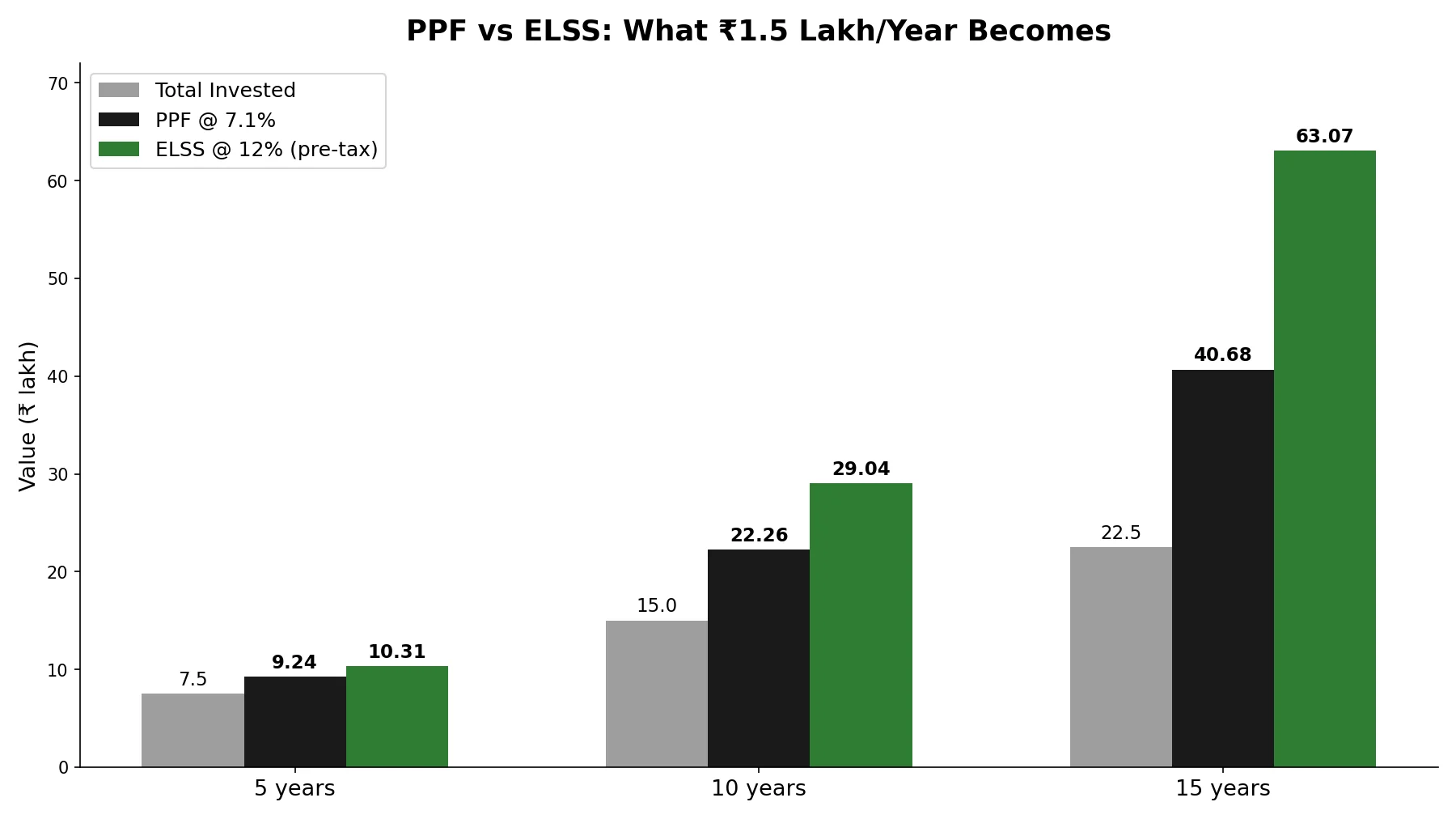
Talk is cheap — let us look at what Rs 1.5 lakh invested every year actually becomes. The table below assumes PPF at 7.1% (current rate) and ELSS at 12% per annum (a reasonable long-term assumption for equity, though actual returns will vary):
| Time Period | Total Invested | PPF Value (7.1%) | ELSS Value (12%, pre-tax) |
|---|---|---|---|
| 5 years | Rs 7.5 lakh | Rs 9.24 lakh | Rs 10.31 lakh |
| 10 years | Rs 15 lakh | Rs 22.26 lakh | Rs 29.04 lakh |
| 15 years | Rs 22.5 lakh | Rs 40.68 lakh | Rs 63.07 lakh |
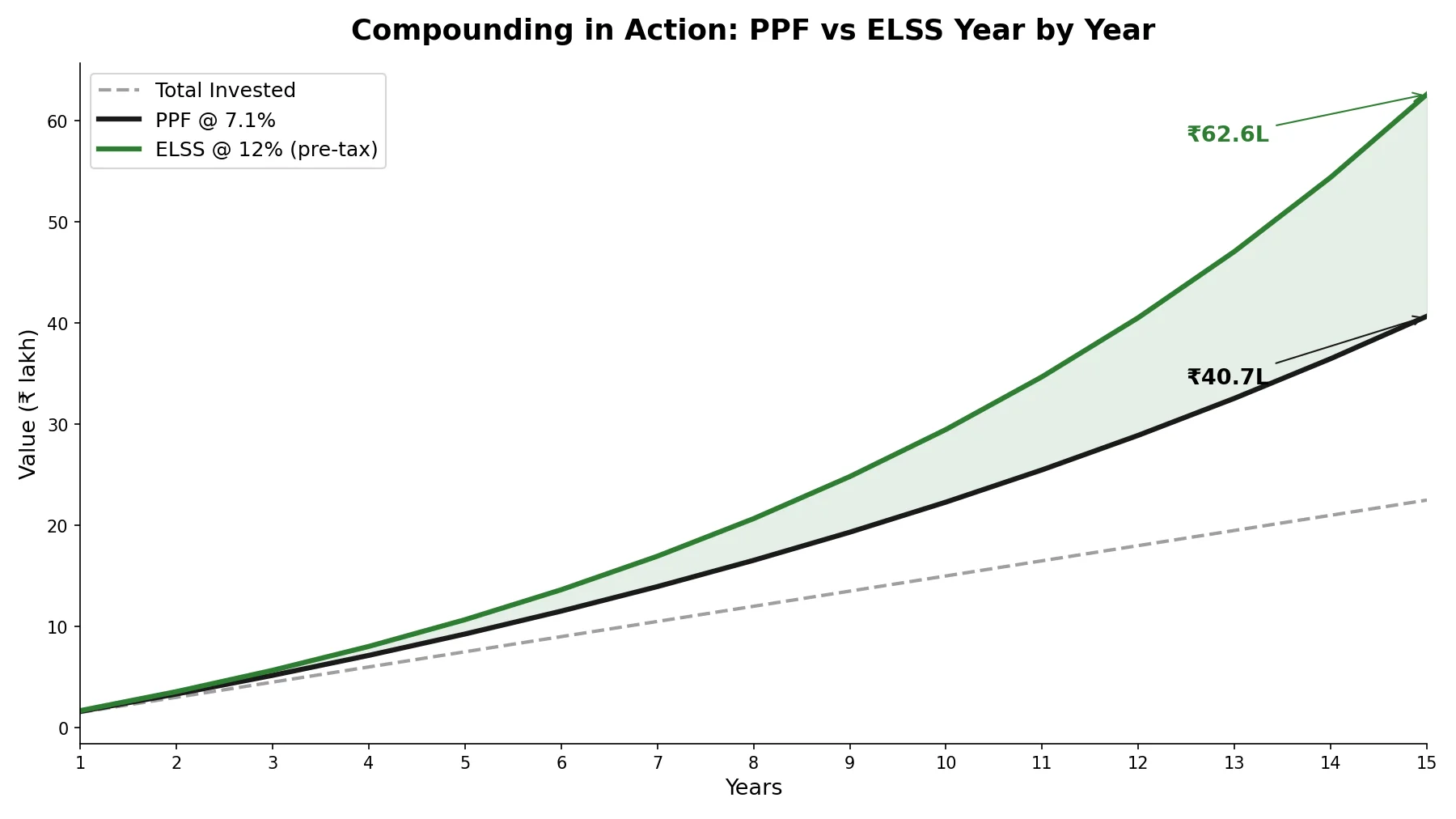
Note: Figures are illustrative. PPF assumes deposits made at the start of each financial year; ELSS assumes a monthly SIP of Rs 12,500 at 12% CAGR. Actual ELSS returns will differ.
The gap is striking. Over 15 years, ELSS builds a corpus of roughly Rs 63 lakh before tax, while PPF reaches about Rs 40.7 lakh. That is a difference of more than Rs 22 lakh on the same Rs 22.5 lakh invested. But wait — ELSS gains are taxed, so let us adjust for that.
If you redeem the ELSS corpus smartly — spreading withdrawals across financial years so you use the Rs 1.25 lakh annual LTCG exemption each time — your effective tax stays low. On a Rs 40.6 lakh total gain, a staggered exit over 3–4 years could keep your total LTCG tax around Rs 4–5 lakh (including cess). That still leaves you with roughly Rs 58–59 lakh in hand, comfortably ahead of PPF’s Rs 40.7 lakh.
Does that mean ELSS always wins? Not quite. Those 12% returns are an assumption, not a promise. In a bad 15-year stretch, equity could deliver 9–10%, which narrows the gap. And PPF’s 7.1% is guaranteed by the government — you will get it no matter what the stock market does. The real question is not just “which gives more” but “which lets you sleep at night while still beating inflation.”
Tax Treatment: The Part Most People Get Wrong
This is where the new tax regime changes everything, so read carefully.
Under the old tax regime: Both PPF and ELSS investments qualify for Section 80C deduction up to Rs 1.5 lakh per year. If you are in the 30% slab, that deduction saves you up to Rs 46,800 in tax (including cess). PPF then enjoys full EEE status — the interest and maturity are completely tax-free. ELSS gains face 12.5% LTCG tax (+ 4% cess) on gains above Rs 1.25 lakh per year.
Under the new tax regime: There is no Section 80C deduction at all. This is the twist most articles gloss over. If you have opted for the new regime, neither PPF nor ELSS gives you any upfront tax saving. PPF’s interest and maturity remain tax-free (that EEE benefit survives regardless of regime), but you lose the deduction on deposits. ELSS loses its main tax advantage entirely — it becomes just another equity mutual fund with a 3-year lock-in.
So here is the practical rule: if you are in the new tax regime, the “tax-saving” argument for ELSS disappears. You might as well compare it with any good flexi-cap fund (no lock-in, same taxation). PPF, on the other hand, still offers tax-free interest — which makes it relatively more attractive under the new regime than ELSS is.
One more nuance: the Rs 1.25 lakh LTCG exemption applies across all your equity gains in a financial year, not per fund. So if you also sell shares or other mutual funds, plan redemptions together. For a side-by-side view of every government-backed tax-saving option (PPF included), see our comparison of all post office schemes with current interest rates and tax benefits.
Lock-in and Liquidity: When Can You Touch Your Money?
This is PPF’s biggest weakness and ELSS’s biggest practical advantage.
With PPF, your money is locked for 15 years. Yes, you can take a loan between the 3rd and 6th year, and make one partial withdrawal per year from the 7th year — but these come with conditions and limits. If you need a large sum urgently in year 4, PPF will not help you. It is designed for goals that are far away: retirement, a child’s higher education, or a house down payment a decade from now.
ELSS locks each investment for only 3 years. After that, the entire amount — investment plus growth — is yours to redeem, partially or fully. If you invest through a monthly SIP, each instalment unlocks 3 years after its own date, so after the initial 3 years you effectively have a rolling window of accessible money.
Ask yourself an honest question: is there any chance you will need this money within the next 5–7 years? If yes, PPF’s 15-year lock-in should worry you more than ELSS’s market risk.
Risk: What Can Actually Go Wrong?
Let us be blunt about the downside of each option, because every investment article loves to talk about returns and hides the risks in fine print.
PPF risks: There is no market risk and no default risk — the Government of India backs it. The real risks are subtler. First, interest rate risk: the 7.1% rate is reviewed quarterly and can fall (it was 8.7% a decade ago). Second, inflation risk: if inflation averages 6%, your real return is barely 1%. Your money is safe, but it grows slowly. Third, liquidity risk, as discussed above.
ELSS risks: The obvious one is market volatility. In 2020, equity funds fell 30–35% in a few weeks during the COVID crash. If you had invested a lump sum just before that crash, you would have watched your money shrink — on paper — for months. ELSS investors who panicked and redeemed locked in real losses; those who stayed invested recovered and grew. There is also fund manager risk: not all ELSS funds perform equally, and a poorly chosen fund can lag its benchmark for years. Finally, return uncertainty: nobody can promise 12%. Over 15 years, equity has usually beaten fixed income in India, but “usually” is not “always”.
Here is the honest truth: PPF protects you from market risk but exposes you to inflation risk. ELSS exposes you to market risk but protects you from inflation risk. You have to pick which risk bothers you less.
Who Should Choose PPF?
PPF is the right choice if most of these describe you:
- You are a conservative investor who cannot tolerate seeing your portfolio value drop, even temporarily.
- You are saving for a very long-term goal (15+ years), like retirement, and will not need the money sooner.
- You are in the old tax regime and want the full EEE benefit — deduction now, tax-free growth, tax-free maturity.
- You already have enough equity exposure elsewhere (EPF, NPS, other mutual funds) and want a stable debt anchor in your portfolio.
- You are close to retirement and capital protection matters more than growth.
PPF also works beautifully as the “safe half” of a balanced plan — which brings us to the smartest approach of all.
Who Should Choose ELSS?
ELSS makes more sense if most of these describe you:
- You have a long time horizon (7+ years) and can ride out market ups and downs without panicking.
- You want to beat inflation meaningfully — 7.1% fixed returns barely stay ahead of rising prices over decades.
- You are in the old tax regime and want tax saving plus growth in a single product.
- You value liquidity — the 3-year lock-in is far more practical than 15 years.
- You are young (20s or 30s) — time is your biggest asset, and equity rewards patience more than any other asset class.
A quick reality check for young investors: Rs 1.5 lakh per year in ELSS from age 25 to 40 (15 years) at 12% builds roughly Rs 63 lakh. The same money in PPF builds Rs 40.7 lakh. That Rs 22 lakh gap is the price of playing it too safe when you had time on your side.
Can You Invest in Both? (The Smart Strategy)
Here is a secret the “PPF vs ELSS” debate usually misses: it does not have to be either-or. In fact, the best portfolios combine both.
Think of it this way — PPF is your foundation and ELSS is your growth engine. A practical split for someone investing Rs 1.5 lakh per year under the old regime:
- Rs 50,000–75,000 in PPF: This builds your guaranteed, tax-free safety net. No matter what happens in the market, this portion is secure.
- Rs 75,000–1,00,000 in ELSS: This chases higher growth. Over 15 years, the equity portion is likely to do the heavy lifting for your corpus.
This split gives you the psychological comfort of guaranteed returns plus the wealth-creation power of equity. If the market crashes, your PPF portion keeps you calm. If the market booms, your ELSS portion captures the upside.
And if you are in the new tax regime? The logic shifts slightly. Without 80C deductions, consider putting the “safe” portion in PPF (interest still tax-free — a rare benefit) and the “growth” portion in a regular flexi-cap or index fund instead of ELSS, since ELSS’s lock-in no longer buys you any extra tax benefit. Though if you specifically want the discipline of a lock-in, ELSS still works fine.
For goal-based planning, you can also check how another popular tax-free option compares — our Sukanya Samriddhi Yojana guide and calculator shows what 8.2% tax-free compounding looks like for a daughter’s future, which is a useful third data point alongside PPF and ELSS.
Also read: Sukanya Samriddhi Yojana 2026: 8.2% Interest Rate | SSY Calculator: Check Your Maturity Amount
Frequently Asked Questions
1. Which gives higher returns, PPF or ELSS?
Over long periods (10–15 years), ELSS has historically delivered higher returns — around 11–13% per annum versus PPF’s current 7.1%. On Rs 1.5 lakh per year for 15 years, that is roughly Rs 63 lakh (pre-tax) versus Rs 40.7 lakh. But ELSS returns are not guaranteed and gains above Rs 1.25 lakh per year attract 12.5% LTCG tax.
2. Is ELSS better than PPF for tax saving?
Under the old tax regime, both give Section 80C deduction up to Rs 1.5 lakh. PPF then offers fully tax-free returns (EEE), while ELSS gains are taxed at 12.5% above Rs 1.25 lakh per year. Under the new tax regime, neither gives an 80C deduction — so the “tax saving” comparison becomes irrelevant, and PPF’s tax-free interest gives it an edge.
3. Can I withdraw PPF before 15 years?
Partially. You can take a loan against your PPF balance between the 3rd and 6th financial year, and make one partial withdrawal per year from the 7th year onwards, subject to limits. Full premature closure is allowed only in specific situations (serious illness, higher education) after 5 years, with a 1% interest penalty.
4. Is ELSS safe for beginners?
ELSS carries market risk, so “safe” is the wrong word — but it is one of the more beginner-friendly equity options because the 3-year lock-in prevents panic selling, which is how most beginners lose money. Start with a SIP rather than a lump sum, pick a fund with a consistent 5–10 year track record, and invest only money you will not need for at least 5 years.
5. What happens to ELSS after the 3-year lock-in?
Nothing automatic — your money just becomes fully redeemable. You can keep it invested for as long as you like; many investors stay invested for 7–10+ years to let compounding work. Each SIP instalment unlocks 3 years after its own investment date.
6. Should I choose PPF or ELSS in the new tax regime?
In the new regime, the 80C deduction does not exist, so ELSS loses its special tax advantage — consider whether a regular equity fund (no lock-in) suits you better. PPF keeps its tax-free interest and maturity regardless of regime, making it relatively more attractive under the new regime than before. Many new-regime investors still use both: PPF for guaranteed tax-free returns, equity funds for growth.
Final Verdict: Which One Should You Pick?
If you forced me to give a one-line answer: young investors with a long horizon should lean towards ELSS, and conservative investors or those nearing retirement should lean towards PPF. But the honest answer is that most people should not choose at all — they should split.
Here is a simple decision framework. Choose PPF if safety and guaranteed returns matter more to you than maximum growth, if you are in the old regime and want the cleanest EEE tax benefit, or if this money is your retirement bedrock. Choose ELSS if you can handle market fluctuations, want to beat inflation convincingly, and prefer a 3-year lock-in over a 15-year one.
And seriously consider the split strategy: part of your Rs 1.5 lakh in PPF for peace of mind, part in ELSS for growth. It is the closest thing to having your cake and eating it too in the tax-saving world.
Whatever you pick, start early in the financial year — not in March. Both PPF interest (calculated on the lowest balance between the 5th and month-end) and ELSS (more time in the market) reward early birds. A decision made in April beats a perfect decision made in March.
Disclaimer: This article is for educational purposes and not financial advice. Mutual fund investments are subject to market risks. Please read all scheme documents carefully and consider consulting a SEBI-registered investment adviser for personalised guidance.