
If you searched for NSAP recently and landed on a confusing government page, you are not alone. I track scheme announcements every week, and when the Cabinet approved a massive ₹53,428 crore package for social pensions on October 14, 2026, the first thing that caught my eye was not the money — it was the name change. The National Social Assistance Programme (NSAP), a scheme running since 1995, has been renamed the PM Samajik Sahayata Yojana. And with the new name came real changes, especially for persons with disabilities.
✅ This guide is based on official government sources and notifications. Last verified: October 17, 2026. Scheme details, eligibility criteria, and benefit amounts are revised by the government from time to time — always cross-check the latest information on the official portal before applying.
This article covers everything in one place: what the renamed scheme is, the new pension amounts per month, the four sub-schemes with their new names, eligibility, documents, and how to apply online. Let us get into it.
PM Samajik Sahayata Yojana Kya Hai?
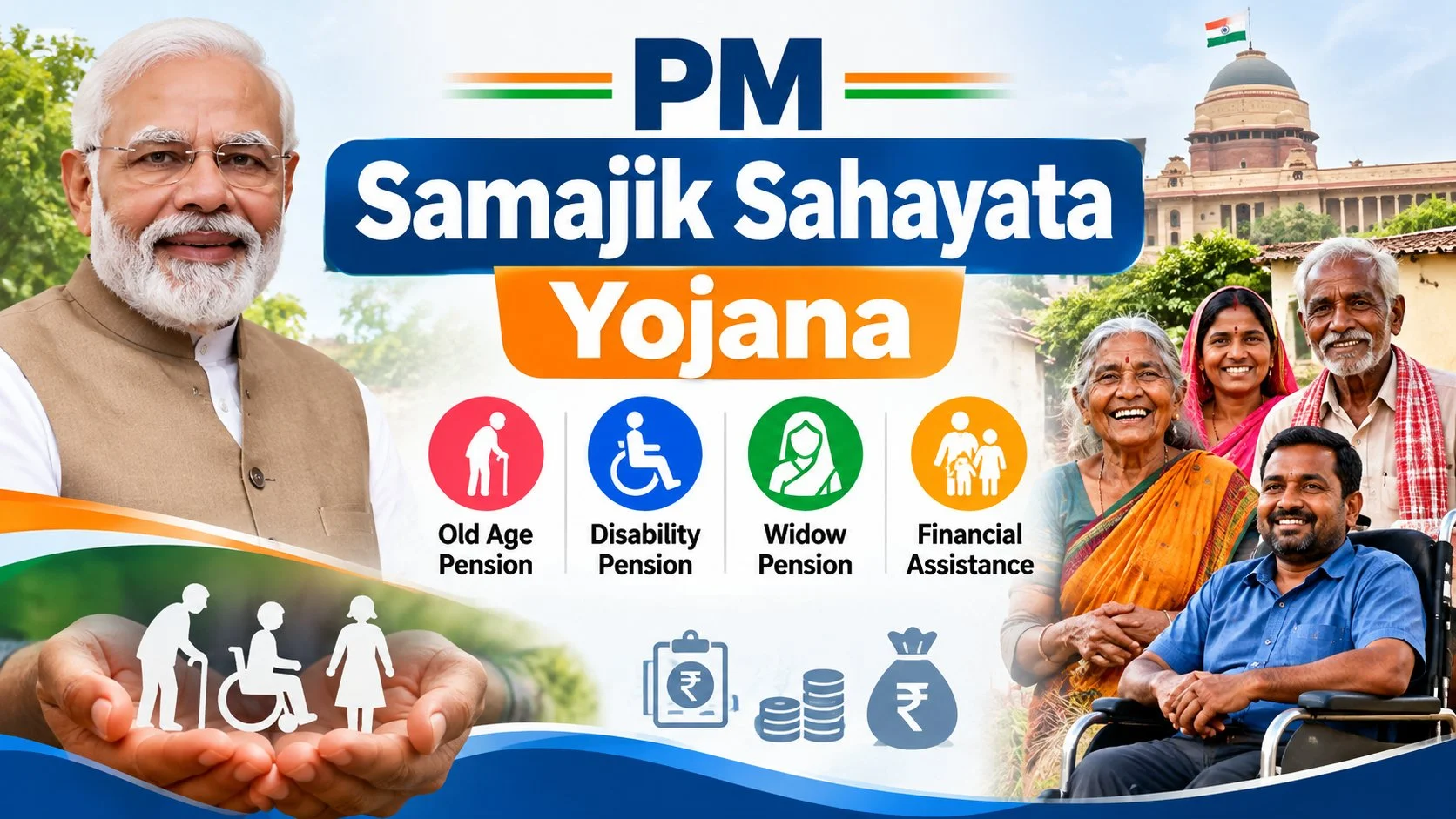
PM Samajik Sahayata Yojana is the new name of the National Social Assistance Programme (NSAP), a central government scheme that provides monthly pensions to elderly persons, widows, and persons with disabilities from poor households, plus a one-time family benefit on the death of the family’s main earning member.
On October 14, 2026, the Union Cabinet, chaired by Prime Minister Narendra Modi, approved the continuation of NSAP for five more years — from 2026-27 to 2030-31 — with a total outlay of ₹53,428 crore. The same approval renamed the scheme and all its sub-schemes, revised the disability pension rules, and kept the old-age, widow, and family benefit components running in their existing form.
A quick bit of background, because it helps you trust the scheme: NSAP was launched on August 15, 1995, in line with Article 41 of the Constitution, which says the State should provide public assistance to citizens in old age, sickness, disablement, and undeserved want. It is implemented by the Department of Rural Development with 100% central assistance, and it covers all 36 states and Union Territories. Around 3.20 crore beneficiaries are expected to benefit from this approval.
PM Samajik Sahayata Yojana 2026 — Key Highlights
| Detail | What Was Announced |
|---|---|
| Approved by | Union Cabinet on October 14, 2026 |
| Total outlay | ₹53,428 crore for 5 years (2026-27 to 2030-31) |
| Beneficiaries | 3.20 crore across all 36 States/UTs |
| Old name | National Social Assistance Programme (NSAP) |
| New name | Pradhan Mantri Samajik Sahayata Yojana (PMSSY) |
| Disability pension (new) | ₹375/month (0-79 years), ₹625/month (80+ years) |
| Disability threshold | Reduced from 80% to 40% (benchmark disability) |
| Minimum age for disability pension | Removed — eligible from birth |
| Old-age, widow, family benefit | Continue in existing form, only renamed |
| Implementation guidelines | To be issued within 3 months of the Cabinet decision |
The 4 Sub-Schemes and Their New Names
One thing that confused me at first was that the Cabinet did not rename just the main scheme — every sub-scheme got a new name too. Here is the full mapping, old name to new name, so you never mix them up:
| Old Name (NSAP) | New Name (PM Samajik Sahayata Yojana) | Who It Covers |
|---|---|---|
| Indira Gandhi National Old Age Pension Scheme (IGNOAPS) | Pradhan Mantri Vridhavastha Pension Yojana | Elderly persons from BPL households |
| Indira Gandhi National Widow Pension Scheme (IGNWPS) | Pradhan Mantri Vidhawa Pension Yojana | Widows from BPL households |
| Indira Gandhi National Disability Pension Scheme (IGNDPS) | Pradhan Mantri Divyangjan Pension Yojana | Persons with disabilities from BPL households |
| National Family Benefit Scheme (NFBS) | Pradhan Mantri Parivar Labh Yojana | BPL family on death of the primary breadwinner |
The older names were linked to former Prime Minister Indira Gandhi. The renaming follows the same pattern the government has used for several schemes in recent years — the substance of the scheme stays, the branding changes. If your state portal or a local office still uses the old names for a few months, do not worry; they refer to the same benefits.
Pension Amount Per Month — How Much You Actually Get
This is the question everyone asks first: kitni pension milegi? Here is the honest answer. Under PM Samajik Sahayata Yojana, the pension comes from two parts — the central assistance decided by the Cabinet, and the extra amount (top-up) that your state adds from its own budget. So the final amount in your bank account depends on which state you live in.
The central assistance rates that were fixed under NSAP norms (and continue under the new name) are:
| Sub-Scheme | Age Group | Central Assistance Per Month |
|---|---|---|
| PM Vridhavastha Pension Yojana (old age) | 60-79 years | ₹200 |
| PM Vridhavastha Pension Yojana (old age) | 80 years and above | ₹500 |
| PM Vidhawa Pension Yojana (widow) | 40-79 years | ₹300 |
| PM Vidhawa Pension Yojana (widow) | 80 years and above | ₹500 |
| PM Divyangjan Pension Yojana (disability) — revised | 0-79 years | ₹375 (earlier ₹300) |
| PM Divyangjan Pension Yojana (disability) — revised | 80 years and above | ₹625 (earlier ₹500) |
And the PM Parivar Labh Yojana (earlier National Family Benefit Scheme) gives a one-time lump sum of ₹20,000 to the BPL household on the death of its primary breadwinner. This is not a monthly pension — it is a single payment meant to give the family immediate support.
Now, my honest take: the central assistance by itself is small. Nobody lives on ₹200-375 a month. But most states add their own contribution on top — in many states the combined old-age pension crosses ₹1,000-2,000 per month. Check your state government’s social welfare department to know the actual amount you will receive. If you are a senior citizen, you may also want to read my guide on the Senior Citizen Savings Scheme, which is a different, savings-based option for retirees.
Disability Pension Ke 3 Bade Badlav — The Biggest News
If there is one part of the October 2026 Cabinet decision worth your full attention, it is this. The disability pension — now called the PM Divyangjan Pension Yojana — got three big changes at once:
1. Pension amount increased by 25%
Monthly assistance has been raised from ₹300 to ₹375 for beneficiaries aged 0-79, and from ₹500 to ₹625 for those aged 80 and above. That is an extra ₹75 and ₹125 per month respectively — ₹900 and ₹1,500 more per year. Small in absolute terms, but for a household living on the margins, every rupee counts.
2. Disability threshold cut from 80% to 40%
Earlier, only persons with 80% or more disability could get this pension. Now, anyone with benchmark disability of 40% or more qualifies. This brings the scheme in line with the Rights of Persons with Disabilities Act, 2016, which defines benchmark disability at 40%. In practice, this means lakhs of persons with disabilities who were excluded earlier can now apply.
3. Pension eligibility starts from birth
The minimum age requirement has been removed entirely. A child born with a qualifying disability is now eligible from birth — earlier the pension started only at age 18. For families raising a disabled child, this is a genuine change, because support starts when expenses start.
One important detail: the government said implementation guidelines covering the revised eligibility, beneficiary numbers, and assistance rates will be issued within three months. So if you are newly eligible because of the 40% rule, keep your disability certificate ready and watch for the state-level rollout.
PM Samajik Suraksha Yojana vs PM Samajik Sahayata Yojana — Confusion Clear Karein
I keep seeing people search “pm samajik suraksha yojana” expecting this scheme. Let me clear this up, because the names sound almost identical:
- PM Samajik Sahayata Yojana = the renamed NSAP. It gives monthly pensions to the elderly, widows, and persons with disabilities, plus a family benefit on a breadwinner’s death. You do not pay any premium — it is welfare assistance funded by the government.
- “Samajik Suraksha” usually points to a different family of schemes — the Jan Suraksha cluster: PM Suraksha Bima Yojana (₹20/year accident insurance) and PM Jeevan Jyoti Bima Yojana (₹436/year life insurance). These are insurance products where you (or your bank) pay a small yearly premium for a ₹2 lakh cover.
Different purpose, different mechanism. If you want insurance-type protection, read my articles on the PM Jan Dhan Yojana account benefits and how these low-cost insurance schemes link to your bank account. If you are looking for a monthly government pension for an elderly parent, a widow, or a disabled family member — this article is the right one.
Eligibility Criteria — Kaun Apply Kar Sakta Hai?
Eligibility is scheme-specific, but one rule is common to all: the applicant must belong to a Below Poverty Line (BPL) household. Let us go through each component:
PM Vridhavastha Pension Yojana (Old Age Pension)
- Age 60 years or above.
- Belongs to a BPL household (as per the criteria used by your state).
- The applicant should be a destitute — meaning little or no regular means of subsistence from their own source of income or through support from family members.
PM Vidhawa Pension Yojana (Widow Pension)
- A widow aged 40 years or above (up to 79 years for the ₹300 slab).
- Belongs to a BPL household.
- Destitute, with no regular means of support.
PM Divyangjan Pension Yojana (Disability Pension)
- Benchmark disability of 40% or above (this is the new, reduced threshold).
- No minimum age — eligible from birth.
- Belongs to a BPL household.
- A valid disability certificate issued by a competent medical authority is mandatory.
PM Parivar Labh Yojana (Family Benefit)
- Given to a BPL household on the death of the primary breadwinner aged between 18 and 59 years.
- The death must be reported with a valid death certificate.
- This is a one-time payment of ₹20,000, not a monthly pension.
A note from my side: states sometimes add their own conditions or extend coverage (for example, some states cover widows below 40 through state schemes). Your district social welfare office or the state portal will have the final word.
Documents Required
Keep these ready before you start the application. The exact list can vary slightly by state, but this covers what is asked almost everywhere:
If you do not have a bank account yet, open one first — a Jan Dhan account works fine. My detailed guide on PM Jan Dhan Yojana account opening and benefits walks you through it.
How to Apply Online — Step by Step
Here is the part that matters most: apply kaise karein? Let me be straight with you. Since the renaming was approved on October 14, 2026 and the revised guidelines are due within three months, the application channels for the next few months continue to be the existing NSAP channels in most states. Here is how applications generally work:
Step 1: Visit the NSAP portal
Go to the official NSAP portal (nsap.nic.in) — you can also check the scheme details on the government’s myScheme portal — or your state government’s social welfare / pension portal. The national portal gives scheme information and state-wise links; the actual application usually happens on the state portal or at the local office.
Step 2: Choose the right sub-scheme
Select old-age, widow, disability, or family benefit as per your case. Read the eligibility shown on the portal once — do not skip this, because applying under the wrong sub-scheme is the most common reason for rejection.
Step 3: Fill the application form
Enter your personal details exactly as they appear on your Aadhaar card: name, date of birth, address, BPL details, and bank account number. Upload scanned copies of the documents listed above. Double-check the bank account number and IFSC — a wrong digit means your pension lands in someone else’s account or bounces back.
Step 4: Submit and note the application number
After submitting, save or print the application/reference number. You will need it for tracking.
Your application goes to the block / tehsil / district social welfare office for verification. An official may visit or call to verify your BPL status and documents. This step takes time — usually a few weeks to a couple of months depending on the state.
Step 6: Approval and DBT payment
Once approved, your name appears on the beneficiary list and the pension starts coming directly into your bank account through DBT, usually quarterly or monthly as per your state’s payment cycle.
No internet at home? You can apply offline too. Visit your nearest Common Service Centre (CSC), Gram Panchayat office, or the District Social Welfare Office with your documents — they will fill the form for you. For farmers’ families, the Kisan Credit Card guide on my site explains a similar CSC-based process you may already be familiar with.
One honest warning: if anyone asks you for money to “approve” your pension application, that is a scam. The scheme has no application fee, and approval depends only on eligibility verification.
NSAP vs PM Samajik Sahayata Yojana — Key Differences
Is this a new scheme or the same one with a new name? Short answer: mostly the same scheme, with one important upgrade. Here is the side-by-side:
| Point | NSAP (Earlier) | PM Samajik Sahayata Yojana (Now) |
|---|---|---|
| Scheme name | National Social Assistance Programme | Pradhan Mantri Samajik Sahayata Yojana |
| Sub-scheme names | IGNOAPS, IGNWPS, IGNDPS, NFBS | PM Vridhavastha, PM Vidhawa, PM Divyangjan Pension Yojana, PM Parivar Labh Yojana |
| Budget | Previous plan period allocations | ₹53,428 crore fixed for 2026-27 to 2030-31 |
| Disability pension | ₹300 (18-79), ₹500 (80+) | ₹375 (0-79), ₹625 (80+) — 25% hike |
| Disability threshold | 80% disability minimum | 40% benchmark disability |
| Minimum age (disability) | 18 years | From birth |
| Old-age / widow / family benefit | Running | Running, unchanged, only renamed |
So if you are an existing NSAP beneficiary, nothing changes for you except the name on the letterhead — your pension continues. The real change is for persons with disabilities who were excluded earlier: lower threshold, no age bar, and a 25% higher amount.
States Ka Role aur DBT Payment
Two things worth knowing about how the money actually reaches you:
States add their own money. The Cabinet-approved amounts are only the central share. Almost every state adds a top-up from its own budget. That is why the old-age pension in some states is ₹1,000+ while the central share is ₹200. Always check your state’s social welfare department for the combined amount.
Payment is through DBT. The pension goes straight into the beneficiary’s bank account — no middlemen. Keep your Aadhaar linked to your bank account and your mobile number updated, or payments can get stuck. If a payment fails, the district social welfare office is the right place to follow up, not the bank alone. Students in the family can also check the NSP Scholarship 2026-27 guide on my site — it uses the same DBT and Aadhaar-seeding process, so the steps will feel familiar.
Honest Limitations — Kya Nahi Badla
I write these articles to help, not to hype. So here is what you should keep in mind:
- The amounts are still small. Even after the hike, ₹375 a month is support, not income. Treat it as one part of the family’s safety net, not the whole net.
- Guidelines are still awaited. The Cabinet said revised guidelines will come within three months. Until then, new applications under the 40% disability rule may move slowly in some states.
- Old-age and widow pensions did not increase in this decision. They continue in their existing form.
- Beware of fake news. After every big Cabinet announcement, viral WhatsApp forwards claim inflated amounts. Check PIB or the official portal before believing any number. (PIB has busted such fakes before — for example, a viral ₹4,000 PM Kisan claim was officially denied earlier this year.) My coverage of the PM Kisan 24th installment follows the same verify-first approach.
If you are planning long-term savings for a daughter alongside these benefits, my Sukanya Samriddhi Yojana guide explains a government-backed option with far higher returns.
Abhi Kya Karein — Action Checklist
If you or a family member might be eligible, here is what I would do this week:
The revised guidelines are expected within three months of the October 14, 2026 Cabinet decision, so states will firm up the new disability-pension process soon. Applying now with complete documents puts you ahead of the queue.
PM Samajik Sahayata Yojana — Quick Recap
To sum up, the PM Samajik Sahayata Yojana is the renamed National Social Assistance Programme with a ₹53,428 crore outlay till 2030-31. If you are planning to apply under the PM Samajik Sahayata Yojana, first confirm your BPL status, keep your Aadhaar and bank details ready, and apply through your state’s pension portal or a nearby CSC. The PM Samajik Sahayata Yojana now covers persons with 40% benchmark disability from birth — the biggest change in the PM Samajik Sahayata Yojana so far
. Remember that PM Samajik Sahayata Yojana pensions are paid through DBT, so an Aadhaar-seeded bank account is essential for every PM Samajik Sahayata Yojana beneficiary. Share this PM Samajik Sahayata Yojana guide with anyone who may be eligible, because many families still do not know the PM Samajik Sahayata Yojana disability rules have changed. For the latest updates on the PM Samajik Sahayata Yojana, always check the official portal before applying under the PM Samajik Sahayata Yojana.
Before you close this tab, here is a quick PM Samajik Sahayata Yojana action list. First, confirm what PM Samajik Sahayata Yojana covers for your category. Second, check the PM Samajik Sahayata Yojana eligibility criteria above and keep your documents ready. Third, submit your PM Samajik Sahayata Yojana application through the official portal or a CSC near you. Remember, PM Samajik Sahayata Yojana is a government welfare pension with no application fee – never pay any agent for PM Samajik Sahayata Yojana approval. If this PM Samajik Sahayata Yojana guide helped you, please share it with families who may be eligible for PM Samajik Sahayata Yojana. Bookmark this page for future PM Samajik Sahayata Yojana updates, because PM Samajik Sahayata Yojana rules may be revised when the new guidelines arrive.
Frequently Asked Questions
1. PM Samajik Sahayata Yojana kya hai?
It is the new name of the National Social Assistance Programme (NSAP), approved by the Union Cabinet on October 14, 2026. It provides monthly pensions to elderly persons, widows, and persons with disabilities from BPL households, plus a one-time family benefit of ₹20,000 on the death of the primary breadwinner. The scheme runs from 2026-27 to 2030-31 with a ₹53,428 crore outlay and covers 3.20 crore beneficiaries.
2. Disability pension ke liye kitni disability chahiye ab?
Now only 40% benchmark disability is needed — reduced from the earlier 80%. The minimum age has also been removed, so eligible persons can get the pension from birth. The monthly amount is ₹375 (age 0-79) and ₹625 (age 80+). You will need a disability certificate from a competent medical authority showing at least 40% disability.
3. Old age pension kitni milegi per month?
The central assistance is ₹200/month for ages 60-79 and ₹500/month for 80+. However, states add their own top-up, so the actual amount credited to your account is usually higher — check your state’s social welfare department for the combined figure.
4. PM Samajik Sahayata Yojana me online apply kaise karein?
Apply through the NSAP portal (nsap.nic.in) or your state’s social welfare/pension portal, or offline at a CSC centre, Gram Panchayat, or District Social Welfare Office. Fill the form with Aadhaar, BPL, age/disability, and bank details, submit, note the reference number, and wait for verification by local authorities. Payment comes via DBT into your bank account.
5. Kya purane NSAP beneficiaries ko dobara apply karna padega?
No. If you are already receiving NSAP pension, you do not need to re-apply — only the scheme name has changed, and your benefits continue. The changes mainly affect new applicants, especially persons with disabilities who now qualify under the 40% threshold.
6. PM Samajik Sahayata Yojana aur PM Suraksha Bima Yojana me kya antar hai?
PM Samajik Sahayata Yojana is a welfare pension scheme (no premium, government-funded monthly pension for the elderly, widows, and disabled). PM Suraksha Bima Yojana is an accident insurance scheme (₹20/year premium for ₹2 lakh cover). They serve completely different purposes — do not confuse the two.
If this guide helped you, share it with someone who might be eligible — especially families with a disabled member who were told earlier that “80% se kam disability par pension nahi milti.” That rule has changed now.