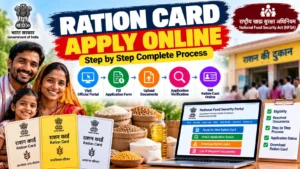

A ration card is one of the most powerful documents an Indian family can hold — it unlocks subsidised food grains every month, works as address and identity proof, and is the gateway to dozens of other government benefits. If you want to ration card apply online, the good news is that almost every state now lets you do it from your phone without visiting any office. In this guide, I’ll walk you through the complete online application process, give you a state-wise portal table so you land on the right website in one click, explain e-KYC and One Nation One Ration Card (ONORC) portability, and answer the real questions people actually search for.
✅ This guide is based on the National Food Security Act, 2013 and state food department portals. Last verified: October 17, 2026. Application processes and portal URLs change from time to time — always verify on your state’s official food supply portal before applying.
What is a Ration Card and Why Does It Matter?
A ration card is an official document issued by state governments. Before you ration card apply online, it helps to understand exactly what you are applying for: under the National Food Security Act (NFSA), 2013. It entitles eligible households to buy food grains (rice, wheat, coarse grains), sugar, and kerosene at heavily subsidised prices from Fair Price Shops — the “ration shops” you see in every neighbourhood.
But its value goes far beyond cheap grain. A ration card is accepted as:
- Address proof — for Aadhaar updates, bank accounts, passports
- Identity proof — for many government applications
- Eligibility proof — for LPG subsidy, scholarships, housing schemes, and pension schemes
Under NFSA, roughly 80 crore Indians are covered — making it the world’s largest food security programme. There are three main card types, and knowing which one applies to you is the first step before you ration card apply online.
Types of Ration Cards in India
| Card Type | Who Gets It | Key Benefits |
|---|---|---|
| AAY (Antyodaya Anna Yojana) | Poorest households (BPL priority) | 35 kg food grains/month at ₹1–3/kg |
| PHH (Priority Household) | Eligible priority families under NFSA | 5 kg per person/month at subsidised rates |
| Non-Priority / APL | Above Poverty Line families | Mainly serves as ID/address proof; limited or no grain subsidy (varies by state) |
Since January 2024, the government has been distributing free food grains to NFSA beneficiaries (the PM Garib Kalyan Anna Yojana extension) — so an AAY or PHH card currently means genuinely free grain, not just subsidised.
Eligibility: Who Can Apply for a Ration Card?
The basic eligibility rules are similar across states:
- You must be a resident of the state you’re applying in
- You should not already hold a ration card in any state (one family, one card)
- Newly married couples, newborn children, and migrants can apply for a new or separate card
- Income criteria apply for AAY/PHH categories (varies by state — typically linked to BPL/SECC lists)
Migrants take note: thanks to One Nation One Ration Card (ONORC), your existing card works across India (explained below) — you don’t need a new card when you move states for work.
Documents Required
Keep these ready before you start the online application — having them scanned saves you from half-finished applications:
If your Aadhaar isn’t updated with your current address or mobile number, fix that first via our Aadhaar update guide — almost every ration card rejection traces back to an Aadhaar mismatch.
State-wise Ration Card Portals — Find Your State in One Click
Ration cards are a state subject — there’s no single national ration card apply online portal. Use the table below to go directly to your state’s food department website. For instance, Gujarat residents can begin at the state food and civil supplies portal. I’ve listed the official portals; always check the URL shows a .gov.in or .nic.in domain before entering personal details.
| State / UT | Official Portal | Department |
|---|---|---|
| Maharashtra | mahafood.gov.in | Food, Civil Supplies & Consumer Protection |
| Uttar Pradesh | fcs.up.gov.in | Food & Civil Supplies Dept, UP |
| Bihar | sfc.bihar.gov.in | State Food Corporation, Bihar |
| Gujarat | dcs-dof.gujarat.gov.in | Food, Civil Supplies & Consumer Affairs |
| Rajasthan | food.raj.nic.in | Food & Civil Supplies Dept |
| Madhya Pradesh | nfsa.samagra.gov.in | Samagra Portal, MP |
| West Bengal | wbpds.wb.gov.in | Food & Supplies Dept, WB |
| Tamil Nadu | tnpds.gov.in | Civil Supplies Dept, TN |
| Karnataka | ahara.kar.nic.in | Food, Civil Supplies & Consumer Affairs |
| Delhi | nfs.delhi.gov.in | Food & Supplies Dept, Delhi |
| Telangana | epds.telangana.gov.in | Civil Supplies Dept |
| Andhra Pradesh | aepos.ap.gov.in | Civil Supplies Dept, AP |
| Punjab | epos.punjab.gov.in | Food & Civil Supplies Dept |
| Haryana | epos.haryanafood.gov.in | Food & Supplies Dept |
| Jharkhand | aahar.jharkhand.gov.in | Food, Public Distribution Dept |
Portal URLs change occasionally — if a link doesn’t open, search “[your state] food civil supplies ration card apply” on Google and pick the .gov.in result.
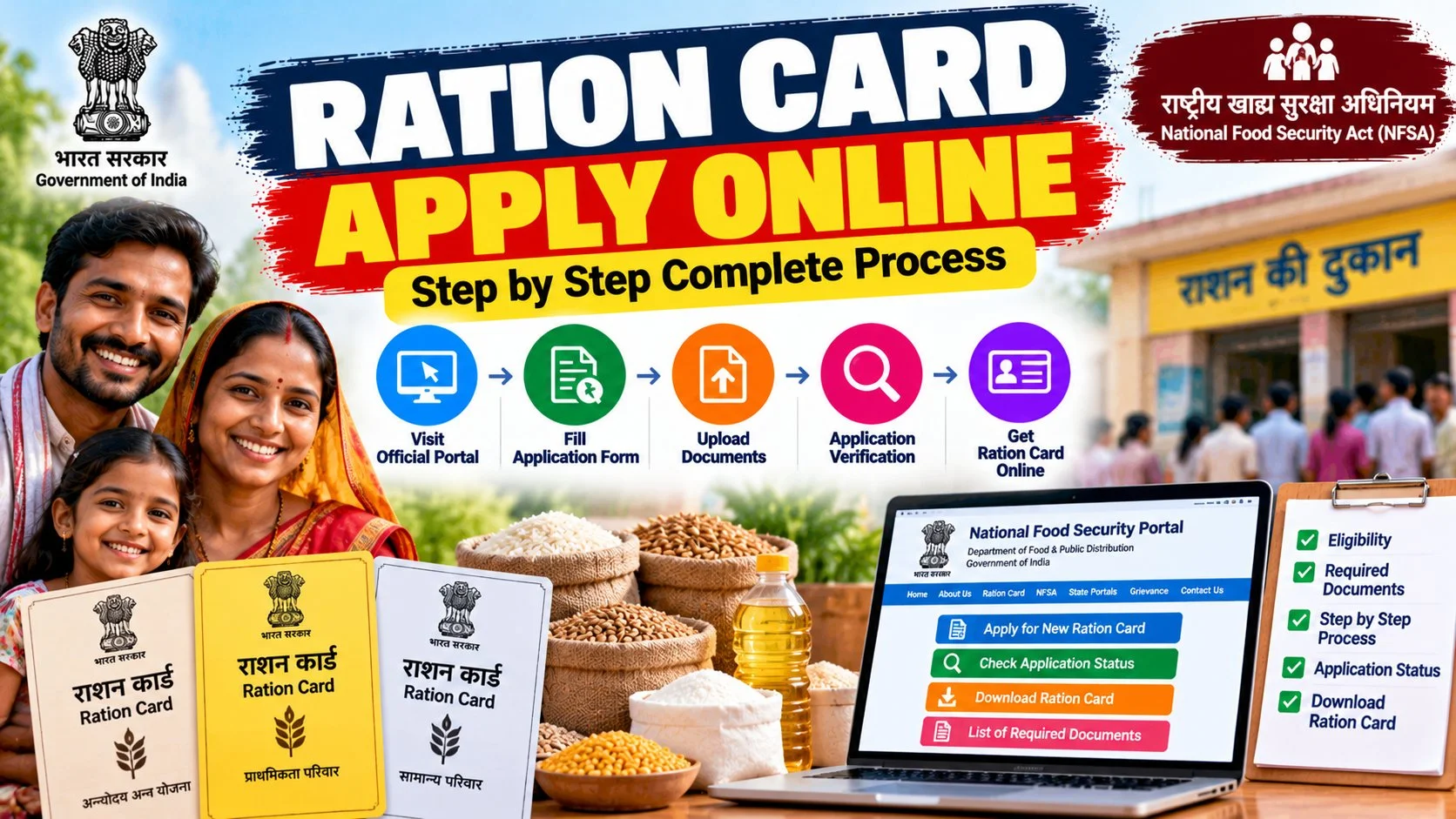
How to Ration Card Apply Online — Step by Step
The exact screens differ by state, but the ration card apply online flow is nearly identical everywhere. Here’s the universal process:
Step 1: Visit your state’s portal. Find it in the table above. Look for “New Ration Card Application,” “Apply Online,” or “e-Services.”
Step 2: Register / log in. Most portals ask for a mobile number and OTP for first-time registration. Some states route you through their single-sign-on (like Digital Gujarat or Samagra).
Step 3: Fill the application form. Enter the head of family’s details exactly as on Aadhaar — name spelling mismatches are the #1 rejection reason. Add each family member with their Aadhaar number, age, and relationship.
Step 4: Upload documents. Upload clear scans or photos of the documents from the checklist above. Blurry uploads get rejected — take photos in good light.
Step 5: Choose your Fair Price Shop. Most portals let you select a nearby ration shop (FPS dealer). Pick one close to home — you’ll visit monthly.
Step 6: Submit your ration card apply online form and note the application/reference number. Save the acknowledgement receipt (PDF or screenshot). You’ll need this number to track status.
Step 7: Verification. A food inspector or local official may visit for physical verification, or it may be done digitally via Aadhaar e-KYC. This usually takes 15–30 days.
Step 8: Download your e-ration card. Once approved, download the digital ration card from the same portal. The physical card (if your state still issues one) follows by post or FPS collection.
Ration Card e-KYC — Why It’s Mandatory Now
The government has made e-KYC mandatory for all ration card holders. Without completing e-KYC, your card can be suspended and grain stopped. Here’s what it involves:
- What: Linking every family member’s Aadhaar to the ration card with biometric or OTP verification
- Where: At your Fair Price Shop (FPS dealer has a biometric device), or via your state’s e-POS app
- Who: Every member listed on the card, including children (Aadhaar enrollment needed first for kids)
- Deadline: Extended multiple times — check your state’s current deadline on its portal
Common e-KYC failures: fingerprint mismatch (try different fingers or iris), Aadhaar-mobile not linked (OTP won’t come), and name mismatches between Aadhaar and the ration card database. Get your Aadhaar details verified first if you’ve had issues.
One Nation One Ration Card (ONORC) — Use Your Card Anywhere in India
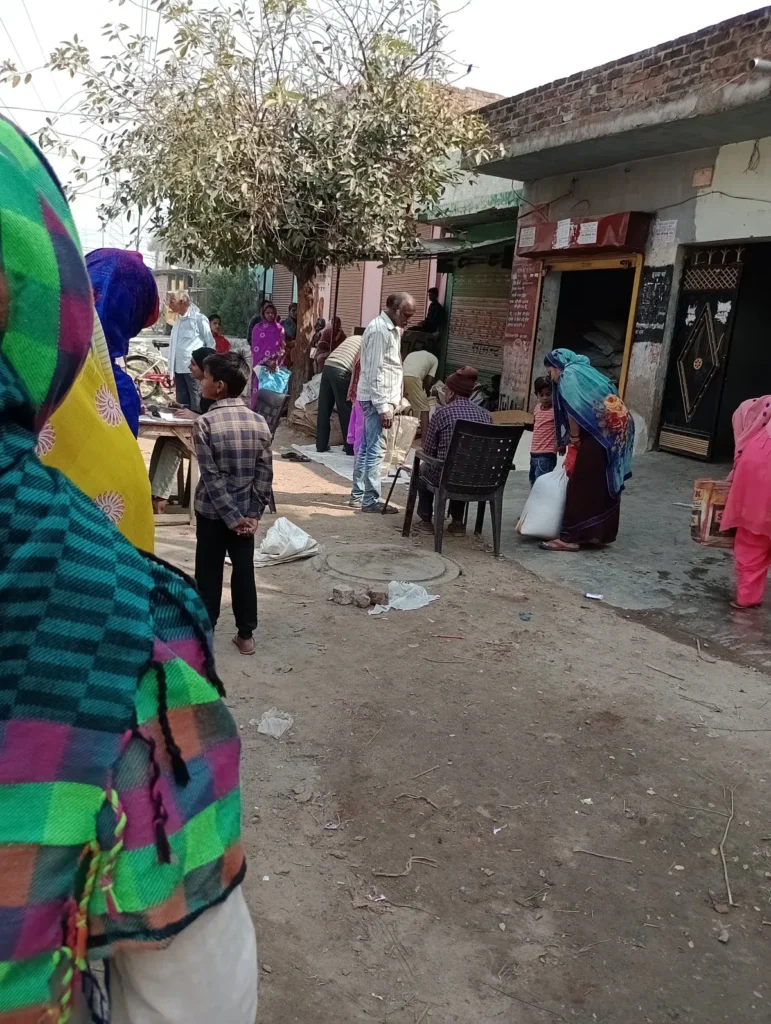
ONORC is a game-changer for India’s 10+ crore migrant workers. Once your ration card is Aadhaar-seeded, you can lift your monthly grain entitlement from any Fair Price Shop in any state — not just your home village’s shop.
How it works: FPS shops now have electronic Point of Sale (e-PoS) devices with biometric authentication. You authenticate with your Aadhaar fingerprint, and the system deducts from your home state’s quota in real time. No new card, no transfer application, no paperwork.
If you’re a migrant worker who hasn’t used ONORC yet: just walk into any FPS shop with Aadhaar-linked ration card holders in your family and ask the dealer. If they claim it “doesn’t work here,” they’re wrong — ONORC is operational in all states and UTs.
How to Check Ration Card Status and Download e-Ration Card
After you ration card apply online, track your application with the reference number on your state’s portal under “Application Status” or “Track Application.” Statuses you’ll see:
- Submitted/Pending — received, waiting for verification
- Under verification — field or digital check in progress
- Approved — card generated, ready to download
- Rejected — with a reason (usually document mismatch — reapply after fixing)
Once approved, look for “Download e-Ration Card” or “Print Ration Card” — you’ll typically need the application number and registered mobile OTP. The e-ration card is legally valid everywhere the physical card is.
Adding a New Family Member (Newborn or Newly Married)
You don’t need a new card for a new member — just update the existing one:
- Log in to your state’s portal → “Add Member” / “Correction in Ration Card”
- Enter the new member’s Aadhaar and details (for newborns, Aadhaar enrollment first)
- Upload birth certificate (newborn) or marriage certificate + spouse’s deletion proof (newly married)
- Submit — the updated e-card is usually available within 15 days
Ration Card Correction: Name, Address, or Member Updates
Mistakes after you ration card apply online are extremely common — wrong spellings, old addresses, deceased members still listed. Here’s how to fix each:
| Correction Type | How to Do It | Document Needed |
|---|---|---|
| Name spelling correction | Portal → “Correction” → update name to match Aadhaar exactly | Aadhaar card |
| Address change | Portal → “Correction” → new address + FPS shop reselection | New address proof |
| Remove member (death/marriage) | Portal → “Delete Member” → select member + reason | Death certificate / marriage certificate |
| Change head of family | Portal → “Change HoF” (some states need offline form) | Aadhaar of new HoF + declaration |
| Mobile number update | Portal → “Update Mobile” → OTP verification | New mobile number (OTP) |
Pro tip: always make corrections match your Aadhaar exactly — the food department’s database cross-checks with UIDAI, and even a single-letter difference can stall your application for weeks.
Which Ration Card Category Should You Apply For?
Choosing the wrong category is the most common application mistake. Here’s a decision guide:
Apply for AAY if: your household is in the poorest category — landless labourers, widows without support, disabled persons without livelihood, elderly without caregivers, or households identified in BPL/SECC surveys. AAY gives the maximum entitlement (35 kg/month per family).
Apply for PHH if: your family is economically vulnerable but not in the poorest bracket — this covers the bulk of NFSA beneficiaries. You get 5 kg per person per month. Most new applicants who qualify for subsidised grain fall here.
Apply for Non-Priority/APL if: your income exceeds the NFSA cutoffs but you still want the card as identity and address proof. You won’t get grain subsidies in most states, but the card remains valuable for LPG, scholarship, and scheme applications.
Not sure which one fits? Apply for PHH — the food department verifies your eligibility during processing and allots the correct category. Applying for AAY when you don’t qualify only delays approval; it doesn’t get you extra benefits.
What to Do If Your FPS Dealer Refuses Grain
It’s illegal for a Fair Price Shop dealer to deny your entitled grain. If it happens:
- Ask for the e-PoS receipt. Every transaction must generate a printed receipt. No receipt = the dealer is likely diverting your grain.
- Check your balance online. Your state’s portal shows your monthly entitlement vs. what was actually disbursed. Screenshot any mismatch.
- Complain on the toll-free helpline. Every state has a food helpline, and the national Anna Sahayata helpline for ration complaints is 14457 (IVRS). Complaints are tracked with a reference number.
- Escalate to the District Food Officer if the helpline doesn’t resolve it within 15 days.
Under ONORC, you can also simply take your business to a different FPS shop — dealers who cheat lose customers, which is exactly the accountability the system was designed for.
Beware of Ration Card Scams
Because ration cards unlock so many benefits, scammers target applicants. Protect yourself:
- Never pay “agents” for faster approval. The application is free and the timeline is the same for everyone. Anyone demanding money is running a scam.
- Only use .gov.in portals. Fake websites mimicking state food departments collect Aadhaar numbers for identity theft. Check the domain carefully.
- Never share OTPs. No government official will ever call asking for the OTP sent to your phone. That’s always fraud.
- Verify SMS senders. Genuine status-update SMS come from government sender IDs (like “GOVT” or state codes), not random 10-digit numbers.
- Check your card’s member list yearly. Ghost members (unknown names added to your card) are a known fraud — someone else draws grain in their name. Verify your member list on the portal once a year.
Frequently Asked Questions
How can I ration card apply online?
To ration card apply online, visit your state’s food department portal (see the state-wise table above), register with your mobile number, fill the application form with Aadhaar-verified family details, upload documents, choose your Fair Price Shop, and submit. Note the reference number to track status. Approval typically takes 15–30 days.
What is ration card e-KYC and is it compulsory?
Yes, e-KYC is compulsory. It means linking every family member’s Aadhaar to the ration card via biometric or OTP verification at your Fair Price Shop. Cards without completed e-KYC can be suspended. Check your state’s current deadline on its official portal.
What is ONORC (One Nation One Ration Card)?
ONORC lets you collect your monthly food grain entitlement from any Fair Price Shop in any Indian state using Aadhaar biometric authentication — no new card or transfer needed. It’s fully operational across all states and UTs, and is especially useful for migrant workers.
Can I apply for a ration card in a state where I rent a house?
Generally you apply where you’re a resident. With ONORC, migrants don’t need a new card — your home-state card works at any FPS shop. Some states allow applications with rent agreements as address proof; check your state’s specific rules.
How long does it take to get a ration card after applying online?
Typically 15–30 days, depending on the verification process in your state. Digital/Aadhaar-based verification is faster; areas requiring physical field visits take longer. Track status with your application reference number.
My ration card application was rejected. What now?
The most common reasons are Aadhaar name mismatches, blurry document uploads, or already holding a card in another state. Fix the specific reason mentioned in the rejection, then reapply — there’s no waiting period or penalty for reapplying.
How do I add my newborn baby to the ration card?
First enroll the baby for Aadhaar, then use the “Add Member” option on your state’s portal. Upload the birth certificate and the baby’s Aadhaar. The updated e-ration card is usually issued within 15 days.
Is the ration card free, or is there an application fee?
To ration card apply online is free in most states. Some states charge a nominal fee (₹5–50) for duplicate cards or corrections. Never pay anyone claiming to “speed up” your application — that’s a scam.
Can I get ration without e-KYC?
Temporarily, some states allow OTP-based exceptions, but e-KYC completion is ultimately mandatory. Dealers are instructed to stop grain distribution for non-e-KYC cards after the deadline. Complete it at your FPS shop as soon as possible.
What documents work as address proof for ration card apply online?
Electricity bill, rent agreement, voter ID, passport, driving licence, or bank passbook with address. The name on the address proof should ideally match the applicant’s name or a family member’s.
Final Word
To ration card apply online is genuinely straightforward once you know which portal to use — and now you do. Get your documents ready, make sure Aadhaar details match exactly, complete e-KYC without delay, and remember that ONORC means your card travels with you anywhere in India. A ration card isn’t just about subsidised grain; it’s the foundation document that unlocks LPG subsidies, scholarships, housing benefits, and more. Don’t leave that value on the table.