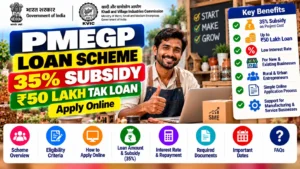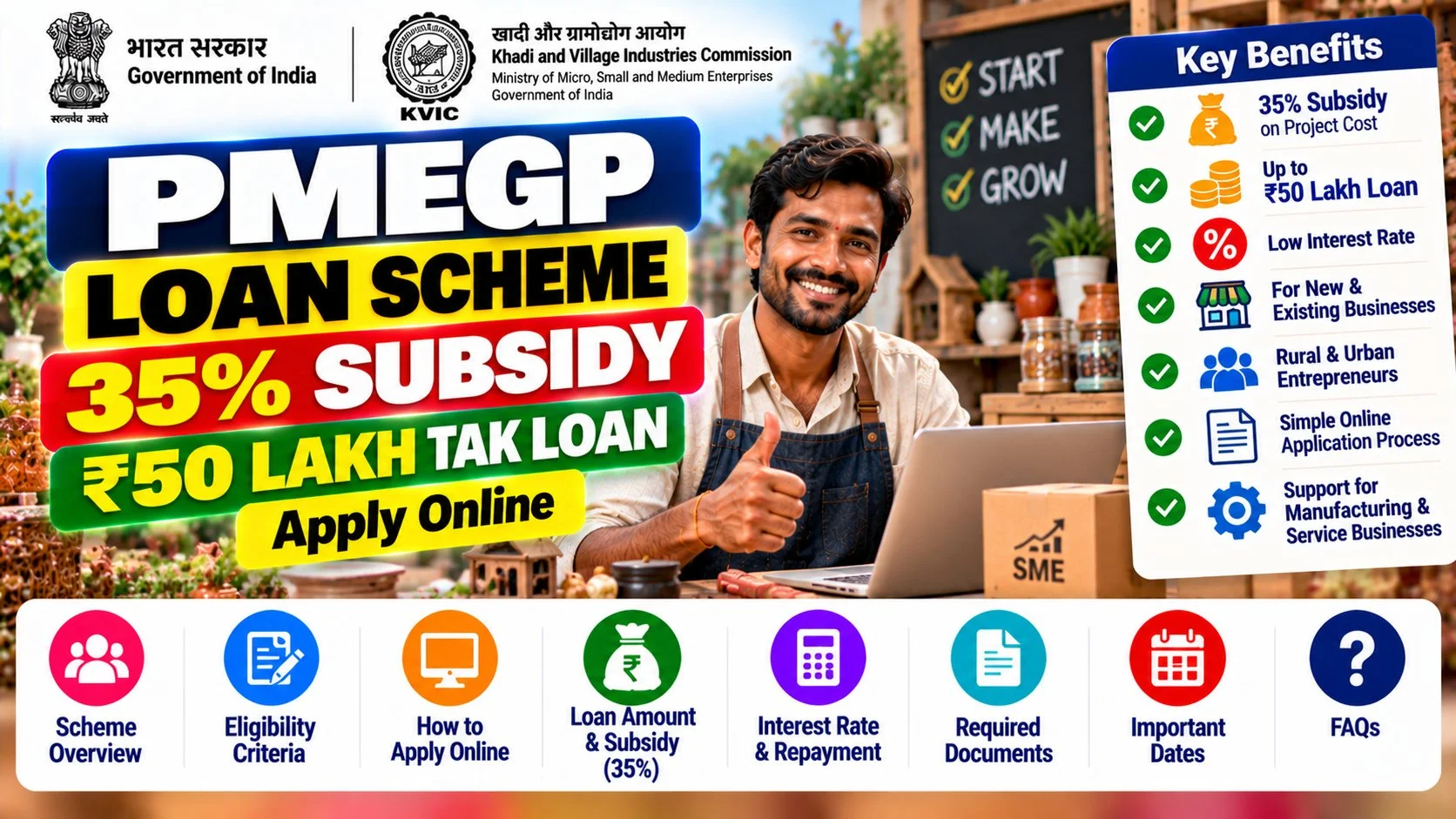

Imagine getting up to 35% of your business cost as a government subsidy — money you never have to repay. That is exactly what the pmegp loan yojana 2026 offers to first-time entrepreneurs. If you want to start a small manufacturing unit or service business in 2026, this is the one scheme you cannot afford to ignore.
✅ This guide is based on official government sources including KVIC and the Ministry of MSME. Last verified: October 13, 2026. Subsidy rates, project-cost limits, and eligibility rules are revised by the government from time to time — always cross-check the latest details on the official PMEGP portal before applying.
What Is the PMEGP Scheme?
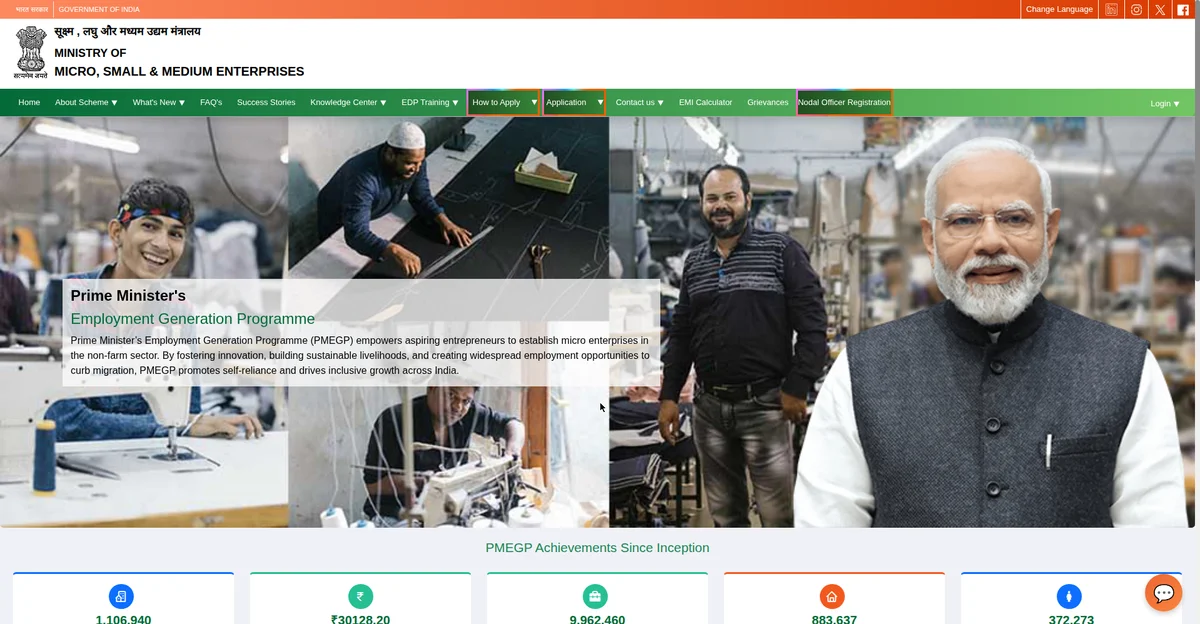
The Prime Minister’s Employment Generation Programme (PMEGP) is a flagship credit-linked subsidy scheme run by the Ministry of Micro, Small and Medium Enterprises (MSME). It has been in operation since 2008-09 and is implemented nationally by the Khadi and Village Industries Commission (KVIC) as the nodal agency, along with State Khadi and Village Industries Boards (KVIBs), District Industries Centres (DICs), and participating banks.
Unlike a regular business loan, PMEGP combines bank finance with a government margin-money subsidy. Here is how the money is structured: you contribute a small share (5% or 10%) of the project cost from your own pocket, the government gives you a subsidy of 15% to 35% (which you do not repay), and the bank finances the rest as a term loan plus working capital. This structure is what makes PMEGP genuinely different from Mudra or Stand-Up India — those schemes give you loans, but PMEGP gives you a subsidy on top of the loan.
The scheme’s core objective is simple: generate self-employment by helping ordinary people set up new micro-enterprises in the non-farm sector. Over the years it has supported lakhs of units across manufacturing, food processing, textiles, rural engineering, services, and dozens of other activities. An outlay of ₹13,554.42 crore was approved for PMEGP for the five financial years from 2021-22 to 2025-26, which shows the scale at which the government is backing this programme.
One thing to understand clearly: PMEGP is not a personal loan. You cannot use it for personal expenses, weddings, or consumption. It finances eligible new business projects only, and the bank appraises your project report for viability before sanctioning anything.
PMEGP Subsidy Rates 2026: The 15% to 35% Breakdown
The subsidy — officially called margin money — is the heart of PMEGP and the reason this scheme beats every other business-loan scheme for eligible applicants. The rate you get depends on two things: which category you belong to and whether your unit is in a rural or urban area.
| Beneficiary Category | Area | Subsidy (% of Project Cost) | Your Contribution |
|---|---|---|---|
| General | Urban | 15% | 10% |
| General | Rural | 25% | 10% |
| Special (SC/ST/OBC/Minorities/Women/Ex-servicemen/Physically Handicapped/NER/Hill & Border areas) | Urban | 25% | 5% |
| Special (SC/ST/OBC/Minorities/Women/Ex-servicemen/Physically Handicapped/NER/Hill & Border areas) | Rural | 35% | 5% |
Read that last row again: a woman entrepreneur or SC/ST applicant setting up a unit in a rural area gets 35% of the entire project cost as a grant and has to contribute only 5% herself. On a ₹10 lakh project, that means ₹3.5 lakh free from the government, ₹50,000 from your pocket, and only ₹6 lakh as a bank loan. Compare that with a Mudra loan where you borrow the full amount and repay every rupee with interest — the difference is enormous.
A few important rules about the subsidy:
- It is a one-time assistance — you cannot claim it again for the same unit (except through the 2nd loan for upgradation, explained below).
- The subsidy is routed through your financing bank and adjusted in your loan account after your unit is set up and verified — it is not handed to you as cash upfront.
- Your unit must be registered on the Udyam portal before the margin money is adjusted.
- Projects financed jointly by two different banks are not eligible for the subsidy.
- Rural vs urban is decided by Panchayati Raj vs Municipality jurisdiction — all areas under Panchayati Raj Institutions count as rural.
Maximum Project Cost: How Big a Loan Can You Get?
PMEGP supports much larger projects than most people realise. Under the pmegp loan yojana 2026 guidelines, the limits below are the maximum project costs admissible for subsidy purposes — your bank can technically finance a bigger project, but the subsidy is calculated only up to these caps.
| Sector | New Unit (Max Project Cost) | 2nd Loan for Upgradation |
|---|---|---|
| Manufacturing | ₹50 lakh | ₹1 crore |
| Business / Service | ₹20 lakh | ₹25 lakh |
Yes, you read that right — a ₹50 lakh manufacturing project can be set up under PMEGP. That is five times the maximum Mudra loan. And if you already run a PMEGP or MUDRA unit with a good repayment record, the 2nd loan for upgradation lets you expand with project costs up to ₹1 crore (manufacturing) or ₹25 lakh (service), with a flat 15% subsidy (20% in NER and hill areas).
A Worked Example: See the Subsidy in Real Numbers
Let us take a concrete case. Suppose you are a woman applicant from a rural area starting a food-processing unit with a total project cost of ₹10 lakh:
- Government subsidy (35%): ₹3,50,000 — you never repay this
- Your contribution (5%): ₹50,000
- Bank loan (60%): ₹6,00,000 — this is what you actually borrow and repay
At a typical bank interest rate of around 11% over 5 years, the EMI on ₹6 lakh works out to roughly ₹13,045 per month. Without the PMEGP subsidy, you would have borrowed nearly the full ₹10 lakh and paid a much higher EMI. That is the real power of this scheme — the subsidy shrinks your actual borrowing dramatically. (Want to check EMIs for your own numbers? Try the Mudra Loan EMI Calculator — the same reducing-balance math applies to any business loan.)
Eligibility Criteria for PMEGP Loan 2026
The eligibility rules are deliberately simple — the scheme is meant for ordinary people, not just the well-connected. Here is the complete checklist:
- Age: Above 18 years. There is no upper age limit.
- Education: Minimum 8th standard pass is required for manufacturing projects above ₹10 lakh and service projects above ₹5 lakh. Below those thresholds, no formal education requirement applies.
- Income ceiling: There is no income ceiling — rich or poor, anyone meeting the other criteria can apply.
- New units only: The scheme is for setting up new micro-enterprises. Existing businesses cannot apply (the only exception is the 2nd loan for upgradation of existing PMEGP/MUDRA units).
- Who can apply: Individuals, Self-Help Groups (SHGs), cooperative societies, institutions registered under the Societies Registration Act, production co-operative societies, and charitable trusts.
- No prior subsidy: You must not have availed subsidy earlier under PMRY, REGP, or PMEGP.
- One person, one unit: Assistance is available for one project per person, though family members can apply for separate viable projects.
Documents Required
Keep these ready before you start the online application — incomplete documentation is the most common reason applications get delayed at the preliminary scrutiny stage:
- Aadhaar card (mandatory — authenticated with UIDAI during application)
- PAN card
- Caste certificate (for special-category subsidy claims)
- Special category certificate, wherever applicable (minority, ex-serviceman, physically handicapped, etc.)
- Project report / DPR — detailed project report with cost estimates (this is the single most important document)
- Rural area certificate (to claim the higher rural subsidy rate)
- Education certificate / EDP / skill-development training certificate
- Passport-size photographs
- Bank account details
- Rent agreement / NOC / proof of business premises
- Any other document the implementing agency asks for
A strong, detailed project report increases your approval chances by a wide margin — banks judge your seriousness and the project’s viability largely from this document. If you have never written one, consider getting help from your DIC (District Industries Centre); many offer guidance for free.
How to Apply for PMEGP Loan Online: Step-by-Step
Online application is mandatory — no manual or paper applications are accepted. Everything happens on the official PMEGP portal at kviconline.gov.in. Here is the exact process:
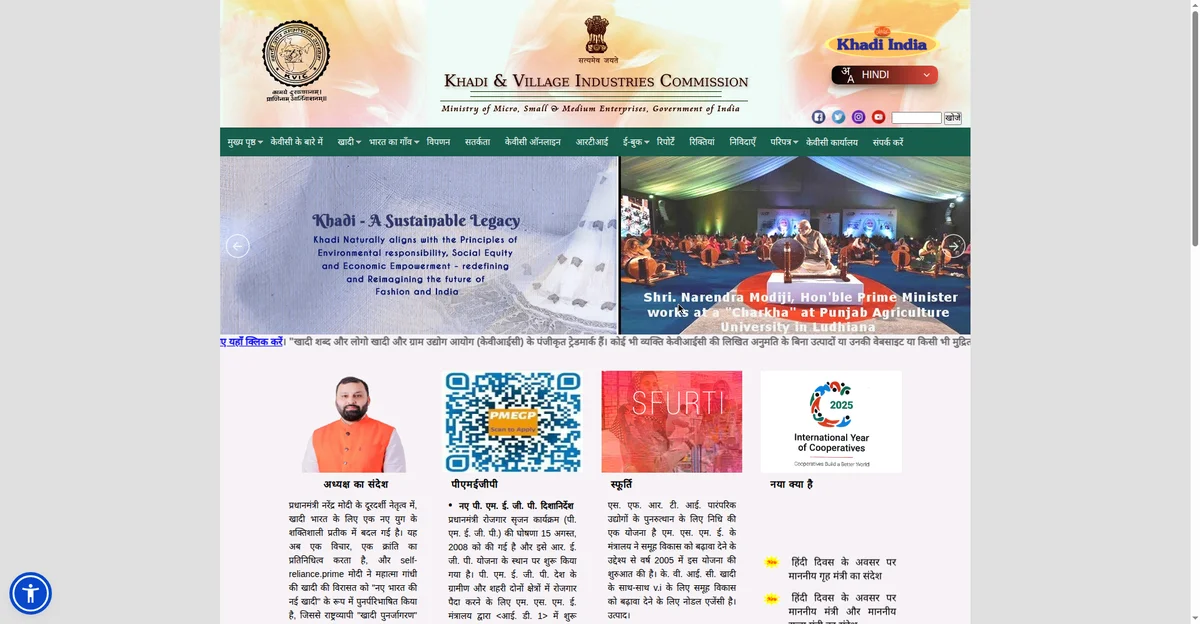
Step 1: Open the PMEGP Portal
Go to kviconline.gov.in and look for the PMEGP e-portal section. You will see separate online application forms for individuals setting up new units and for upgradation of existing units — choose the one that matches your case.
Step 2: Register and Fill the Application Form
Enter all required details in the respective fields: personal information, Aadhaar number (authenticated against the UIDAI database before you proceed), proposed unit details, project cost, activity, and location. The moment you save the application data, a username and password are sent to your registered mobile number for tracking your application status later.
Step 3: Upload Photo and Documents
Upload your photograph and all documents listed above — caste certificate, special category certificate, rural area certificate, project report, and education/EDP/training certificates. A self-assessed score is generated based on the information you fill, which helps in screening.
Step 4: Final Submission and Application ID
After completing documentation, make the final submission. You will receive a unique Application ID (also sent to your registered email) through which you can track your application status. Download and print the acknowledgement as proof. Your entire application is then electronically forwarded to the implementing agency (KVIC, State KVIB, or DIC) you selected.
Step 5: Preliminary Scrutiny (Within 5 Working Days)
Within five working days of receiving your application, the nodal officer of the implementing agency will contact you personally — by telephone or in a meeting — to confirm receipt and do a preliminary scrutiny. They may correct details in consultation with you, so keep your phone reachable.
Step 6: Bank Appraisal
Your file moves to the bank you chose. The bank manager appraises the project’s viability, your documents, and your repayment capacity. This is where a solid project report pays off. If everything checks out, the bank sanctions the loan.
Step 7: EDP Training and Disbursement
Complete the mandatory EDP training (explained below), submit your own contribution to the bank, and once your unit is set up and physically verified, the margin-money subsidy is credited to your loan account. The official KVIC website is kvic.org.in for scheme guidelines and updates.
EDP Training: What It Is and Why It Is Mandatory
Entrepreneurship Development Programme (EDP) training is compulsory for PMEGP beneficiaries. Think of it as a short business-management course the government wants every subsidised entrepreneur to complete. It typically covers basics like bookkeeping, marketing, managing working capital, and understanding loan repayment.
Practically, here is how it works: after your loan is sanctioned, you attend the EDP training conducted by approved institutes, and the training institute uploads your EDP certificate directly. You need to submit your contribution, the EDP certificate, your photograph, and Aadhaar details to the financing bank, generally within 30 working days of receiving the loan sanction communication. Do not skip this step — your subsidy adjustment depends on completing it.
What You Cannot Do Under PMEGP: The Negative List
PMEGP has a defined negative list of activities that are not eligible for assistance. Knowing these upfront saves you a rejected application:
- Businesses related to meat processing, slaughterhouses, and intoxicants (alcohol, tobacco, pan masala, etc.)
- Crop cultivation and plantation activities
- Trading and direct marketing activities are generally not allowed — the scheme is for manufacturing and services, not buy-and-sell trading
- Any activity already covered under other specific government schemes where duplication would occur
Eligible activities span a wide range: agriculture and food processing, forest-based products, handmade paper and fibre, mineral-based products, polymer and chemical products, rural engineering and bio-technology, services, and textiles. Beauty salons, diagnostic centres, cyber cafes, transport services, restaurants, tailoring units, and small-scale production units are all typical PMEGP projects.
Interest Rate, Collateral, and Repayment
Interest rate: Under the pmegp loan yojana 2026, there is no government-fixed rate — your bank decides based on its own policies. In practice, PMEGP loans typically carry interest around 11% to 12% per annum, though your actual rate depends on the bank, your profile, and prevailing rates.
Collateral: As per RBI guidelines, projects costing up to ₹10 lakh do not require any collateral. Above ₹10 lakh, the bank may ask for security as per its norms — but remember, the CGTMSE credit-guarantee cover often applies, which is why banks are comfortable lending under this scheme.
Repayment: The bank structures the term loan (usually 3 to 7 years depending on the project) plus a working-capital component. Repay on time — a clean repayment record is exactly what qualifies you later for the 2nd loan for upgradation at higher project costs.
PMEGP vs Mudra Loan vs Stand-Up India: Which Should You Choose?
This is the question every aspiring entrepreneur asks. All three are central government schemes for small businesses, but they solve different problems. Here is the honest comparison:
| Feature | PMEGP | Mudra Loan | Stand-Up India |
|---|---|---|---|
| Subsidy | 15%–35% (grant, not repaid) | None | None (but RuPay card benefits) |
| Max amount | ₹50L (mfg) / ₹20L (service) | ₹20L (Tarun Plus) | ₹1 crore |
| New or existing business | New units only | New + existing | New (greenfield) only |
| Who is it for | Anyone 18+ (special categories get more) | Micro entrepreneurs | Women + SC/ST only |
| Trading allowed? | No | Yes | Yes |
| Training | EDP mandatory | Not required | Not required |
| Best when… | You want the subsidy + run manufacturing/services | You need quick collateral-free credit, incl. trading | You are a woman/SC/ST entrepreneur needing ₹10L+ |
The bottom line: if your project is manufacturing or services and you are setting up a new unit, PMEGP’s subsidy makes it the cheapest money available — nothing else gives you 15–35% free. If you are into trading, or you need money fast without the EDP and paperwork, Mudra is simpler. For detailed Mudra guidance, read the PM Mudra Loan Yojana 2026 guide, and if you are planning for old age alongside your business, the Atal Pension Yojana is worth a look too.
7 Tips to Increase Your PMEGP Approval Chances
- Invest in the project report. This is the document the bank actually reads. Include realistic cost break-ups, machinery quotations, working-capital calculations, and month-wise revenue projections. Vague reports get rejected.
- Choose the right implementing agency. You can route your application through KVIC, your State KVIB, or the DIC — pick the one most responsive in your district.
- Get your category certificates in order. If you qualify for the special-category subsidy (SC/ST/OBC/women/minority), have the certificates ready before applying — they directly increase your subsidy from 15% to up to 35%.
- Confirm rural status early. The rural-urban difference is 10 percentage points of subsidy. Get the rural area certificate from the competent authority before final submission.
- Keep your contribution ready. You need 5% or 10% of the project cost from your own funds. Banks check this — it proves commitment.
- Complete EDP training on time. Delays in training delay your subsidy adjustment. Attend as soon as the bank sanctions the loan.
- Register on Udyam. Your unit must be registered on the Udyam portal before margin money is adjusted — do it early, not at the last moment.
Frequently Asked Questions
What is the subsidy rate under PMEGP loan yojana 2026?
The margin-money subsidy ranges from 15% to 35% of the project cost. General category applicants get 15% in urban and 25% in rural areas; special categories (SC/ST/OBC/minorities/women/ex-servicemen/physically handicapped) get 25% in urban and 35% in rural areas.
What is the maximum loan amount under PMEGP?
The maximum project cost eligible for subsidy is ₹50 lakh for manufacturing and ₹20 lakh for business/service for new units. Under the 2nd loan for upgradation of existing PMEGP/MUDRA units, it goes up to ₹1 crore (manufacturing) and ₹25 lakh (service).
Is there any income limit to apply for PMEGP?
No. There is no income ceiling for setting up projects under PMEGP. Anyone above 18 years of age meeting the other criteria can apply.
Can existing businesses apply for PMEGP?
For the main scheme, only new units are eligible. However, existing PMEGP/MUDRA units with a good track record can apply for the 2nd loan for upgradation and expansion with a 15% subsidy (20% in NER and hill areas).
Is EDP training really mandatory?
Yes. Entrepreneurship Development Programme training is compulsory, and the training institute uploads your certificate. Your margin-money subsidy adjustment depends on completing it, so finish it promptly after loan sanction.
PMEGP vs Mudra — which is better?
If your business is manufacturing or services and it is a new unit, PMEGP is better because of the 15–35% subsidy you never repay. Mudra is better for trading activities, existing businesses, and faster processing without EDP training. Many entrepreneurs use Mudra first and PMEGP’s 2nd loan later for expansion.
Final Thoughts
The pmegp loan yojana 2026 remains the most generous central scheme for first-time entrepreneurs — a 15% to 35% subsidy is effectively free capital that no bank loan can match. The trade-off is paperwork: a proper project report, EDP training, and patience through bank appraisal. If you are serious about starting a manufacturing or service unit, that trade-off is overwhelmingly worth it.
Start by drafting your project report, keep your documents ready, and apply on the official portal at kviconline.gov.in. And if you are comparing all your business-finance options, do not miss the PM Mudra Loan Yojana 2026 guide and the EMI calculator to plan your repayments.
Ready to Start Your Business?
Check your loan EMI before you apply — plan repayments like a pro.