Your loan got rejected and the bank officer said two words: “low CIBIL.” Or maybe you applied for a credit card and never heard back. Either way, you are now staring at a three-digit number that decides whether banks trust you with their money — and you have no idea what that number is. A quick CIBIL score check is the first step to taking control.
Here is the good news: you can find out your CIBIL score completely free, in about 10 minutes, without visiting any office and without hurting your score. This guide walks you through the official free method on cibil.com, shows you how to check the other three credit bureaus too, and gives you a practical playbook to improve a low score.
✅ This guide is based on official sources including TransUnion CIBIL and RBI guidelines. Last verified: October 15, 2026. Bureau processes and RBI rules change from time to time — always cross-check the latest steps on the official bureau website before sharing your personal details.
What Is a CIBIL Score?
A CIBIL score is a three-digit number between 300 and 900 that tells lenders how safely they can lend you money. TransUnion CIBIL, India’s oldest credit bureau, calculates it from your credit history — every loan, credit card, and EMI you have ever taken, paid on time, or missed.
Think of it as your financial report card. Banks check it before approving home loans, car loans, personal loans, and credit cards. A high score means lower interest rates and faster approvals. A low score means rejections — or loans at punishing interest rates.
CIBIL Score Ranges: What Your Number Means
| Score Range | Rating | What It Means for You |
|---|---|---|
| 750–900 | Excellent | Easy loan approvals, best interest rates, premium credit card offers |
| 700–749 | Good | Most loans approved; rates may be slightly higher than the best offers |
| 650–699 | Fair | Some lenders will approve; expect higher interest and stricter checks |
| 550–649 | Poor | Frequent rejections; only high-interest or secured options available |
| 300–549 | Very Poor | Almost certain rejection; needs serious repair work (see the improvement section below) |
| -1 / NH | No History | You have no credit history yet — common for first-time borrowers |
What score do banks actually want? Most lenders treat 750 and above as the comfort zone. Some will approve at 700+, but 750 is the number to aim for. If your report shows “NH” (No History) or -1, it simply means no lender has reported data about you yet — not that you did something wrong.
Is the CIBIL Score Check Really Free?
Yes — and this is not some app’s marketing trick. It is your legal right. A free CIBIL score check is something every Indian is entitled to, yet most people either do not know about it or assume there is a hidden catch. There is not.
Under RBI guidelines, every credit bureau operating in India must give you one free full credit report every calendar year. The report must contain the same detail lenders receive, including your credit score, and bureaus must display the free-report link prominently on their homepage.
Three things most people do not know about this rule:
- It applies to each bureau separately. You get one free report from CIBIL plus one from Experian, one from Equifax, and one from CRIF High Mark — four free reports a year if you space them out.
- The calendar year runs January to December. If you used your free CIBIL report in March, your next free one becomes available in January of the following year.
- It is a full report, not just a number. You see every account, every payment record, and every enquiry — the same detail a bank sees.
Beyond the official free report, many banks and apps (Google Pay, PhonePe, Paytm, BankBazaar) show you a free score anytime. These are safe to use — they pull your data from a bureau with your consent, and checking this way never reduces your score. Just read the consent screen before agreeing, since some apps use your data to show loan offers.
How to Check Your CIBIL Score Free on cibil.com (Step by Step)
Step 1: Enter your details on the CIBIL enrollment page
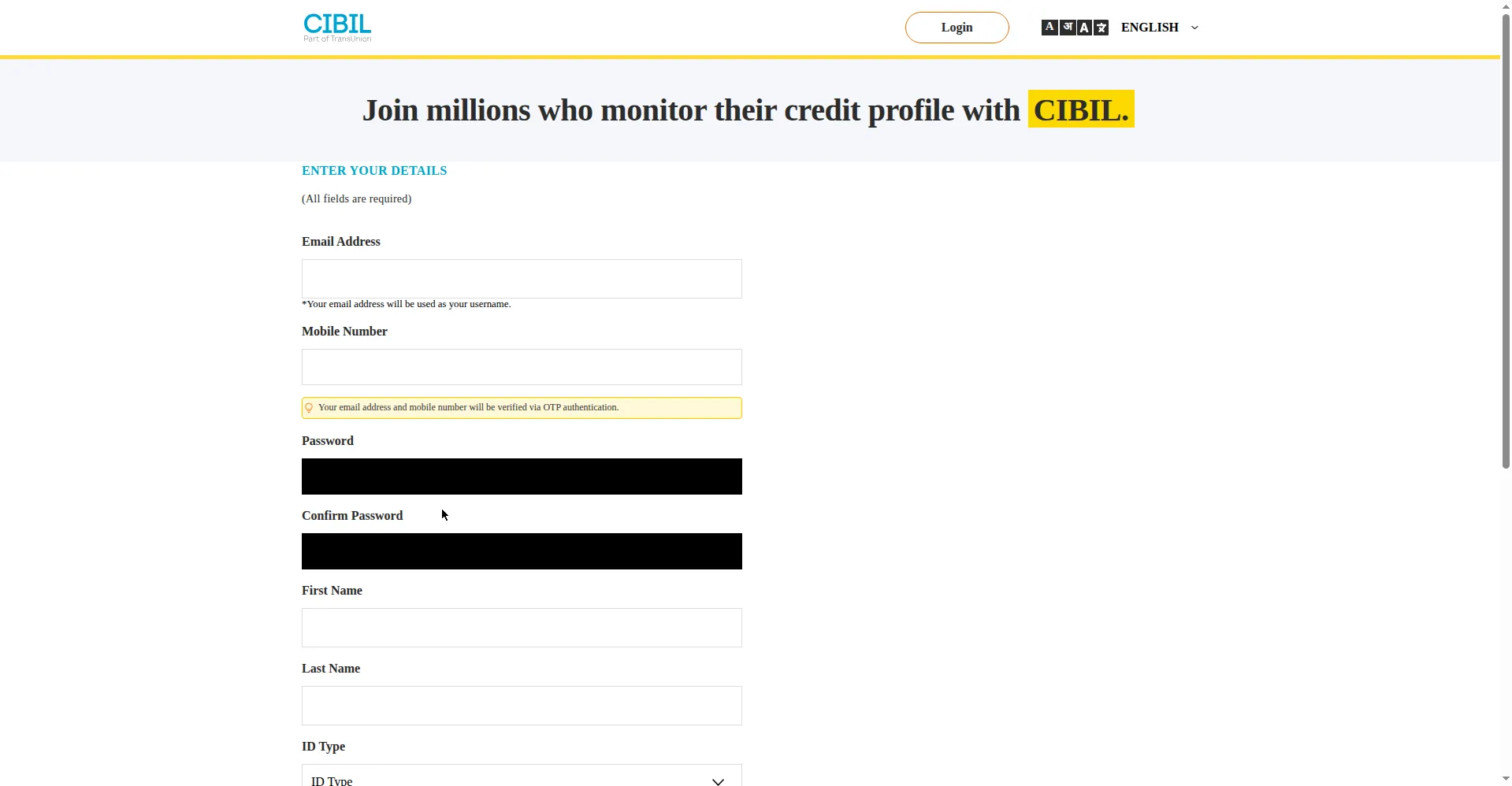
This is the official method — straight from the bureau, full report included, no marketing attached. Keep your PAN card (or another ID), mobile phone, and email handy. The whole process takes 5–10 minutes.
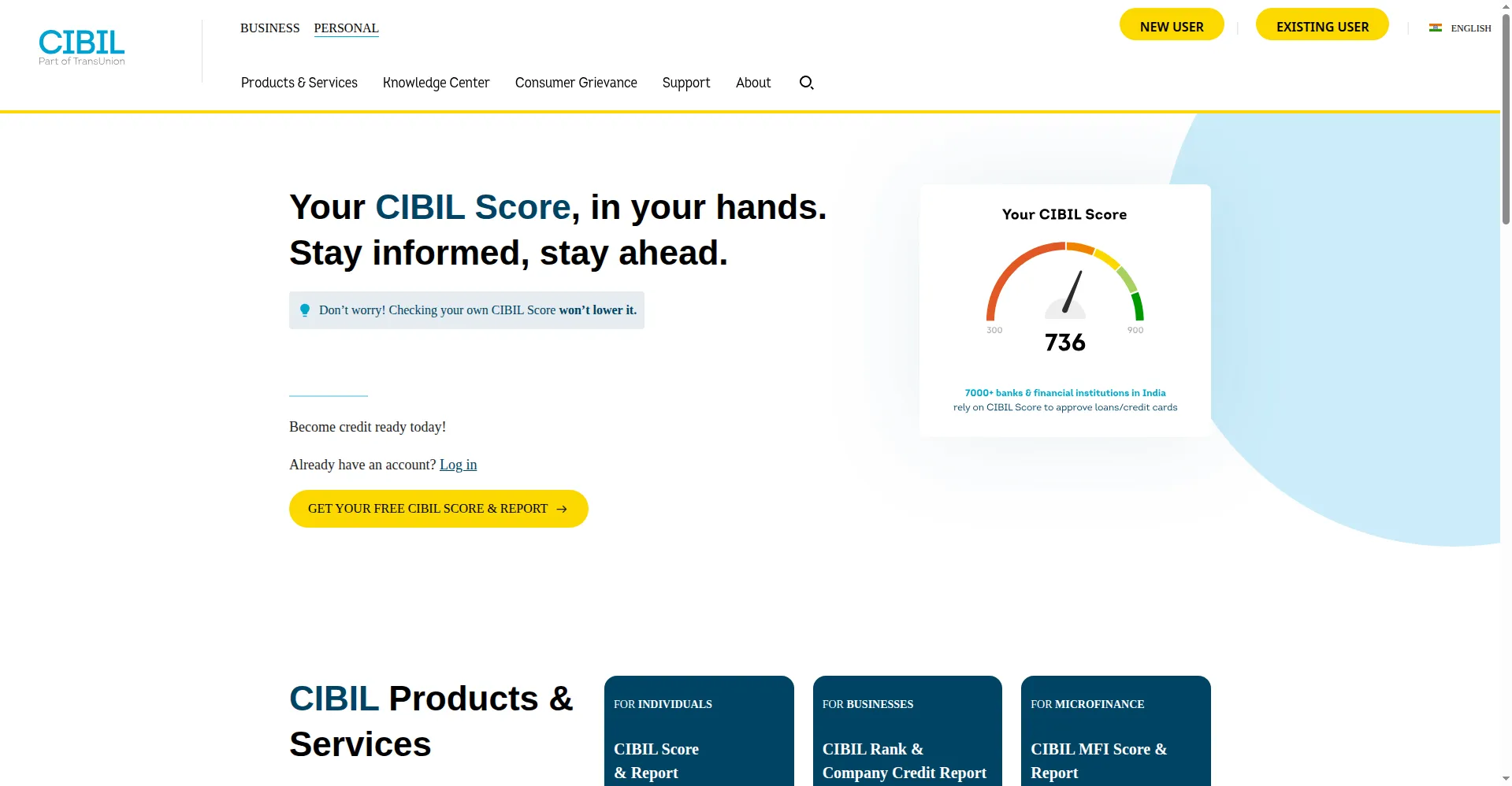
Step 1: Go to the official free-score page. Open cibil.com/freecibilscore in your browser. Make sure the address bar shows cibil.com — never check your score through links in SMS or WhatsApp messages.
Step 2: Click “Get Your Free CIBIL Score & Report.” You will see an option to create a new account or log in if you already have one.
Step 3: Create your account. Enter your full name (exactly as on your PAN card), email address, and mobile number, then set a password. Your name spelling must match your official documents — mismatches are the most common reason the process fails.
Step 4: Enter your identity details. Fill in your date of birth, gender, PIN code, and an identity document number. PAN is the usual choice because it links all your financial accounts together, but you can also use a passport, voter ID, driving licence, or ration card number.
Step 5: Verify with OTP. CIBIL sends a one-time password to your mobile number (and sometimes email). Enter it to prove the number belongs to you.
Step 6: Answer security questions. CIBIL may ask 3–5 questions about your existing loans or credit cards — for example, which bank issued a particular card. This confirms you are really you.
Step 7: View and download your report. Your CIBIL score appears on the dashboard along with your full credit report: every account, 36 months of payment history, and all enquiries. Download the PDF and save it — you only get this free version once per calendar year.
What If Authentication Fails?
Sometimes CIBIL cannot verify you online — usually because your name, date of birth, or address does not match what lenders reported. Do not panic. You can complete verification by uploading KYC documents (self-attested identity proof, address proof, and the payment confirmation form) on CIBIL’s document-upload page. After verification, CIBIL sends your score and report to you.
CIBIL Is Only One of Four Bureaus
Here is the content gap almost every ranking article ignores: your CIBIL score is not your only credit score. India has four RBI-licensed credit bureaus, each holding its own copy of your credit data and each calculating its own score. A lender might check any of them.
The 4 Credit Bureaus in India Compared
| Bureau | Score Range | Since | Free Report | Who Uses It |
|---|---|---|---|---|
| TransUnion CIBIL | 300–900 | 2000 | 1 free/year on cibil.com | ~90% of lenders; the standard for home/car loans |
| Experian | 300–900 | 2010 (India) | 1 free/year on experian.in | Many banks and NBFCs; second most used |
| Equifax | 300–900 | 2010 (India) | 1 free/year (online + offline form) | Digital lenders and fintechs |
| CRIF High Mark | 300–900 | 2011 (India) | 1 free/year on its score page | Microfinance and small-ticket lenders |
Smart strategy: check one bureau every three months. CIBIL in January, Experian in April, Equifax in July, CRIF High Mark in October. You get year-round monitoring without paying a rupee, and you catch errors on any bureau before a lender does.
Why do scores differ across bureaus? Each bureau uses its own formula, and banks may report your payments to each bureau at slightly different times in the monthly cycle. Small differences (20–40 points) are normal. Large gaps usually mean one bureau has wrong or missing data — worth disputing.
Soft Inquiry vs Hard Inquiry: What Actually Lowers Your Score
This is the most misunderstood part of credit scores, so let us settle it clearly.
A soft inquiry never lowers your score. Checking your own score — on cibil.com, through your bank’s app, or on Google Pay — is a soft inquiry. You can do it every day if you want; the number will not move because of it.
A hard inquiry can lower your score slightly. When you apply for a loan or credit card, the lender pulls your report. That is a hard inquiry, and it stays on your report. One or two hard inquiries are harmless. But five loan applications in a single month tells every lender you are desperate for credit — and your score drops.
| Situation | Inquiry Type | Affects Score? |
|---|---|---|
| Checking your own score on cibil.com | Soft | No |
| Viewing score in Google Pay / PhonePe / bank app | Soft | No |
| Applying for a home loan | Hard | Small temporary dip |
| Applying for 4 credit cards in one week | Hard × 4 | Yes — noticeable drop |
| Employer background verification | Soft | No |
One exception worth knowing: if you are rate-shopping for a home or car loan, multiple hard inquiries within a short window (around 14–30 days) are usually treated as a single inquiry by scoring models. So compare lenders freely — just do it within the same couple of weeks instead of spreading applications across months.
How to Improve Your CIBIL Score: The Practical Playbook
Found your score lower than 750? Do not waste money on “credit repair” agents — no one can delete genuine negative history. What you can do is build new positive history, and scores respond faster than most people expect. Before starting the repair work, do one more CIBIL score check across a second bureau (Experian or Equifax) to confirm whether the low score is consistent or caused by a data error on one bureau. Here is the playbook, ordered by impact.
1. Pay every EMI and credit card bill on time — no exceptions
Payment history is the single biggest factor in your score. A single 30-day-late payment can drag a good score down by 60–100 points. Set up auto-debit for at least the minimum amount due on every card and loan. If you have missed payments in the past, start a clean streak now — recent good behaviour counts more than old mistakes.
2. Keep credit utilisation below 30%
If your card limit is ₹1,00,000, try not to use more than ₹30,000 in a billing cycle. High utilisation signals that you depend on credit to get by. This is the fastest lever most people can pull: paying down balances before the statement date can lift your score within one or two reporting cycles.
3. Do not close your oldest credit card
The length of your credit history matters. That 8-year-old card with a ₹50,000 limit is quietly boosting your score even if you barely use it. Closing it shortens your history and reduces your total available credit — both hurt. Keep it active with one small transaction every few months.
4. Stop applying for credit you do not need
Every application is a hard inquiry. Space out applications by at least 3–6 months, and never apply for multiple products at once unless you are rate-shopping for one specific loan (see the exception above).
5. Fix errors on your report
Studies and consumer complaints repeatedly show that credit reports contain mistakes — loans marked unpaid that you closed years ago, someone else’s account on your file, wrong personal details. Pull your full free report (not just the score) and read every account line. If you find an error, raise a dispute with CIBIL online and attach supporting documents. Bureaus must investigate and correct genuine errors.
6. Settle “settled” accounts properly
If a lender ever accepted a partial payment to close a loan, your report shows “Settled” instead of “Closed.” Lenders read “Settled” as “this person did not pay in full.” If possible, pay the remaining balance and ask the lender to update the status to “Closed.” It makes a real difference on your report.
7. Build history if you have none (score NH)
No credit history is better than bad history, but lenders still hesitate. Start with a secured credit card (fixed deposit–backed) or a small consumer durable loan, use it lightly, and pay in full every month. Within 6–12 months you will have a real score.
| Action | Expected Impact | Time to See Results |
|---|---|---|
| Pay all bills on time | Highest | 3–6 months of clean streak |
| Bring utilisation under 30% | High | 1–2 billing cycles |
| Dispute and fix report errors | High (if errors exist) | 30–45 days per dispute |
| Convert “Settled” to “Closed” | Medium–High | 1–2 reporting cycles |
| Stop new hard inquiries | Medium | Inquiries fade in 12 months |
| Keep old accounts open | Medium | Ongoing |
Why Your Score Matters for Government Schemes and Loans
You might wonder what a credit score has to do with a site about Sarkari Yojana. Quite a lot, actually. Several government-backed loans check your credit history before approval:
- PM Mudra Loan Yojana — banks offering Tarun and Kishore category loans routinely pull your CIBIL report. A 750+ score smooths the process.
- Stand-Up India and PMEGP loans — these pass through regular banks, and banks apply their normal credit checks.
- Home loans under PMAY interest subsidy — the subsidy helps with interest, but the loan itself still needs bank approval, which means your score matters.
A good CIBIL score is also useful beyond loans: landlords, employers, and even some insurance companies check credit reports. Building it early — through the steps above — pays off for years.
And if you are planning long-term savings alongside borrowing, read our guides on Atal Pension Yojana and post office schemes compared to balance both sides of your financial life.
Common CIBIL Myths — Busted
Myth 1: “Checking my own score lowers it.” False. Self-checks are soft inquiries. Check as often as you like.
Myth 2: “I have never taken a loan, so my score must be perfect.” No — with no history you get NH (No History), not 900. Lenders cannot judge you, which is itself a hurdle.
Myth 3: “Closing credit cards improves my score.” Usually the opposite. It shortens your history and raises your utilisation ratio.
Myth 4: “My CIBIL score and my Experian score should be identical.” They are calculated by different companies with different formulas and slightly different data. Small differences are normal.
Myth 5: “Paying the minimum due keeps my score safe.” It avoids a “late payment” mark, but high revolving balances hurt your utilisation ratio. Pay in full whenever you can.
Myth 6: “A credit repair company can delete my defaults.” No one can remove accurate negative information. Anyone promising this is selling you something worthless — or a scam.
Frequently Asked Questions
1. How can I do a CIBIL score check for free?
Visit cibil.com/freecibilscore, create a free account with your PAN, mobile number, and email, verify via OTP, answer the security questions, and view your score and full report. You get one free report per calendar year from each of the four bureaus.
2. Cibil score kaise check kare bina PAN card ke?
Aap PAN ke bina bhi score check kar sakte hain. CIBIL passport number, voter ID, driving licence, ya ration card number bhi accept karta hai. Process same hai — bas ID type ke dropdown me apna document select karein.
3. What is a good CIBIL score for a loan in India?
750 or above is considered excellent and gets you the best rates. Most banks approve home and car loans at 700+, while 650–699 may still get approved at higher interest. Below 650, expect rejections or secured-loan-only options.
4. Does checking my CIBIL score reduce it?
No. Checking your own score is a soft inquiry and has zero effect. Only hard inquiries — when you apply for a loan or credit card — can cause a small temporary dip.
5. How long does it take to improve a CIBIL score?
With consistent on-time payments and utilisation under 30%, most people see meaningful improvement in 3–6 months. Fixing report errors can help within 30–45 days. Deep damage (defaults, settlements) takes 12–24 months of clean behaviour to fade.
6. Which credit bureau score do banks check most?
TransUnion CIBIL — roughly 90% of Indian lenders use it as their primary check, especially for home and car loans. Fintechs and digital lenders also check Experian, Equifax, or CRIF High Mark, so monitoring all four (one free report each per year) is the smart move.
Final Word
Your CIBIL score is not a mystery and not a punishment — it is a record. And records can be rewritten with consistent behaviour. Check your score free today using the steps above, read your full report line by line, fix what is wrong, and follow the playbook. Six months of discipline can move a score more than most people believe.
Before you apply for your next loan, also make sure your identity documents are in order — see our guide on linking Aadhaar with PAN, since mismatched KYC details are one of the most common reasons score checks and loan applications fail.