
Have you been staring at the PM-Kisan portal for weeks, only to see “Payment Pending” or “Rejected” every single time? I know exactly how that feels.
Last April, my uncle in Maharashtra missed two consecutive installments of the PM Kisan Samman Nidhi Yojana — that’s Rs. 4,000 that never hit his bank account. He called me, frustrated: “Beta, naam toh list mein hai, phir bhi paisa nahi aaya.” (Son, my name is on the list, still no money.) I thought it’d be a quick fix. It wasn’t. It took us weeks of trial and error, a few trips to the local CSC centre, and a crash course in eKYC, land seeding, and Aadhaar-bank linking before that money finally landed in his account.
That experience opened my eyes. Since then, I’ve helped more than a dozen farmers in my extended family and village sort out similar issues. This guide isn’t theory — it’s the real, on-the-ground process that works in 2026. I’ll walk you through every step: from checking if you’re eligible, registering for the first time, checking your beneficiary status, getting your eKYC done, and most importantly, troubleshooting the most common reasons your payment is stuck.
What Exactly Is PM Kisan Samman Nidhi Yojana?
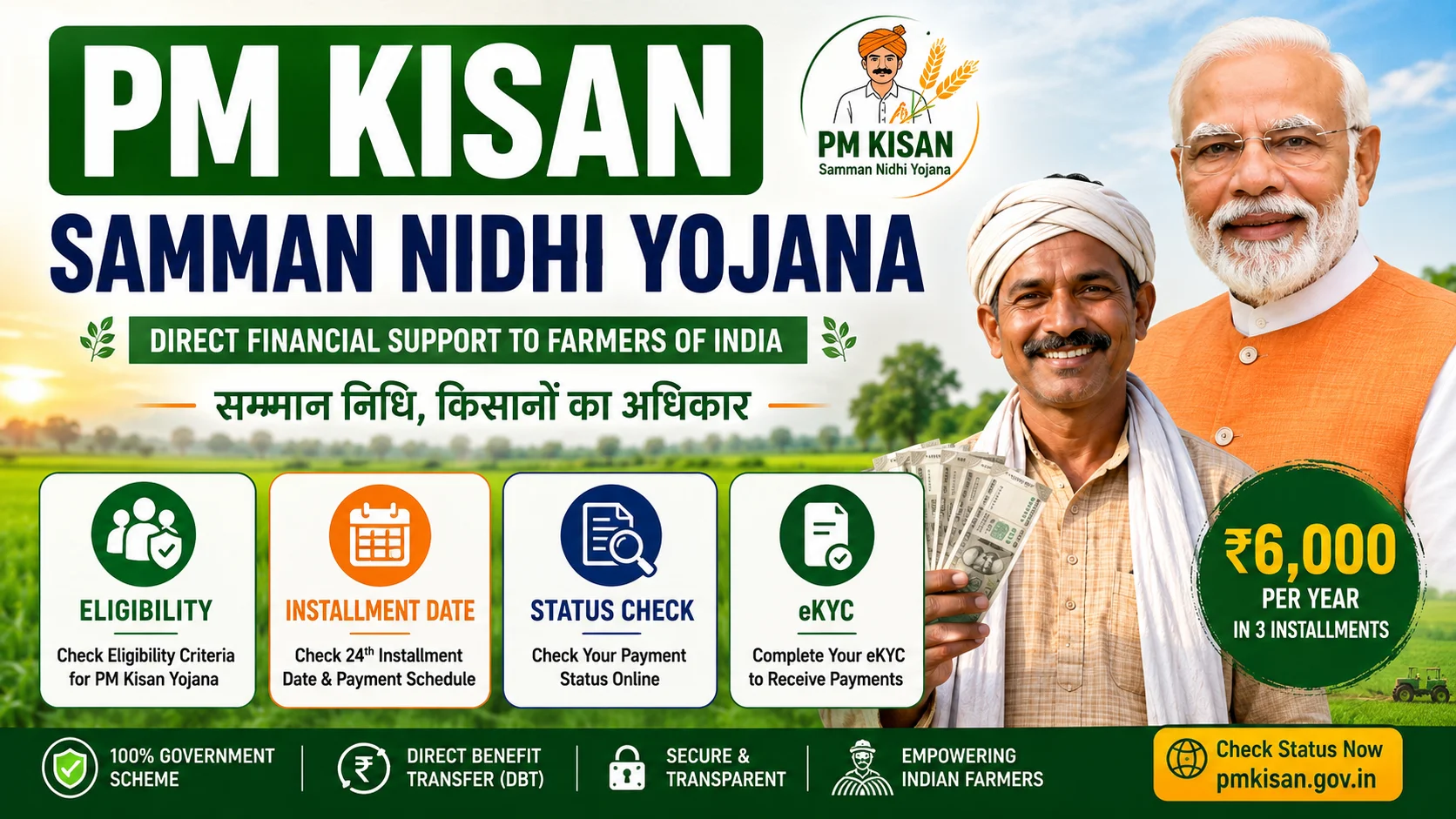
Pradhan Mantri Kisan Samman Nidhi (PM-Kisan) is a central sector scheme launched by Prime Minister Narendra Modi in February 2019. The Ministry of Agriculture & Farmers Welfare runs it. The promise is simple: every eligible landholding farmer family gets Rs. 6,000 per year in three equal instalments of Rs. 2,000 each. The money transfers directly into the farmer’s bank account through Direct Benefit Transfer (DBT), using the Public Financial Management System (PFMS) and NPCI’s Aadhaar Payment Bridge.
It’s one of the world’s largest DBT schemes. As of mid-2026, over 11 crore farmer families are enrolled, and the government has disbursed more than Rs. 2.8 lakh crore since inception. But numbers don’t tell the full story. For a small farmer, that Rs. 2,000 every four months means buying seeds, paying for irrigation, or keeping a child in school.
Important: The scheme is not a loan waiver or a one-time grant. It’s ongoing income support. As long as you remain eligible and your records stay clean, the money keeps coming.
PM-Kisan 2026 Latest Updates: Deadlines You Can’t Miss
In 2026, the government tightened eKYC rules to weed out ineligible beneficiaries. Here’s what’s new:
-
23rd Instalment Released: The 23rd instalment was released in June 2026. If you didn’t receive it, your eKYC or land seeding is likely pending.
-
Mandatory eKYC: All PM-Kisan beneficiaries must complete eKYC. The last date for OTP-based and biometric eKYC was extended several times; currently, the window is open, but the government can stop payments for non-eKYC accounts without warning. Don’t wait.
-
Face Authentication: PM-Kisan now supports face authentication via the PM-Kisan mobile app, making eKYC easier for farmers whose Aadhaar-linked mobile number is inactive.
-
Land Seeding Compulsory: Many states now require farmers to link their land record (Bhulekh/7/12 extract) with their PM-Kisan account. If your land details aren’t verified, payments won’t process.
Staying on top of these updates is what saved my uncle’s payments. When we ignored the eKYC SMS, the 21st instalment vanished. After we completed it, both pending instalments arrived together.
Are You Eligible? The Real Eligibility Checklist That Most People Get Wrong
Eligibility sounds straightforward, but a single wrong assumption can get your application rejected. Let’s break it down exactly as the rules define it.
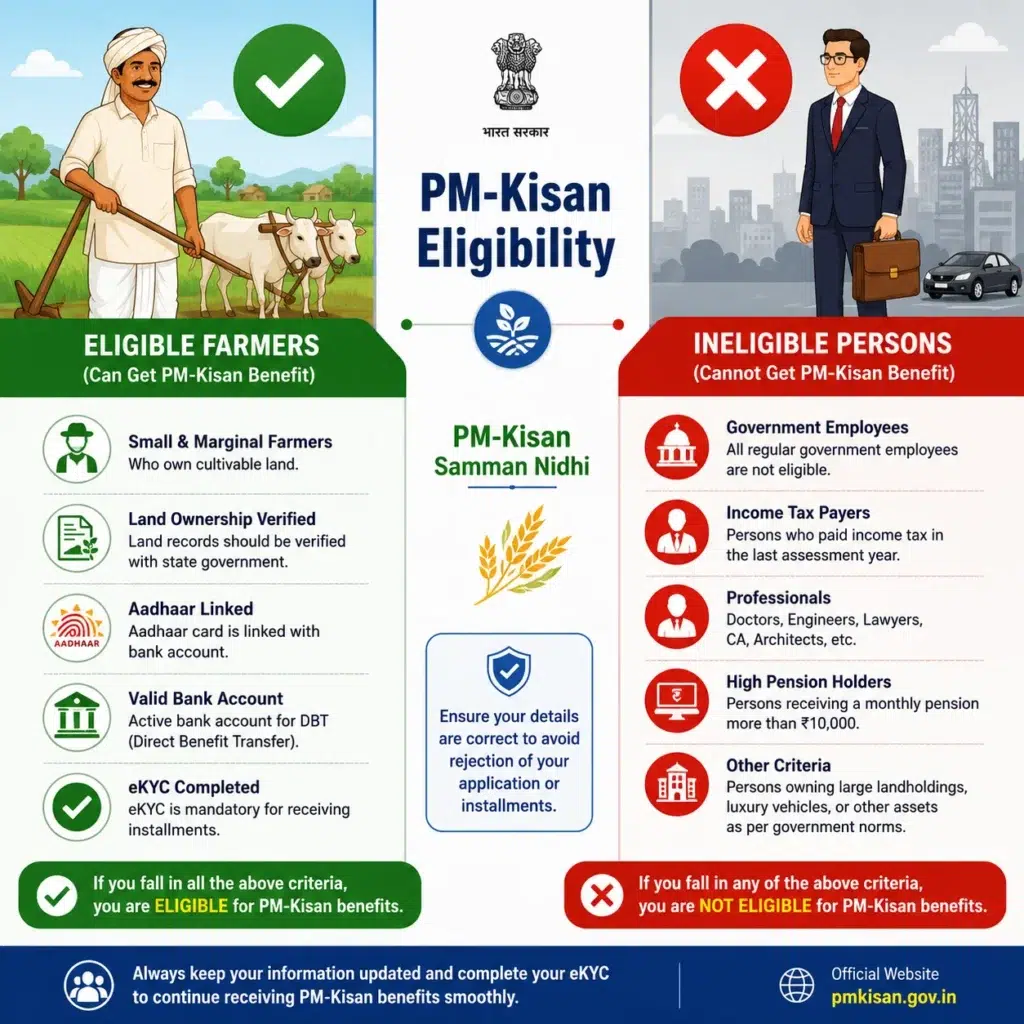
You are eligible if:
-
You are a landholding farmer family — meaning husband, wife, and minor children who together own cultivable agricultural land. Land records must be in the family’s name.
-
The land can be in any part of India. Scheme covers all states except a few specific exclusions (most of India is covered).
-
There is no upper age limit, and farmers from all social categories can apply.
You are NOT eligible if any member of the family:
-
Has paid income tax in the last assessment year.
-
Holds or has held a constitutional post (current or former MP, MLA, Minister, Mayor, Zilla Parishad Chairperson, etc.).
-
Is a serving or retired government employee (except Class IV/multitasking staff).
-
Is a professional registered with a professional body (doctors, engineers, lawyers, chartered accountants, architects).
-
Owns institutional land (e.g., family owns land registered in the name of a trust, company, or society).
-
Draws a pension of Rs. 10,000 or more per month (excluding freedom fighter pension).
-
Is a farmer who owns more than the land ceiling limit fixed by the state — but for PM-Kisan, all landholding families are eligible as long as they meet other criteria; there is no land ceiling for PM-Kisan itself. However, large institutional landowners are excluded. I’ve seen confusion on this: a family with 10 acres can still get PM-Kisan if no member is an income taxpayer, professional, or constitutional post holder.
I made a simple table that I stick to whenever someone in the village asks me if they qualify.
| Category | Eligible? | Why? |
|---|---|---|
| Small farmer with 1 acre, no income tax | Yes | Meets landholding + no exclusion |
| Farmer family, one son is a doctor | No | Professional family member makes it ineligible |
| Retired school teacher (Class III) | No | Government pensioner (except Class IV) |
| Widow farmer, husband was MLA | No | Family held constitutional post |
| Farmer with 5 acres, paid income tax | No | Income taxpayer in the family |
| Sharecropper with no land records | No | No land in family’s name |
One painful lesson: in our village, a farmer was rejected because his father, who died years ago, was still listed as a pensioner in some government record. Clean your family’s official status before applying.
Documents You Need to Apply for PM-Kisan
Keep scanned copies or clear photos of these on your phone. I’ve listed them in order of importance.
-
Aadhaar Card – of the beneficiary (usually the head of family). Aadhaar must be linked to the bank account where payments will come.
-
Bank Account Details – account number, IFSC code. Must be a savings account in an Indian bank. The account must be Aadhaar-seeded and linked with NPCI mapper.
-
Land Ownership Records – Khatauni, Khasra, or 7/12 extract. The name on the land record must match the applicant’s name exactly.
-
Mobile Number – registered with Aadhaar (for OTP eKYC) or at least active for SMS updates.
-
Passport-size Photograph – required only in some offline forms.
-
Caste Certificate / Income Certificate – not mandatory for PM-Kisan, but helpful if your land record needs supporting proof.
If you are registering through a Common Service Centre (CSC), they may ask for a nominal fee (Rs. 30–50). Never pay anyone who claims to “fix” your payment or charge hundreds of rupees.
How to Register for PM-Kisan Online (Step-by-Step)
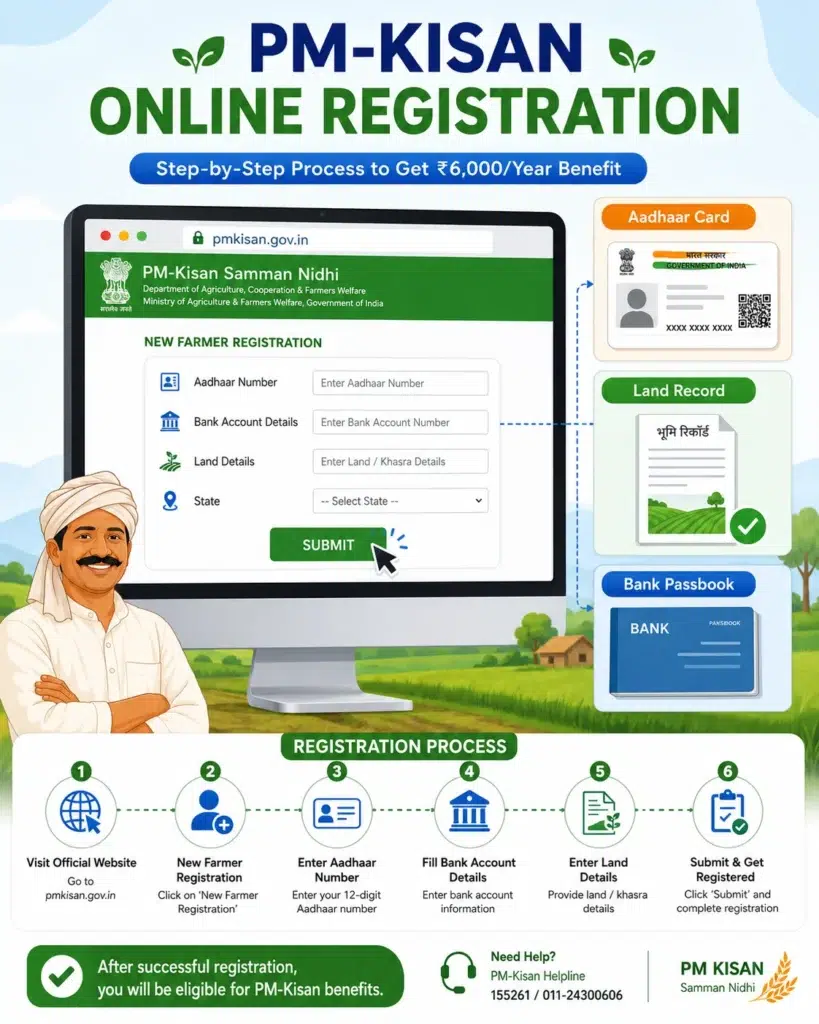
I’ll walk you through the online path that worked for my uncle. The same process applies whether you’re a new farmer or someone whose application was earlier rejected.
-
Visit the official PM-Kisan portal: pmkisan.gov.in
-
On the home page, find the “New Farmer Registration” section. Click it.
-
Select your state and enter your Aadhaar number. Fill the captcha and click “Click here to continue”.
-
An OTP will go to your Aadhaar-linked mobile number. Enter it. If your mobile is not linked to Aadhaar, you’ll have to either link it first or use the biometric route at a CSC.
-
The registration form will open with some details pre-filled from Aadhaar. Fill in:
-
Personal Details: Name as per Aadhaar, gender, category, date of birth.
-
Bank Details: Account number, IFSC, bank name. Double-check IFSC; a single wrong digit sends payment into the void.
-
Land Details: State, district, tehsil, village, survey number, khasra number, area owned. Match it word-for-word with your land record. When I registered my uncle, the portal refused to accept the Khata number until we removed an extra space. Copy-paste from the digital land record if you can.
-
-
Upload your documents if asked. In many states, the system auto-verifies land records if the state’s land database is integrated. Bihar, UP, MP, Maharashtra, and others are integrated. Still, keep soft copies handy.
-
Preview the form, tick the declaration, and submit. You’ll get an acknowledgement number — screenshot it.
Offline registration: You can visit any nearest CSC or District Agriculture Office. The operator will fill the same form. Ask them to show you the submitted acknowledgment.
After registration, don’t just wait. Check your application status within 7 days.
How to Check Your PM Kisan Beneficiary Status and Payment Details
This is the step most farmers repeat every month. There are four reliable ways.
1. Via PM-Kisan Portal (Beneficiary Status)
-
Go to pmkisan.gov.in → “Beneficiary Status” tab.
-
Enter your Aadhaar number or account number, and the captcha.
-
Click “Get Data”. It will show your name, registration ID, payment status, and instalment details.
2. Via PM-Kisan Mobile App
-
Download the PM-Kisan app (available on Android). Use the “Beneficiary Status” option.
-
The app also lets you do face authentication eKYC.
3. Via UMANG App
-
Open UMANG, search PM-Kisan, and go to beneficiary status.
4. Via SMS (if your state supports it)
-
Some states send SMS alerts on payment credit. Not foolproof.
When my uncle’s status showed “FTO has been generated and signed,” I initially celebrated — but the money didn’t arrive for 10 days. That’s when we learned that “FTO signed” doesn’t mean “credited.” The payment can still fail at the bank level. That’s where the real troubleshooting starts.
PM Kisan Installment Tracker: When Does the Money Come?
The financial year runs April to March. Instalments are spread across three periods:
-
1st instalment (April – July)
-
2nd instalment (August – November)
-
3rd instalment (December – March)
In 2026, the 23rd instalment (first of FY 2026-27) was transferred in June. PM Kisan 24th instalment is expected around September-October. But these dates shift based on election schedules and administrative readiness. Don’t fixate on an exact date. Instead, once the government announces the release, check your status daily for about a week.
PM Kisan Installment History (2019–2026)
This is the data the government has put out officially. I’ve added it as a table because most “PM Kisan installment” searches end in confusion — different sites report different numbers, and dates have slipped.
| Installment | Release Date | Amount Disbursed | Farmers Covered |
|---|---|---|---|
| 1st | 24 Feb 2019 | Initial launch transfer | ~3.16 crore |
| 19th | 24 Feb 2025 | ~₹22,000 crore | ~9.8 crore |
| 20th | 2 Aug 2025 | ₹20,500 crore | 9.71 crore |
| 21st | 19 Nov 2025 | ~₹18,000 crore | ~9 crore |
| 22nd | 13 Mar 2026 | ₹18,640 crore | 9.32 crore |
| 23rd | 20 Jun 2026 | ₹18,880 crore | 9.44 crore |
| 24th | Expected Oct 2026 | TBA | TBA |
Three things stand out from this table:
- The number of beneficiaries peaked in 2024 and has slowly corrected downward as ineligible or duplicate entries were removed.
- The 21st, 22nd, and 23rd installments were each around ₹18,000–19,000 crore — consistent with the four-month release cycle of ~9.3–9.7 crore farmers.
- The 24th installment is expected in October 2026, covering the August–November 2026 cycle. The official date hasn’t been announced yet.
If you’re checking “when will the 24th installment come” — bookmark pmkisan.gov.in. That’s where the announcement shows up first, usually a week before release.
The eKYC Trap: Why It’s the #1 Reason Payments Fail (And How to Do It Right)
If I had to point a finger at one culprit that blocks PM-Kisan payments, it’s incomplete or expired eKYC. The scheme mandates eKYC to prevent ghost beneficiaries. There are three methods. Here’s a real breakdown with my experience.
| eKYC Method | How It Works | Works If |
|---|---|---|
| OTP-based (online) | Visit pmkisan.gov.in eKYC section, enter Aadhaar, OTP sent to Aadhaar-linked mobile | Aadhaar mobile number is active and with you |
| Biometric at CSC/Bank | Visit a biometric centre; operator scans fingerprint/iris | Aadhaar mobile not mandatory |
| Face authentication (App) | Download PM-Kisan app, click face auth, scan face via mobile camera | Android phone, good light, Aadhaar-linked mobile not necessary? Needs backend support |
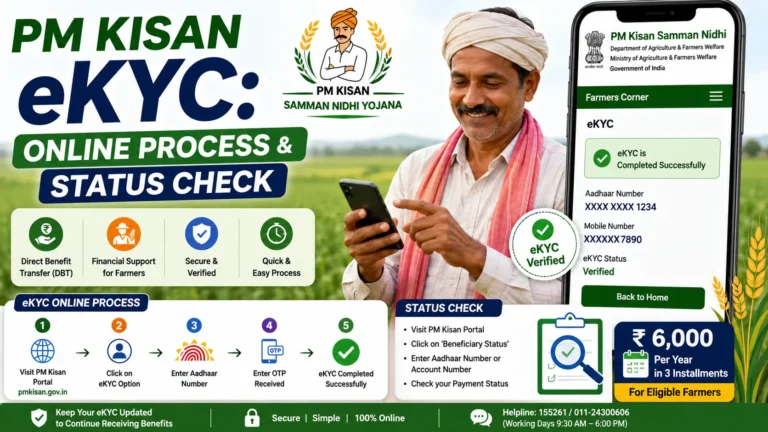
Step-by-step for the OTP method:
-
Go to pmkisan.gov.in → eKYC section.
-
Enter Aadhaar number, captcha → get OTP on linked mobile.
-
Enter OTP, submit. It will show “eKYC completed.”
-
Check beneficiary status after 3–4 days; the eKYC column should show “Yes.”
If your Aadhaar mobile number is lost or inactive, the OTP method is useless. Visit the nearest bank branch (where your account is) or a CSC. Most nationalised banks now have a micro-ATM operator who can do biometric eKYC for PM-Kisan. That’s what we did.
Crucial tip: eKYC is not permanent. It may need renewal after 3–5 years depending on government directives. If your payment stops suddenly even though you were getting it earlier, assume eKYC has expired.
6 Common PM-Kisan Problems and Their Real Fixes
I’ve made a list of situations I’ve personally dealt with or helped others resolve. These solutions are based on portal logic, bank complaints, and CSC operator advice.
| Problem | Likely Reason | What to Do |
|---|---|---|
| Name not in beneficiary list | Application rejected or data mismatch | Re-register with correct land and Aadhaar details. Check rejection reason on the portal. |
| “Payment Pending” even after FTO signed | Aadhaar not seeded with bank account | Visit bank with Aadhaar and passbook, fill NPCI linking form. Check NPCI mapper status. |
| Payment sent but returned by bank | Account closed, dormant, or IFSC wrong | Update bank details through edit option on portal or at CSC. Submit fresh account. |
| Land record mismatch error | Khata/Khasra number differs from state db | Correct land details through “Edit Aadhaar/Land Details” on portal or update state land record first. |
| eKYC status shows “No” | eKYC incomplete or expired | Do eKYC by OTP or biometric. Wait 48 hours for status update. |
| Mobile number not linked to Aadhaar | Can’t do OTP eKYC | Link mobile to Aadhaar at a permanent enrolment centre, or use biometric/face auth. |
One case stuck with me: a farmer in my village had the right IFSC and Aadhaar seeding, yet payment failed. The reason? His bank account name had “Sri” prefix while Aadhaar didn’t. The NPCI mapper rejected it because of a name mismatch. He had to get his bank to update the name exactly as on Aadhaar. Small things kill payments.
How to File a Complaint or Reach PM-Kisan Helpline
If you’ve done everything right and still no money, take the grievance route.
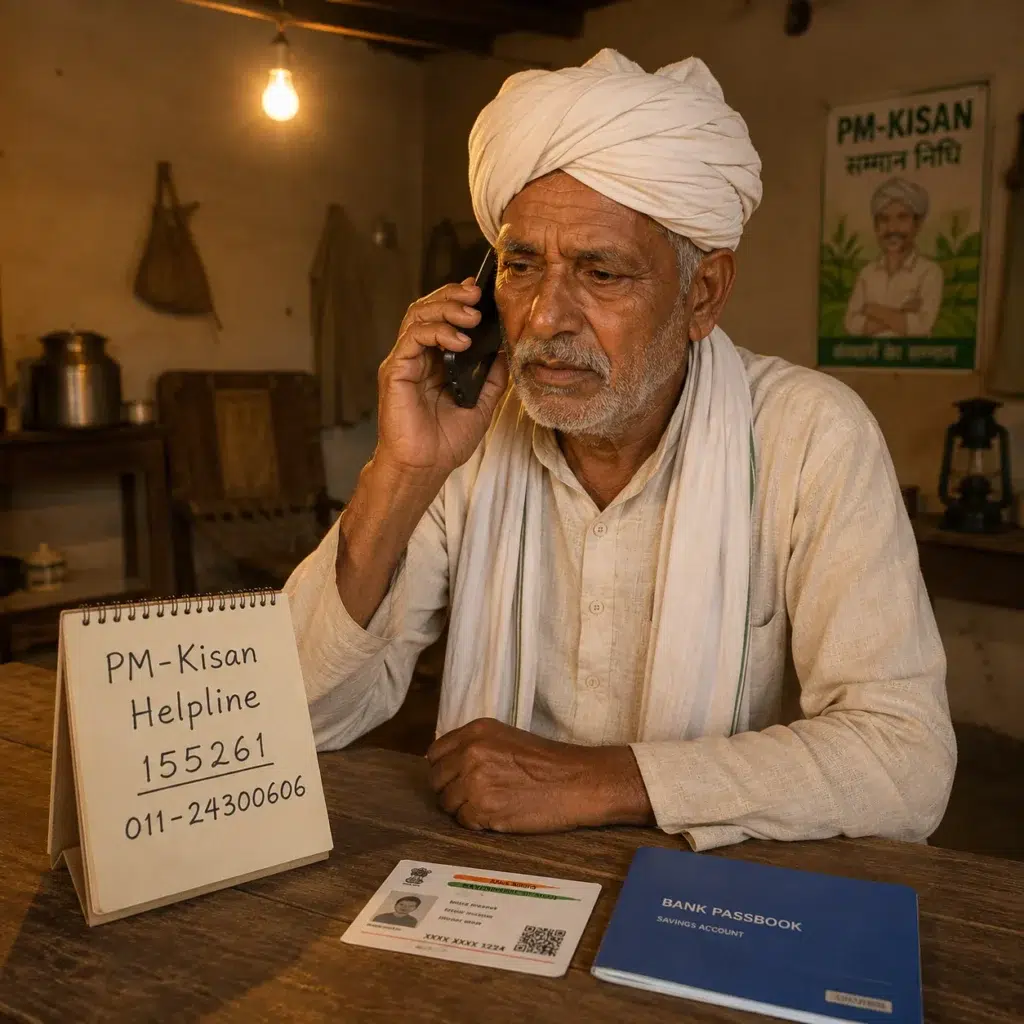
-
PM-Kisan Helpline Numbers: 011-24300606, 1800-115-526 (toll-free), 155261
-
Email: [email protected]
-
Online Grievance: Visit pmkisan.gov.in → “Help Desk” → lodge a complaint. You’ll get a reference number.
-
CSC / Agriculture Office: In-person visit works best for complex land record issues.
When I used the helpline for my uncle, the executive told us exactly which field was causing rejection. The call took 20 minutes on hold, but the information was worth it.
Real-World Impact: What ₹6,000 a Year Actually Does
I know the cynical take — “₹6,000 a year, that’s ₹500 a month, who does that help?” I held that view until I sat in a few homes in East Champaran and Samastipur and watched how families actually use it.
The money is almost never used the way the brochures describe. It is not a “production subsidy.” It is working capital during the Kharif and Rabi squeeze. Specifically:
- Buying diesel for the pump-set in the 2-3 weeks between sowing and the first crop advance.
- Paying the school van when the school reopens in July, and the new harvest money isn’t in yet.
- Buying DAP/urea in small 5-kg packets when the cooperative society runs out, and the local dealer is selling at a markup.
- Clearing a small outstanding at the fertiliser shop so the next purchase can be on credit.
In that light, ₹2,000 every four months isn’t life-changing, but it is liquidity-changing — and liquidity is what most Indian small farmers actually lack.
From a macro lens, the data is striking: ₹4.46 lakh crore transferred to 9.44 crore farmer families in seven years. Over 2.18 crore women beneficiaries. 25%+ of the total benefit going to women — and that is one of the quietly powerful outcomes of the DBT model, because the money is credited to the bank account that the family actually uses, not the one the bank officer thought was convenient.
What Changed in 2025 and 2026
Two big shifts in the last 18 months:
1. Strict eKYC enforcement
The June 2025 deadline for eKYC was the first time the government truly enforced it. As a result, several million ineligible or duplicate entries were weeded out. That’s why the beneficiary count dropped from 9.7 crore (20th installment) to 9.32 crore (22nd installment) to 9.44 crore (23rd installment). The dips are real-world cleanups, not scheme shrinkage.
2. Aadhaar-linked land seeding
From 2025, Aadhaar is no longer just for eKYC — it is now also linked to the land record seeding process. This was a major transparency reform because earlier, multiple family members on the same land could register, which inflated the count. With seeding, the portal now cross-checks the land record against Aadhaar.
There’s also been a quiet push towards AI-based land record verification at the district level, especially in states with digitised land records (Karnataka, Maharashtra, MP). This is why a stale rejection from 2021 can suddenly revive — the system is rerunning verifications in the background.
The 24th Installment: What to Expect
Based on the four-month cycle, the 24th installment of PM Kisan is expected in October 2026, covering the August–November 2026 period. The official date hasn’t been announced as of late July 2026, but the government typically gives a 7–10 day advance notice on pmkisan.gov.in and through a Press Information Bureau (PIB) release.
If you’re wondering “do I need to do anything before October?”:
- Yes — complete your eKYC if you haven’t.
- Yes — make sure your Aadhaar is linked to your bank account.
- Yes — check your beneficiary status in September.
If your name is in the list and your eKYC is “Yes,” you should get the credit automatically. If not, the money will skip you, and you’ll spend the next four months figuring out why.
Frequently Asked Questions About PM Kisan Samman Nidhi Yojana
Who is not eligible for PM Kisan Samman Nidhi Yojana?
Any family that includes an income tax payer, a current or former MP/MLA/Minister, a professional (doctor, engineer, CA, lawyer, architect), a government employee (except Class IV), or a pensioner drawing Rs. 10,000+ per month is not eligible. Institutional landowners are also excluded.
Can I apply for PM-Kisan if I have a government job?
Only if you are a Class IV/multitasking staff employee. All other serving or retired government employees are ineligible.
How many instalments of PM-Kisan are released in a year?
Three instalments: Rs. 2,000 each, totalling Rs. 6,000 per year. They usually arrive between April-July, August-November, and December-March.
I didn’t get my PM-Kisan instalment even though my name is on the list. Why?
Common reasons: eKYC pending or expired, Aadhaar not seeded with bank account, bank account closed or IFSC incorrect, name mismatch between Aadhaar and bank, land record not verified. Check your beneficiary status and take corrective steps.
How can I do PM-Kisan eKYC if my Aadhaar mobile number is not active?
Use biometric eKYC at a CSC or bank branch, or try face authentication via the PM-Kisan mobile app if your phone has a working camera and good internet.
Is there any fee for PM-Kisan registration?
No, registration is free. At a CSC, you may pay a nominal service charge (Rs. 30–50). Don’t pay anyone promising to release your payment.
Can tenant farmers or sharecroppers apply for PM-Kisan?
No. The scheme requires cultivable land in the farmer family’s name. Without land records in your name, you cannot register.
My Final Advice
After months of running around for my uncle, I learned one thing: PM-Kisan is a simple scheme made complicated by paperwork and digital gaps. If your payment is stuck, don’t panic. Go step by step — check eligibility, update land records, complete eKYC, ensure Aadhaar-bank linking, and if all else fails, call the helpline.
Print a small checklist and paste it near the village shop. Share it with fellow farmers. One corrected application means Rs. 6,000 a year into a family’s pocket — and that’s worth every minute of effort.